The Republic of Su
dan’s government
facilitated a remark
able opportunity by
sending our student,
Gatkouth Keuth,
alongside other educa
tors, to the Republic of Yemen
to teach Mathematics for five
years. This initiative, born
from a protocol signed between
the two governments, allowed
him to explore workplace cul
ture and the nuances of living
in a foreign country.
Having previously worked at
Lutfi Senior Secondary School in
Jezeera, Sudan —established to support displaced South
Sudanese children— he
brought a wealth of
experience to his new
role. His journey back to
Khartoum school break
also allowed him to
continue personal milestones.
Gatkouth Keuth shared valu
able insights into the work
place culture in Yemen, where
teachers and administrators
hold authoritative positions.
Decisions made by senior staff
are typically adhered to without
challenge, fostering a strong
sense of discipline and moral
values within the educational environment. Schools em
phasize social responsibility,
creating an atmosphere where
students respect their elders
and maintain community
standards.
Collaboration among teach
ers is a hallmark of Yemeni
schools, where sharing teach
ing strategies and supporting
professional development are
encouraged. The influence of
religious practices is evident,
with schools accommodating
daily prayers and adjusting
schedules during Ramadan.
Gatkouth noted the separation
of boys and girls in most class
rooms, adhering to ...
Read full text:
The Republic of Su
dan’s government
facilitated a remark
able opportunity by
sending our student,
Gatkouth Keuth,
alongside other educa
tors, to the Republic of Yemen
to teach Mathematics for five
years. This initiative, born
from a protocol signed between
the two governments, allowed
him to explore workplace cul
ture and the nuances of living
in a foreign country.
Having previously worked at
Lutfi Senior Secondary School in
Jezeera, Sudan —established to support displaced South
Sudanese children— he
brought a wealth of
experience to his new
role. His journey back to
Khartoum school break
also allowed him to
continue personal milestones.
Gatkouth Keuth shared valu
able insights into the work
place culture in Yemen, where
teachers and administrators
hold authoritative positions.
Decisions made by senior staff
are typically adhered to without
challenge, fostering a strong
sense of discipline and moral
values within the educational environment. Schools em
phasize social responsibility,
creating an atmosphere where
students respect their elders
and maintain community
standards.
Collaboration among teach
ers is a hallmark of Yemeni
schools, where sharing teach
ing strategies and supporting
professional development are
encouraged. The influence of
religious practices is evident,
with schools accommodating
daily prayers and adjusting
schedules during Ramadan.
Gatkouth noted the separation
of boys and girls in most class
rooms, adhering to ...
Read full text:
 NOVEMBER 13 2024.
Amidst the ongoing
struggle for gen
der equality, Patrick
Vuonze, an alumnus
of Atlantic Interna
tional University (AIU),
has emerged as a powerful
advocate for women’s rights
in South Sudan. Patrick, who
earned an Associate degree
in Psychology, is spearhead
ing efforts to combat deeply
entrenched gender inequali
ties in one of the world’s most
challenging environments.
As a Gender and Protection Manager for CARE, Pat
rick is on the front lines
of South Sudan’s hu
manitarian crisis, where
millions of women and
girls face violence, lim
ited access to education,
and early marriage. His journey,
driven by a passion for justice
since childhood, is reshaping
attitudes toward gender norms,
particularly in rural areas where
women often lack basic rights
and resources.
Patrick’s work focuses on
empowering girls through
education, with a special emphasis on combating child
marriage. By engaging families
in conversations about the
importance of keeping girls in
school and offering alterna
tive economic solutions, he is
shifting cultural perceptions
and creating opportunities for
girls to pursue their dreams. ...
Patrick’s efforts align with
AIU’s core values of education,
empowerment, and social jus
tice. Through his advocacy, he
is demonstrating how education
can break cycles of poverty and
violence, and provide a path to
gender equality ...
Read full text:
NOVEMBER 13 2024.
Amidst the ongoing
struggle for gen
der equality, Patrick
Vuonze, an alumnus
of Atlantic Interna
tional University (AIU),
has emerged as a powerful
advocate for women’s rights
in South Sudan. Patrick, who
earned an Associate degree
in Psychology, is spearhead
ing efforts to combat deeply
entrenched gender inequali
ties in one of the world’s most
challenging environments.
As a Gender and Protection Manager for CARE, Pat
rick is on the front lines
of South Sudan’s hu
manitarian crisis, where
millions of women and
girls face violence, lim
ited access to education,
and early marriage. His journey,
driven by a passion for justice
since childhood, is reshaping
attitudes toward gender norms,
particularly in rural areas where
women often lack basic rights
and resources.
Patrick’s work focuses on
empowering girls through
education, with a special emphasis on combating child
marriage. By engaging families
in conversations about the
importance of keeping girls in
school and offering alterna
tive economic solutions, he is
shifting cultural perceptions
and creating opportunities for
girls to pursue their dreams. ...
Patrick’s efforts align with
AIU’s core values of education,
empowerment, and social jus
tice. Through his advocacy, he
is demonstrating how education
can break cycles of poverty and
violence, and provide a path to
gender equality ...
Read full text:
 NOVEMBER 7 2024. In
a remarkable initia
tive to combat climate
change, Yousif Omer
Khalifa, a AIU stu
dent and CEO of Migas
Enterprises in Sudan, is
making waves with his innova
tive approach to brick pro
duction. His groundbreaking
proposals, aimed at reducing
pollution from traditional brick
kiln firing along the Nile bank,
are currently under review by
local authorities.
Yousif’s invention replaces
conventional fuels like wood,
charcoal, and animal residues with Liquefied Petro
leum Gas (L.P. Gas)
in the firing process.
This shift not only
minimizes the release
of toxic gases and
heavy smoke but also
sets a new standard for en
vironmentally friendly brick
manufacturing.
The benefits of Yousif’s
method are multifaceted. By
implementing L.P. Gas, he
has significantly reduced the
workforce required for firing.
What once took ten people
now only requires three,
translating to substantial cost savings and a dramatic reduc
tion in labor. Furthermore, the
firing duration has decreased
from 4-5 days to just two
days, streamlining production
and increasing efficiency.
The results speak for them
selves: the bricks produced
are more uniform and du
rable, capable of withstanding
extreme weather conditions,
high humidity, and shrink
age. This innovation not only
promises to enhance the qual
ity of construction materials
but also ... Read full text: https://www.aiu.
edu/news/innovative-solutions-for-a-greener-future
aiu-student-yousif-omer-khalifas-pioneering-work/
NOVEMBER 7 2024. In
a remarkable initia
tive to combat climate
change, Yousif Omer
Khalifa, a AIU stu
dent and CEO of Migas
Enterprises in Sudan, is
making waves with his innova
tive approach to brick pro
duction. His groundbreaking
proposals, aimed at reducing
pollution from traditional brick
kiln firing along the Nile bank,
are currently under review by
local authorities.
Yousif’s invention replaces
conventional fuels like wood,
charcoal, and animal residues with Liquefied Petro
leum Gas (L.P. Gas)
in the firing process.
This shift not only
minimizes the release
of toxic gases and
heavy smoke but also
sets a new standard for en
vironmentally friendly brick
manufacturing.
The benefits of Yousif’s
method are multifaceted. By
implementing L.P. Gas, he
has significantly reduced the
workforce required for firing.
What once took ten people
now only requires three,
translating to substantial cost savings and a dramatic reduc
tion in labor. Furthermore, the
firing duration has decreased
from 4-5 days to just two
days, streamlining production
and increasing efficiency.
The results speak for them
selves: the bricks produced
are more uniform and du
rable, capable of withstanding
extreme weather conditions,
high humidity, and shrink
age. This innovation not only
promises to enhance the qual
ity of construction materials
but also ... Read full text: https://www.aiu.
edu/news/innovative-solutions-for-a-greener-future
aiu-student-yousif-omer-khalifas-pioneering-work/
 NOVEMBER 18 2024. A
cognitive psychologist,
author, and leadership
coach, Dr. Rachel
Nekati has become a
transformative figure
in Botswana, using her
expertise in mindset change
and leadership development
to make a profound impact on
individuals, organizations, and
national policy.
Dr. Nekati’s transformative
journey began at AIU, where
she pursued advanced studies
in business psychology and
cognitive neuroscience. The strong academic foundation
she received at
AIU equipped her with
the tools to understand
human behavior,
decision-making, and
the psychological factors
that contribute to personal
and organizational success.
This education provided the
perfect launchpad for her
career, ultimately shaping her
into a leader who is committed
to empowering others and
driving systemic change.
As the Founder and CEO of
Achievement Enterprises, Dr. Nekati has dedicated her career
to helping individuals and
organizations unlock their full
potential through self-leadership
and mindset change. Her
expertise in cognitive psychology
led her to a key role as
Mindset Change Ambassador
for Botswana’s Office of the
President. In this capacity, Dr.
Nekati has been instrumental
in supporting the country’s
national transformation strategy,
where mindset change is
a central pillar for fostering
economic innovation, personal
growth, and social ...
Read full text:
NOVEMBER 18 2024. A
cognitive psychologist,
author, and leadership
coach, Dr. Rachel
Nekati has become a
transformative figure
in Botswana, using her
expertise in mindset change
and leadership development
to make a profound impact on
individuals, organizations, and
national policy.
Dr. Nekati’s transformative
journey began at AIU, where
she pursued advanced studies
in business psychology and
cognitive neuroscience. The strong academic foundation
she received at
AIU equipped her with
the tools to understand
human behavior,
decision-making, and
the psychological factors
that contribute to personal
and organizational success.
This education provided the
perfect launchpad for her
career, ultimately shaping her
into a leader who is committed
to empowering others and
driving systemic change.
As the Founder and CEO of
Achievement Enterprises, Dr. Nekati has dedicated her career
to helping individuals and
organizations unlock their full
potential through self-leadership
and mindset change. Her
expertise in cognitive psychology
led her to a key role as
Mindset Change Ambassador
for Botswana’s Office of the
President. In this capacity, Dr.
Nekati has been instrumental
in supporting the country’s
national transformation strategy,
where mindset change is
a central pillar for fostering
economic innovation, personal
growth, and social ...
Read full text:
 At Atlantic International University (AIU),
we’re always looking for ways to sup
port our students’ academic and profes
sional success. If you own or operate a
company, we’d love to learn more about
it and explore how we can collaborate to
meet your hiring needs with AIU’s talent
ed students and graduates. Please take a
moment to complete this short question
naire. (CLICK ON LINK) https://aiu.typeform.com/to/xSGlrIad
At Atlantic International University (AIU),
we’re always looking for ways to sup
port our students’ academic and profes
sional success. If you own or operate a
company, we’d love to learn more about
it and explore how we can collaborate to
meet your hiring needs with AIU’s talent
ed students and graduates. Please take a
moment to complete this short question
naire. (CLICK ON LINK) https://aiu.typeform.com/to/xSGlrIad

| Tarek Laroussi Doctor of Philosop hy Legal Studies Algeria |
José Antonio da Costa Bachelor of Information Technology Information Systems Engineering Angola |
Kavya Saxena Doctor of Science Biology Australia |
Hermann Bado Doctor of Philosop hy Marketing Burkina Faso |
Kahisha Alidor Munemeka Doctor of Legal Studies Legal Studies Congo (DRC ) |
Hector Augusto Rodriguez Bachelor of Political Science Political Science Dominican Republic |
| Lucia Placencia Jaya Bachelor of Coa ching Psychology Ecuador |
Carmita Dayci Gracia Santana Bachelor of Engineering Business Administration Engineering Ecuador |
Jose Miguel Lopez Vasquez Bachelor of Logistics Logistics Engineering El Salvador |
Eulalia Francisca Tela Miaga Obiang Bachelor of Business Administration Banking and Finance Equatorial Guinea |
Priscila Nena Panades Master of Education Educational and Organizational Leadership Equatorial Guinea |
Beniam Tilahun Jenber Doctor of Project Management Development Projects Management Ethiop ia |
| Abraham Demissie Chare Doctor of International Business International Business Ethiop ia |
Milena Rampoldi Doctor of Philosop hy Sociology Finland |
Thimotee Leon Coly Doctor of Education Education Gabo n |
Bukari Zakari Doctor of Health Economics Health Policy and Financing Ghana |
Evalyne Nthoki Nzuve Bachelor of Psychology Organizational Psychology Ghana |
Alejandro Gudberto Camas Chávez Doctor of Education Education Guatemala |
| Conde Mamoudou Doctor of Business Administration Banking and Finance Guinea |
Flor Elizabeth Meza Melgar Bachelor of Science Biochemistry and Health Science Honduras |
Johnny Kadunsin Ruangmei Doctor of Science Computer Science India |
Shaymaa Ahmed Zaidan Doctor of Science Biology Iraq |
Patricia Wilson Bachelor of Science CPR, Nutrition and Diet and Behavior Mod. Jamaica |
Gary Anthony Mckenzie Doctor of Science Psychology Jamaica |
| William Sagini Oribu Post-Doctorate of Management Operations Management Kenya |
Agnes Wavinya Nzioka Doctor of Science Public Health Kenya |
Sidy Diarra Doctor of Science Telecommunications Engineering Mali |
Praveen Obeegadoo Doctor of Philosop hy Sustainable Architecture and Urbanism Mauritius |
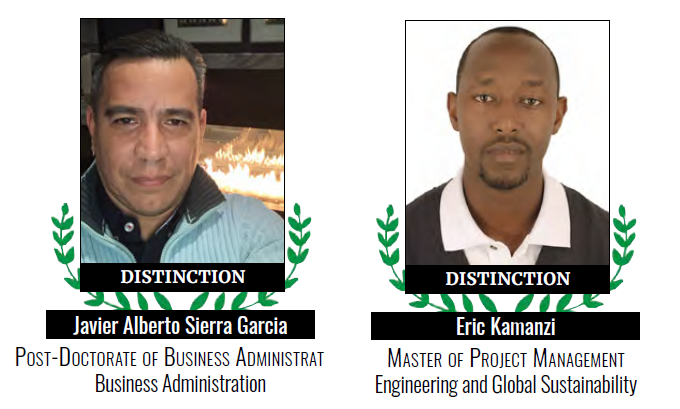
Javier Alberto Sierra Post-Doctorate of Business Administration Business Administration Mexico |
Murray Orji Doctor of Management Management Nigeria |
| Freda Isioma Nwaulune Doctor of Philosop hy Psychology Nigeria |
Chinenye Keren Uche Onyejike Master of Science Interior Design Nigeria |
Robert Kout Lee Dowi Master of Science Public and Community Health Pap ua New Guinea |
Jordan Jair Baldeon Alcedo Bachelor of Finance Finance Peru |
Cordelia Clara Adeline Pratt Master of Arts Human Resource Management Sierra Leone |
Amir Singh Post-Doctorate of Psychology Positive Psychology Singapo re |
| Vusi Clement Nkuna Doctor of Philosop hy Criminal Justice Administration South Africa |
David Gordon Misaka Bachelor of Health Science Public Health and Epidemiology South Sudan |
Frida Mwendwa Nkonge Bachelor of Science Legal Studies South Sudan |
Nilsa Gricelda Giménez González Bachelor of Science Psychopedagogy Spa in |
Ebrima Williams Bachelor of Arts Leadership The Gambia |
Sybris Abiola Harvey Doctor of Science Clinical Psychology Trinidad & Toba go |
| Ali Mohammadi Doctor of Philosop hy Clinical Psychology Türkiye |
Achulo Osara Florence Doctor of Clinical Psychology Traumatology and Family Counseling Uganda |
Natacha Paola Richieri Balsiger Bachelor of Science Psychology Uruguay |
Abdou Diouf Baranyizigiye Bachelor of Business Administration Business Administration USA |
Mohammed Odunowo Doctor of Transpo rtation Management Airport Operation Management USA |
Milka Gronlund Post-Doctorate of Arts Dance and Movement Therapy USA |
| Hudu Mohammed Doctor of Science Electrical Engineering USA |
Demetria Piedad Mba Elomba Master of Business Administration Business Administration USA |
Miriam E. Ponce López de Huasco Master of Science Psychology USA |
Bobby Ewart Hamilton Doctor of Business Administration Business Administration USA |
Eric Kamanzi Master of Project Management Engineering and Global Sustainability USA |
Wondimagegn Tadesse Tagegn Doctor of Art Public Finance USA |
| Patricia Lynn Moore Armstrong Doctor of Philosop hy Theology USA |
Carmen Nineth Samudio Rodríguez Doctor of Science Food Science and Nutrition USA |
Mapanza Hakanyinza Nkwilimba Doctor of Management Leadership and Management Zambia |
|||
 Oluwaseun Yinka Alabi
  Fredrick Shadrec Bonyonga
  Jacob Oyugi
  Emmanuel Mawindo
The 2024 Nobel Prize in
Economics was awarded to
Daron Acemoglu, Simon Johnson
and James A. Robinson for
their work on Nogales divided
by a border between Mexico
and the United States. What
they demonstrated was that
institutions are the generators
of prosperity. The wealth of
nations depends on the institutions
that exist.
The winners have been
working in Political Economy
for some time. Political
Economy aims to study the
origin and development of the
wealth of nations based on
their institutions.
Previous works to the
award-winning work are: Why
Countries Fail -2014, The Narrow
Corridor -2019 and Power
and Progress, our millennial
struggle for technology and
Prosperity -2023.
These investigations open
the space to question what the winners consider when
they say that the institutions that are created create wealth;
here comes what the rulers
do and in what conditions of
participation the citizens are.
We are living in a world where
we don’t know where we are
going elections of governments
everywhere and populist rulers
on the rise: these two events
governed by hate speech and
misinformation.
What can we expect? What can we do? The first thing is
to have a calm head to be able
to analyze events and place
ourselves in a space where we
can live in peace.
Hate speech and misinformation
reach their point
of dominance in many human
beings when emotions
are brought to the maximum
point. The purpose of those
who promote this type of information is, precisely, to
take people to that maximum
point so that reason diminishes
and thus obtain the ends that
would not be achieved through
analysis and reasoning.
UNESCO tells us that: “Hate
speech is spread for a variety of
reasons, including to deliberately
attempt to polarize,
divide, antagonize or frighten
the population or members of
specific target groups”. UNESCO
-Combating hate speec h throu gh
educ ation : A guide for policymakers.
UNESCO 2024, p. 19. https://unesdoc.
unesco.org/ark:/48223/pf0000390977
The award winners place
great importance on citizen
participation, so we should ask
ourselves what will come of all
the elections we have witnessed
that have been based on
idle talk and disinformation.
What will come of the countries
where we have seen hate
speech and disinformation at their highest level?
Populist governments that
rely on this type of discourse
and disinformation benefit
only their group and the bulk
of the population is told that
they will give them this and
that benefit.
What happens is that the
bulk of the population is kept
in the belief that they must
comply with these and the
other requirements and so, in
the end, they are given nothing;
they continue with the
same instruments that brought
them to power.
UNESCO says that disinformation
is: “Disinformation:
false information that is deliberately
spread to cause harm or
intentionally transmit misinformation.
The uninformed
public may continue to spread
messages with false content
without meaning to”. UNESCO -
Combating hate speec h throu gh educ ation
: a guide for policymakers. UNESCO
2024, p. 18. https://unesdoc.unesco.
org/ark:/48223/pf000039097
Disinformation has precise
objectives: to obtain power at
any cost. The question is. What
will the used ones do when
time passes, and they realize
that they were deceived?
Hence the importance that
Acemoglu, Johnson and Robinson
give to nations to achieve
their development. “The massive
growth of paid political
disinformation —driven by powerful and consolidated political
fronts in different countries
of the world that have
used and spread hate speech
and dehumanizing images with
the aim of obtaining political
gain or votes— has been a factor
of utmost importance for
the increase in hate speech”.
UNESCO - Combating hate speec h
throu gh educ ation : a guide for policy
makers. UNESCO 2024, p. 30. https://
unesdoc.unesco.org/ark:/48223/
pf0000390977
There is a problem to identify
with the power achieved
through hate speech and disinformation:
for society to obtain
better jobs, it needs education,
and this is beginning to
be changed in its Study Plans
and Programs for the benefit
of the system, so it will not
advance, and it will take time.
Hate speech towards groups
that don’t benefit them is also
usually included. Disciplines
that offer development of
rational or moral thought are
also removed.
We have an element to consider
in development: Artificial
Intelligence. It is considered
that using it is already enough
to achieve everything, and it
is forgotten that more study is
required to apply it.
According to The International
Monetary Fund: “All this techno-
optimism is inspired by the
“productivity spillover effect”:
the deep-rooted belief that technological change —including
automation— generates
an increase in productivity,
which in turn raises net wages
and leads to shared prosperity”.
Internation al Mone tary Fun d.
Rebalanc ing Artificial Intelligence .
Dece mber 2023. https://www.imf.org/
es/Publications/fandd/issues/2023/12/
Rebalancing-AI-Acemoglu-Johnson
Hence the UNESCO study to
generate elements that clearly
identify hate speech and misinformation
due to the consequences
they generate.
That is why UNESCO in its
proposal to combat hate speech
tells us: “The educational approach to counteract hate
speech requires focusing on
social and emotional learning
(SEL) so that students can
recognize their strengths and
develop their skills with the
aim of controlling stress and
negative emotions, solving
problems effectively and thus
improving self-confidence,
self-efficacy and assertiveness”.
UNESCO- Combating hate
speec h throu gh educ ation : a guide for
policy makers. UNESCO 2024, p. 37.
https://unesdoc.unesco.org/ark:/48223/
pf0000390977
Faced with totalitarianism
and populism at their most extreme, it seems that 2025
will be a somewhat hectic year.
The goals that both groups set
for themselves by wanting to
annual freedoms and turn the
world into a group of workers
and others with all the power
for enrichment seem to make
the outlook somewhat bleak.
About this situation, Acemoglu
and Johnson say the
following: “Is there no remedy
against these disastrous ideas
that are imposed on people
without their consent? Is there
no barrier against the social
bias of technology? Are we
trapped in an endless cycle in which one arrogant vision
gives way to the next
while shaping our future and
ignoring the possible damage?
No. There is hope, because
History has also taught us that
there can be a more inclusive
approach, which listens
to a broader set of voices and
recognizes the negative consequences
on the rest of the
population.” Ace moglu. and Simon
Johnson . 2023, p. 40.
The best thing to do is to
stay calm and watch the events
that are happening, and those
who have power through hate
speech and misinformation
don’t want the other who
thinks and took power like
them to eat the biggest part of
the cake; surely there will be problems between them.
They talk a lot about technology
and Artificial Intelligence,
but it is to use it to
their advantage, that is why
Acemoglu and Johnson say:
“The good news —or the bad
news, depending on how you
look at it— is that the concrete
way of applying knowledge and
scientific advances depends
on our perspective, on how
human beings can transform
knowledge into techniques
and methods aimed at solving
specific problems.” Ace moglu.
and Simon Johnson . 2023, p. 35.
We must live in this world,
but without being victims of
hate speech or misinformation.
The bad thing about the situation
is that hate speech goes hand in hand with misinformation,
so it is better to be
informed and not to be looking
for what this or that person
said if we already know the
path they are taking.
Most likely, the above factors
will diminish when people stop
looking for what others say.
The purpose of saying
outrageous things is to attract
attention so that they will continue
to follow them because,
according to them, something
must stick.
We already know that when
emotions are carried to the
maximum, people end up
fleeing the situation out of
exhaustion.
That is why Acemoglu and
Johnson say: “The really bad
news is that, even in the best
moments of History, the vision
of people with power exerts a
disproportionate effect on the
concrete use of the tools we
have at our disposal and on the
direction that innovation takes.
That is, the effects of technology
coincide with their beliefs
and interests and have often
been proven to have a very
high cost for the rest of the
population. The good news is
that decisions and perspectives
can change”. Ace moglu. and Simon
Johnson . 2023, p. 35.
According to the researchers
awarded the Nobel Prize in
Economics 2024, the situation
generated by totalitarianism and populism will have a cost
for the universal population;
we will see those costs that will
also affect them because they
are also part of the population.
These moments in History
have always been a learning
experience for all human beings.
The learning situation is
very important, so whatever
may happen, what we must do
is continue studying.
The situation that technology
will leave many unemployed
is part of a fallacious
discourse: all jobs are
not done through advanced
technology or Artificial Intelligence.
The upper spheres
of production are, but that
demands greater production
from the lower spheres
of production. We will not
have robots everywhere and
human beings sitting around.
International Monetary Fund.
Rebalancing AI. Dece mber 2023.
https://www.imf.org/es/Publications/
fandd/issues/2023/12/Rebalancing- AI-Acemoglu-Johnson Acemoglu and
Simon Johnson. Power and Progress,
our millennial fight for technology
and Prosperity. 2023.
Depending on what area of
production you want to be in is
what you have to do with your
studies. You are student at Atlantic
International University
(AIU). Study; prepare yourself
for the world that, as the Nobel
Prize winners 2024 —Acemoglu,
Johnson and Robinson—
say, is under construction.
It is up to you where
you want to be. Study
because you will have
a more fulfilling life
because knowledge will
free you from the anguish
of misinformation
and hate speech.
Study and finish your
program because knowledge,
in addition to providing
the means for life,
also gives peace.
BIBLIOGRAPHY. Acemoglu. A y Simon Johnson. Poder y Progreso,
nuestra lucha milenaria por la tecnología y la Prosperidad. España,
Ediciones Deusto, 2023 | Fondo Monetario Internacional.
Reequilibrar la Inteligencia Artificial. Diciembre 2023.
https://www.imf.org/es/Publications/fandd/issues/2023/12/
Rebalancing-AI-Acemoglu-Johnson | UNAM -Nobel de Economía
2024: el papel clave de las instituciones en la prosperidad
https://unamglobal.unam.mx/global_revista/nobel-de-economia-2024-elpapel-
clave-de-las-instituciones-en-la-prosperidad/ | UNESCO -Combatir
el discurso de odio a través de la educación: una guía para los
responsables de la formulación de políticas. UNESCO 2024. https://
unesdoc.unesco.org/ark:/48223/pf0000390977

The concept of intelligence in
the context of information
The concept of intelligence
refers to the collection, analysis
and use of key information
for strategic decisionmaking,
particularly in areas
such as security, defense and
the private sector. Although it is commonly associated with
espionage, intelligence is much
more complex. It is a process
that involves obtaining secret
information and processing it
to support decision-making in
situations of uncertainty. Over
time, different authors have
defined intelligence in different ways, addressing its relationship
with decision-making and
data analysis.
Definitions of intelligence
Sherman Kent in 1949, in his
work Strategic Intelligence for
American World Policy, addresses
the term ‘information’ as a synonym for knowledge. For
Kent, intelligence refers to the
collection of high-level data,
especially on foreign affairs.
Michael Warner (2002)
expands on this definition,
suggesting that intelligence
goes beyond simple information
gathering; it primarily
involves obtaining secret
information. Secrecy is seen
by Warner as the most crucial
component within the intelligence
process.
Mark Lowenthal (2011) argues
that analysis is the fundamental
piece of intelligence. Analysis
provides policy makers with
assessments that allow for
informed decisions, although
analysis sometimes does not
anticipate all the consequences
of decisions.
Karl von Clausewitz, in “Vom
Kriege” (1832), points out that
war involves high uncertainty,
and therefore, deep intelligence
is essential to discern the truth
amidst this uncertainty.
Jennifer Sims (2019) discusses
international cooperation in
intelligence, called ‘linkage’, as
a way to improve information
gathering, reduce risks and
costs, and optimize the speed
with which data is processed.
Richard J. Heuer (1999)
reinforces the idea that intelligence
depends on interaction
with various sources to obtain
a more complete view of the
situation, beyond the automated
information provided by
machines.
Artificial Intelligence (AI)
Artificial intelligence is an
interdisciplinary field that
combines computer science
and engineering with the aim
of developing systems capable
of performing tasks that
require human intelligence,
such as reasoning, learning,
natural language understanding,
visual perception, and
decision making.
John McCarthy (2007), in his
definition of AI, points out that
this discipline seeks to develop
intelligent machines, which
do not necessarily imitate the
human brain, but rather solve
complex problems using computational
methods.
Although computer systems do not have an Intelligence
Quotient (IQ) like human
beings, the concept of IQ is related
to the early development
of intelligence in children,
calculating the relationship
between age and cognitive
abilities. AI, on the other hand,
is not limited by these parameters
and focuses on creating
machines that can perform
tasks efficiently.
CIQ vs. Artificial Intelligence
Although AI may not have
an IQ, several thinkers such
as Alan Turing (1950) proposed
that computer programs
should imitate the mind of a
child, since the education process
is similar to that of human
beings. Turing suggested that
by progressively teaching a
machine, it could achieve adult
capabilities.
On the other hand, Stuart
Russell and Peter Norvig (1995)
argue that AI seeks not only to
understand how humans think,
but also to create machines
that are intelligent in their
own right, reaching a level of
superintelligence.
In this sense, AI models
based on neural network
theory have been proposed,
such as deep learning models,
which allow machines to learn
autonomously from large volumes
of data. However, these
models are often described as
‘black boxes’ due to their lack
of transparency in the process
that leads to their results.
Black boxes in Artificial
Intelligence
The concept of black boxes
refers to complex systems
whose internal workings are
difficult to understand, even
though the inputs and outputs
of the system can be known.
In the case of AI systems,
especially those using deep
learning, although the results
obtained are accurate, the
process by which machines
arrive at those conclusions can
be opaque.
Nicholas Diakopoulos (2014)
argues that, although algorithms
are black boxes, reverse
engineering can allow us to
understand their inputs and
outputs, and therefore their
internal processes.
Arthur Holland Michel
(2020) also observes that, in
computer science, black boxes
are systems whose transformation
of inputs into outputs
is unknown, although the system
itself can be very accurate.
The future of Artificial
Intelligence
There are two opposing
views on the future of AI: an
optimistic one and a pessimistic
one. In the optimistic
view, AI could benefit humanity
by helping solve complex
problems and improving the
have the ability to learn continuously
and manage uncertainty.
This type of intelligence
could radically change the way
humans live, work, and relate
to each other.
Being is just a state of mind
One of the big philosophical
and ethical questions raised by
AI is whether a machine can
‘be’ in the sense that humans
are. If we consider that ‘being’
implies having consciousness
and emotions, then the debate
arises as to whether an AI,
however advanced, can achieve
a form of self-awareness similar
to that of a human. This
quality of life. However, in the
pessimistic view, AI could pose
a risk if used inappropriately
or if it evolves into intelligence
beyond human control.
Eliezer Yudkowsky (2008)
warns about the potential risks
of AI, suggesting that an AI
programmed to implement a
specific political system, such
as communism or liberalism,
could become a threat if not
properly controlled.
Ray Kurzweil’s (2005)
view, on the other hand, is
more optimistic. According
to Kurzweil, the Singularity
is a time in the future where
technological advancement will
reach such a speed that it will
profoundly transform human
life, including institutions,
the economy, and the perception
of death. In this scenario,
the integration of biology
and technology would allow
humans to transcend their biological
condition, which would
mean that people would have
the ability to decide how many
years they live.
Towards the Singularity
The idea of the Singularity
refers to the point at which
machines reach such advanced
intelligence that they surpass
the human ability to understand
or control them. Nick
Bostrom (2014) points out that
for an AI system to achieve
general intelligence, it must
raises philosophical questions
about the nature of being and
whether machines can have a
subjective experience of reality.
Intelligence, both human
and artificial, continues to
be a complex and expanding
field. As technology advances,
new opportunities and risks
arise associated with creating
machines that mimic or even
surpass human intelligence.
The future of AI poses great
unknowns, but it also offers
the possibility of radically
transforming our lives, our
institutions, and our relationship
with technology.
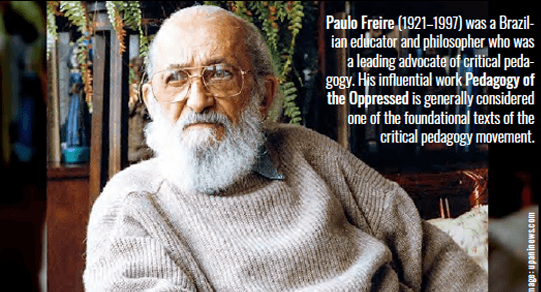 Across the globe, many societies deeply
rooted in colonial practices and
systemic racism are once again invoking
the dehumanizing language of colonial
oppression to justify exclusion and violence.
... We live in an age when genocide
is legitimated through the language of
dehumanization, a culture of lies and the
erasure of history and culture.
In this context, Paulo Freire’s work
takes on an extraordinary and urgent
relevance. His revolutionary pedagogy
provides a powerful framework for
dismantling the ideologies that sustain
colonialism and systemic oppression.
It empowers individuals to critically
interrogate and resist the narratives that
dehumanize, silence, and perpetuate
inequality. As global politics increasingly
embrace the hallmarks of fascist ideology
—ranging from racial cleansing and ultranationalism to violence against
marginalized groups and a ferocious
disdain for public goods— Freire’s
vision of education as both a form of
resistance and a horizon of possibility
becomes indispensable. His work challenges
us to see education not merely
as a tool for learning but as a practice
of freedom, fostering critical agency
and collective action in the struggle for
justice and democracy.
Freire’s work remains a cornerstone
for progressive educators, especially at
a time when faculty are being fired for
critical views. ... Freire’s name has become
synonymous with critical pedagogy,
which is increasingly understood
as both a moral and political project ...
Read full text at CounterPunch:
Across the globe, many societies deeply
rooted in colonial practices and
systemic racism are once again invoking
the dehumanizing language of colonial
oppression to justify exclusion and violence.
... We live in an age when genocide
is legitimated through the language of
dehumanization, a culture of lies and the
erasure of history and culture.
In this context, Paulo Freire’s work
takes on an extraordinary and urgent
relevance. His revolutionary pedagogy
provides a powerful framework for
dismantling the ideologies that sustain
colonialism and systemic oppression.
It empowers individuals to critically
interrogate and resist the narratives that
dehumanize, silence, and perpetuate
inequality. As global politics increasingly
embrace the hallmarks of fascist ideology
—ranging from racial cleansing and ultranationalism to violence against
marginalized groups and a ferocious
disdain for public goods— Freire’s
vision of education as both a form of
resistance and a horizon of possibility
becomes indispensable. His work challenges
us to see education not merely
as a tool for learning but as a practice
of freedom, fostering critical agency
and collective action in the struggle for
justice and democracy.
Freire’s work remains a cornerstone
for progressive educators, especially at
a time when faculty are being fired for
critical views. ... Freire’s name has become
synonymous with critical pedagogy,
which is increasingly understood
as both a moral and political project ...
Read full text at CounterPunch:
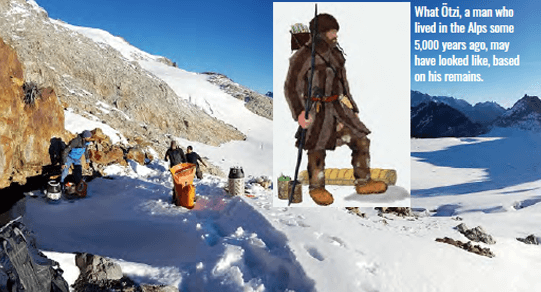 Some 5,000 years ago, a tattooed
man in his 40s, with brown eyes
and thinning black hair, climbed a steep
mountain in the Ötztal Alps, on the
border between what is now Italy and
Austria, to a mountain ridge more than
3,000m (9,800ft) above sea level. He
was wearing a striped goat-fur coat,
a bear-fur cap, and sturdy shoes with
bear-leather soles, and he seemed to
be in a rush. Although he was genetically
predisposed to obesity, his active
lifestyle had generally kept him fit and
muscular. He had some health issues
—stomach problems, knee issues.
He carried an extraordinary amount of
gear, some incomplete, as if packed in
a hurry: unfinished bow and arrows, a
precious copper axe, medicinal mushrooms,
and even two portable stoves
made from birch bark.
He was about to cross the high ridge,
perhaps hoping for safety on the other
side, when an arrow hit his shoulder,
severed an artery, and killed him. Snow
and ice covered his body and belongings.
He lay there, undetected, for
thousands of years. ...
Glaciers retreating at an ever-faster
pace revealed the eerie, sometimes grisly
remains, giving rise to a new scientific
field: glacial archaeology, the study
of ancient finds from melting glaciers.
They present a detailed and unexpectedly
long timeline of adventure, innovation
and danger in the high mountains.
... The discoveries show the human
ingenuity it took to trudge over Alpine
ridges and passes, to trade, to flee, to
hunt, to herd, or to conquer. ...
Read full text:
Some 5,000 years ago, a tattooed
man in his 40s, with brown eyes
and thinning black hair, climbed a steep
mountain in the Ötztal Alps, on the
border between what is now Italy and
Austria, to a mountain ridge more than
3,000m (9,800ft) above sea level. He
was wearing a striped goat-fur coat,
a bear-fur cap, and sturdy shoes with
bear-leather soles, and he seemed to
be in a rush. Although he was genetically
predisposed to obesity, his active
lifestyle had generally kept him fit and
muscular. He had some health issues
—stomach problems, knee issues.
He carried an extraordinary amount of
gear, some incomplete, as if packed in
a hurry: unfinished bow and arrows, a
precious copper axe, medicinal mushrooms,
and even two portable stoves
made from birch bark.
He was about to cross the high ridge,
perhaps hoping for safety on the other
side, when an arrow hit his shoulder,
severed an artery, and killed him. Snow
and ice covered his body and belongings.
He lay there, undetected, for
thousands of years. ...
Glaciers retreating at an ever-faster
pace revealed the eerie, sometimes grisly
remains, giving rise to a new scientific
field: glacial archaeology, the study
of ancient finds from melting glaciers.
They present a detailed and unexpectedly
long timeline of adventure, innovation
and danger in the high mountains.
... The discoveries show the human
ingenuity it took to trudge over Alpine
ridges and passes, to trade, to flee, to
hunt, to herd, or to conquer. ...
Read full text:
 When you bake a batch of muffins,
you put the dough into a pan. In
the oven, it expands into the baking
pan. Any chocolate chips or blueberries
in the muffin batter become farther
away from each other as the batter
expands. The expansion of the universe
is, in some ways, similar. But, while
the dough expands into the baking pan,
the universe doesn’t have anything to
expand into. It just expands into itself.
In the expanding universe, there is
just dough. Even if there were a pan,
it would be part of the universe and
therefore it would expand with the pan.
... Scientists know the universe is
expanding because they can track other
galaxies as they move away from ours.
They define expansion using the rate
that other galaxies move away from us.
This definition allows them to imagine
expansion without needing something
to expand into. ...
The Big Bang describes the origin of
the universe as an extremely dense,
hot singularity. This tiny point suddenly
went through a rapid expansion
called inflation, where every place in
the universe expanded outward. But
the name Big Bang is misleading. It
wasn’t a giant explosion, as the name
suggests, but a time where the universe
expanded rapidly.
The universe then quickly condensed
and cooled down, and it started making
matter and light. Eventually, it evolved
to ...
When you bake a batch of muffins,
you put the dough into a pan. In
the oven, it expands into the baking
pan. Any chocolate chips or blueberries
in the muffin batter become farther
away from each other as the batter
expands. The expansion of the universe
is, in some ways, similar. But, while
the dough expands into the baking pan,
the universe doesn’t have anything to
expand into. It just expands into itself.
In the expanding universe, there is
just dough. Even if there were a pan,
it would be part of the universe and
therefore it would expand with the pan.
... Scientists know the universe is
expanding because they can track other
galaxies as they move away from ours.
They define expansion using the rate
that other galaxies move away from us.
This definition allows them to imagine
expansion without needing something
to expand into. ...
The Big Bang describes the origin of
the universe as an extremely dense,
hot singularity. This tiny point suddenly
went through a rapid expansion
called inflation, where every place in
the universe expanded outward. But
the name Big Bang is misleading. It
wasn’t a giant explosion, as the name
suggests, but a time where the universe
expanded rapidly.
The universe then quickly condensed
and cooled down, and it started making
matter and light. Eventually, it evolved
to ...
 Scientists from the University of
Bristol and the UK Atomic Energy
Authority (UKAEA) have successfully
developed the world’s first carbon-14
diamond battery. This revolutionary
energy source has the potential to
power devices for thousands of years,
offering a sustainable and efficient solution
for a wide range of applications.
The carbon-14 diamond battery
leverages the radioactive decay of
carbon-14, a radioactive isotope commonly
used in radiocarbon dating,
to generate electricity. Encased in a
diamond, which is one of the hardest
materials known, the battery safely
captures radiation to produce power.
Carbon-14 emits short-range radiation,
which is absorbed by the diamond
casing, ensuring safety while generating low levels of electricity.
The battery operates similarly to solar
panels, but instead of converting light
into electricity, it uses fast-moving
electrons from radioactive decay. The
result is a long-lasting, reliable power
source with an impressive lifespan.
Since carbon-14 has a half-life of 5,700
years, the battery will retain half of its
power even after thousands of years.
One of the most promising aspects
of carbon-14 diamond batteries is their
versatility. ... The bio-compatible battery
could revolutionize healthcare by
powering implants such as pacemakers,
hearing aids, and ocular devices. The
diamond battery could last for decades,
reducing patient discomfort and ...
Scientists from the University of
Bristol and the UK Atomic Energy
Authority (UKAEA) have successfully
developed the world’s first carbon-14
diamond battery. This revolutionary
energy source has the potential to
power devices for thousands of years,
offering a sustainable and efficient solution
for a wide range of applications.
The carbon-14 diamond battery
leverages the radioactive decay of
carbon-14, a radioactive isotope commonly
used in radiocarbon dating,
to generate electricity. Encased in a
diamond, which is one of the hardest
materials known, the battery safely
captures radiation to produce power.
Carbon-14 emits short-range radiation,
which is absorbed by the diamond
casing, ensuring safety while generating low levels of electricity.
The battery operates similarly to solar
panels, but instead of converting light
into electricity, it uses fast-moving
electrons from radioactive decay. The
result is a long-lasting, reliable power
source with an impressive lifespan.
Since carbon-14 has a half-life of 5,700
years, the battery will retain half of its
power even after thousands of years.
One of the most promising aspects
of carbon-14 diamond batteries is their
versatility. ... The bio-compatible battery
could revolutionize healthcare by
powering implants such as pacemakers,
hearing aids, and ocular devices. The
diamond battery could last for decades,
reducing patient discomfort and ...
 A team led by fungal researcher
Francis Schwarze from Empa’s
Cellulose & Wood Materials lab looks
into the idea of making wood glow in
the dark using a fungus that infiltrates
the material. The research begins with
the ringless honey fungus, which infects
trees and causes a condition that
damages wood. Some species of this
fungus can produce luciferin. It’s this
liquid that’s responsible for bioluminescence,
allowing what it permeates
to glow or have the ability to emit light.
The fungus triggers a two-stage reaction
that stimulates luciferin, causing
the wood to emit a green light.
This happens when fungal threads
spread throughout the wood. After
that, the wood that glows in the dark
is dubbed a biohybrid because it’s a
combination of living fungus and nonliving
wood. ...
A team led by fungal researcher
Francis Schwarze from Empa’s
Cellulose & Wood Materials lab looks
into the idea of making wood glow in
the dark using a fungus that infiltrates
the material. The research begins with
the ringless honey fungus, which infects
trees and causes a condition that
damages wood. Some species of this
fungus can produce luciferin. It’s this
liquid that’s responsible for bioluminescence,
allowing what it permeates
to glow or have the ability to emit light.
The fungus triggers a two-stage reaction
that stimulates luciferin, causing
the wood to emit a green light.
This happens when fungal threads
spread throughout the wood. After
that, the wood that glows in the dark
is dubbed a biohybrid because it’s a
combination of living fungus and nonliving
wood. ...
 In design, we need to move beyond
the obsession with the new and focus
on rediscovering the value of materials
refined by time —things once considered
obsolete or waste that can be
reclaimed and revitalized.
Dutch Design Week 2024 (Eindhoven,
19–27 October) was a vibrant platform
for this conversation. A prime example
of an interdisciplinary approach is the
collaboration between Blom&Blom and
vanPlestik, two studios with distinct
yet complementary approaches to
sustainability. Blom&Blom, renowned
for restoring industrial lighting, and
vanPlestik, experts in transforming
recycled plastic into bespoke, circular
products, joined forces to unveil a
preview of their first lamp from the
Mutualism collection. This pendant light
blends 3D printing with the ancient
craft of copper casting, reimagining
two contrasting materials —both
repurposed and remelted— into a
striking new form. The collaboration
underscores design’s transformative
power in creating sustainable solutions.
...
In design, we need to move beyond
the obsession with the new and focus
on rediscovering the value of materials
refined by time —things once considered
obsolete or waste that can be
reclaimed and revitalized.
Dutch Design Week 2024 (Eindhoven,
19–27 October) was a vibrant platform
for this conversation. A prime example
of an interdisciplinary approach is the
collaboration between Blom&Blom and
vanPlestik, two studios with distinct
yet complementary approaches to
sustainability. Blom&Blom, renowned
for restoring industrial lighting, and
vanPlestik, experts in transforming
recycled plastic into bespoke, circular
products, joined forces to unveil a
preview of their first lamp from the
Mutualism collection. This pendant light
blends 3D printing with the ancient
craft of copper casting, reimagining
two contrasting materials —both
repurposed and remelted— into a
striking new form. The collaboration
underscores design’s transformative
power in creating sustainable solutions.
...
 As a finalist of Fast Company’s 2024
Innovation by Design Awards in the
accessible design category, this is Cionic
Neural Sleeve™, a bionic wearable
that uses electric pulses and artificial
intelligence to correct muscle movements
in people with limited mobility.
Sophisticated sensors continuously
monitor movement in real-time to
evaluate muscle firing and limb position.
Personalized algorithms deliver
functional electrical stimulation to activate
the necessary muscles precisely
coordinated to the gait cycle.
The Cionic has software-steered
Functional Electrical Stimulation delivered
to the four major muscle groups
of the leg: Hamstring, quadriceps, calf
and shin. The system knows when
you’re sitting, standing, or walking,
providing the right stimulation at the
right time. ...
Visit:
As a finalist of Fast Company’s 2024
Innovation by Design Awards in the
accessible design category, this is Cionic
Neural Sleeve™, a bionic wearable
that uses electric pulses and artificial
intelligence to correct muscle movements
in people with limited mobility.
Sophisticated sensors continuously
monitor movement in real-time to
evaluate muscle firing and limb position.
Personalized algorithms deliver
functional electrical stimulation to activate
the necessary muscles precisely
coordinated to the gait cycle.
The Cionic has software-steered
Functional Electrical Stimulation delivered
to the four major muscle groups
of the leg: Hamstring, quadriceps, calf
and shin. The system knows when
you’re sitting, standing, or walking,
providing the right stimulation at the
right time. ...
Visit:
 It can be hard to get some time to
yourself, but for some people it’s
crucial to do so —a new national survey
has found that 56% of people surveyed
reported that alone time is very important
for their mental health.
The survey was commissioned by
The Ohio State University Wexner Medical
Center and asked 1,000 Americans about
their wellbeing during the holidays.
The results revealed that 46% of people
asked said they don’t get the alone time
they need during the holidays. That’s
despite more than half of them saying
that alone time is crucial for their
wellbeing. For many people, the results
may feel quite close to home. ...
“By taking a brief pause alone, our
nervous system can settle, our mind can
settle, our body can settle,” said Sophie
Lazarus, PhD, a clinical psychologist in
the Department of Psychiatry and Behavioral
Health at Ohio State, in a release. “And
I think that can be important. We know
that chronic stress is not good for us.”
“Some people might experience alone
time from going to a movie by themselves
or going to a park where there’s a
lot of people, or going to a coffee shop.
It can also be this absence of having to
perform or interact socially in a more
direct way.” It can be easier said than
done to find time for yourself when
there is so much going on, particularly
for those with dependents. Where possible,
even small pockets of peace can
make all the difference, and ditching
screen time as you regroup ...
Read full text
It can be hard to get some time to
yourself, but for some people it’s
crucial to do so —a new national survey
has found that 56% of people surveyed
reported that alone time is very important
for their mental health.
The survey was commissioned by
The Ohio State University Wexner Medical
Center and asked 1,000 Americans about
their wellbeing during the holidays.
The results revealed that 46% of people
asked said they don’t get the alone time
they need during the holidays. That’s
despite more than half of them saying
that alone time is crucial for their
wellbeing. For many people, the results
may feel quite close to home. ...
“By taking a brief pause alone, our
nervous system can settle, our mind can
settle, our body can settle,” said Sophie
Lazarus, PhD, a clinical psychologist in
the Department of Psychiatry and Behavioral
Health at Ohio State, in a release. “And
I think that can be important. We know
that chronic stress is not good for us.”
“Some people might experience alone
time from going to a movie by themselves
or going to a park where there’s a
lot of people, or going to a coffee shop.
It can also be this absence of having to
perform or interact socially in a more
direct way.” It can be easier said than
done to find time for yourself when
there is so much going on, particularly
for those with dependents. Where possible,
even small pockets of peace can
make all the difference, and ditching
screen time as you regroup ...
Read full text
 Rhonda James was skeptical when her
husband ordered a weighted blanket
for her online. But five minutes after she
wrapped it around her body, she zonked
out. “It felt like a really big hug,” said
James, a banker in Charleston, South
Carolina. Some people say the added
pressure helps them soothe the worries
of the day and get to sleep faster.
Weighted blankets come with extra
heft in the form of glass beads, pellets,
cotton or another filling.
The blankets’ firm touch may calm
the brain’s fight-or-flight response,
said Dr. Neal Walia, a sleep medicine
expert at UCLA Health. “The evenly distributed
weight on you tells your body,
‘Hey, you’re in a calm environment’”.
The extra pressure also may signal
the brain to release oxytocin. It’s produced during bonding and cuddling,
and can also lower anxiety, Walia said.
For most healthy adults, experts say to
choose a blanket that is about 10% of
their body weight. So a 150-pound person
may opt for a 15-pound blanket.
Weighted blankets are not recommended
for babies or toddlers since
they can hinder movement and breathing.
People with sleep apnea, sleep-related
disorders or respiratory problems
should check with a doctor before using
a weighted blanket. The blankets aren’t
for everyone. ... And the extra swaddling
comes at a cost: quality weighted
blankets can range from $50 to over
$300 depending on the size, weight and
material. ...
Read full text:
Rhonda James was skeptical when her
husband ordered a weighted blanket
for her online. But five minutes after she
wrapped it around her body, she zonked
out. “It felt like a really big hug,” said
James, a banker in Charleston, South
Carolina. Some people say the added
pressure helps them soothe the worries
of the day and get to sleep faster.
Weighted blankets come with extra
heft in the form of glass beads, pellets,
cotton or another filling.
The blankets’ firm touch may calm
the brain’s fight-or-flight response,
said Dr. Neal Walia, a sleep medicine
expert at UCLA Health. “The evenly distributed
weight on you tells your body,
‘Hey, you’re in a calm environment’”.
The extra pressure also may signal
the brain to release oxytocin. It’s produced during bonding and cuddling,
and can also lower anxiety, Walia said.
For most healthy adults, experts say to
choose a blanket that is about 10% of
their body weight. So a 150-pound person
may opt for a 15-pound blanket.
Weighted blankets are not recommended
for babies or toddlers since
they can hinder movement and breathing.
People with sleep apnea, sleep-related
disorders or respiratory problems
should check with a doctor before using
a weighted blanket. The blankets aren’t
for everyone. ... And the extra swaddling
comes at a cost: quality weighted
blankets can range from $50 to over
$300 depending on the size, weight and
material. ...
Read full text:
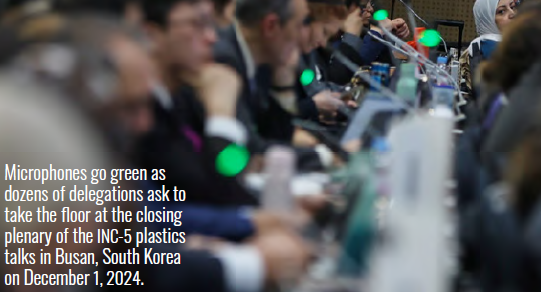 Talks over a global UN pact to tackle
plastic pollution will restart at a
later date after bitter divisions stopped
governments reaching an agreement at
what was due to be the final round of
negotiations in the South Korean city of
Busan. Despite proceedings going into
overtime in the early hours of Monday
[November 25], diplomats failed to
break a stalemate over core issues under
consideration for the treaty, including
reductions in plastic production.
More than 100 developed and developing
countries strongly pushed for
measures to cap plastic manufacturing,
but a handful of oil and gas-producing
states —vocally led by Saudi Arabia,
Russia, Kuwait and Ira— stonewalled
their efforts, arguing the pact should
only address consumption and recycling.
Negotiators failed to find common
ground during the discussions —and
following numerous missed deadlines,
the chair of the talks, Luis Vayas
Valdivieso, released a new draft treaty
text mid-afternoon on Sunday, the
final day. But the document was littered
with opposing options and hundreds of
brackets around all contentious issues.
... Ultimately, countries decided to
buy more time and suspend the session
with a view to resume it —likely
at some point next year [2025]. “We
have made significant progress in
Busan, however, our work is far from
complete,” said a bleary-eyed Vayas
Valdivieso as he opened the closing
plenary. ...
Read full text:
Talks over a global UN pact to tackle
plastic pollution will restart at a
later date after bitter divisions stopped
governments reaching an agreement at
what was due to be the final round of
negotiations in the South Korean city of
Busan. Despite proceedings going into
overtime in the early hours of Monday
[November 25], diplomats failed to
break a stalemate over core issues under
consideration for the treaty, including
reductions in plastic production.
More than 100 developed and developing
countries strongly pushed for
measures to cap plastic manufacturing,
but a handful of oil and gas-producing
states —vocally led by Saudi Arabia,
Russia, Kuwait and Ira— stonewalled
their efforts, arguing the pact should
only address consumption and recycling.
Negotiators failed to find common
ground during the discussions —and
following numerous missed deadlines,
the chair of the talks, Luis Vayas
Valdivieso, released a new draft treaty
text mid-afternoon on Sunday, the
final day. But the document was littered
with opposing options and hundreds of
brackets around all contentious issues.
... Ultimately, countries decided to
buy more time and suspend the session
with a view to resume it —likely
at some point next year [2025]. “We
have made significant progress in
Busan, however, our work is far from
complete,” said a bleary-eyed Vayas
Valdivieso as he opened the closing
plenary. ...
Read full text:
 Over the past six years more than 180
articles in medical publications or
medical articles in other publications
have acknowledged funding by the fossil
fuel industry, and an additional 1000 articles
have authors who worked for a fossil
fuel company or related organisation.
Many studies don’t have an obvious
link with fossil fuel industry interests,
but experts speaking to The BMJ say that
publishing research benefits the companies
by enhancing their reputation and
buying influence among researchers and
health practitioners. Some of the papers
cover topics related to environmental
health effects or that might relate to
workforce health issues.
David McCoy, a research lead at the
United Nations University, says collaborations
with academia give industry a “social licence to continue and behave
in the way that they behave.” ...
A previous investigation by The
BMJ found that the fossil fuel industry
has funnelled billions of dollars to
academia in a decades long effort to
weaken messages on climate. A recent
review found that “universities are
an established yet under-researched
vehicle of climate obstruction by the
fossil fuel industry.” ... Its analysis
found that Saudi Aramco, Saudi Arabia’s
national oil company, was involved in
around 600 medical articles, mostly
through Johns Hopkins Aramco Healthcare
(JHAH), a joint project between the
oil giant and Johns Hopkins Medicine. ...
ExxonMobil was linked to the second
largest group of articles. ...
Read full text:
Over the past six years more than 180
articles in medical publications or
medical articles in other publications
have acknowledged funding by the fossil
fuel industry, and an additional 1000 articles
have authors who worked for a fossil
fuel company or related organisation.
Many studies don’t have an obvious
link with fossil fuel industry interests,
but experts speaking to The BMJ say that
publishing research benefits the companies
by enhancing their reputation and
buying influence among researchers and
health practitioners. Some of the papers
cover topics related to environmental
health effects or that might relate to
workforce health issues.
David McCoy, a research lead at the
United Nations University, says collaborations
with academia give industry a “social licence to continue and behave
in the way that they behave.” ...
A previous investigation by The
BMJ found that the fossil fuel industry
has funnelled billions of dollars to
academia in a decades long effort to
weaken messages on climate. A recent
review found that “universities are
an established yet under-researched
vehicle of climate obstruction by the
fossil fuel industry.” ... Its analysis
found that Saudi Aramco, Saudi Arabia’s
national oil company, was involved in
around 600 medical articles, mostly
through Johns Hopkins Aramco Healthcare
(JHAH), a joint project between the
oil giant and Johns Hopkins Medicine. ...
ExxonMobil was linked to the second
largest group of articles. ...
Read full text:
 Finding a job after graduation can be
an intimidating process for students,
and if you’re an undergraduate chemistry
student in Mexico, the job pool is
now delving into the illegal. According
to a New York Times article, cartels
in Mexico are luring undergraduate
chemistry students in Mexico to work
for them. Their goal: to synthesize
precursors.
According to the Financial Crimes Enforcement
Network Advisory Board of the
United States, precursors are chemicals
used to synthesize drugs. Cartels in
Mexico primarily obtain their precursors
from companies located in the
People’s Republic of China, which they
then synthesize into fentanyl and distribute
in the United States. With China
restricting exports of fentanyl precursors
to Mexico and the coronavirus
pandemic clogging supply chains,
Mexican cartels are seeking to synthesize
precursors by recruiting chemists.
... Mexican cartels release their
recruiters onto Mexican university
campuses who then target potential
recruits. The recruiter interviewed by
the New York Times indicated that for a
student to be recruited by a cartel, the
student had to be ambitious, academically
inclined, discrete, and someone
who would not be consternated
at the idea of working for a cartel.
Recruiters will go as far as talking
to a student’s family and friends to
learn if they would be willing to do
that kind of work and in the months
spent trying to find potential candidates,
few have been targeted. ...
Read full text:
Finding a job after graduation can be
an intimidating process for students,
and if you’re an undergraduate chemistry
student in Mexico, the job pool is
now delving into the illegal. According
to a New York Times article, cartels
in Mexico are luring undergraduate
chemistry students in Mexico to work
for them. Their goal: to synthesize
precursors.
According to the Financial Crimes Enforcement
Network Advisory Board of the
United States, precursors are chemicals
used to synthesize drugs. Cartels in
Mexico primarily obtain their precursors
from companies located in the
People’s Republic of China, which they
then synthesize into fentanyl and distribute
in the United States. With China
restricting exports of fentanyl precursors
to Mexico and the coronavirus
pandemic clogging supply chains,
Mexican cartels are seeking to synthesize
precursors by recruiting chemists.
... Mexican cartels release their
recruiters onto Mexican university
campuses who then target potential
recruits. The recruiter interviewed by
the New York Times indicated that for a
student to be recruited by a cartel, the
student had to be ambitious, academically
inclined, discrete, and someone
who would not be consternated
at the idea of working for a cartel.
Recruiters will go as far as talking
to a student’s family and friends to
learn if they would be willing to do
that kind of work and in the months
spent trying to find potential candidates,
few have been targeted. ...
Read full text:
 Last month in Manchester saw the
latest incident highlighting the
discrimination that Gypsies, Roma, and
Travellers (GRT) have faced for centuries
in the UK.
While traveling to a Christmas
market on November 30th, Greater
Manchester Police forced children from
these communities —some aged as
young as ten— onto trains carrying
them far from the city center. Some
claim they ended up 100 miles away in
Grimsby. According to reports in The
Travellers’ Times and national press,
children were assaulted in the process.
The police have been criticized for
“racial profiling,” violating children’s
physical safety, and undermining their
dignity and human rights. Despite
public outcry after videos of the train deportation and other flare-ups between
police and the GRT communities
surfaced on social media, no justification
has been provided, and the officers
involved remain in their posts.
By many metrics the most marginalized
communities in the UK, the incident
has been framed by GRT people as
part of a broader, ingrained targeting
of them by authorities, society, and the
media —some of whom took the extra
step of organizing a protest in London
this past weekend.
“Seeing the police brutality —the boy
held down, with pressure on his neck—
was horrifying,” said Laura Collins, a
GRT activist who organized the demonstration
in Parliament Square November
30. ...
Last month in Manchester saw the
latest incident highlighting the
discrimination that Gypsies, Roma, and
Travellers (GRT) have faced for centuries
in the UK.
While traveling to a Christmas
market on November 30th, Greater
Manchester Police forced children from
these communities —some aged as
young as ten— onto trains carrying
them far from the city center. Some
claim they ended up 100 miles away in
Grimsby. According to reports in The
Travellers’ Times and national press,
children were assaulted in the process.
The police have been criticized for
“racial profiling,” violating children’s
physical safety, and undermining their
dignity and human rights. Despite
public outcry after videos of the train deportation and other flare-ups between
police and the GRT communities
surfaced on social media, no justification
has been provided, and the officers
involved remain in their posts.
By many metrics the most marginalized
communities in the UK, the incident
has been framed by GRT people as
part of a broader, ingrained targeting
of them by authorities, society, and the
media —some of whom took the extra
step of organizing a protest in London
this past weekend.
“Seeing the police brutality —the boy
held down, with pressure on his neck—
was horrifying,” said Laura Collins, a
GRT activist who organized the demonstration
in Parliament Square November
30. ...
 Philosopher Peter Godfrey-Smith
has devoted his career to examining
how animal minds evolved. He blends
formidable analytical skills with a
deep curiosity about the natural world,
mostly experienced at first hand in his
native Australia. While writing his latest
book, Living on Earth, he spent many
hours scrutinizing noisy parrots and
cockatoos in his back garden, weeks
observing gobies building underwater
towers made of shells ... The result is an
inclusive perspective on Earth’s many
distinct minds and agents that urges
readers to consider humans’ collective
choices and their diverse consequences.
Living on Earth offers an extended
philosophical meditation on life, mind,
the world and our place in it, completing
a trilogy of works on the nexus of agency, sensation and felt experience.
His 2016 book Other Minds explored
octopus cognition and evolution. And
Metazoa (2020) appraised the subjective
experiences of animals, concluding that
there exists an “animal way of being”
that arises from the integration of sensory
information in nervous systems.
This implies that sentience and subjectivity
—life-shaping combinations
of perception, goals and values— are
widespread across the tree of life.
In his latest book, the author casts his
net wider still, asking how the minds
and agency of living things have affected
Earth. “The history of life is not just
a series of new creatures appearing on
the stage,” he notes. “The new arrivals
change the stage itself.” ...
Philosopher Peter Godfrey-Smith
has devoted his career to examining
how animal minds evolved. He blends
formidable analytical skills with a
deep curiosity about the natural world,
mostly experienced at first hand in his
native Australia. While writing his latest
book, Living on Earth, he spent many
hours scrutinizing noisy parrots and
cockatoos in his back garden, weeks
observing gobies building underwater
towers made of shells ... The result is an
inclusive perspective on Earth’s many
distinct minds and agents that urges
readers to consider humans’ collective
choices and their diverse consequences.
Living on Earth offers an extended
philosophical meditation on life, mind,
the world and our place in it, completing
a trilogy of works on the nexus of agency, sensation and felt experience.
His 2016 book Other Minds explored
octopus cognition and evolution. And
Metazoa (2020) appraised the subjective
experiences of animals, concluding that
there exists an “animal way of being”
that arises from the integration of sensory
information in nervous systems.
This implies that sentience and subjectivity
—life-shaping combinations
of perception, goals and values— are
widespread across the tree of life.
In his latest book, the author casts his
net wider still, asking how the minds
and agency of living things have affected
Earth. “The history of life is not just
a series of new creatures appearing on
the stage,” he notes. “The new arrivals
change the stage itself.” ...
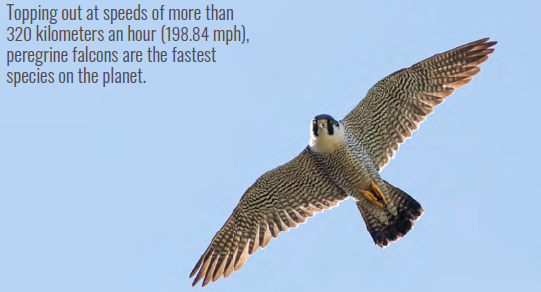 Peregrine falcons hold near-mythical
appeal in our collective imagination,
and for good reason. Topping out
at speeds of more than 320 kilometers
an hour, they’re the fastest species on
Earth, plummeting from the sky like
amber-eyed missiles. They hit their
prey at such staggeringly high velocities
that they’ve prompted studies on
the physics of momentum and the
aerodynamics of flight. Their nest sites,
or aeries—selected for their inaccessibility
to predators and view of the
world below—often require biologists
to include technical climbing gear as
part of their standard kit. ...
By the early 1970s, humans had
decimated peregrine populations across
much of their native range. In North
America, they were extirpated east of the Rocky Mountains and south of the
boreal forest; across northern Europe,
only a few stragglers remained. ...
Over the preceding decades, peregrines
had been documented by
Greenlanders and occasionally captured
by enterprising foreign falconers
who’d traveled by sailboat, cargo
ship, or military plane to Greenland.
... Like the peregrines themselves,
Greenland is full of contradictions. The
world’s largest island is neither green
nor especially land-like to most eyes,
at least from a distance. ... Known
also as Kalaallit Nunaat, or “Land of
the People,” Greenland has also been
home to Indigenous residents for
more than 4,000 years ...
Peregrine falcons hold near-mythical
appeal in our collective imagination,
and for good reason. Topping out
at speeds of more than 320 kilometers
an hour, they’re the fastest species on
Earth, plummeting from the sky like
amber-eyed missiles. They hit their
prey at such staggeringly high velocities
that they’ve prompted studies on
the physics of momentum and the
aerodynamics of flight. Their nest sites,
or aeries—selected for their inaccessibility
to predators and view of the
world below—often require biologists
to include technical climbing gear as
part of their standard kit. ...
By the early 1970s, humans had
decimated peregrine populations across
much of their native range. In North
America, they were extirpated east of the Rocky Mountains and south of the
boreal forest; across northern Europe,
only a few stragglers remained. ...
Over the preceding decades, peregrines
had been documented by
Greenlanders and occasionally captured
by enterprising foreign falconers
who’d traveled by sailboat, cargo
ship, or military plane to Greenland.
... Like the peregrines themselves,
Greenland is full of contradictions. The
world’s largest island is neither green
nor especially land-like to most eyes,
at least from a distance. ... Known
also as Kalaallit Nunaat, or “Land of
the People,” Greenland has also been
home to Indigenous residents for
more than 4,000 years ...

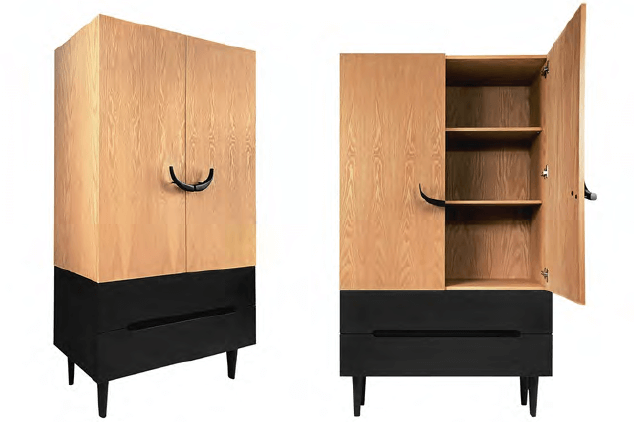 This sideboard with ample storage area will be a unique and functional
touch in your home. Cabinet, doors, shelves and/or drawers: Multiplay.
Legs: Solid wood. molacreativo.com
This sideboard with ample storage area will be a unique and functional
touch in your home. Cabinet, doors, shelves and/or drawers: Multiplay.
Legs: Solid wood. molacreativo.com
 Your compact solution to combat anxiety,
stress, and distractions. Hugging
it will ground you and calm a racing
mind as preparation for a restful sleep.
www.onequietmind.com
Your compact solution to combat anxiety,
stress, and distractions. Hugging
it will ground you and calm a racing
mind as preparation for a restful sleep.
www.onequietmind.com

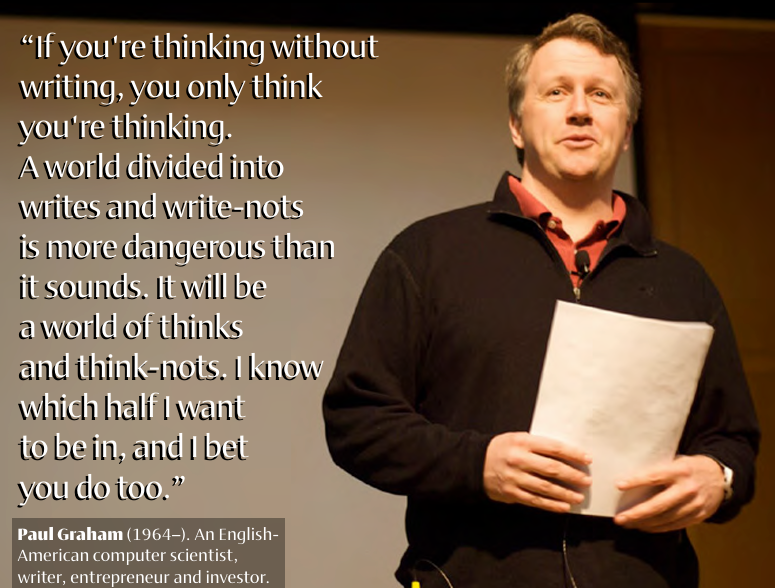


 In the Bachelor program in Biohacking
and Nutrigenomics, students
have the possibility to learn about the
effects of specific nutrients on an individual’s
genetic makeup. Our students
gain extensive knowledge on the relationship
between diet, gene expression,
and health outcomes. Our program
focuses on understanding the relationship
between genes and nutrients and
how these findings can help improve
health and prevent diseases.
AIU’s Distance Learning Bachelor of
Biohacking and Nutrigenomics will be
a tailor-made program, designed just
for you by you and your counselor.
This flexibility to meet your needs is
rarely found in other distance learning
programs. Our program does not
require that each student study the
same subjects and use the same books
and study materials as other students.
Instead, our online Bachelor Programs
are designed just for you. They are individually
designed to meet your needs
and help you achieve your professional
and personal goals.
With a Bachelor in Biohacking and
Nutrigenomics, graduates are presented
with numerous employment
opportunities in the field. Our program
provides students with the skills they
need to work at universities, research
institutes, hospitals, governmental
organizations, and non-governmental
organizations. With the better understanding
of the connection between
diet and chronic diseases, scientists can
work to prevent or treat these diseases.
In the Bachelor program in Biohacking
and Nutrigenomics, students
have the possibility to learn about the
effects of specific nutrients on an individual’s
genetic makeup. Our students
gain extensive knowledge on the relationship
between diet, gene expression,
and health outcomes. Our program
focuses on understanding the relationship
between genes and nutrients and
how these findings can help improve
health and prevent diseases.
AIU’s Distance Learning Bachelor of
Biohacking and Nutrigenomics will be
a tailor-made program, designed just
for you by you and your counselor.
This flexibility to meet your needs is
rarely found in other distance learning
programs. Our program does not
require that each student study the
same subjects and use the same books
and study materials as other students.
Instead, our online Bachelor Programs
are designed just for you. They are individually
designed to meet your needs
and help you achieve your professional
and personal goals.
With a Bachelor in Biohacking and
Nutrigenomics, graduates are presented
with numerous employment
opportunities in the field. Our program
provides students with the skills they
need to work at universities, research
institutes, hospitals, governmental
organizations, and non-governmental
organizations. With the better understanding
of the connection between
diet and chronic diseases, scientists can
work to prevent or treat these diseases.
 Atlantic International University is accredited by the Accreditation Service for International
Schools, Colleges and Universities (ASIC). ASIC Accreditation is an internationally
renowned quality standard for colleges and universities. Visit ASIC’s Directory of Accredited
Colleges and Universities. ASIC is a member of CHEA International Quality Group
(CIQG) in the USA, an approved accreditation body by the Ministerial Department of the Home Office
in the UK, and is listed in the International Directory of the Council for Higher Education Accreditation
(CHEA). The University is based in the United States and was established by corporate charter in 1998.
Atlantic International University is accredited by the Accreditation Service for International
Schools, Colleges and Universities (ASIC). ASIC Accreditation is an internationally
renowned quality standard for colleges and universities. Visit ASIC’s Directory of Accredited
Colleges and Universities. ASIC is a member of CHEA International Quality Group
(CIQG) in the USA, an approved accreditation body by the Ministerial Department of the Home Office
in the UK, and is listed in the International Directory of the Council for Higher Education Accreditation
(CHEA). The University is based in the United States and was established by corporate charter in 1998.
 In some cases, accredited colleges
may not accept for transfer courses and degrees
completed at unaccredited colleges, and some
employers may require an accredited degree as
a basis for eligibility for employment. Potential
students should consider how the above may affect
their interests, AIU respects the unique rules and
regulations of each country and does not seek to
influence the respective authorities. In the event
that a prospective student wishes to carry out any
government review or process in regards to his
university degree, we recommend that the requirements
of such are explored in detail with the relevant
authorities by the prospective student as the
university does not intervene in such processes.
AIU students can be found in over 180 countries,
they actively participate and volunteer
in their communities as part of their academic
program and have allocated thousands of service
hours to diverse causes and initiatives. AIU
programs follow the standards commonly used by
colleges and universities in the United States with
regards to the following: academic program
structure, degree issued, transcript, and
other graduation documents.
AIU graduation documents can include
an apostille and authentication from the
US Department of State to facilitate their
use internationally.
In some cases, accredited colleges
may not accept for transfer courses and degrees
completed at unaccredited colleges, and some
employers may require an accredited degree as
a basis for eligibility for employment. Potential
students should consider how the above may affect
their interests, AIU respects the unique rules and
regulations of each country and does not seek to
influence the respective authorities. In the event
that a prospective student wishes to carry out any
government review or process in regards to his
university degree, we recommend that the requirements
of such are explored in detail with the relevant
authorities by the prospective student as the
university does not intervene in such processes.
AIU students can be found in over 180 countries,
they actively participate and volunteer
in their communities as part of their academic
program and have allocated thousands of service
hours to diverse causes and initiatives. AIU
programs follow the standards commonly used by
colleges and universities in the United States with
regards to the following: academic program
structure, degree issued, transcript, and
other graduation documents.
AIU graduation documents can include
an apostille and authentication from the
US Department of State to facilitate their
use internationally.
| Dr. Franklin Valcin Presi den t/Academic Dean |
Dr. José Mercado Chief Executive Officer Chairman of the Board of Trustees |
Ricardo González, PhD Provost |
| Dr. Ricardo Gonzalez Chief Operation Officer and MKT Director |
Linda Collazo Logistics Coordinator |
AIU Tutors Coordinators: Deborah Rodriguez Amiakhor Ejaeta Amanda Gutierrez William Mora Miriam James Admissions Coordinators: Amalia Aldrett Sandra Garcia Junko Shimizu Veronica Amuz Alba Ochoa Jenis Garcia Judith Brown Chris Soto René Cordón Dr. Anderas Rissler Academic Coordinators: Dr. Adesida Oluwafemi Dr. Emmanuel Gbagu Dr. Lucia Gorea Dr. Edgar Colon Dr. Mario Rios Freddy Frejus Dr. Nilani Ljunggren De Silva Dr. Scott Wilson Dr. Mohammad Shaidul Islam |
| Dr. Miriam Garibaldi Vice provost for Research |
Carolina Valdes Human Resource Coordinator |
|
| Dr. Ofelia Miller Director of AIU |
Carlos Aponte Teleco mmunications Coordinator |
|
| Clara Margalef Director of Special Projects of AIU |
David Jung Corporate/Legal Counsel |
|
| Juan Pablo Moreno Director of Operations |
Bruce Kim Advisor/Consultant |
|
| Paula Viera Director of Intelligence Systems |
Thomas Kim Corporate/ Accounting Counsel |
|
| Felipe Gomez Design Director / IT Supervisor |
Maricela Esparza Administrative Coordinator |
|
| Kevin Moll Web Designer |
Chris Benjamin IT and Hosting Support |
|
| Daritza Ysla IT Coordinator |
Maria Pastrana Accounting Coordinator |
|
| Daritza Ysla IT Coordinator |
Roberto Aldrett Communications Coordinator |
|
| Nadeem Awan Chief Programming Officer |
Giovanni Castillo IT Support |
|
| Dr. Edward Lambert Academic Director |
Antonella Fonseca Quality Control & Data Analysis |
|
| Dr. Ariadna Romero Advisor Coordinator |
Adrián Varela Graphic Design |
|
| Jhanzaib Awan Senior Programmer |
Vanesa D’Angelo Content Writer |
|
| Leonardo Salas Human Resource Manager |
Jaime Rotlewicz Dean of Admissions |
|
| Benjamin Joseph IT and Technology Support |
Michael Phillips Registrar’s Office |
|
| Rosie Perez Finance Coordinator |
||
 The School of Business and Economics
allows aspiring and practicing
professionals, managers, and entrepreneurs
in the private and public sectors
to complete a self paced distance
learning degree program of the highest
academic standard.
The ultimate goal is to empower
learners and help them take advantage
of the enormous array of resources
from the world environment in order
to eliminate the current continuum of
poverty and limitations.
Degree programs are designed for
those students whose professional experience has been in business,
marketing, administration, economics,
finance and management.
The School of Business and Economics
allows aspiring and practicing
professionals, managers, and entrepreneurs
in the private and public sectors
to complete a self paced distance
learning degree program of the highest
academic standard.
The ultimate goal is to empower
learners and help them take advantage
of the enormous array of resources
from the world environment in order
to eliminate the current continuum of
poverty and limitations.
Degree programs are designed for
those students whose professional experience has been in business,
marketing, administration, economics,
finance and management.
 The School of Social and Human Studies
is focused on to the development of
studies which instill a core commitment
to building a society based on social and
economic justice and enhancing opportunities
for human well being.
The founding principles lie on the
basic right of education as outlined
in the Declaration of Human Rights.
We instill in our students a sense of
confidence and self reliance in their
ability to access the vast opportunities
available through information channels,
the world wide web, private, public,
nonprofit, and nongovernmental organizations in an ever expanding
global community.
Degree programs are aimed towards
those whose professional life has been
related to social and human behavior,
with the arts, or with cultural studies.
The School of Social and Human Studies
is focused on to the development of
studies which instill a core commitment
to building a society based on social and
economic justice and enhancing opportunities
for human well being.
The founding principles lie on the
basic right of education as outlined
in the Declaration of Human Rights.
We instill in our students a sense of
confidence and self reliance in their
ability to access the vast opportunities
available through information channels,
the world wide web, private, public,
nonprofit, and nongovernmental organizations in an ever expanding
global community.
Degree programs are aimed towards
those whose professional life has been
related to social and human behavior,
with the arts, or with cultural studies.
 The School of Science and Engineering
seeks to provide dynamic, integrated,
and challenging degree programs
designed for those whose experience
is in industrial research, scientific production,
engineering and the general
sciences. Our system for research and
education will keep us apace with the
twenty-first century reach scientific
advance in an environmentally and
ecologically responsible manner to allow
for the sustainability of the human
population. We will foster among our
students a demand for ethical behavior,
an appreciation for diversity, an understanding
of scientific investigation, knowledge of design innovation, a
critical appreciation for the importance
of technology and technological change
for the advancement of humanity.
The School of Science and Engineering
seeks to provide dynamic, integrated,
and challenging degree programs
designed for those whose experience
is in industrial research, scientific production,
engineering and the general
sciences. Our system for research and
education will keep us apace with the
twenty-first century reach scientific
advance in an environmentally and
ecologically responsible manner to allow
for the sustainability of the human
population. We will foster among our
students a demand for ethical behavior,
an appreciation for diversity, an understanding
of scientific investigation, knowledge of design innovation, a
critical appreciation for the importance
of technology and technological change
for the advancement of humanity.
 With access to a global catalog created and maintained collectively by more than
9,000 participating institutions, AIU students have secured excellent research
tools for their study programs.
With access to a global catalog created and maintained collectively by more than
9,000 participating institutions, AIU students have secured excellent research
tools for their study programs.