Building AI for Healthcare Applications with Open Foundation Models
Artificial intelligence (AI) is no longer just a promise – it is becoming a practical tool for clinicians, researchers, and healthcare administrators. From reading radiology scans to helping doctors draft patient notes AI is revolutionizing the healthcare ecosystem.
According to Forbes, 2025 began with AI breakthroughs reshaping healthcare possibilities. Cost-efficient models like China’s DeepSeek and major global investments are accelerating open foundation model adoption, driving innovation and transforming healthcare strategies. But here’s the catch: building effective AI for healthcare is hard.
The field is governed by strict regulations since – medical data is sensitive and mistakes can have serious consequences. Training AI systems from scratch is also expensive and time-consuming, often requiring vast amounts of labeled medical data that is difficult (and sometimes impossible) to share across institutions.
That’s where open foundation models come in.
The truth is, these open foundation models are game-changing for healthcare setting. By starting with large, pre-trained AI models that are openly available – healthcare innovators can skip the resource-intensive stages of training and focus on adapting the model to specific medical tasks. This will reduce the integration cost considerably – making it even more ideal.
This approach offers speed, cost-efficiency, and flexibility—without having to hand over private patient data to third-party black-box systems.
What Exactly Are Open Foundation Models?
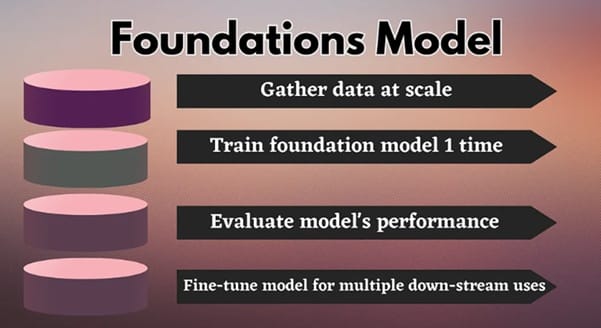
A foundation model is a large-scale AI model trained on huge datasets – often billions of words, images, or other data types so that it can understand general patterns and relationships. Think of it as a Swiss Army knife of AI – powerful out of the box – but far more effective when adapted to a specific task.
When a foundation model is open, it means:
- You can access the model’s weights (its learned parameters).
- You can often modify or fine-tune it for your needs.
- You can inspect its architecture and training setup (sometimes even its training data sources).
- You’re free to run it locally or on your own cloud infrastructure.
Examples include:
- Text models: LLaMA 2, Falcon, BLOOM, MPT
- Vision models: OpenCLIP, SAM (Segment Anything Model), BiomedCLIP
- Multimodal models: Florence, OpenFlamingo
Key difference from closed models: With open models, you’re not sending patient data to someone else’s API – you control the environment, which is crucial for healthcare compliance.
Why Healthcare and Open Models Are a Perfect Match
Healthcare is one of the most data-sensitive industries in existence. That makes open foundation models perfect for it. Data privacy is crucial in the healthcare sector. Regulations like – HIPAA (US), GDPR (EU), and others require that patient data be stored, processed, and transmitted under strict controls. With open models – AI can be deployed on-premises or in a private cloud – ensuring patient data never leaves a secure environment. However, a general-purpose AI model may not understand medical languages and images. Open models can be fine-tuned on domain-specific datasets like – radiology reports, pathology slides, or genomic data. This can simplify the workflows.
In healthcare, transparency is important. Hence, explanations are required to support why a model is recommending a particular diagnosis or treatment. In open models one can integrate that too.
Again, training a medical-grade AI model from scratch can cost millions. Open foundation models empower -startups, research labs, and even small hospitals experiment and innovate without the cost burden.
Real-World Applications
According to Forbes, foundation models help small businesses adopt AI faster by offering flexible frameworks that cut costs and time, enabling quick integration of voice agents, insights, and automation. Here are just a few ways open foundation models can be adapted for healthcare:
- Medical imaging analysis – where vision transformers are used to detect – tumors, fractures, or anomalies in X-rays, CT scans, or MRIs.
- Clinical decision support can – summarize patient histories, flag potential drug interactions, or generate treatment plans.
- Drug discovery and genomics can – improve with generative models that propose new molecular structures or predict protein folding – speeding up pharmaceutical research.
- Multilingual chatbots that answer questions, schedule appointments, and provide post-surgery care instructions – is essential for patient communication.
- Automated medical coding help with – billing and diagnostic codes from unstructured clinical notes.
Challenges to Keep in Mind
Even with open models – one can face hurdles with – regulatory approval. Clinical AI tools may require FDA, EMA, or local regulatory clearance. There can be bias and data gaps in the medical datasets. Again, with changes in medical guidelines, AI models must keep pace with it. Also, there can be challenges with ethics and accountability requiring human intervention.
The Future of Open AI in Healthcare
We’re on the verge of an open AI healthcare ecosystem where:
- Hospitals run AI models entirely on their secure servers.
- Researchers fine-tune shared open models without moving patient data.
- Regulators have greater confidence because models are auditable.
- Healthcare practitioners trust AI more.
Emerging technologies like – federated learning and synthetic data generation will amplify the value of open foundation models even further.
Final Thoughts
Open foundation models are not a shortcut to bypass the rigor healthcare demands – but they are a powerful starting point. With careful fine-tuning, strict adherence to privacy regulations, and a commitment to transparency – they can bring cutting-edge AI capabilities into hospitals, research labs, and even patients’ homes. If the last decade was about proving AI could work in healthcare, the next one will be about making it safe, equitable, and accessible—and open foundation models will be at the heart of that transformation.
If this article triggers curiosity and you are eager to explore the role of open foundation models in healthcare settings then AIU offers a list of Mini courses, Blogs, News articles and many more on related topics that one can access such as:
AIU also offers a comprehensive array of recorded live classes spanning various subjects. If any topic piques your interest, you can explore related live classes. Furthermore, our expansive online library houses a wealth of knowledge, comprising thousands of e-books, thereby serving as a valuable supplementary resource.
Reference
Reminder to our Dear Students,
Please ensure you are logged in as a student on the AIU platform and logged into the AIU Online
Library before accessing course links. This step is crucial for uninterrupted access to your learning
resources.