Masters in Semiconductor Engineering

School of Science & Engineering

Academic Freedom to Discover Your Purpose

Open Curriculum Design at Atlantic International University

The masters in semiconductor engineering is an advanced, multi-disciplinary program teaching participants skills needed for careers in one of the fastest growing and most strategic industries. The program covers semiconductor materials, integrated circuit design, microelectronics, nanotechnology, fabrication processes, chip manufacture, testing of chips, and new technologies used in modern electronics. Students of semiconductor engineering masters will receive a solid foundation in theoretical principles and their real-world applications and be equipped to solve problems in computing, telecommunication, artificial intelligence, automobile systems, and consumer electronics. The emphasis on research, innovation and an industry focus will provide online masters in semiconductor engineering students with knowledge and skillsets to contribute to the design, development, and advancement of the next generation of semiconductor technologies.

Masters in Semiconductor Engineering : Industry Growth & Global Impact

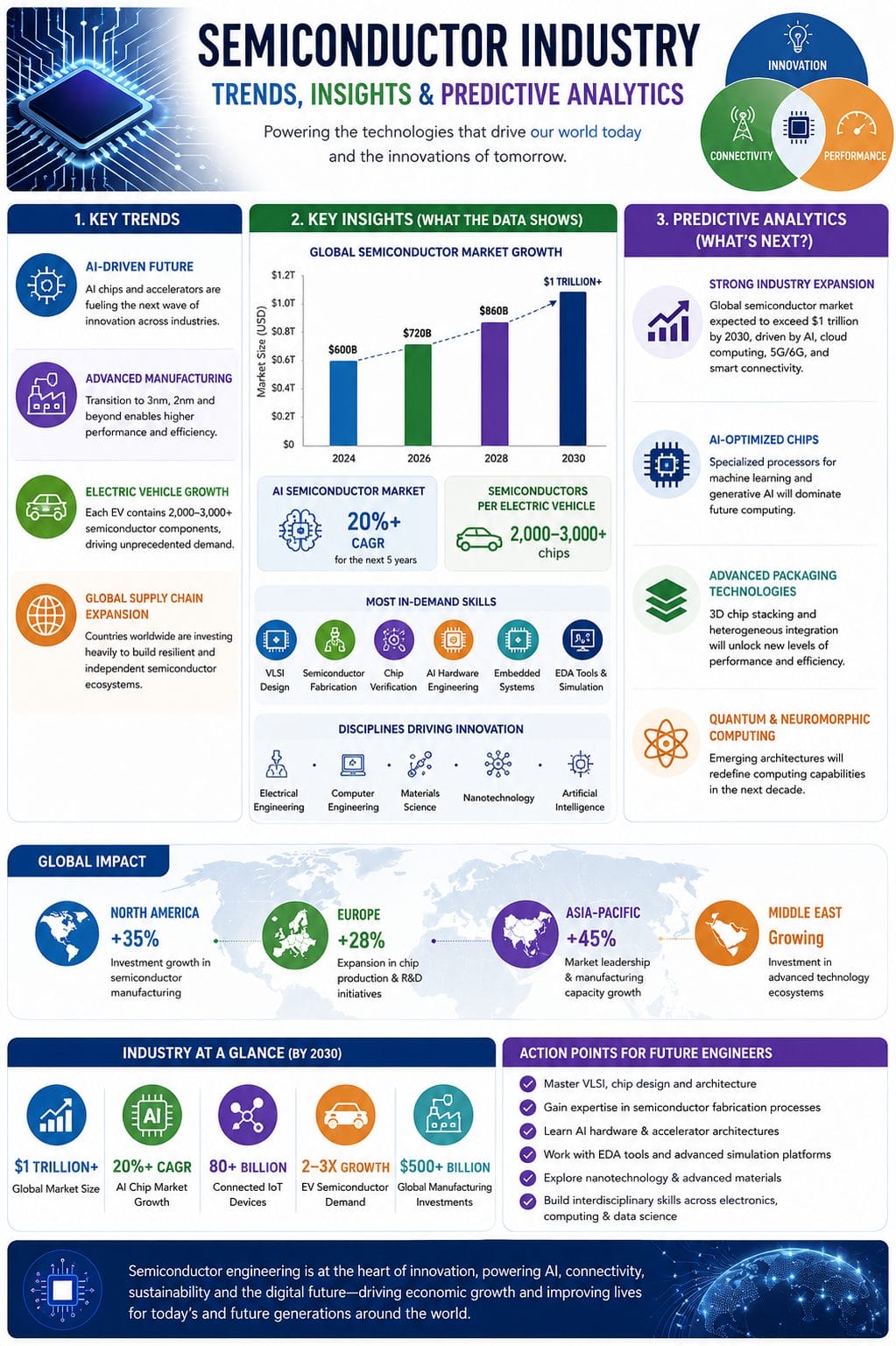
The semiconductor industry is one of the fastest-growing areas of the worldwide economy. Moreover, it provides the foundation behind technology such as: artificial intelligence (AI), cloud computing, 5G, autonomous vehicles, next generation medical devices, and consumer electronics (Consumer Electronics). Estimates published recently by industry analysts suggest that by 2030, the global market for semiconductors will have grown larger than $1 trillion – up from approximately $600 billion today – primarily because of increased demand for high performance chips and smart connected device types. In fact, the market for AI semiconductors alone is expected to grow at an annual growth rate greater than 20% for each of the next 5 years; moreover, there are upwards of several thousand semiconductor devices contained within each electric vehicle produced. 

With more than $500B worth of semiconductor manufacturing fabrics of plant facilities planned or already in development with various government agencies. They have recognized how essential semiconductors are strategically. Given the continuing digital transformation across all sectors of our economy, semiconductor engineers will be essential to helping deliver innovations for economic prosperity through development of new technology semiconductor engineering degree solutions that will positively impact the lives of today’s and future generations globally.
Masters in Semiconductor Engineering
The infographic highlights the fast growth and evolution of the semiconductor industry through AI, advanced manufacturing, electric vehicles and global digitalisation. The infographic reports on size and growth of the semiconductor markets, demand for chips, the use of predictive analytics for semiconductor design and manufacture, and the patterns of growth by region. The infographic illustrates how the future of engineering semiconductors and technological change worldwide is being defined by innovation, automation and new technologies.
Masters in Semiconductor Engineering : Trends, Insights & Predictive Analytics

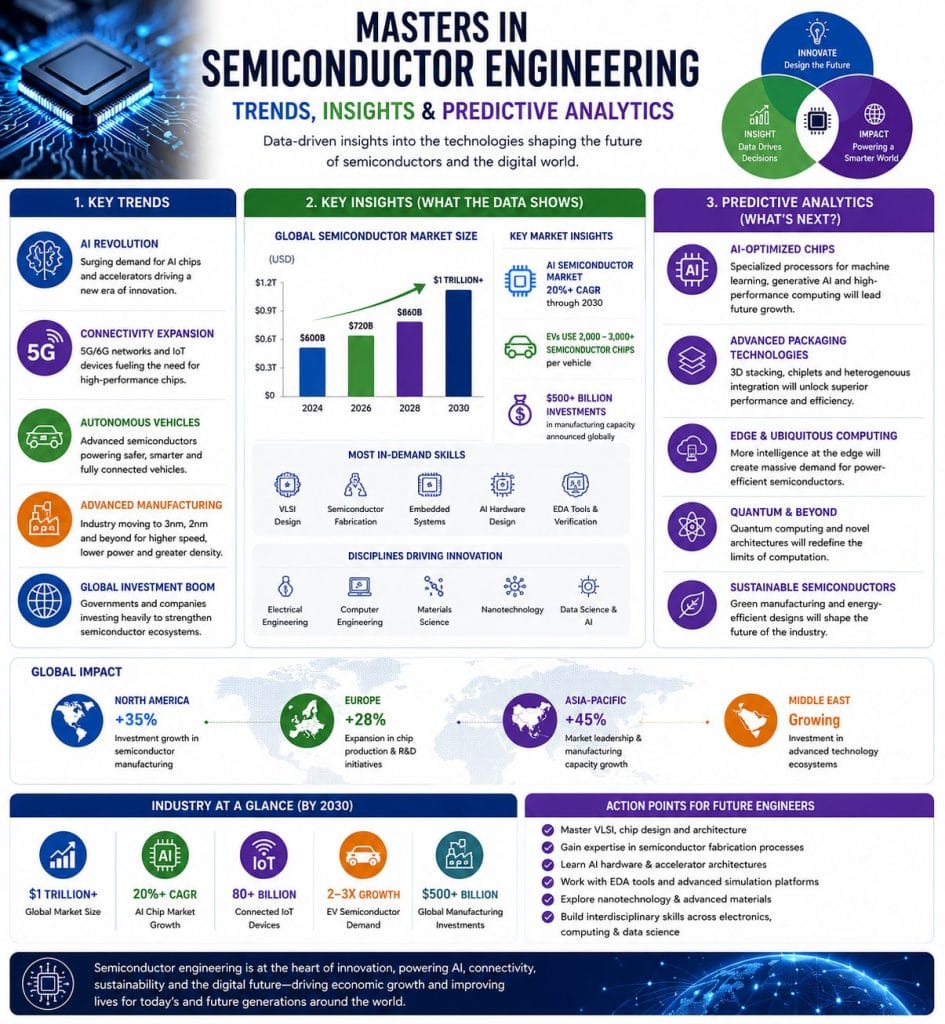
The semiconductor industry is growing at a pace never before seen, due to the demand for faster, smaller, and more energy-efficient chips caused by new technologies, such as: artificial intelligence, cloud computing, 5G networks, autonomous vehicles and more advanced healthcare systems. Industry analysts are reporting that there is an increasing trend towards: advanced manufacturing nodes, artificial intelligence-optimized processors and heterogeneous integration with next-generation packaging technology. In fact, according to some analysts, the global semiconductor market is projected to exceed masters in semiconductor engineering market $1 trillion by 2030, with strong semiconductor engineering graduate program support from massive investments in semiconductor engineering course research, manufacturing plants and expanding supply chains throughout the world. Additionally, based on prediction analytics, growth in specialized chip designs, quantum computing and edge computing will continue to increase, as will the demand for highly-skilled master in semiconductor engineering engineers to lead innovation in this rapidly evolving and strategically vital industry.
Masters in semiconductor engineering
This infographic presents key trends, insights, and predictive analytics shaping the semiconductor industry. It highlights advancements in AI-driven design, smart manufacturing, electric vehicles, and next-generation computing. Through market forecasts, growth projections, and data-driven insights, the visual demonstrates how predictive analytics is improving efficiency, accelerating innovation, optimizing production, and driving the future of the global semiconductor ecosystem.
Career Opportunities & Professional Development

The semiconductor industry is growing at a pace never before seen, due to the demand for faster, smaller, and more energy-efficient chips caused by new technologies, such as: artificial intelligence, cloud computing, 5G networks, autonomous vehicles and more advanced healthcare systems. Industry analysts are reporting that there is an increasing trend towards: advanced manufacturing nodes, artificial intelligence-optimized processors and heterogeneous integration with next-generation packaging technology. In fact, according to some analysts, the global semiconductor market is projected to exceed $1 trillion by 2030, with strong support from massive investments in research, manufacturing plants and expanding supply chains throughout the world. Additionally, based on prediction analytics, growth in specialized chip designs, quantum computing and edge computing will continue to increase, as will the demand for highly-skilled engineers to lead innovation in this rapidly evolving and strategically vital industry.

Career roadmap
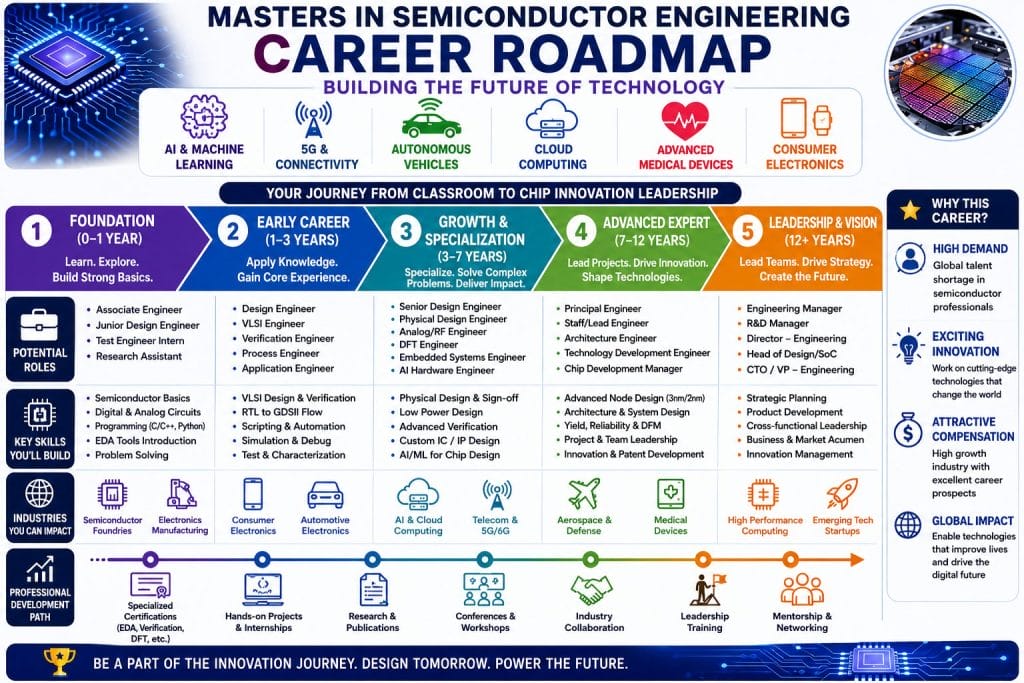
This career navigational infographic is a comprehensive showing for a clear route from basic to advanced semiconductor knowledge within engineering and towards being an industry leader; emphasizing the learning that occurs through each of the core competencies, including technical skill levels, industry certification, and practical experience milestones so that students will continue to innovate, solve problems, specialize, and have fulfilling careers in semiconductor design, manufacturing, research or leading the technology of the future.

The AI Experience: Future-Focused Areas in Semiconductor Engineering

In terms of the industry, artificial intelligence (AI) is having a major impact on how semiconductors will be made in the future. Demand for faster, more intelligent, and energy-efficient semiconductor chips used in advanced computing applications is creating new opportunities at all levels of the semiconductor engineering field. Examples of these future-focused areas of semiconductor engineering include AI accelerator design, machine learning based processors, neuromorphic computing, edge AI devices and IoT devices, autonomous vehicle systems, advanced packaging of silicon-based chips, and smart manufacturing processes. 

In addition to these areas, AI is being applied to the entire semiconductor lifecycle in order to improve the design of semiconductor chips, automate chip verification, optimize chip fabrication workflows, predict machine failures and reduce costs through advanced research and development techniques. As the use of AI continues to grow in many industries, semiconductor engineers who have both microelectronics and AI expertise will have a key role in developing the next generation of semiconductor technology masters processors, sensors, and other smarter systems that power the digital economy.

Contact Us Today!

Begin Your Journey!
AIU’s Summer of Innovation and Growth gives you the ability to earn up to $5000 in tuition credit by completing free lessons and courses.
Whether you’re looking to acquire new skills, advance your career, or simply explore new interests, AIU is your gateway to a world of opportunities. With free access to 3400 lessons and hundreds of courses the ability to earn credits and earn certificates there’s no better time to start learning.
Join us today as a Guest Student and take the first step towards a brighter, more empowered future.
Explore. Learn. Achieve.

Academic Freedom & Customized Curriculum

By giving students the ability to establish their own educational goals and to do research on topics of particular interest or relevance to them outside of the classroom, the Master in Semiconductor Engineering will help them to become entrepreneurs, innovators, and independent thinkers-just as they will become through their studies. In addition to developing these skills, students may select specialized fields within semiconductor engineering such as: VLSI design; semiconductor manufacturing; nanotechnology; embedded systems; artificial intelligence (AI) hardware; chip verification; advanced materials; next-generation computing technology. Students may also utilize the Snyder Computer Science and Information Systems Technology (CSIST) curriculum to create unique educational pathways to achieve their professional goals, while learning how to apply the core concepts of semiconductor technology and engineering. 

Ultimately, students will gain valuable experience within the semiconductor industry that will enhance their accredited semiconductor engineering masters competencies in all aspects of semiconductor technology-chain from the semiconductor engineering degree online design phase to the production phase-and prepare them to adapt to changes in the global semiconductor industry.

Why Study Semiconductor Engineering at AIU?

Benefits of Semiconductor Engineering 

The Semiconductor Engineering field provides exceptional possibilities to be part of an exciting new era in technology development, supporting industries ranging from AI to telecom to health care to aerospace (and beyond) as part of the rapid expansion of VLSI design microelectronics  digital transformation. The field has a high global demand for career opportunities, competitive salary potential, and opportunities for research, entrepreneurship, and leadership. As semiconductor technologies continue to be integrated into our daily lives and are essential to the ongoing digital transformation of a large portion of the world, those who work within this area will have an important role to play in creating the innovative chips, chip fabrication, intelligent devices, and new computing solutions that will drive our world into the future (and beyond).

Traditional vs Flexible Education : Masters in Semiconductor Engineering 

Standard training for semiconductor engineers tends to follow a scripted study plan with set course schedules established by each program along with rigid learning paths creating limited opportunities for specialization. With a flexible learning environment, each student creates their own study plan aligned with their career goals, IC design research interests, and family obligations. Students learn about new technologies including artificial intelligence (AI) hardware devices, very-large-scale integration (VLSI) design, semiconductor production methods, nano-technology and advanced chip design processes. 

Through personalized education through flexible learning, students can learn at their own pace, access web-based resources any time of day from anywhere in the world and complete “real-world” projects as part of their overall educational experience. Personalizing the education of semiconductor engineers will give them the unique integrated circuits technical expertise required for a career in the semiconductor industry and enable them to achieve both their professional development and research goals and their lifelong educational objectives.

Key Strengths of the Masters in Semiconductor Engineering at AIU

AIU’s Master in Semiconductor Engineering gives students a flexible, student-centric learning experience, which is aligned with today’s rapidly-changing semiconductor industry. The program offers students many unique embedded systems features, including a curriculum that can be customized to meet career goals, opportunities to study across disciplines with subject matter experts, and a strong emphasis on new and emerging technologies, such as artificial intelligence (AI) hardware, new chip designs, nanotechnology, and semiconductor production. 

In addition, students benefit from hands-on independent wafer fabrication research and from working in teams to develop a practical project. Students will each have the ability to specialize in areas of their choice, while building critical thinking and nanoelectronics innovation skills. Additionally, the program supports global learners utilizing a flexible educational mode; therefore, the students may be different types of professionals using this program to enhance their education while maintaining their job requirements, research obligations, as well as their personal lives.

Transform & Evolve with AIU

Click Here

Core Courses & Technical Skills

Important: Below is an example of the topics or areas you may develop and work on during your studies. By no means is it a complete or required list, as AIU programs do not follow a standardized curriculum. It is meant solely as a reference point and example. Want to learn more about the curriculum design at AIU? Check here: Course and Curriculum

The Master of Science in Semiconductor Engineering (M.S.) combines theory and practice throughout all areas of the semiconductor industry. Through courses ranging from chip design to microelectronics, manufacturing technology, materials science, and new forms of computer hardware or so-called emerging computing architectures; students develop both advanced technical skills necessary to facilitate innovation in this constantly changing industry. The program also builds knowledge and competence in both core engineering principles as well as technologies associated with supporting artificial intelligence (AI), telecommunications, automotive electronics, and high-performance computing (HPC).

  • Semiconductor Physics and Electronic Materials
  • Microelectronics and Integrated Circuit Design
  • VLSI Design and Verification
  • Semiconductor Device Fabrication
  • Nanotechnology and Nanoelectronics
  • AI Hardware and Accelerator Design
  • High-Performance Computing Architectures
  • Signal Integrity and Reliability Engineering

Tools & Technologies You Will Master

Engineering semiconductors today depends on more than just the ability of engineers to create state-of-the-art integrated circuits through a combination of design/simulation, verification, and manufacturing tools. To develop cutting-edge integrated circuits, there exists an entire ecosystem of tools in the semiconductor industry that allows engineers to optimize fabrication processes, and accelerate the pace of innovation. These are standard tools across the semiconductor industry for chip design, chip verification, chip physical implementation, process simulation and chip testing by different companies and labs developing semiconductor products.

Essential Tools for Semiconductor Engineering

Modern semiconductor engineering relies on a combination of design, simulation, verification, and manufacturing tools that enable engineers to develop advanced integrated circuits, optimize fabrication processes, and accelerate innovation. These industry-standard platforms are widely used across semiconductor companies, research laboratories, and manufacturing facilities to support chip design, verification, physical implementation, process simulation, and testing.

  • Cadence Design SystemsWorld leader in electronic design (EDA) software for EDA-based integrated circuit (IC) design, verification
  • Synopsys – Provides chip design, verification, silicon lifecycle management, and semiconductor IP solutions.
  • Siemens EDA (Mentor Graphics) – Utilized in PCB Creation, Validation and Simulation as well as Electronic Device Development.
  • ANSYS Electronics – Allows for the analysis of Electronic Device Characteristics such as Electro-Magnetic, Thermal and Signal Integrity
  • COMSOL Multiphysics –Provides Algorithm Developing, Algorithms Processing (Signal), Modeling and Research of Semiconductor Devices
  • MATLAB & Simulink – Specifically Targeted Tool(s) For Electromagnetic Device & Processes
  • Silvaco TCAD – Specialized tool for semiconductor device and process simulation.
  • Keysight PathWave Design Software –Intended to Create Validating Proofs of Semiconductor Devices Using Electromagnetic Waves at RF, Microwave and High Speed Frequencies (Semiconductors are the backbone of all Electronics)
  • Xilinx Vivado –FPGA Design Software To Design and Optimize For Programmable Logic Devices
  • Intel Quartus Prime – FPGA design and optimization software for programmable logic devices.
  • LTspice – Widely Used Free Analog and Mixed-Signal Circuit Simulator
  • KLayout –Open Source Integrated Circuit (IC) Layout Viewer/Editor & Verification Tool

Career-Focused Learning in Semiconductor Engineering

This program offers both virtual classroom-based education about the fundamentals of semiconductor technology and industry-based experiences to better prepare students to enter the workforce in the semiconductor industry. While providing a broad range of opportunities, many positions within the semiconductor industry involve designing or manufacturing microprocessors or other logic devices; developing application specific integrated circuits (ASICs); creating and engineering very large scale integrated (VLSI) devices; designing and engineering embedded systems; developing and creating hardware for artificial intelligence (AI); conducting research and developing new solutions; etc.

The curriculum includes hands-on projects, an exploration of emerging technology, and hands-on experience to help students develop the basic problem-solving skills needed in the semiconductor industry. The program will help students gain valuable skills that are extremely valuable in several industries including AI, telecommunications, automotive electronics, healthcare technology, aerospace, and high-performance computing.

Real-World Projects & Capstone Experience

Through practical projects and extensive capstone experiences, students in this masters in semiconductor engineering  program gain working knowledge of how to integrate existing knowledge into actual work. Integrated circuit design, VLSI verification, semiconductor device characterization and modeling, embedded AI hardware acceleration, fabricating process improvement, and innovative packaging techniques are all examples of the types of projects students may work on as part of their studies. 

With their Capstone project, students can build on the experience gained throughout their degree, while using research tools and developing creative solutions to solve an engineering problem that is based on current industry requirements. These experiences help masters in semiconductor engineering  students improve their technical skills, problem solving ability and Project Management expertise; therefore, increasing the likelihood that they will take on leadership positions in the areas of semiconductor design, manufacturing, research and technology innovation.
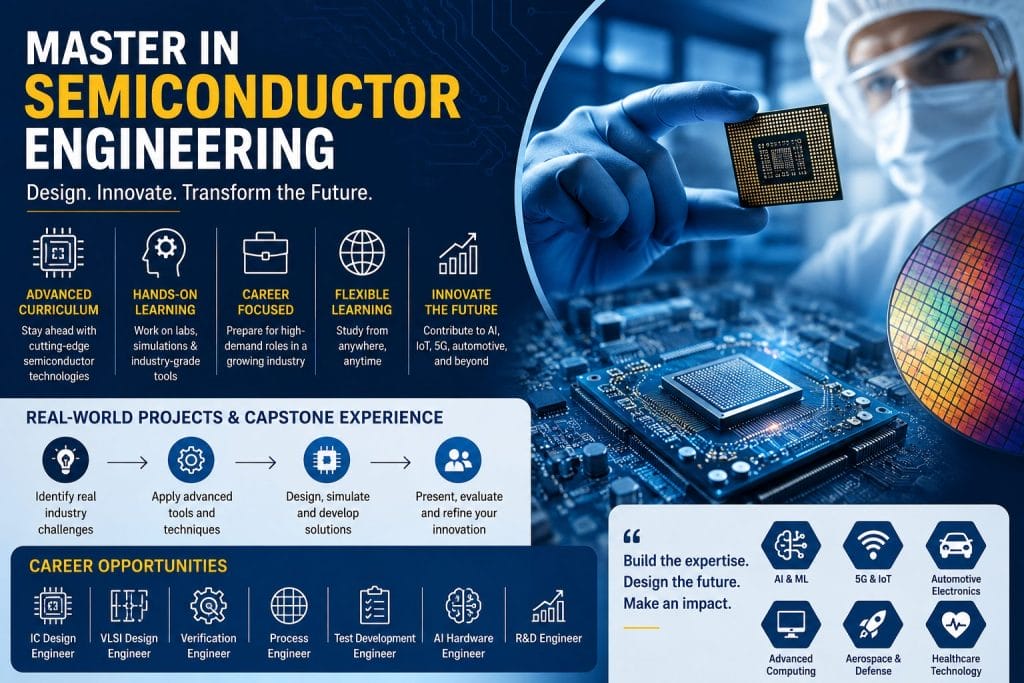
Master in semiconductor engineering
This infographic illustrates the importance of real-world projects and capstone experiences in semiconductor engineering. It highlights hands-on learning through chip design, fabrication, testing, AI hardware development, and process optimization. By solving practical industry challenges, students gain technical expertise, innovation skills, and professional experience, preparing them for careers in semiconductor research, manufacturing, and advanced technology development.
Masters in Semiconductor Engineering : Research Projects & Innovation

The Masters in Semiconductor Engineering emphasizes research and innovation as keys to discovering new technologies with a major impact on the future of electronics and computing, allowing students to perform research in several disciplines including: advanced materials for semiconductors; VLSI design; AI accelerator chips; nanomaterials; semiconductor manufacturing; chip package design; embedded systems; quantum computers; and energy efficient processor architecture(s). Independent study, and experimentation, are part of developing technology and gaining experience as a solution to complex engineering problems while also increasing the performance, reliability and sustainability of semiconductor devices. The research oriented approach instills creativity, problem-solving, and technical leadership skills that are highly sought after in both Masters in Semiconductor Engineering industry and academia.

Get Started with AIU’s Virtual Campus 

Begin Your Journey

Thesis & Research Defense Process

The Master in Semiconductor Engineering Thesis and Research Defense Process allows students to illustrate their advanced knowledge, independent research ability and innovative problem-solving abilities by way of conducting a thorough investigation into a specific area of semiconductor engineering (for instance chip design, semiconductor fabrication, AI hardware, nanotechnology, advanced materials, and new forms of computing) and preparing a Thesis or formal research document that includes objectives, methods, results and field contribution. In addition, the Thesis Defense requires students to present and defend their research to an academic reviewer(s) thereby demonstrating their technical capabilities, analytical processes and ability to effectively communicate complex engineering concepts.

This experience further develops research capabilities, provides graduates the skills necessary to assume positions of leadership in industry, promote innovation, advance technology and foster research and development in technology.

Student Experience & Virtual Campus

Students have access to flexible, engaging learning tools and are able to use them anytime and anywhere, including their courses, research materials, digital libraries, academic help and cooperative learning experiences through an interactive virtual platform with faculty members, discussions, research collaboration and industry-relevant information. Technology-enabled learning connects students to the global community while developing their ability to learn independently and advance their careers within the semiconductor engineering industry.

Live Classes, Symposiums & Global Networking

Students can have access to professors, professionals in the field, researchers, and fellow students from different countries and cultures during live classes, symposiums, or global networking opportunities. Students will participate in live sessions, webinars, and classroom-style academic discussions to increase their source of knowledge regarding semiconductor technology, trends in the industry, and the advancement of research activities while developing critical relationships that will assist them in their careers and continue providing opportunities throughout their lives.

Academic Resources & AI-Powered Learning

The Master’s degree program in Semiconductor Engineering is supported by a robust community of educational resources and artificial intelligence technologies that are utilized to improve one’s understanding of both technical concepts as well as their ability to conduct research. Students will be given access to various types of digital library catalogs, scholarly journal articles, research indices and databases, technical publications, simulation sources, and various industry-related reports dealing with semiconductor technology and new developments within this field. 

In addition to these resources, AI-driven learning tools will assist students in personalizing the educational process through finding relevant studies/information related to their area of expertise; exploring areas of knowledge based upon interest; analyzing data; reinforcing concepts; and developing new projects. As a result, the combination of these forms of technology-enhanced learning masters in semiconductor engineering environments gives each student the ability to stay up-to-date on current developments in one’s field; increase research output; create professional skills that will allow individuals to thrive in an ever-changing marketplace.

You are Just a Click Away from Innovation with AIU 

Get Started

Admission Requirements

The Masters in Semiconductor Engineering degree program at AIU was designed to make this program available to students with various educational and professional experiences. Prospective students will generally need to have a bachelor’s degree or an equivalent qualification (normally 120 semester hours) in the areas of engineering, electronics, electrical engineering, computer engineering, physics, or other appropriate technical area(s). Applicants must show a desire to enter the semiconductor technology, microelectronics, advanced computing, and similar fields. 

During the application process, prospective students may be required to submit transcripts from their prior colleges, a résumé or CV, and any other documentation which demonstrates their past education and experience. The admissions process evaluates candidates’ preparedness for graduate-level study of semiconductor engineering, their career goals, and their likelihood of being successful in graduate-level studies of semiconductor engineering.

How to Apply ?

The process of applying for the Master of Science in Semiconductor Engineering at AIU is simple, which will assist you in starting your educational path.

  1. Fill out the online application with all of your personal (Contact Information) and (Career Information) or your educational career history including all of the information requested for you and your past educational experiences.
  2. Send your academic transcripts from your previous institutions as well as any other documentation that you have.
  3. Send a current résumé/CV outlining your educational history, skills/technical skills, and work history.
  4. Talk with an Admissions Counselor about your academic goals and career plans.
  5. Await the results of your evaluation based on your qualifications, previous experiences, and your intended program.
  6. Complete the enrollment procedures that will allow you to choose a tuition payment option.
  7. Login to the online campus or other academic resources and academic support services to begin your classes.

Tuition, Financial Support & Scholarships

The goal at AIU is to provide access to advanced education by providing affordable tuition options and flexible payment plans for students with different educational and professional backgrounds.

For example, through the Master in Semiconductor Engineering program, students can obtain an excellent education without incurring large amounts of debt that are typically associated with traditional graduate programs. In addition, students will be able to seek additional financial assistance through grants, scholarships, tuition reimbursement programs from employers and other forms of assistance as they are available. In addition to offering flexible enrollment and payment options, AIU will assist students in focusing on their goals of completing their education and establishing successful careers, while managing their investment in education in a manner that meets their particular needs.

FAQs

What is a Masters in Semiconductor Engineering?

An advanced, graduate-level degree known as the master of semiconductor engineering focuses on the design, development, fabrication, testing, and optimization of semiconductors and integrated circuits. Students will receive technical training to become highly skilled in microelectronics, VLSI, semiconductor manufacturing, nanotechnology, and new technologies that support today’s electronics, artificial intelligence (AI), telecommunications, and computer technology development.

What can you do with a Masters in Semiconductor Engineering?

With a master’s in semiconductor engineering, graduates may be able to find employment in various career paths, including chip design, very large scale integration engineering, semiconductor manufacturing, process engineering, embedded systems, artificial intelligence hardware development, research and development, quality assurance, and advanced electronics. These graduates may find employment within the following industries: artificial intelligence, telecommunications, automotive technology, aerospace, healthcare, consumer electronics and high-performance computing; these industries will help develop future-generation semiconductor products.

How long does it take to complete a semiconductor engineering master’s degree?

2 years.

Can I study Semiconductor Engineering online?

Yes, AIU offers Semiconductor Engineering online.

What are the admission requirements for a Masters in Semiconductor Engineering?

A Bachelor Degree in Semiconductor Engineering or any relevant stream is a must.

Let us know your goals and aspirations so we can chart a path at AIU to achieve them!
//
Admissions Counselor
Sandra Garcia-Fierro
Available
//
Admissions Counselor
Rene Cordon
Available
//
Admissions Counselor
Juan Mejia
Available
//
Admissions Counselor
Ariadna Romero
Available
//
Admissions Counselor
Alba Ochoa
Available
//
Admissions Counselor
Veronica Amuz
Available

"*" indicates required fields

This field is for validation purposes and should be left unchanged.
Name*

"*" indicates required fields

This field is for validation purposes and should be left unchanged.
Name*

"*" indicates required fields

This field is for validation purposes and should be left unchanged.
Name*

"*" indicates required fields

This field is for validation purposes and should be left unchanged.
Name*

"*" indicates required fields

This field is for validation purposes and should be left unchanged.
Name*

"*" indicates required fields

This field is for validation purposes and should be left unchanged.
Name*

"*" indicates required fields

This field is for validation purposes and should be left unchanged.
Name*

"*" indicates required fields

This field is for validation purposes and should be left unchanged.
Name*

"*" indicates required fields

This field is for validation purposes and should be left unchanged.
Name*

"*" indicates required fields

This field is for validation purposes and should be left unchanged.
Name*

"*" indicates required fields

This field is for validation purposes and should be left unchanged.
Name*

"*" indicates required fields

This field is for validation purposes and should be left unchanged.
Name*

"*" indicates required fields

This field is for validation purposes and should be left unchanged.
Name*

"*" indicates required fields

This field is for validation purposes and should be left unchanged.
Name*

"*" indicates required fields

This field is for validation purposes and should be left unchanged.
Name*

"*" indicates required fields

This field is for validation purposes and should be left unchanged.
Name*

"*" indicates required fields

This field is for validation purposes and should be left unchanged.
Name*

"*" indicates required fields

This field is for validation purposes and should be left unchanged.
Name*

"*" indicates required fields

This field is for validation purposes and should be left unchanged.
Name*

"*" indicates required fields

This field is for validation purposes and should be left unchanged.
Name*

"*" indicates required fields

This field is for validation purposes and should be left unchanged.

Submit your data.

After submitting, a widget will appear at the bottom-left corner so you can start your training.

Name*

Do you hate spam? Don’t worry, we hate them too. Your email is 100% secure with us.

"*" indicates required fields

This field is for validation purposes and should be left unchanged.

Submit the form below to begin your interview.

After submitting, a widget will appear at the bottom-left corner so you to start your AI interview.

Name*
Accepted file types: docx, pdf, Max. file size: 500 MB.

Do you hate spam? Don’t worry, we hate them too. Your email is 100% secure with us.