
Bachelors in Cognitive Science

School of Science & Engineering

Academic Freedom to Discover Your Purpose

Open Curriculum Design at Atlantic International University

A Bachelor in Cognitive Science is an interdisciplinary path that dives into how the mind works by mixing neuroscience, psychology, computer science, linguistics, and philosophy. Students build a solid grasp of human cognition, cognitive psychology, and brain science – plus the ins and outs of learning and memory. With this program, learners pick up key analytical and research skills. These help them figure out both human behavior and smart systems, which later really boost their careers.

The growing demand for professionals who can bridge human thinking and technology has increased the value of a cognitive science degree. In fact, a cognitive science bachelor’s degree equips students with knowledge that is relevant across healthcare, education, technology, research, and user experience design, which is essential since industries increasingly adopt artificial intelligence, cognitive science professionals play an important role in developing human-centered solutions and improving decision-making systems.

A flexible learning model further enhances the appeal of a cognitive science course. An online cognitive science degree has advantages beyond comprehension. It enables students to balance education with personal and professional commitments while accessing high-quality academic resources from anywhere. This provides convenience without compromising academic rigor. When pursuing a well-recognized cognitive science degree – students benefit from recognized credentials and industry-relevant training. As a cognitive science major, learners engage in advanced cognitive science studies and receive a modern cognitive science education aligned with evolving AI and analytics-driven industries.

Important: Below you’ll find a summary and basic overview of the subjects and fields you can delve into and engage with throughout the course of your academic journey. It’s important to note that this list is neither exhaustive nor mandatory, as the graduate school and professional programs here at AIU might differ from conventional curriculum. Its main purpose is to serve as a guiding and visual aid. Are you interested in diving deeper into the curriculum framework at AIU?

Bachelors in Cognitive Science Industry Growth & Global Impact

A Bachelor in Cognitive Science is a great degree one can choose especially if one opts it from Atlantic International University (AIU). It covers everything from artificial intelligence to neuroscience, psychology, and data science, all tied together with human behavior under the guidance of mentors and academic advisors. Because more companies need folks who get both tech and how our minds work, there’s a growing demand for these graduates. You see it in healthcare, education, tech, research, and businesses everywhere.

The AI industry is expected to hit over $4 trillion by 2030 thanks to smart tech and wider implementation in companies. The Cognitive AI market alone is looking at a big jump from about $33.8 billion in 2025 to over $110 billion by 2030 which will increase the demand for skilled professionals who know how to blend AI tech with designs that fit how we think and make choices.

Students in these programs pick up the nuts and bolts of cognitive psychology, brain science, learning, memory, machine learning, and more. That’s why employers love hiring folks with a degree in cognitive science – they can dive into AI and also understand people’s mental processes and how they interact with tech.

Global AI adoption is also driving salary growth. According to PwC’s 2025 AI Jobs Barometer – roles requiring AI skills command an average wage premium of 56% due to rapid expansion of AI worldwide. With the knowledge from courses or degrees in cognitive science, graduates can ace jobs in AI, UX, neuroscience, and more. Since businesses are blending AI with people-focused solutions – these courses offer solid career tracks worldwide.

Future Trends in Cognitive Science

Cognitive science, the interdisciplinary study of mind, intelligence, perception, learning, and decision-making (drawing from psychology, neuroscience, AI, linguistics, philosophy, and anthropology), is rapidly evolving. Key future trends through 2030 and beyond include:

  • Integration with AI and Brain-Computer Interfaces (BCIs): Advances in neural decoding, brain augmentation, and BCIs are enabling direct human-machine interaction. Breakthroughs in 2025 highlighted reversing aspects of brain aging, multi-stage brain development models, and regenerative technologies.
  • Cognitive Computing and Modeling: Emphasis on explainable AI, cognitively inspired neural networks, reinforcement learning, and mental model alignment for safer, more interpretable systems.
  • Human-Centered AI and Ethics: Focus on aligning AI with human cognition, addressing biases, metacognition, aging, and perception, alongside applications in personalized medicine, education, and behavioral interventions.
  • Multimodal and Embodied Cognition: Greater integration of sensory processing, language, and real-world interaction in both human and artificial systems.
  • Neuroscience-Driven Personalization: Tools for enhanced learning, mental health, and performance optimization using insights from cognitive stages and plasticity.

These trends position cognitive science at the intersection of understanding natural intelligence and engineering artificial systems.
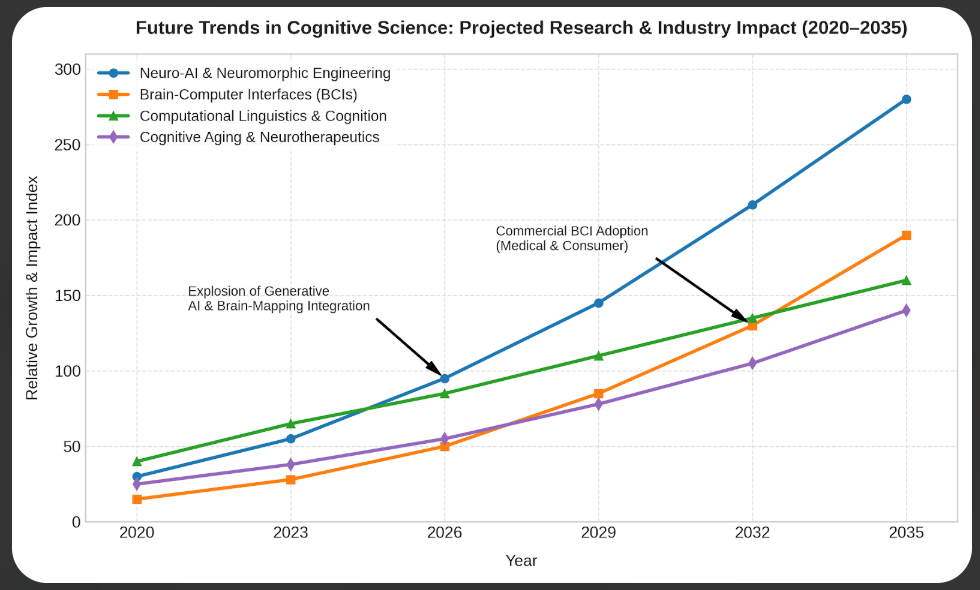
Future Trends in Cognitive Science Projected Research & Industry Impact
The chart compares projected growth across Neuro-AI, Brain-Computer Interfaces, Computational Linguistics, and Cognitive Aging through 2035. Neuro-AI shows the strongest growth trajectory, while all four fields demonstrate sustained expansion, driven by advances in generative AI, brain-mapping technologies, and the increasing adoption of commercial BCI applications.
Trend Comparisons

Cognitive science trends can be compared across domains:

  • Vs. Traditional Psychology/Neuroscience: Cognitive science is more computational and interdisciplinary, incorporating AI/ML for modeling, whereas traditional fields may focus more on empirical observation.
  • Cognitive Science vs. Pure AI/CS: Cognitive science emphasizes human-like processes (e.g., bounded rationality, biases, embodiment) to improve AI robustness and interpretability, while pure AI prioritizes performance/scalability. Hybrids like cognitively inspired interpretability in LLMs bridge this.
  • Past vs. Future: Earlier decades focused on symbolic/connectionist debates and Bayesian models; current/future shifts toward AI-augmented experimentation, large-scale data, and real-time brain interaction.
  • Regional/Industry: North America leads in adoption due to tech infrastructure; applications in healthcare/tech outpace others like marketing or law in growth velocity.

Overall, cognitive science provides a “people science” lens for the future of work, complementing data-heavy AI approaches with human behavioral insights.

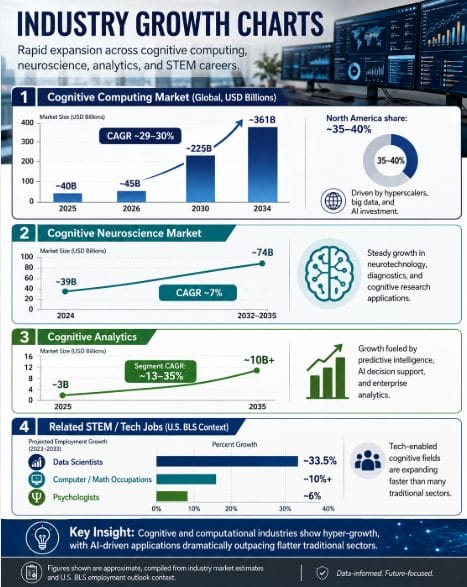
Industry Growth Charts

The cognitive/computational fields show explosive growth, tied to broader AI and data markets (text-based representations below; actual visuals would use bar/line charts with sources):

  • Cognitive Computing Market (Global, USD Billion):
  • ~2025: ~35–45B
  • 2026: ~45B
  • 2030: ~225B (CAGR ~28%)
  • 2034: ~361B (CAGR ~29–30%)

North America (led by USA) holds ~35–40% share, driven by hyperscalers, big data, and AI investment.

  1. Cognitive Neuroscience Market: Projected from ~39B (2024) to ~74B by ~2032–35 (CAGR ~7%).
  2. Cognitive Analytics: From ~3B (2025) to ~10B+ by 2035 (CAGR 13–35% in segments).
  3. Related STEM/Tech Jobs (US BLS Context): Computer/math occupations grow much faster than average (~10%+ for broader STEM), with data scientists at ~33.5% growth (2024–2034). Psychologists (overlapping) ~6% growth.

These charts illustrate hyper-growth in tech-enabled cognitive applications compared to flatter traditional sectors.
Industry Growth Charts
Cognitive computing is projected to expand rapidly, reaching an estimated market value of USD 361 billion by 2034. North America remains the leading region, supported by strong AI and big data investments, while cognitive neuroscience, analytics, and AI-driven decision support continue to drive growth across research, healthcare, and technology sectors.
Insights about Future Technologies and Smart Industries

Cognitive science fuels “smart” industries by informing human-AI symbiosis:

  • Healthcare: Personalized diagnostics, cognitive therapies, brain augmentation for aging/Alzheimer’s, and BCIs for communication/restoration.
  • Technology/EdTech: Intuitive interfaces, adaptive learning systems, UX/UI grounded in human perception/attention, and cognitively aligned AI tutors.
  • Business/Finance: Predictive modeling of behavior, risk assessment, and decision support via cognitive analytics.
  • Manufacturing/Automation: Human-robot collaboration, ergonomic design, and cognitive automation for complex decisions.
  • Smart Cities/Security: Behavioral insights for ethical AI governance, bias reduction, and human-centered design.

Future technologies like advanced LLMs/VLMs, generative AI, and neurotech will rely on cognitive science for interpretability, alignment, and augmentation—shifting from observation to interaction.

Impact of AI on Business Intelligence and Predictive Analytics 

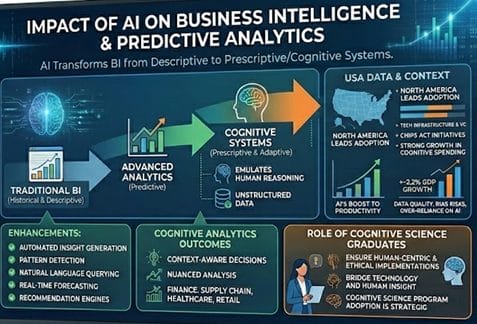
AI transforms BI and predictive analytics by moving from descriptive/historical reporting to prescriptive/cognitive systems that emulate human reasoning on unstructured data.

  • Enhancements: Automated insight generation, pattern detection, natural language querying, real-time forecasting, and recommendation engines. Cognitive analytics processes vast datasets for nuanced, context-aware decisions in finance, supply chain, healthcare, and retail.
  • USA Data/Context: North America (USA dominant) leads adoption due to tech infrastructure, VC, and initiatives like CHIPS Act. Markets show strong growth (e.g., cognitive systems spending). AI boosts productivity, GDP potential (~2.5% growth forecasts in optimistic scenarios), and strategic agility, though challenges include data quality, bias, and over-reliance risks to human skills.
  • Outcomes: Faster, more accurate decisions; competitive edges in personalization and optimization. Cognitive science grads contribute uniquely by ensuring human-centric, ethical implementations.
Impact of AI on Business Intelligence & Predictive Analytics
The infographic illustrates the evolution from traditional business intelligence to advanced analytics and cognitive systems, highlighting the shift toward predictive, prescriptive, and adaptive decision-making. It emphasizes North America’s leadership in adoption, the growing impact of cognitive analytics across industries, and the critical role of cognitive science professionals in ensuring human-centered AI implementation.
Scope of Automation

Cognitive automation extends RPA (robotic process automation) with AI/ML for judgment-based, unstructured tasks – handling exceptions, learning from data, and making decisions.

  • In Cognitive Science: Automates routine experimentation/analysis but requires human oversight for insight, creativity, and ethics. AI aids hypothesis generation and data processing, yet core scientific practice (interpretation, novel theory) remains human-led.
  • Broader Impact: Expands automation in knowledge work (e.g., BI, customer service, diagnostics). In digital economies, it augments rather than fully replaces roles, creating demand for cognitive experts to design, monitor, and align systems. Limits exist in highly contextual, creative, or empathetic tasks.

Graduates are well-positioned to bridge automation gaps with human cognition expertise.

Future Career Demand in Evolving Digital Economies

A Bachelor’s in Cognitive Science offers high flexibility and strong demand in tech-driven economies.

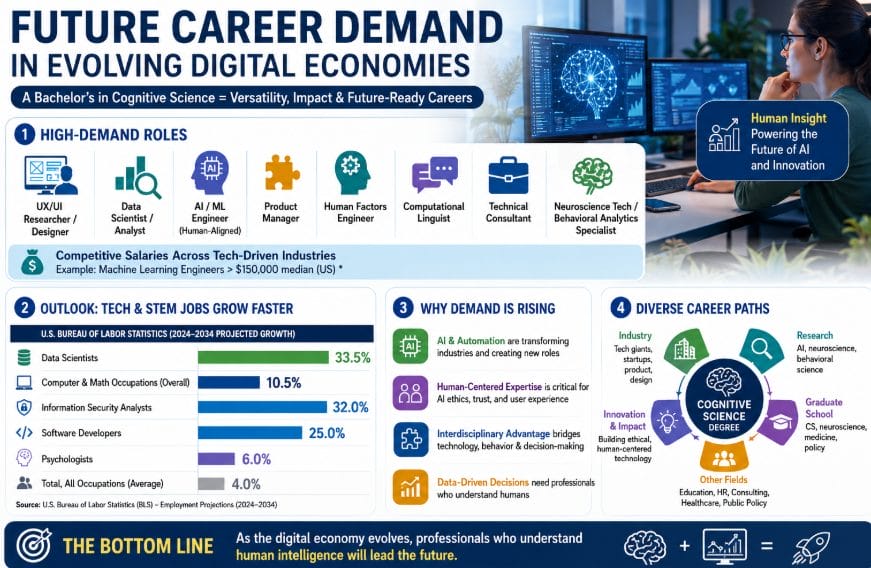
  • High-Demand Roles: UX/UI researcher/designer, data scientist/analyst, AI/ML engineer (human-aligned), product manager, human factors engineer, computational linguist, technical consultant, and roles in HCI, neuroscience tech, or behavioral analytics. Salaries are often competitive (e.g., ML engineers >$150K median in examples).
  • Outlook: Tech/STEM jobs grow faster than average (BLS: computer occupations significantly above average; data scientists ~33%+). Cognitive skills are prized for AI ethics, user-centered design, and interdisciplinary problem-solving. Paths include industry (tech giants, startups), research, grad school (CS, neuroscience, medicine), or fields like education, HR, and consulting.
  • Digital Economy Fit: As AI automates routine tasks, demand rises for professionals who understand human intelligence to build, evaluate, and integrate systems.

This degree equips graduates for resilient, high-impact careers at the forefront of intelligence technologies. Prospective students should combine it with skills in programming, statistics, and domain electives for optimal outcomes.
Future Career Demand
Cognitive science prepares graduates for high-growth careers at the intersection of AI, data, user experience, and human-centered technology. As automation expands, demand for professionals who can combine technical expertise with human insight continues to rise across technology, research, healthcare, consulting, and education sectors.

Career Opportunities & Professional Development of a Student with Bachelors in Cognitive Science

The field of cognitive science is wide and includes neuroscience, psychology, human cognition and artificial intelligence. Some jobs available to a graduate with a bachelor of cognitive science or a cognitive science bachelor’s degree include user experience researcher, behavioral analyst, human-computer interaction designer, developer of learning technologies, data analyst, innovative health care applications and artificial intelligence-based product development.

Some of the industries hiring employees with degrees in cognitive science include technology, healthcare, education, consulting, research firms and product development firms. New areas that focus on the future such as machine learning, intelligent systems, cognitive computing, neurotechnology, intelligent tutoring systems and brain inspired AI highly regard a degree in cognitive science. Foundational knowledge in cognitive psychology, brain science and learning and memory will serve graduates well.

Regardless of whether one pursues their study in a cognitive science program, cognitive science course, online cognitive science degree, cognitive science degree online, or online bachelors in cognitive science, developing a portfolio is a valuable experience for students that every AIU student experience during the course. Further, AIU offers support in career development, job placement, resumes, interviews and employer connections.
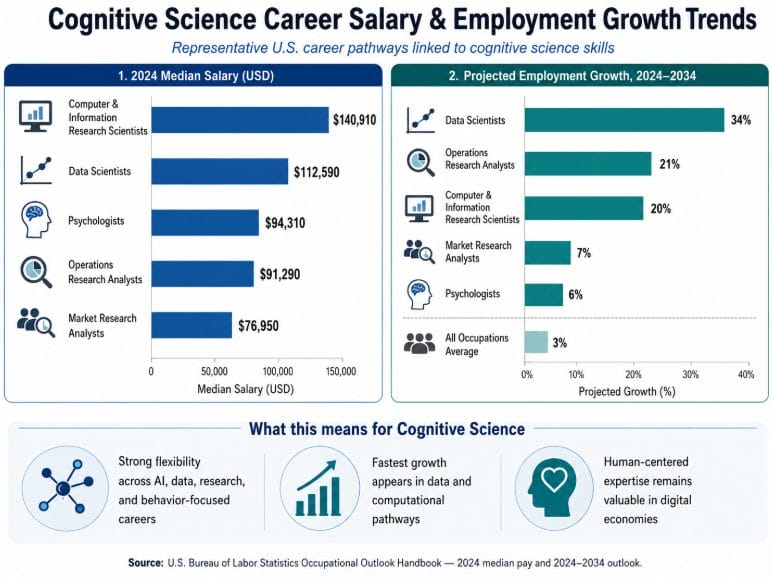
Cognitive Science Career Salary & Employment Growth Trends
Career opportunities linked to cognitive science offer strong earning potential and job growth, led by computer and information research scientists and data scientists. The field provides a versatile foundation for careers in AI, analytics, research, and other data-driven, human-centered technology sectors.

Contact Us Today!

Begin Your Journey!
AIU’s Summer of Innovation and Growth gives you the ability to earn up to $5000 in tuition credit by completing free lessons and courses.
Whether you’re looking to acquire new skills, advance your career, or simply explore new interests, AIU is your gateway to a world of opportunities. With free access to 3400 lessons and hundreds of courses the ability to earn credits and earn certificates there’s no better time to start learning.
Join us today as a Guest Student and take the first step towards a brighter, more empowered future.
Explore. Learn. Achieve.

Academic Freedom & Customized Curriculum

Customization is another advantage of academic freedom where educators can develop a curriculum to suit the modern learner. The Cognitive Science track such as Bachelors in Cognitive Science or even an associate in Cognitive Science will give an educator the opportunity to be able to customize a curriculum according to the learner’s needs. An online Cognitive Science degree or online Bachelors in Cognitive Science is suitable for the working professional who would like to improve his/her expertise through distance learning while working on a full-time job. 

A degree in Cognitive Science at AIU will be designed based on adult learning theory, instructional design, curriculum development and educational leadership in order to serve diverse student populations. With the help of lifelong learning and continuing education, educators can develop workforce education and also promote professional development within different industries. Such initiatives will encourage innovation while continuing education due to its customization nature that offers convenience to learners.

Why Study Bachelors in Cognitive Science at AIU?

Obtaining a Bachelor in Cognitive Science degree through AIU will offer you access to contemporary approaches for comprehending complex issues associated with the human mind, behaviors, and intelligent systems. Indeed, an innovative cognitive science degree program at AIU includes fundamental areas like neuroscience, psychology, cognition, artificial intelligence, and brain science to give you profound knowledge in terms of human cognition, learning and memory, and decision-making processes.

The self-paced learning at AIU will help you earn your cognitive science bachelor’s degree regardless of your individual time availability. Besides, the custom curriculum with curriculum builder tool will allow you to choose topics of interest within your cognitive science program, be it cognitive psychology, applications of artificial intelligence in cognitive science, or research-based paths. Being one of the top providers of AI-powered education, the university utilizes state-of-the-art digital tools that foster personalized and immersive educational experience.

The interdisciplinary nature of the courses, which are part of the AIU study programs, will give you an opportunity to study a number of different subjects related to cognitive science major. Moreover, AIU builds a global learning community where you can learn from other people coming from a variety of countries.

If you are looking to pursue a cognitive science bachelor’s degree online, AIU is the right place for you because the curriculum is designed in a way that gives access to cutting-edge courses and prepares the learner for future careers in a variety of fields.

Explore a Flexible Online Cognitive Science Degree Today

Apply Now for Admission

Core Courses, Topics & Technical Skills in Bachelors in Cognitive Science

A Bachelor in Cognitive Science at AIU is an interdisciplinary cognitive science degree that combines insights from – neuroscience, psychology and cognition, linguistics, philosophy, and artificial intelligence. A typical cognitive science bachelor’s degree covers core subjects such as – human cognition, cognitive psychology, brain science, perception, language processing, decision-making, and learning and memory as part of the program goal. Students in a cognitive science program develop analytical, research, and computational skills through coursework in the following – data analysis, cognitive modeling, machine learning, and experimental methods.

A cognitive science major also explores how the mind processes information and how intelligent systems can be designed to emulate cognitive functions. Through comprehensive cognitive science studies – learners can gain valuable technical skills in programming, statistical analysis, behavioral research, and AI applications. Modern cognitive science education may include laboratory work, research projects, and specialized electives within a cognitive science course structure. For flexibility, students can pursue an online cognitive science degree, including online bachelors in cognitive science, a cognitive science degree online, or an accredited cognitive science degree from recognized institutions.

  • Introduction to Cognitive Science
  • Human Cognition and Information Processing
  • Learning and Memory
  • Artificial Intelligence and Cognitive Modeling
  • Language, Perception, and Communication
  • Cognitive Psychology
  • Neuroscience and Brain Science
  • Psychology and Cognition
  • Research Methods in Cognitive Science
  • Computational Approaches to Cognitive Science and Data Analysis

Tools & Technologies You Will Master

While pursuing a Bachelor in Cognitive Science program, students can master tools for data analysis, experimentation, neuroscience research, and artificial intelligence. They develop skills in programming, statistical modeling, cognitive testing, machine learning, brain data analysis, and behavioral research using industry-standard software and research platforms.

  • Python: Widely used for data analysis, machine learning, cognitive modeling, and research automation. 
  • R Project: Popular for statistical analysis, data visualization, and behavioral research. 
  • MATLAB: Used for computational modeling, signal processing, and neuroscience applications. 
  • PsychoPy: Enables researchers to design and run cognitive and psychological experiments. 
  • EEGLAB: An open-source toolbox for analyzing EEG and brain activity data.
  • TensorFlow: Supports machine learning and artificial intelligence projects related to cognition. 
  • PyTorch: Commonly used for deep learning, neural networks, and cognitive AI research. 
  • IBM SPSS Statistics: Helps perform statistical testing and quantitative research analysis. 
  • Jupyter Notebook: Provides an interactive environment for coding, analysis, and data visualization. 
  • OpenSesame: Used to create experiments for studying perception, attention, learning, and memory.

Career-Focused Learning in Cognitive Science

A bachelors in cognitive science combines neuroscience, psychology and cognition, artificial intelligence, and brain science to help students build practical, career-ready skills for today’s evolving workforce.

Industry-Ready Skills

Students in a cognitive science degree develop the ability to:

  • Analyze human cognition, behavior, and decision-making. 
  • Apply cognitive psychology principles to real-world challenges. 
  • Conduct research, interpret data, and solve complex problems. 
  • Improve user experiences, products, and learning systems. 
  • Collaborate across technology, healthcare, education, and business sectors. 
Entrepreneurship & Innovation

A bachelor in cognitive science prepares students to:

  • Identify user needs and market opportunities. 
  • Design human-centered products and services. 
  • Apply behavioral insights to business and innovation. 
  • Use data-driven approaches to support decision-making. 
Remote & Global Careers

A cognitive science bachelor’s degree equips graduates for flexible careers by enabling them to:

  • Conduct digital research and data analysis. 
  • Work effectively with remote and international teams. 
  • Support online learning, technology, and user research projects. 
  • Adapt to rapidly changing work environments. 
Consulting & Strategic Roles

Through a comprehensive cognitive science program, students learn to:

  • Evaluate organizational and consumer behavior challenges. 
  • Deliver evidence-based recommendations. 
  • Communicate complex insights clearly to stakeholders. 
  • Apply knowledge from neuroscience and cognitive psychology to business decisions. 
Future AI-Driven Workplaces

A cognitive science major helps students thrive in technology-focused careers by teaching them to:

  • Understand interactions between humans and artificial intelligence. 
  • Design ethical, human-centered AI solutions. 
  • Apply principles of learning and memory to training and workforce development. 
  • Bridge the gap between technology and human behavior. 
Flexible Learning Pathways

Modern cognitive science studies offer accessible options, including an online cognitive science degree, online bachelors in cognitive science, and cognitive science degree online programs. Students can pursue an accredited cognitive science degree while gaining practical skills through applied coursework and research.

Career Opportunities

Graduates with a cognitive science education and specialized cognitive science course experience can pursue careers in:

  • UX Research and Human-Computer Interaction 
  • Behavioral and Data Analytics 
  • Educational Technology 
  • AI and Human-Centered Technology 
  • Product Development and Innovation 
  • Market Research and Consulting 

A cognitive science degree provides the interdisciplinary skills needed to succeed in industry, entrepreneurship, consulting, remote work, and the future of AI-powered careers.

Real-World Projects & Capstone Experience

The Cognitive Science program emphasizes hands-on learning, enabling students to apply concepts from human cognition, cognitive psychology, neuroscience, and artificial intelligence to real-world challenges. Through project-based learning, students build practical experience and develop a professional portfolio that showcases their skills to employers and graduate programs.

Portfolio Projects

Students can complete industry-relevant projects that demonstrate their ability to analyze cognitive processes and solve complex problems.

  • Design research-based solutions focused on human behavior and decision-making.
  • Create user-centered projects informed by cognitive science principles.
  • Develop portfolios that highlight analytical, research, and problem-solving skills.
  • Showcase interdisciplinary applications of cognition, technology, and behavioral science.
AI Models & Intelligent Systems

AIU integrates practical learning opportunities that connect cognitive science with emerging technologies.

  • Explore the relationship between artificial intelligence and human cognition.
  • Develop and evaluate AI-driven solutions for real-world applications.
  • Understand how intelligent systems learn, adapt, and interact with users.
  • Apply cognitive science concepts to human-centered technology design.
Analytics Case Studies

Students strengthen their analytical capabilities through data-driven investigations and case studies.

  • Analyze behavioral and cognitive data to identify meaningful patterns.
  • Apply research methods to evaluate human performance and decision-making.
  • Interpret findings to support evidence-based recommendations.
  • Use critical thinking to address challenges across business, education, healthcare, and technology.
Capstone Development

The capstone experience allows students to integrate knowledge gained throughout the program into a comprehensive project.

  • Investigate a real-world problem through a cognitive science lens.
  • Conduct independent research and analysis.
  • Develop innovative solutions grounded in scientific evidence.
  • Present findings through professional reports, presentations, or applied projects.
Research Applications

AIU encourages students to apply cognitive science theories and methodologies in practical research settings.

  • Explore topics related to learning and memory, cognition, behavior, and technology.
  • Design and conduct research studies using established scientific methods.
  • Evaluate real-world implications of cognitive science discoveries.
  • Build skills that support careers in research, consulting, technology, and innovation.
Outcome-Focused Learning

By combining portfolio projects, AI applications, analytics case studies, capstone development, and research experiences, AIU helps students graduate with practical skills, a strong body of work, and the confidence to contribute to industry, research, entrepreneurship, and future AI-driven workplaces.
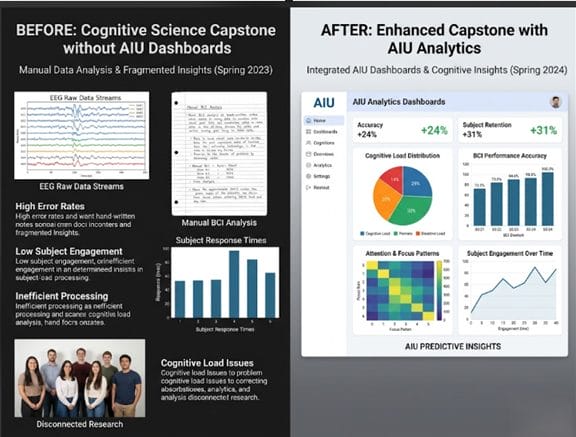
Cognitive Science Capstone without AIU Dashboards
The infographic compares a traditional, manual BCI research workflow with an AI-powered analytics model. The transition to an integrated digital dashboard delivers measurable improvements in accuracy, subject retention, data processing efficiency, and the quality of cognitive insights, while enhancing collaboration and engagement.
Research Projects & Innovation in Bachelors in Cognitive Science

Research Projects & Innovation are central in a Bachelor in Cognitive Science as they give students the practical skills of how to investigate human cognition using various approaches. Cognitive science incorporates concepts from neuroscience, cognitive psychology, brain science, psychology and cognition, and artificial intelligence among others to tackle the real-life problems facing humans. The process of undertaking a cognitive science bachelor degree is made up of research innovations in learning and memory, decision making, language processes, and intelligent systems.

The cognitive science degree provides learners with opportunities for applying theoretical knowledge through carrying out experiments, collecting data, and technological projects. Whether undertaking a conventional bachelor in cognitive science degree or online cognitive science degree, one will acquire critical skills. Online bachelor degrees in cognitive science also offer a convenient way of studying cognitive science.

The study of cognitive science gives students an opportunity to acquire all-rounded cognitive science education together with an organized cognitive science course. The graduates from cognitive science programs or online cognitive science degree are well equipped for careers in different fields such as research, technology, health care, among others.

  • MBM300 Thesis Proposal
  • MBM302 Bachelor Thesis (5,000 words)

Publication: Students pursuing Bachelors in Cognitive Science at AIU actively contribute to educational discourse through research projects, often resulting in publications in academic journals and conferences. These publications showcase their innovative approaches to teaching and learning, further solidifying AIU’s reputation as a leading institution for bachelor’s programs in Cognitive Science.

Learn Through Research & Innovation 

Unlock Your Potential

Dissertation & Thesis Defense

In the final stage of the Cognitive Science course at AIU, students are presented with a unique chance to demonstrate their proficiency and creativity through an extensive thesis proposal. This critical stage marks the culmination of their journey, providing a venue to delve into complex topics within the curriculum.

The thesis defense, a fundamental element of the program, enables students to exhibit their research abilities, analytical thinking, and literary knowledge, highlighting their preparedness to make significant contributions to the field after graduating from AIU.

Student Experience in Pursuing Bachelors in Cognitive Science

A student who chooses a degree in cognitive science will learn more about the mind, behavior, and technology because of the comprehensive, unique and unrepeatable nature of the cognitive science program. By studying cognitive science, the student will learn about neuroscience, psychology and cognition, artificial intelligence, and brain science to have a full comprehension of human cognition. 

Cognitive science program curriculum incorporates both theory and research to enable the student to use analytical skills to solve problems by studying the subject matter. In the study of the field of cognitive science, the student will be able to learn about cognitive psychology, learning and memory, among others. An online cognitive science degree or cognitive science degrees online can be taken into consideration. Students should choose the best degree, which is either a degree in cognitive science or a cognitive science bachelor’s degree.

Community & Social

The full online education program at AIU cultivates an energetic community environment using cutting-edge technologies and collaborative tools, ensuring a nurturing academic journey. Through platforms like the Virtual Campus, Mobile APP, MYAIU, AIULink, and AIUTV, students, faculty, and alumni unite, creating a network of interconnected minds. Engaging in thought-provoking symposiums, webinars, and conferences fosters a global perspective of general education and connections among the various community members.

Accessing the Merlin Media Center provides a wealth of academic resources while staying linked through AIULink, which ensures ongoing internet connectivity. The AIU Virtual Campus, APP compatible with Android and iOS, offers effortless access to programs, tools, information systems, and academic resources. These platforms facilitate sharing personal narratives, exploring holistic development, and contributing to the betterment of humanity, shaping an unparalleled AIU experience.

Live Classes

AIU introduces an innovative approach to virtual learning by incorporating dynamic live sessions twice daily. One can also access these live classes from the archive that hosts 100s of courses that can be combined to personalize a student’s academic journey. Led by seasoned faculty and experts from various industries, these sessions offer real-time discussions, interactive Q&A segments, and collaborative problem-solving, enriching your comprehension of the community. 

Participating in these sessions augments your expertise, equipping you to shape policies and refine your skills in Cognitive Science. AIU’s live classes promise intellectually engaging dialogues, up-to-the-minute industry perspectives, and individualized instructor feedback, guaranteeing a rewarding journey through the study of Cognitive Science. You can access 700+ live classes, 2000+ assignments and projects, 3400 mini courses free of cost as a Guest Student to learn new skills, new abilities, and earn certificates to grow and access new opportunities in your field of interest. In fact, one can earn up to $5000 credit towards their tuition fee by completing 5 Mini-courses and/or Live classes as a Guest Student

Feel free to glance through some of our recorded live sessions on different subjects.


Academic Resources

At AIU, the Virtual Campus is an innovative center equipped with more than 25 specialized tools, all geared towards supporting and empowering students throughout their educational endeavors. Our newest feature, the Virtual Reality 3D immersive experience, elevates community interaction and nurtures growth, motivation, and inspiration among our diverse student population. 

Also, AIU includes the leading Artificial intelligence (AI) tools such as ChatGPT, Dall-E and Midjoruney, PDF Executive Assistance, and Slide Generator, plus others, and is adding new AI tools to ensure students are fluent in this emerging trend and benefit from the boost in productivity they bring.

Within our extensive online library, comprising 260,000 books and 30 million peer-reviewed articles, alongside 105,000 resources co-curated by the AIU community, we establish an unmatched academic setting dedicated to fostering our students’ growth, development, and success.

Become a Leader in Cognitive Science 

Our Guest Student Access

Admission Requirements for Bachelors in Cognitive Science

The admission process for bachelor in cognitive science at AIU requires completion of high school or its equivalent, preferably with an excellent background in math, science and communication skills. When applying for bachelors in cognitive science – a student can be required to provide his academic transcripts, standardized test scores and a personal statement that outlines his passion in the field of human cognition and interdisciplinary learning.

A cognitive science program involves courses like psychology and cognition, neuroscience, artificial intelligence, linguistics and philosophy. When selecting potential students for a cognitive science bachelor’s degree or a cognitive science major, some institutions seek out students who exhibit analytical thinking, as well as curiosity in brain science, cognitive psychology, learning and memory.

Regardless of whether a student chooses a conventional or online cognitive science program, the degree program offers a full-fledged cognitive science course and education in a holistic and asynchronous way. The cognitive science degree, which includes a cognitive science degree online or online bachelors in cognitive science, equips its recipients with strong knowledge from the cognitive science course structure.

How Can You Apply for Bachelors in Cognitive Science?

To apply for the Bachelors in Cognitive Science at AIU, follow these steps:

  1. Visit the University Website: Navigate to the official AIU website to access the program details.
  2. Complete the Online Application: Fill out the application form with personal, academic, and contact information.
  3. Submit Required Documents: Provide transcripts, a resume, personal statement, and any additional documentation requested.
  4. Pay the Application Fee: Ensure the application fee is paid to complete the submission process.
  5. Interview: After reviewing your application, you may be contacted for an interview.
  6. Await Admission Decision: You’ll be notified via email about your admission status.

This process ensures a smooth application to the Cognitive Science degree program, preparing students for careers in Cognitive Science.

Financial Support & Scholarships

We’re excited to present an array of Bachelors in Cognitive Science full scholarships crafted for our students. Kindly share your details to unlock numerous Bachelors in Cognitive Science scholarship possibilities to bolster your academic endeavors. Allow us to aid you in reaching your educational aspirations and fostering your scholarly pursuits.

FAQs

What is a Bachelor's in Cognitive Science?

A Bachelor’s in Cognitive Science is an interdisciplinary degree that explores human cognition through psychology, neuroscience, artificial intelligence, linguistics, and philosophy, helping students understand how people think, learn, perceive, and decide.

What can you do with a Cognitive Science degree?

A Cognitive Science degree prepares graduates for careers in UX research, data analytics, educational technology, human-computer interaction, consulting, research, and AI-related fields that require understanding human behavior and cognition.

Is a Cognitive Science degree worth it?

Yes, a Cognitive Science degree offers versatile skills in research, problem-solving, data analysis, and human-centered design, making graduates valuable in growing industries including technology, healthcare, education, and artificial intelligence.

What jobs can I get with a Cognitive Science degree?

Graduates can pursue roles such as UX researcher, behavioral analyst, data analyst, human factors specialist, learning experience designer, market researcher, AI product associate, consultant, or research assistant.

Can I earn a Cognitive Science degree online?

Yes, many institutions offer an online Cognitive Science degree that provides flexible learning, accredited coursework, and practical projects, enabling students to gain career-relevant skills from virtually anywhere.

Let us know your goals and aspirations so we can chart a path at AIU to achieve them!
//
Admissions Counselor
Rene Cordon
Available
//
Admissions Counselor
Sandra Garcia-Fierro
Available
//
Admissions Counselor
Jessica Garcia
Available
//
Admissions Counselor
Juan Mejia
Available

"*" indicates required fields

This field is for validation purposes and should be left unchanged.
Name*

"*" indicates required fields

This field is for validation purposes and should be left unchanged.
Name*

"*" indicates required fields

This field is for validation purposes and should be left unchanged.
Name*

"*" indicates required fields

This field is for validation purposes and should be left unchanged.
Name*

"*" indicates required fields

This field is for validation purposes and should be left unchanged.
Name*

"*" indicates required fields

This field is for validation purposes and should be left unchanged.
Name*

"*" indicates required fields

This field is for validation purposes and should be left unchanged.
Name*

"*" indicates required fields

This field is for validation purposes and should be left unchanged.
Name*

"*" indicates required fields

This field is for validation purposes and should be left unchanged.
Name*

"*" indicates required fields

This field is for validation purposes and should be left unchanged.
Name*

"*" indicates required fields

This field is for validation purposes and should be left unchanged.
Name*

"*" indicates required fields

This field is for validation purposes and should be left unchanged.
Name*

"*" indicates required fields

This field is for validation purposes and should be left unchanged.
Name*

"*" indicates required fields

This field is for validation purposes and should be left unchanged.
Name*

"*" indicates required fields

This field is for validation purposes and should be left unchanged.
Name*

"*" indicates required fields

This field is for validation purposes and should be left unchanged.
Name*

"*" indicates required fields

This field is for validation purposes and should be left unchanged.
Name*

"*" indicates required fields

This field is for validation purposes and should be left unchanged.
Name*

"*" indicates required fields

This field is for validation purposes and should be left unchanged.
Name*

"*" indicates required fields

This field is for validation purposes and should be left unchanged.
Name*

"*" indicates required fields

This field is for validation purposes and should be left unchanged.

Submit your data.

After submitting, a widget will appear at the bottom-left corner so you can start your training.

Name*

Do you hate spam? Don’t worry, we hate them too. Your email is 100% secure with us.

"*" indicates required fields

This field is for validation purposes and should be left unchanged.

Submit the form below to begin your interview.

After submitting, a widget will appear at the bottom-left corner so you to start your AI interview.

Name*
Accepted file types: docx, pdf, Max. file size: 500 MB.

Do you hate spam? Don’t worry, we hate them too. Your email is 100% secure with us.