Skills Over Seals: How Industry Certifications Are Outpacing Traditional Accreditation
December 17, 2025 2025-12-17 6:41
In the modern workforce, a quiet revolution is unfolding — one that’s reshaping how employers evaluate talent and how individuals prove their expertise. For decades, the traditional path to attaining professional skills was dependent upon – degrees, diplomas, and institutional seals of approval and accreditation. However, the value of industry certifications has emerged as an important factor now.
From software engineering and cybersecurity to project management and marketing analytics, certifications are increasingly viewed not as alternatives to formal education, but as more relevant, practical, and agile indicators of skill. The global job market is shifting toward a model where what you can do often outweighs where you went to school.
The Erosion of Academic Exclusivity
For much of the 20th century, universities held a near-monopoly on career development. Degrees were seen as the gold standard – offering both theoretical knowledge and a recognizable credential. But several forces have played a role to change that. The most important of them all is the cost of higher education which left graduates burdened with debt and uncertain job prospects. Again, rapid technological change due to continuous emergence of innovation led to confusion and uncertainty among professionals to decide which path to choose. In fact, curriculums at traditional institutions are struggling to keep pace with the speed of innovation. By the time a syllabus is updated, entire technologies or frameworks may already be obsolete – resulting in ambiguity among students.
Here, it must be mentioned that even employers now increasingly prioritize demonstrable competencies over credentials. In fast-moving sectors like – tech, data science, and digital marketing, hiring managers often care more about what tools you’ve mastered than about your alma mater. As a result, degrees are slowly losing power to certifications, designed by and for industries that are filling that gap.
Certifications as the New Competence Currency
Now, the value of industry certifications offers a compelling proposition – targeted, skills over accreditation, and often stackable credentials that demonstrate proficiency in real-world applications. For example, in the tech industry a computer science degree provides a foundation, but certifications like – AWS Certified Solutions Architect, Google Cloud Professional Engineer, or CompTIA Security+ show that an individual can operate directly within a given technological ecosystem. Similarly, in digital marketing a recruiter relies on certifications from Google, HubSpot, or Meta for the preliminary screening process before conducting an interview. This is effective to analyze if the candidate has knowledge related to evolving tools and strategies.
These certifications do something that traditional degrees rarely can:
- Signal immediate job readiness
- Keep pace with industry evolution
- Offer flexibility and accessibility
The agility of certification programs is particularly significant. While universities may take years to approve and implement new curricula – certification bodies can update their standards in real time – responding to shifts in market demand or technology trends within months.
The Democratization of Expertise
Perhaps the most transformative aspect of certifications is how they democratize access to opportunity due to cost, geography, or time constraints. On the other hand, online certification programs are less expensive, more flexible and allow learners to upskill from anywhere in the world.
Courses and certification programs in partnership with major tech firms, have further reduced the boundaries between formal and informal learning. Hence, a learner in Nairobi can earn a Google Data Analytics Professional Certificate alongside a peer in New York, both acquiring skills that are directly applicable to global job markets. This makes the world connected and inclusive.
Further, this has also empowered career switchers. A former teacher can pivot into UX design; a logistics coordinator can become a data analyst. Certifications provide a structured, affordable pathway to entirely new careers and how certifications impact career growth is something that universities cannot deny.
Employers Are Rewriting the Rules
The focus is on competence over mere credentials. According to secondary research, a growing number of employers have dropped degree requirements for technical and operational roles – focusing instead on validated skills. Tech giants like – Google, IBM, and Tesla have been vocal about this shift. Google’s “Career Certificates” program explicitly markets itself as a degree alternative, while IBM has integrated certifications into its hiring and promotion frameworks.
Even sectors once seen as traditional such as – finance and healthcare are embracing this shift. Fintech firms now prefer candidates with CFA, FRM, or blockchain certifications over those with purely academic backgrounds. In healthcare IT too certifications like – Epic Systems or HL7 are seen as essential for practical implementation.
However, with the rise of certifications comes challenges. Employers must choose from meaningful, industry-backed certifications. Hence, a blend of theoretical foundation and practical certifications is ideal for the job market. Again, it must be remembered that certifications require regular renewal to stay valid – reflecting the ever-changing nature of technology and best practices. While this ensures ongoing competence, it can also create a perpetual cycle of recertification which might appear as a problem for some professionals.
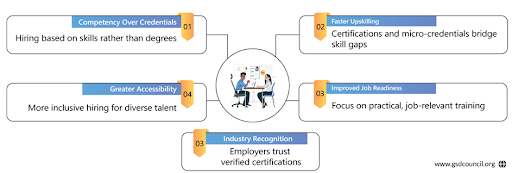
Key benefits of skill-based hiring
Source: gsdcouncil.org
The Hybrid Future of Credentialing
Rather than viewing degrees and certifications as rivals, the future likely lies in a hybrid model that integrates both. Hence, universities around the world are offering micro-credentials and partnerships with certification providers – embedding industry-recognized courses within degree programs. Again, employers are building skills-based frameworks that value learning as a continuous process rather than a one-time milestone.
According to secondary research, the World Economic Forum predicts that by 2030 – over 50% of employees will need reskilling. This shift aligns with the broader focus towards lifelong learning – where professionals are expected to continuously evolve alongside their industries.
Conclusion: From Prestige to Proof
We’re entering a world where skills over accreditation are the true basis of employability. The prestige of an academic seal is no longer enough – it must be accompanied by tangible proof of capability. Certifications are leading this transformation, creating a meritocratic system where opportunity is tied not to privilege or pedigree, but to demonstrated skill. In an age defined by disruption, the most valuable credential isn’t framed on a wall — it’s the one that keeps pace with change.
Author Bio

Kathakali Basu is a dynamic Content Strategist and Brand Communication expert at Atlantic International University, with a knack for transforming ideas into compelling narratives. With a Masters in Sociology and certification in Content Marketing, Kathakali expertly crafts strategies that elevate brands and captivate audiences. Her extensive experience in content writing and strategy has helped numerous businesses articulate their vision and connect meaningfully with their target market. Passionate about blending creativity with data-driven insights, Kathakali thrives on creating impactful content for the last 16+ years that not only resonates but drives results.
An animal lover and believer in inclusivity, she actively participates in animal rescues and rehoming. When she’s not strategizing, you’ll find her exploring the latest trends in digital marketing or indulging in reading and her love for storytelling.