How Do Online Classes Work? A Complete Guide with 10 Proven Tips for Success
June 12, 2026 2026-06-12 6:54
In This Article:
- Understanding How Online Classes and Courses Work
- Real-World Stats on Effectiveness:
- Top 10 Online Learning Tips or Distance Learning Tips
- 1. A productive learning environment
- 2. Effective time management
- 3. Active engagement while learning
- 4. Purpose-based learning
- 5. Academic freedom and open curriculum
- 6. Technically prepared and organized
- 7. Real-world application of the learning
- 8. Andragogy is the key
- 9. Support from mentors and academic advisors
- 10. Planned schedule with regular reflection
- Studying Online Successfully: The Long-Term Edge
Education is no longer an uncommon choice; it has become mainstream. There are millions of individuals all over the globe enrolling in universities, certification courses, and skills training to enhance their knowledge in the digital age. The growing questions are around the actual operation of the classes offered online or how do online classes work? It concerns working adults when it comes to improving their knowledge. Additionally, it is essential to examine why some learners succeed while others fail.
Institutes such as Atlantic International University (AIU) provide online learning, which goes beyond watching lectures and doing assignments. Learning strategies such as Andragogy – defined as adult learning, and the study of the methods used therein – are applied due to the recognition that adults have experience, a professional setting and intrinsic motivation for learning. Purpose-based learning, open curriculum, academic freedom and focus on practicality rather than theoretical knowledge make this type of learning unique.
Understanding How Online Classes and Courses Work
Online learning, also known as virtual classroom learning or distance learning, involves offering educational programs through the internet. These could be totally asynchronous (self-paced), totally synchronous (real-time learning) or a mixture.
The following components should be part of online education:
- Management Learning Systems (MDS) such as Canvas, Moodle, etc. This is your virtual university where you have syllabi, video lectures, textbooks, forums, and submission areas.
- Courses that involve watching videos, interactive classes, textbooks, podcasts, and simulations. The innovative courses at universities would involve projects that are relevant to your future career or goals.
- Asynchronous forums, webinar classes (Zoom etc.), collaborations on group projects with the help of Google workspace or Microsoft Teams, and individual consultations.
- Quizzes, papers, portfolios, peer assessment projects, capstone projects, or skill demonstration assignments. In AIU-style programs, the emphasis is on application of skills like implementation of a business plan or community project rather than exam scores.
- Help desk services, academic advising, tutoring services, and career services offered remotely.
How Online Courses Work Day-to-Day: Online classes for students offer login options anytime that suits you well (one of the main features that attract working adults or individuals). An ordinary week will entail watching modules, participating in class forums, doing reading assignments, and engaging in projects. Although there will be deadlines, there is much flexibility to allow you to study at 6 AM or 10 PM.
Real-World Stats on Effectiveness:
- According to a meta-analysis conducted by the Department of Education, USA, students tend to fare slightly better in online classes due to the personalized approach and instant feedback.
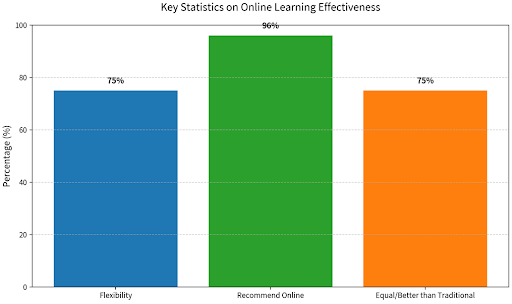
- 75% of online students view flexibility to balance jobs, family life, and academics as the major strength of online learning.
- Out of 96% of graduates who would recommend online programs, 75% believe it is as good or even better than the traditional mode of education.
- Creating self-directed and relevant online programs could help increase retention and completion rates, which are characteristics of andragogy.
What distinguishes the online university from others is its philosophical perspective. Instead of a fixed and rigid curriculum, an open curriculum provides the flexibility of choice to the learners. The concept of academic freedom inspires students to question and investigate their interests. The purpose-driven approach helps connect learning objectives to the missions of learners such as improving sustainability or innovations in technology.
Experiment, Reflect, and Adjust with Online Learning
Top 10 Online Learning Tips or Distance Learning Tips
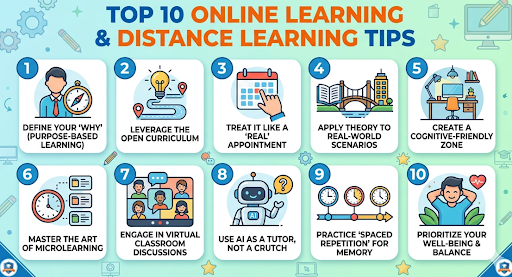
Online learners who perform well have discipline, planning, and proactivity. The ten strategies below, which are based on real-world experiences of students, research findings, and best practices in learning in virtual classrooms, can guide online students to do exceptionally well in their online courses.
1. A productive learning environment
Create a conducive study environment since successful online students set aside specific areas where there is sufficient light, minimum disturbances, constant internet connection, and all other tools that might be required. Many people living in noisy cities like Bangalore employ noise-cancelling earphones to keep themselves focused throughout the virtual classroom period.
2. Effective time management
Learn effective time management with a focus because successful online learners have effective time management strategies. They set up structured weekly plans according to their highest energy periods and other personal engagements. Online education deserves to be taken seriously just like any other form of education; hence, they break down major assignments into small daily assignments and allocate 10-15 hours per week per course.
3. Active engagement while learning
Active engagement is important where learners are active participants in online discussions, join online classes, and create virtual study groups. This kind of involvement reduces feelings of loneliness associated with distance learning and encourages collaboration – thus boosting both satisfaction and information retention.
4. Purpose-based learning
Instead of merely doing assignments for the sake of getting credits, learners should integrate their education with their own purposes and goals. In other words, successful students link course content to their larger purposes and life goals – an approach that forms the basis of andragogy.
5. Academic freedom and open curriculum
Learners who enjoy flexible curriculums may fully benefit from the opportunity by choosing the subjects that interest them and undertaking relevant projects through tools like curriculum builder tools. Professionals often complete capstone projects that help solve problems within their organizations, instead of producing purely theoretical essays.
6. Technically prepared and organized
Stay technologically savvy and organized since good learners do all these things ahead of time and stay systematically organized with their technology tools, such as microphone, camera, and sufficient bandwidth. They make use of two screens to maximize their efficiency while taking part in online courses.
7. Real-world application of the learning
Focus on applying theories to the real world rather than only mastering the theory. The best learners put into practice what they learn in the professional or personal world. For example, the student majoring in management would start implementing newly acquired management skills at work and then record results in their assignment. In modern progressive universities, this technique speeds up the process of acquiring new knowledge and skills.
8. Andragogy is the key
Develop self-directed study skills, something that is very important for adult learners since they need to take responsibility for their own learning. It means having a list of goals for themselves, searching for additional materials, and assessing oneself. Life experience helps in doing so.
9. Support from mentors and academic advisors
It is advisable to seek help early enough from lecturers, academic advisors, and other students whenever faced with difficulties in studies. Open curricula have academic advisors who mentor individualized learning experiences that correspond highly with greater chances of course completion.
10. Planned schedule with regular reflection
Additionally, disciplined learners maintain their welfare through planning for breaks, exercise, and off-line activities to avoid burnout. Learners also participate in reflective practice on a weekly basis by considering the techniques they use, making necessary changes, and assessing their relevance to their ultimate goal in the process. It is clear that self-disciplined individuals build self-efficacy and success in virtual learning environments.
Learners who adopt all the online learning tips become excellent self-disciplined individuals, skilled at using computers, and equipped with practical skills in solving problems. Through purposeful learning, academic freedom, and application of the acquired knowledge, these learners will succeed both academically and professionally.
Studying Online Successfully: The Long-Term Edge
Such tips for taking online classes help graduates who have mastered excellent self-discipline, digital literacy skills, and synthesis of information – assets that are highly valued in today’s job market. Such is the case at AIU where education takes place through a partnership in which the individual student’s experience is paramount and the learning goal driven.
If you’re a professional planning to upgrade yourself or an adult with a passion for a new career – online classroom learning provides unmatched opportunities. Choose one or two tips and try them out this week. There is no shortage of learning tools at hand – the rest depends on how you wield them.
Is Your Degree Actually Preparing You for the Future?
FAQs-
Q. How is an online classroom typically structured?
An online classroom revolves around a learning management system featuring – modules, video lectures, discussion forums, assignments, and live sessions for interactive learning and a great experience.
Q. What are some challenges of online learning?
Common challenges are with self-discipline, technical issues, isolation, time management, and staying motivated without a traditional classroom environment or a fellow student to physically communicate.
Q. How do I communicate with instructors online?
Students can communicate with instructors through email, scheduled video calls, discussion forums, chat features, and virtual office hours within the LMS platform.
Q. Do Online Classes Have In-Person Components?
Although online classes have no in-person requirements, some hybrid programs include occasional campus visits or proctored exams.
Q. What Should Students Know Before Enrolling in an Online Course?
Students should understand the program’s flexibility, technology requirements, time commitment, and whether it supports purpose-based, self-directed learning like andragogy.
Author Bio

Kathakali Basu is a dynamic Content Strategist and Brand Communication expert at Atlantic International University, with a knack for transforming ideas into compelling narratives. With a Masters in Sociology and certification in Content Marketing, Kathakali expertly crafts strategies that elevate brands and captivate audiences. Her extensive experience in content writing and strategy has helped numerous businesses articulate their vision and connect meaningfully with their target market. Passionate about blending creativity with data-driven insights, Kathakali thrives on creating impactful content for the last 16+ years that not only resonates but drives results.
An animal lover and believer in inclusivity, she actively participates in animal rescues and rehoming. When she’s not strategizing, you’ll find her exploring the latest trends in digital marketing or indulging in reading and her love for storytelling.