- RESEARCHDistance Learning at AIU is enhanced by vast academic resources and innovative technologies build into the Virtual Campus: Hundreds of self-paced courses with video lectures and step by step lessons, thousands of optional assignments, 140,000 e-books, the Social Media & Networking platform allowing collaboration/chat/communications between students, and MYAIU develop students holistically in 11 areas beyond just academics.
- PROGRAMS OFFERED
- Areas of Study
- Courses and Curriculum
- Open Courses
- Register for a Program
- Associate Program
- Associate in Addiction Counseling
- Associate in Agriculture Food And Resources
- Associate in Anti Terrorism Security
- Associate in Behavior Analysis In Special Education
- Associate in Bioethics
- Associate in Climatology
- Associate in Cultural Theological Communication
- Associate in Culinary Arts
- Associate in Ecotechnology
- View all Associates Programs
- Bachelor Program
- Bachelors in Community Development
- Bachelors in Environmental Science
- Bachelor in Education (B.Ed, BS)
- Bachelors in Economics
- Bachelors in Entrepreneurship
- Bachelors in Financial Administration
- Bachelors in Human Resource Management
- Bachelors in Linguistics
- Bachelors in Nutritional Science
- Bachelors in Occupational Health and Safety
- Bachelors in Psychology
- View all Bachelor Programs
- Doctorate Program
- Doctor | of Biology (PhD)
- Doctorate in Business Administration (DBA, PhD)
- Doctor of Economics (PhD)
- Doctor of Electrical Engineering (D.Sc, PhD)
- Doctor of Finance (PhD)
- Doctorate in International Relations
- Doctorate in Information Technology (D.Sc)
- Doctor of Legal Studies (PhD)
- Doctor of Project Management (PhD)
- Doctor of Sociology (PhD, D.Sc)
- Doctorate in Sustainable Natural Resources Management
- View all Doctorate Programs
- Master Program
- Postdoctoral Program
- Postdoctoral in Animal Science
- Postdoctoral in Anti Terrorism Security
- Postdoctoral in Behavior Analysis In Special Education
- Postdoctoral in Bioethics
- Postdoctoral in Blockchain Technology and Digital Currency
- Postdoctoral in Business Management
- Postdoctoral in Cloud Computing
- Postdoctoral in Computer Engineering
- View all Postdoctoral Programs
AIU offers a wide range of majors in areas including the Arts, Business, Science, Technology, Social, and Human studies. More than 120 degrees and programs are available for adult learners at the associate’s, bachelor’s, master’s, doctoral and postdoctoral level. - VIRTUAL CAMPUS
Distance Learning at AIU is enhanced by vast academic resources and innovative technologies build into the Virtual Campus: Hundreds of self-paced courses with video lectures and step by step lessons, thousands of optional assignments, 140,000 e-books, the Social Media & Networking platform allowing collaboration/chat/communications between students, and MYAIU develop students holistically in 11 areas beyond just academics.
- ALUMNI
The world is YOUR campus!”, that is the message of AIU’s month magazine Campus Mundi. Hear the voices and see the faces that make up AIU. Campus Mundi brings the world of AIU to you every months with inspirational stories, news and achievements by AIU members from around the world (students and staff are located in over 200 countries).

AI in Chip Design

Why is balancing cost, power use, and performance such a serious challenge in microchip design, and how will trade-offs vary by industry sector (eg: healthcare vs. consumer electronics)?
If chip design in principle can come with an infinite number of permutations, what strategies, techniques or technologies (like AI or simulation tools) could engineers use to help themselves manage this in a better way?
Microchips often also must be designed for specificity in environments such as space, deep oceans, and medical implants. What challenges do you think are unique to their respective environments, considering performance and reliability?
To complete your next assignment, write an essay which answers the following questions: What does the video communicate about nature and animal behavior? Do you think such videos have the potential to change our view of wildlife? Why is it necessary to verify the authenticity of viral videos, before believing or sharing them? Give examples to support your answers, and present an introduction, body and conclusion in your essay.
(Login to your student section to access the AIU Additional Resources Library.)
AI in Chip Design: How Artificial Intelligence Is Transforming the Future of Semiconductors?
It’s 2028, and you’ve just launched a tech startup that, in all likelihood, has a concept so audacious it could completely upend the industry. With its potential to change how technologies are integrated into people’s lives, the only thing holding you back from launching is the need for a custom-designed microchip — a microchip elevated specifically to support your innovation.
Until only a few years ago, given the scope of this complex evolution, commissioning a custom-designed microchip would almost certainly be unfeasible. In fact, microchip design in 2023 or earlier meant pouring hundreds of millions of dollars (even billions) into developing it with the advanced inventiveness of a few select teams of elite engineers and access to some of the most revered semiconductor foundries in the world. The cost of simply developing a prototype custom chip would have cost most startups well more than their entire company valuation, effectively locking out practically all other innovators from the semiconductor sector, and leaving chip design tethered to multi-nation companies with superiority of capital investment.
However, the world looks very different today. In 2028, your team can initiate and develop an advanced chip from the ground up, in a fraction of the time and expense, and now it is driven largely by artificial intelligence (AI). AI has completely altered how we design chips: quickly, affordably, and with greater precision. The chips we are using to commercialize our startup’s technology foundation are built on chips designed by artificial intelligence — and created a brilliant cycle where AI propels its own evolution, improving the hardware computing platform upon which it sits.
This loop of feedback — AI learning to design chips which produce fundamentally better AI — is just one form of revolutionizing an entire technological advance the likes of which we haven’t seen this magnitude since the invention of the Internet. It is more than an increase in efficiency — it is a paradigm shift in innovation. The future of custom chip design is simplifying timelines and costs that will democratize accessibility to chip design, therefore enabling startups, researchers and even small independent groups of innovators to universally compete in an environment that was once reserved solely for the largest technology companies in the world.

The Basics: What are Microchips?
Microchips, or Integrated Circuits (ICs), are the basic building blocks of modern computing. Microchips are small but powerful, they are fabricated by combining transistors and other small components into a piece of silicon. When components are combined, there are pathways for instructions to be processed, transferred and stored. Microchips can be found in everything from cellphones to satellites.
Why Chip Design is Important?
Chip design is far more than an engineering problem. The specifications and design can dictate how the device will work. The specifications of the chip can dictate:
Speed and Efficiency: The quicker the chips are, the more powerful the devices have to do big and complex tasks.
Environmental Compatibility: Chips are designed to work in the conditions they are intended to be employed in. For example: sensors that are put into cars have to work in heat and cold.
Cost, Power and Performance Balance: Designers have to balance what the chip can and cannot do based on the level of performance that has to be achieved at a reasonably low cost and use of power.
The Unfathomable Complexity of Chip Design
Designing a microchip is one of the most sophisticated undertakings we currently face in mass-produced technology. Each chip can have millions or billions of transistors and components, and deciding how they will be assembled, connected, or optimized is almost incomprehensible with so many configurations. When engineers refer to the permutations of a single chip layout, they often compare them to the number of atoms in the universe, which highlights the basis of understanding the huge challenge of chip design.
Where We’ve been: Hand Drawn Circuits to Automation
The earliest microchips in the 1950s and 60s were hand drawn circuits. By the late 1960s, engineers began to leverage solutions to automate pieces of the process when EDA made an entrance.
Thanks to EDA tools engineers have been capable of:
- Simulating designs in software prior to the manufacturing of a prototype.
- Absolute risk reduction by not having to design a prototype (the cost of one is well into the billions).
- Efficiently testing multiple variations.
As Rob Knoth from Cadence notes:
“In the semiconductor industry we aim to simulate 99% of the design in software…and then — when we write that billion-dollar check — the chip is going to work the first time.”
Yet, despite these advances, designers were still limited by their traditional design methods. Engineers could only test a few layouts at a time and jumped to “good enough” designs without achieving an optimal design.
Where We are: AI as a Chip Designer
Today in chip design we are now utilizing AI to fundamentally shift the horizon. Companies like Synopsys, Cadence, and Nvidia are tapping into AI, especially reinforcement learning, to evaluate and dramatically expand the number of chip design permutations at rates unattainable by human beings.
Reinforcement learning, the same approach that powered DeepMind game playing AlphaZero, enables AI to do the following:
- Explore millions of permutations in chip designs.
- Earning “rewards” based on improvements in efficiency, power consumption, or performance.
- Evolve into a near expert chip designer in a few or hours or a couple days.
Nvidia’s chief scientist Bill Dally goes on to say the following:
“AI is already doing some parts of the design process better than people… Sometimes, the AI comes up with completely bizarre ideas that actually work because it thinks outside of the way people do.”
In summary, we are applying AI to the combination of engineers and AI to produce chips that not only work but are optimized chips for speed, efficiency and sustainability.
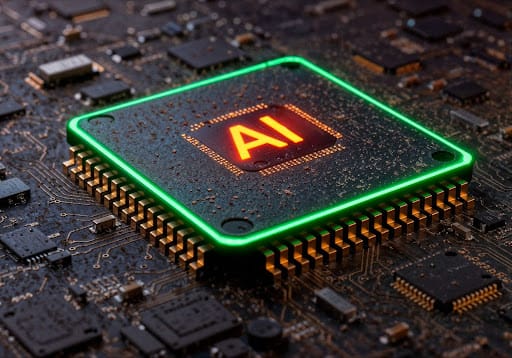
The Urgency: Why AI-Based Design is Important Now
The AI boom itself is partly responsible for this growing demand for better chips:
- AI training and deployment (massive data centers).
- Autonomous vehicles require ultra-fast and reliable processing needs.
- Robotics and IoT devices are ultra-low power demand.
Energy efficiency is becoming more important. Data center energy usage is expected to increase 160% by 2030, and much of this is due to AI workloads. Smarter, AI designed chips could reduce energy consumption significantly.
Rob Knoth brought that point home saying:
“The power consumption of data centers is directly dependent upon the power consumption of the integrated circuits that we’re making … AI itself can help us build better chips and better data centers.”
Where We Are Headed: Generative AI in Chip Design
Reinforcement learning is just the tip of the iceberg. Generative AI (GenAI), from the same class of models as ChatGPT, is being layered into EDA workflows now too.
Synopsys.ai Copilot
In 2023 Synopsys launched Copilot which is a generative AI assistant that will enable engineers to interface with chip design tools using natural language. This development provides a more inclusive way to streamline chip design, while also accelerating onboarding in an industry that suffers major demands for talent.
Cadence’s ChipGPT
Cadence has introduced ChipGPT, which is a proof-of-concept LLM that reviews early chip designs, checks them against specifications, and provides feedback for design improvements – all in natural English. Early users, such as Renesa, have reported ChipGPT helped dramatically reduce the total time from specifications to final design.
Google DeepMind’s AlphaChip
DeepMind’s AlphaChip is another step forward. It is available as open-source software and already shown to outdo expert human designers in basic floorplanning with Google’s own Tensor Processing Units (TPUs).
The promise of open-source software for chip design could democratize the design process, enabling start-ups and smaller innovators to produce world-class chips without billion-dollar budgets.
The Foundations: What are Microchips, Really?
Microchips, also known as integrated circuits (ICs), are the backbone of modern computing. These tiny, yet mighty devices are constructed by embedding, onto a wafer of silicon, transistors and other minuscule components. Each component creates a pathway that enables the processing, transferring and storing of information. Microchips are powering everything from smartphones to satellites.
Why Chip Design Matters
The design of a chip is not just an engineering problem, it determines the overall potential of a device. Once you have the blueprints of a chip, you define:
Successive Speed and Efficiency: The evolution of chip development means a faster design produces a faster chip, and a more powerful device that handles complex problems with ease.
Environmental Specificity: Chips, and their associated specs, need to be tailored around the conditions in which they operate, such as automotive sensors needing to operate seamlessly in heat and in freezing temperatures.
Managing the cost, power, and performance generation to generation: How to ensure the performance is there but we never get too expensive nor consume too much energy.
The Enormous Complexity of Chip Design
The process of microchip design is one of the most complex things ever done in technology. Each chip can have millions…even billions of transistors and components. Of course, a big part of determining how these components should be arranged, connected, optimized, etc., is driven by an astronomical number of possible ways to accomplish this. In fact, when modeling all of the possible arrangements of a single chip, it is even often compared to the number of atoms in the universe as a reminder of the sometimes maddening complexity of the design process.
Conclusion: AI Designing the Brains of the Future
From hand-drawn circuits to reinforcement learning and generative AI, chip design has become a first principle use case for AI.
In the next several years, AI will be designing the chips that power our apps, cars, and robots, as well as being part of a self-reinforcing loop to democratize innovation, offer lower energy consumption, and accelerate innovation everywhere.
The startup in 2028 that designs its own custom chip today may be just the beginning. The real revolution is how mankind now has the tools to rethink the foundations of modern technology.
At Atlantic International University (AIU), we believe the future will fundamentally belong to a generation of individuals that can leverage new technologies and apply technology for a greater purpose. Our learning model allows you to explore cutting-edge fields that are at, or even near, the forefront of human exploration – examples include AI, microchip design, innovations and emerging technology, while at the same time developing a curriculum that enables you to achieve specific goals.
We invite you to join AIU today and become part of a generation that will ultimately redefine the future of technology, innovation, and human development.
- Bachelors in Electronic Engineering
- AIU Reshaping AI
- Microelectronics and Semiconductors
- Engineering Research
- Two Decades of Innovation
- Wireless Networks
- Masters in Information Technology
- Join AIU
References
Reminder to our Dear Students,
Please ensure you are logged in as a student on the AIU platform and logged into the AIU Online
Library before accessing course links. This step is crucial for uninterrupted access to your learning
resources.
AIU Success Stories







Contact Us Today!
Begin Your Journey!
AIU’s Summer of Innovation and Growth gives you the ability to earn up to $5000 in tuition credit by completing free lessons and courses.
Whether you’re looking to acquire new skills, advance your career, or simply explore new interests, AIU is your gateway to a world of opportunities. With free access to 3400 lessons and hundreds of courses the ability to earn credits and earn certificates there’s no better time to start learning.
Join us today as a Guest Student and take the first step towards a brighter, more empowered future.
Explore. Learn. Achieve.