vitality, and growth; the other – stillness, silence, and decay. But what if this boundary isn’t as fixed as we once believed! What if death doesn’t always bring an end – but instead gives rise to something new – something that occupies a strange “third state” beyond life and death!
More than a poetic metaphor – it is a real and rapidly evolving area of science that is shaking up biology, medicine, and our very understanding of what it means to be alive.
Redefining Life and Death
Traditionally – scientists have defined death as the irreversible cessation of all biological functions within an organism. Yet organ donation, tissue transplants, and cellular studies have indicated that life lingers within the body long after death of an individual. A heart can beat outside the body. Corneal tissue can restore sight days after a donor has passed away. Bone marrow can generate blood for years in a recipient’s body.
These examples reveal that “death” is not absolute but layered—some systems collapse quickly, while others quietly persist. And under the right conditions, these surviving cells don’t just endure—they can reorganize and even create something entirely novel.
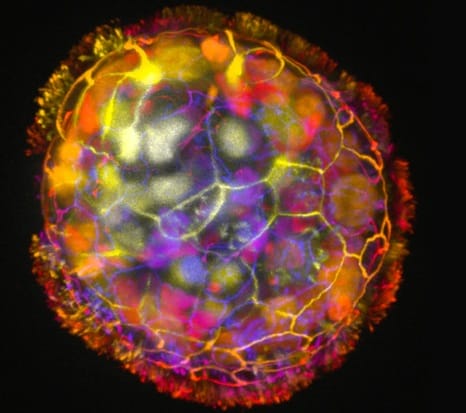
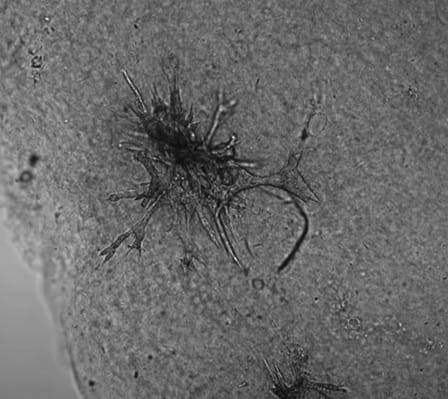
The most striking examples of this third state is that from experiments with frog embryo skin cells. Removed from their original environment and cultured in a petri dish, these cells spontaneously assembled into multicellular organisms dubbed xenobots.
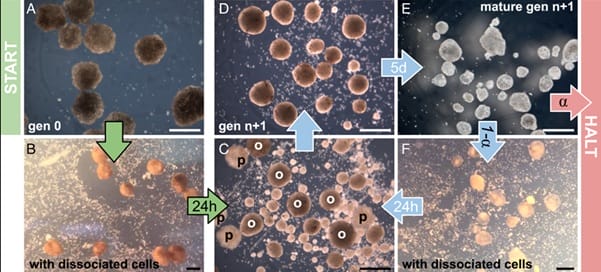
According to secondary research, unlike their origins would suggest, xenobots don’t simply act like frog skin. Instead, they develop new behaviors and structures. They use hair-like cilia to swim and navigate, heal wounds, and interact with their environment. Incredibly, xenobots can perform kinematic self-replication – not by dividing like normal cells, but by pushing loose cells together until they form a new xenobot.
Even more astonishing, human cells have shown similar abilities. Researchers discovered that lung cells could self-organize into anthrobots – tiny multicellular clusters capable of movement, self-repair, and even healing nearby neuron damage. These structures, born from death, defy biology’s usual playbook.
The fact that life continues even after death depends on several factors such as –
- Some cells like white blood cells – survive only a few days. Others – such as fibroblasts can be cultured weeks after death. Cells with lower energy requirements generally outlast those with high metabolic demands.
- Preservation techniques like cryopreservation extend cellular function far beyond natural limits – keeping tissues viable for transplants.
- Surprisingly, certain genes become more active after death. Stress-response and immune-related genes “switch on,” as if cells are fighting to stabilize themselves despite the collapse of the larger organism.
- Trauma, infection, temperature, and even the age and health of the deceased organism all shape postmortem survival.
According to secondary research, some scientists believe that these cells persist and adapt because of the bioelectric circuits embedded in their membranes. These microscopic pumps and channels act like wiring – allowing cells to communicate, coordinate, and reorganize even outside their original context.
The idea of a third state is not just philosophically provocative – it may also unlock new medical frontiers.
Anthrobots, for instance, could one day be designed from a patient’s own cells to deliver targeted drugs, dissolve arterial plaque, or clear mucus from diseased lungs. Because they originate from the patient, hence, wouldn’t trigger immune rejection. However, unlike cancerous growths – the degradation happens naturally after several weeks which acts as a safety mechanism.
Now, it is important to understand – how cells adapt after death to improve – organ transplantation, regenerative medicine, and even cancer therapies. In fact, researchers can harness this to design living tools that can – repair tissues, regenerate organs, or combat degenerative diseases.
Philosophical and Evolutionary Questions
At its heart, the third state forces us to rethink some of biology’s most fundamental assumptions. Life, it turns out, doesn’t have to follow predetermined developmental pathways. Death isn’t always a biological dead end. Instead, it may create new opportunities for transformation.
This raises profound questions:
- Should these postmortem organisms be considered alive?
- Are they entirely new entities, or extensions of their original hosts?
- Could death itself play a hidden role in evolution, offering raw material for entirely novel forms of life?
The answers remain elusive. But one thing is clear – the boundary between life and death is far blurrier and far more fascinating than we ever imagined.
The Future of Possibility
As research advances – we may begin to see a future where death no longer means finality but metamorphosis. In medicine – this could mean patient-specific therapies built from their own cells after death. In philosophy – it may reshape our concepts of identity and mortality.
Xenobots and anthrobots are more than scientific curiosities; they are windows into life’s hidden potential. They show that cells – even outside their original purpose can create structures and behaviors beyond anything we imagined. In doing so, they remind us that biology is not just a system of rules but a vast landscape of possibilities.