Bachelor in Anti Terrorism Security

School of Social and Human Studies

Academic Freedom to Discover Your Purpose

Open Curriculum Design at Atlantic International University

Bachelor in Anti-Terrorism Security is an advanced academic degree that aims to equip students to face modern problems of national security, safety and protection from possible threats. This anti-terrorism security degree curriculum includes topics such as counter terrorism, homeland security, intelligence studies, security assessments, crisis management, emergency planning and security management. An anti-terrorism degree such as Associate in Anti-Terrorism Security may also be called anti-terrorism studies degree, security and terrorism degree, counter-terrorism degree, or bachelor of security studies degree.

This anti-terrorism program becomes extremely important for today’s society because of the increased need for security services by governments, businesses and critical infrastructure facilities. Homeland security bachelor’s degree or security management degree will provide a basis for effective leadership within the security field.

Online bachelor in anti-terrorism security provides a very convenient education system for students and professionals who want to be able to balance their education and other obligations. An online anti-terrorism security degree gives individuals an opportunity to complete their coursework anytime while gaining industry knowledge.

AI and advanced analytics have become increasingly important in terrorism and security studies. With the help of modern technologies, it is possible to detect threats, make forecasts and decisions based on real-time analysis. Students of anti-terrorism security who decide to work in this sphere will be offered plenty of job positions related to anti-terrorism security degree and homeland security careers.

Important: Below you’ll find a summary and basic overview of the subjects and fields you can delve into and engage with throughout the course of your academic journey. It’s important to note that this list is neither exhaustive nor mandatory, as the graduate school and professional programs here at AIU might differ from conventional curriculum. Its main purpose is to serve as a guiding and visual aid. Are you interested in diving deeper into the curriculum framework at AIU?

Bachelor in Anti-Terrorism Security Industry Growth & Global Impact

A bachelor in anti-terrorism security at Atlantic International University (AIU) prepares students for leadership roles in national security, intelligence, and risk management. As global threats become more sophisticated, demand for professionals with an anti-terrorism security degree, counter terrorism degree, homeland security bachelor’s degree, and security management degree continues to rise.

The integration of Artificial Intelligence (AI) into counter terrorism, homeland security, and security operations is transforming the industry. Recent studies show that 79% of organizations already use AI in production environments, while 30% of security teams have integrated AI-powered security tools to improve threat detection and response.

The field of anti-terrorism and homeland security is rapidly evolving with emerging technologies that shift operations from reactive defense to proactive, intelligence-driven prevention.

Key technologies include:
  • Quantum Machine Learning & Computing: Enables ultra-fast pattern recognition in massive datasets for detecting complex terrorist networks and financial flows.
  • Edge Computing & Neuromorphic Systems: Supports real-time processing in distributed surveillance networks, drones, and IoT sensors at borders or critical infrastructure.
  • Federated Learning & Explainable AI (XAI): Allows secure, privacy-preserving collaboration across agencies while providing transparent decision-making for legal and ethical compliance.
  • Autonomous Systems & Biotechnology: Includes AI-powered drones, robotics for hazardous response, and advanced biometrics for threat identification.
  • Advanced Sensing & Digital Identity Technologies: Enhances border security, cargo screening, and real-time risk assessment.

These technologies are central to DHS’s Innovation, Research & Development Strategic Plan (FY24-30), focusing on AI, autonomous systems, cybersecurity, and data integration.
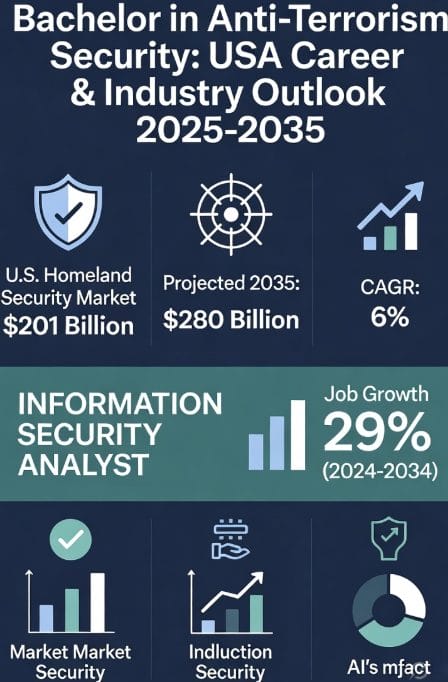
Bachelor in anti-terrorism security USA career & industry outlook 2025–2035
The infographic highlights a strong career outlook for Anti-Terrorism Security graduates, driven by projected growth in the U.S. homeland security market and rising demand for security professionals. It emphasizes expanding opportunities in cybersecurity, homeland security, and specialized security sectors, supported by robust industry growth through 2035.
Trends, Insights & Predictive Analytics for a Bachelor’s in Anti-Terrorism Security

AI is fundamentally transforming anti-terrorism from manual analysis to predictive, automated intelligence thus driving demand for these graduates. 

  • U.S. Homeland Security Market: Valued at ~USD 156–200 billion in 2025, projected to reach USD 280+ billion by 2035 (CAGR ~6%). North America holds ~37% global share, led by the U.S.
  • Global Counter-Terror Public Safety Technology: ~USD 21.6B in 2024 → USD 37B+ by 2035 (CAGR ~5%).
  • DHS Budget Influence: Significant annual spending (e.g., $52B+ in earlier years) on counterterrorism, cybersecurity, and infrastructure protection fuels job creation.
Trend Comparison:
  • Post-9/11 surge in programs and enrollment (2000s–2010s).
  • Steady growth in specialized undergrad offerings (e.g., concentrations in Homeland Security & Counterterrorism at SNHU, AMU, etc.).
  • Recent acceleration in cyber/hybrid threats, with information security roles growing much faster than average.
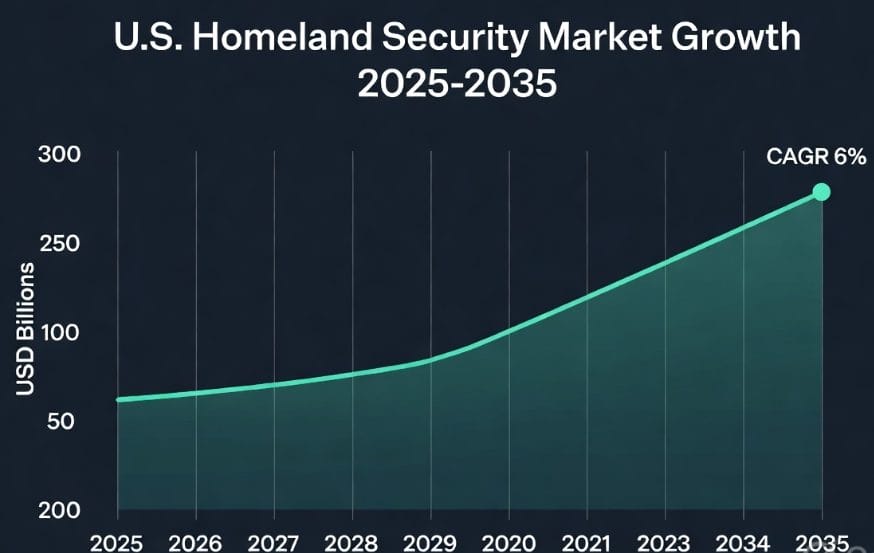
U.S. homeland security market growth 2025–2035
The chart projects steady growth in the U.S. homeland security market over the next decade, with a 6% CAGR driving market value from just over USD 50 billion to nearly USD 280 billion. The overall trend reflects sustained expansion and increasing investment in homeland security technologies and services.
Projected Employment Growth 

Graduates with skills in AI ethics, machine learning for security, and data fusion will be highly valued as agencies move toward “hyperwar” speed decision-making. With AI in the rise, predictive analytics, threat detection and automation, hybrid threat defense will become the key anti-terrorism security factor. Hence, Anti-Terrorism Security graduates will play critical roles in protecting smart cities, critical infrastructure (energy, transport, finance), and industry.
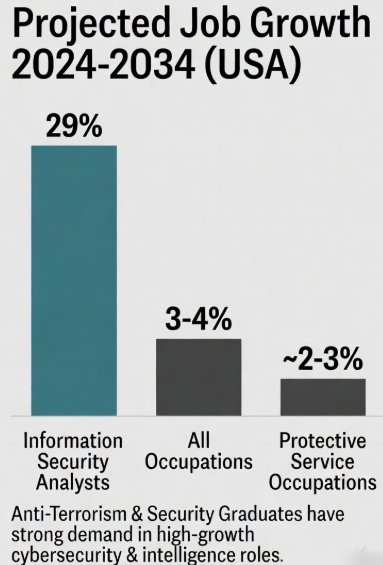
Projected Employment Growth
Employment demand across homeland security fields is expected to grow steadily, led by Information Security Analysts with projected growth of 29–33% through 2034. Security, intelligence, and protective service roles are also anticipated to expand, driven by increasing cybersecurity and data-driven security requirements.

Career Demand & Salary Growth

Employment for security and intelligence professionals is expanding rapidly, with information security and threat analysis roles projected to grow by nearly 29–33% over the next decade. Median annual salaries exceed $124,000 in many security-related positions.

Graduates of terrorism and security studies such as Master in Anti-Terrorism Security, bachelor of security studies, anti-terrorism studies degree, security and terrorism degree, or an online bachelor in anti-terrorism security develop expertise in intelligence analysis, risk assessment, crisis management, emergency preparedness, and security operations. These skills open diverse careers in anti-terrorism security, including intelligence officer, security analyst, homeland security specialist, and emergency management professional. Strong homeland security career opportunities and growing demand for anti-terrorism security degree jobs make this an excellent future-focused academic pathway.

  • Specialized programs exist at institutions like American Military University (AMU), Southern New Hampshire University (SNHU), The Citadel, Texas A&M, Arizona State, and others. Many are online/hybrid for working professionals.
  • Graduate-level programs in Homeland Security grew ~85% over a recent 10-year period; undergrad follows similar interest driven by career demand.
  • Limited public granular enrollment stats for “pure” Anti-Terrorism Bachelor’s (often concentrations within Criminal Justice or Security Studies), but related fields show stable-to-growing completions (e.g., hundreds annually in Terrorism & Counterterrorism Operations).
Impact of AI on Business Intelligence & Predictive Analytics

AI transforms anti-terrorism security from reactive to predictive, heavily influencing degree relevance and graduate employability.
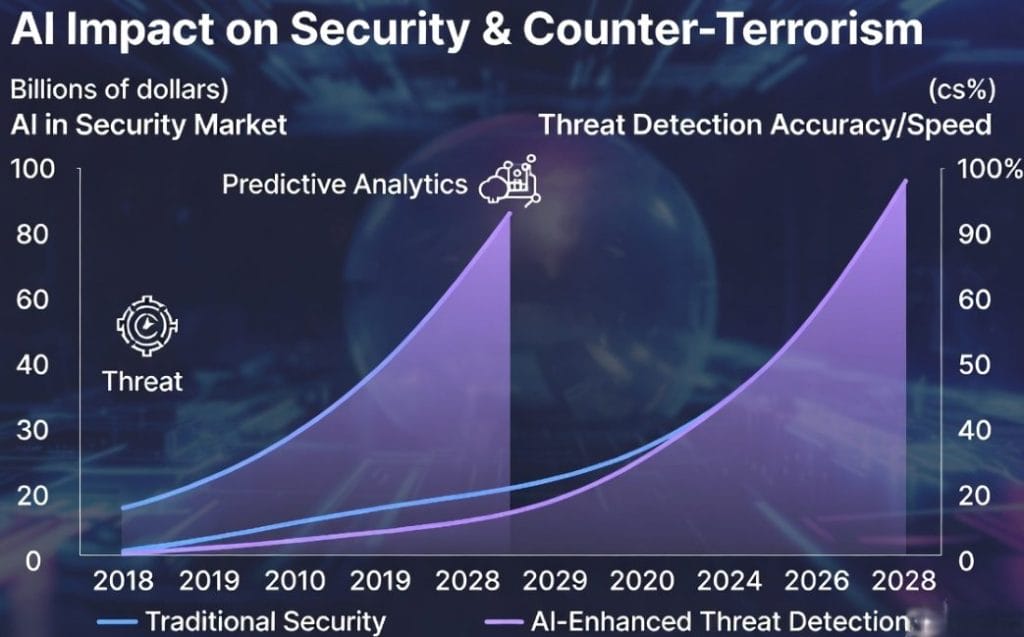
AI on Business Intelligence & Predictive Analytics
The graph highlights the growing impact of AI in the security sector, showing rapid increases in both market value and threat detection performance over time. Compared with traditional security approaches, AI-enhanced threat detection demonstrates significantly faster growth, driven by advances in predictive analytics and automated threat intelligence.
Key Applications:
  • Threat Detection & Predictive Policing: AI analyzes vast datasets (social media, financial transactions, metadata, geospatial) to identify radicalization patterns, forecast attacks, or flag anomalies. Examples include machine learning for online content moderation and risk scoring.
  • Intelligence Analysis: Natural Language Processing (NLP), behavioral biometrics, and pattern recognition process petabytes of data faster than humans. Tools like predictive models for insurgent activity (e.g., historical Raven Sentry achieving notable accuracy).
  • Resource Optimization: Prioritizes high-risk areas, disrupts financing, and enhances surveillance/forensics.
  • Challenges: False positives, privacy/human rights concerns, data access limits, and adversarial AI use by threats.

Business Intelligence Angle: AI enables real-time dashboards, network mapping, and scenario modeling. In the private sector (critical infrastructure protection), it integrates with BI tools for risk analytics. The market for AI in security is exploding (e.g., strong double-digit CAGRs in related defense AI/analytics).

Predictive Analytics Outlook: Enhances accuracy in forecasting (e.g., attack locations, radicalization). Degrees emphasizing data science, ML, and ethics will produce the most competitive graduates. U.S. agencies (DHS, FBI, etc.) increasingly adopt these, creating demand.

Career Opportunities & Professional Development of a Student with Bachelor in Anti-Terrorism Security

The Bachelor in Anti-Terrorism Security at AIU will give the learner specialized education in counter terrorism, homeland security, intelligence analysis, risk management, crisis management, emergency preparation, and security operations as part of the program goals

A graduate from an anti-terrorism security degree program, an anti-terrorism studies degree program, a homeland security degree program, a counter terrorism degree program, security and terrorism degree program, or a bachelor of security studies degree program can explore various employment options in the anti-terrorism security field in government agencies, law enforcement, border security, private security companies, defense institutions, critical infrastructure agencies, transportation organizations, and corporate security management divisions. 

Some new technology-based areas in anti-terrorism security include cybersecurity, threat intelligence, AI surveillance, digital forensics, data analytics, and smart security systems, which provide excellent homeland security career options. 

The student enrolled in an anti-terrorism program, an online bachelor in anti-terrorism security program, an anti-terrorism security degree online program, or a homeland security bachelor’s degree program is encouraged to develop a portfolio through research projects, certifications, internships, and case studies. AIU facilitates career development for the students with academic advice, career counseling, and other resources.
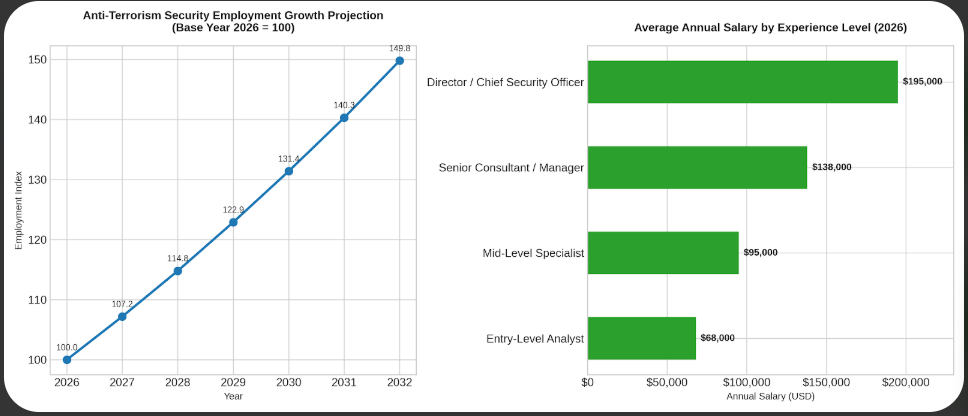
Anti-terrorism security employment growth projection
The image displays a line graph projecting a 49.8% increase in anti-terrorism security employment from 2026 to 2032, alongside a bar chart showing 2026 salaries ranging from $68,000 to $195,000.
Employment Growth Factors
  • Compounded Demand: The employment index projects a robust ~7% compound annual growth rate through 2032.
  • Sector Drivers: Growth is heavily concentrated in critical infrastructure protection (energy grids, transportation hubs), defense contracting, and corporate intelligence units within multinational corporations.
  • Skill Shift: The traditional physical security paradigm is rapidly blending with cybersecurity. Professionals who understand both physical perimeter defense and digital counter-terrorism methods see the highest demand.
Salary Breakdown
  • Entry-Level ($68,000): Typically includes Intelligence Analysts, Risk Assessment Associates, and Security Operations Center (SOC) personnel. A bachelor’s degree in International Relations, Homeland Security, or Criminology is common here.
  • Mid-Level ($95,000): Consists of seasoned Counter-Terrorism Specialists and Security Engineers. Obtaining a security clearance (e.g., Secret/Top Secret in the US) or specialized certifications (like CPP or PSP) usually triggers this salary bump.
  • Senior Management ($138,000 – $195,000+): Directors, Consultants, and Chief Security Officers (CSOs). These roles demand extensive field experience, strategic crisis management capabilities, and leadership over large-scale cross-functional security teams.


Contact Us Today!

Begin Your Journey!
AIU’s Summer of Innovation and Growth gives you the ability to earn up to $5000 in tuition credit by completing free lessons and courses.
Whether you’re looking to acquire new skills, advance your career, or simply explore new interests, AIU is your gateway to a world of opportunities. With free access to 3400 lessons and hundreds of courses the ability to earn credits and earn certificates there’s no better time to start learning.
Join us today as a Guest Student and take the first step towards a brighter, more empowered future.
Explore. Learn. Achieve.

Academic Freedom & Customized Curriculum

Customization is another advantage of academic freedom where educators can develop a curriculum to suit the modern learner. The Anti-Terrorism Security track such as Bachelor in Anti-Terrorism Security or even an associate in Anti-Terrorism Security will give an educator the opportunity to be able to customize a curriculum according to the learner’s needs. An online Anti-Terrorism Security degree or online Bachelor in Anti-Terrorism Security is suitable for the working professional who would like to improve his/her expertise through distance learning while working on a full-time job. 

A degree in Anti-Terrorism Security at AIU will be designed based on adult learning theory, instructional design, curriculum development and educational leadership in order to serve diverse student populations. With the help of lifelong learning and continuing education, educators can develop workforce education and also promote professional development within different industries. Such initiatives will encourage innovation while continuing education due to its customization nature that offers convenience to learners.

Why Study Bachelor in Anti-Terrorism Security at AIU?

The Bachelor of Anti-Terrorism Security at AIU was developed with students who wish to have a future in modern security, intelligence, and public safety. The advanced anti-terrorism security degree from AIU incorporates excellent education with flexibility, making it the perfect choice for professionals and security specialists around the world.

Probably the main benefit of taking an anti-terrorism degree from AIU is the self-paced learning process. Students will be able to complete their anti-terrorism security degree online in accordance with their own schedule while learning about counter terrorism, homeland security, intelligence analysis, risk assessment, crisis management, emergency preparedness, and security operations.

AIU’s customizable curriculum using curriculum builder tool can enable learners to tailor their security and terrorism degree to match specific career goals. Whether you are interested in a homeland security degree, security management degree, or specialized anti-terrorism program – AIU provides interdisciplinary flexibility to explore multiple fields of study.

The university also integrates AI-powered education tools that can enhance research, critical thinking, and professional development. As a global learning institution – AIU connects students from diverse backgrounds, creating an international perspective on security challenges.

Graduates of this online bachelor in anti-terrorism security gain valuable skills for careers in anti-terrorism security, including government agencies, private security firms, emergency response organizations, and intelligence services. With strong homeland security career opportunities and growing demand for anti-terrorism security degree jobs, a homeland security bachelor’s degree from AIU can help build a rewarding and impactful career.

Join the Next Generation of Protectors

Apply Now for Admission

Core Courses, Topics & Technical Skills in Bachelor in Anti-Terrorism Security

Bachelor degree programs in anti-terrorism security give students the necessary expertise to handle current security challenges. This anti-terrorism security major blends principles of terrorism and security studies, counter terrorism, and homeland security to create the necessary grounding for protecting nations and organizations from various risks. 

Some of the courses that make up a degree program in anti-terrorism studies or homeland security may include intelligence analysis, risk assessment, crisis management, emergency preparedness, security operations, cybersecurity, and threat detection. Those enrolling in bachelor degree programs in security studies, security management, and security and terrorism will be equipped with policy development, investigation procedures, and strategic planning knowledge. This can be helpful when pursing Postdoctoral in Anti-Terrorism Security program.

Anti-terrorism security programs will also expose students to specialized training in surveillance procedures, critical infrastructure protection, and response plans. Alternative flexible modes of studying like online bachelor in anti-terrorism security or anti-terrorism security degree online provide a great learning opportunity for working individuals. Career prospects in anti-terrorism security include anti-terrorism security degree jobs, among others, in homeland security.

  • Introduction to Counter Terrorism and Global Security
  • Intelligence Analysis and Threat Assessment
  • Risk Assessment and Security Planning
  • Emergency Preparedness and Disaster Management
  • Cybersecurity and Counterterrorism Technologies
  • Homeland Security Principles and Strategies
  • Terrorism and Political Violence Studies
  • Crisis Management and Incident Response
  • Critical Infrastructure Protection and Security Operations
  • Security Management, Law, and National Security Policy

Tools & Technologies You Will Master

A Bachelor in Anti-Terrorism Security program helps students develop proficiency in intelligence gathering, threat monitoring, geospatial analysis, surveillance systems, cybersecurity tools, risk assessment platforms, emergency response technologies, and security management software. Students also gain hands-on experience with data analytics, intelligence databases, and security operations technologies used in modern counter-terrorism environments.

  • ArcGIS AllSource: Used for geospatial intelligence, link analysis, threat mapping, and operational planning.
  • Palantir Gotham & Foundry: Integrates large volumes of intelligence data to identify patterns, threats, and operational insights.
  • MISP Threat Intelligence Platform: Supports intelligence sharing, threat correlation, and analysis across security agencies.
  • TrapWire: Provides real-time threat detection and protective intelligence capabilities.
  • AstraSight Intelligence: AI-powered OSINT platform used for threat monitoring, multilingual analysis, and risk detection.
  • Microsoft Sentinel: Cloud-native security information and event management (SIEM) platform for monitoring threats.

These tools are commonly associated with counter-terrorism, intelligence analysis, homeland security, risk assessment, security operations, and crisis management functions across government agencies, law enforcement organizations, and private security firms.

Career-Focused Learning in Anti-Terrorism Security

A bachelor in anti-terrorism security is designed to help students build practical, workforce-ready skills for modern security environments. Whether pursuing an anti-terrorism security degree, anti-terrorism studies degree, homeland security degree, counter terrorism degree, security and terrorism degree, or bachelor of security studies, learners gain expertise that supports diverse career pathways.

Students develop practical skills for:

  • Industry Roles: Apply counter terrorism, intelligence analysis, risk assessment, crisis management, emergency preparedness, and security operations in government agencies, law enforcement, corporate security, and critical infrastructure protection. 
  • Entrepreneurship: Use knowledge gained through a security management degree or anti-terrorism program to launch security consulting firms, risk advisory services, and security technology ventures. 
  • Remote Careers: Leverage skills in threat monitoring, intelligence research, compliance, and security planning through an online bachelor in anti-terrorism security or anti-terrorism security degree online. 
  • Consulting Opportunities: Support organizations with homeland security, security management, business continuity planning, and risk mitigation strategies. 
  • Future AI-Driven Workplaces: Learn data-driven decision-making, predictive threat assessment, and technology-enabled security practices that are shaping the future of terrorism and security studies. 

These competencies prepare graduates for rewarding careers in anti-terrorism security, a wide range of anti-terrorism security degree jobs, and growing homeland security career opportunities worldwide.

Real-World Projects & Capstone Experience

AIU emphasizes practical, hands-on learning in its Anti-Terrorism Security programs. The university bridges theory and real-world application through flexible, student-centered approaches such as academic freedom and open curriculum that prepare graduates for roles in homeland security, counterterrorism, intelligence analysis, and risk management.

Portfolio Projects: Building a Professional Showcase

AIU students develop comprehensive portfolios that demonstrate applied skills in anti-terrorism security. These portfolios include:

  • Threat Assessment Reports — Students analyze real or simulated terrorist threats, incorporating open-source intelligence (OSINT), behavioral profiling, and vulnerability assessments of critical infrastructure.
  • Counterterrorism Strategy Documents — Detailed plans for preventing or responding to incidents, including crisis management protocols and interagency coordination frameworks.
  • Intelligence Analysis Artifacts — Compiled dossiers, predictive modeling outputs, and risk matrices derived from case studies on topics like violent extremism, cyber threats, or transnational crime.

These portfolios serve as tangible evidence of expertise for employers in government agencies, private security firms, or international organizations. They highlight a student’s ability to translate knowledge into actionable security solutions.

AI Models: Leveraging Technology for Security Solutions

AIU integrates artificial intelligence directly into the learning experience, using advanced virtual reality systems and AI-powered tools for personalized education and practical application.

Students build and deploy AI models for:

  • Predictive Threat Analytics — Machine learning models that forecast potential terrorist activities by analyzing patterns in historical data, social media, and geospatial information.
  • Anomaly Detection in Surveillance — Computer vision and natural language processing (NLP) systems to identify suspicious behaviors or content in large datasets.
  • Simulation and Scenario Planning — AI-driven virtual environments for training in real-time decision-making during simulated terror incidents.

These experiences mirror real-world applications like Project Maven-style initiatives, where AI automates processing of intelligence data for faster threat identification.

Analytics Case Studies: Applying Data-Driven Insights

Through structured case studies, students examine historical and contemporary terrorism events to develop analytical proficiency:

  • Post-Incident Analysis — Dissecting events like major attacks to evaluate response effectiveness, intelligence failures, and lessons learned.
  • Radicalization Pathway Modeling — Using data analytics to map online and offline factors contributing to violent extremism.
  • Cyber-Physical Threat Convergence — Studying how AI and emerging technologies are exploited by or defended against terrorist actors.

Students employ tools for big data processing, statistical analysis, and visualization to generate actionable intelligence reports. This builds skills in turning complex datasets into strategic recommendations for counterterrorism operations.

Capstone Development: Culminating Real-World Application

The capstone experience represents the pinnacle of practical learning at AIU. Students undertake a significant project that integrates program knowledge with real-world problem-solving:

  • Client-Focused Projects — Similar to partnerships seen in other security programs, students may develop solutions for simulated or actual stakeholders, such as AI-enhanced tools for homeland security challenges.
  • Policy and Operational Plans — Designing comprehensive counterterrorism frameworks, including risk mitigation strategies, emergency response protocols, or technology integration recommendations.
  • Research-Driven Solutions — Addressing current gaps, such as the use of AI in countering terrorist propaganda or securing critical infrastructure against hybrid threats.

Capstones often involve research, report writing, presentations, and teamwork — preparing students for leadership roles. In AIU’s flexible model, projects are tailored to individual interests and career goals.
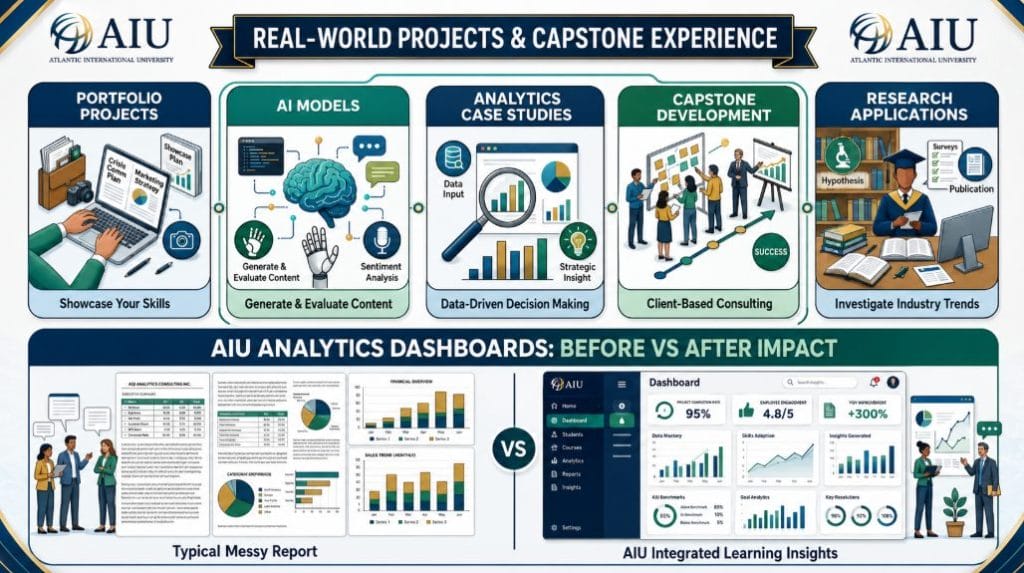
Real-world projects & capstone experience
The infographic outlines a five-stage learning journey spanning portfolio development, AI modeling, analytics case studies, capstone projects, and research applications. It also demonstrates how AIU analytics dashboards transform complex, text-heavy reports into clear, visual, and actionable insights.
Why AIU’s Approach Stands Out

AIU delivers practical learning by combining self-paced online theoretical learning with cutting-edge tools like AI-enhanced simulations and personalized learning pathways. This prepares professionals for real jobs where they can handle evolving threats in a technology-driven security landscape. In fact, along with theoretical knowledge, a robust portfolio of projects, models, analyses, and research truly empower a professional.

Key Business Impact of the Transformation:

It delivers measurable ROI through smarter, proactive, and technology-enabled anti-terrorism security. Thus ensuring:

  • Stronger risk mitigation by deploying AI-powered predictive models and analytics to proactively identify and prevent threats, reducing security incidents and operational disruptions.
  • Data-driven decisions to enable evidence-based security strategies through real-world case studies and intelligence analysis.
  • Cost efficiency by minimizing external consultants, crisis response costs, and potential losses from security breaches.
  • Innovation assuring tech edge to assure modern counterterrorism solutions into organizational security operations.
  • A boost in capability with high-performing professionals with practical portfolios and capstone experience, enhancing internal expertise.
  • Improves organizational resilience, reputation, and confidence in high-risk environments.
Research Projects & Innovation in Bachelor in Anti-Terrorism Security

In an anti-terrorism security bachelor’s program – research projects are key. They push innovation and give students hands-on experience. Not only do students learn theory – but they also dig into applied research in fields like counterterrorism, homeland security, intelligence analysis, and risk assessment. They explore new threats, devise strategies, and check out the technology for security and crisis management.

This degree really combines practical work with real-world challenges – preparing students for their careers while adding a great student experience during the program. It encourages research on things like emergency preparedness – protecting critical infrastructure, and global security trends. Students usually work together on projects involving data analytics, threat detection, and strategic planning.

Getting an online bachelor’s or doing an anti-terrorism security degree online still gives graduates the same valuable skills. These equip them for roles in anti-terrorism and diverse homeland security jobs in government, law enforcement, intelligence agencies, and private security firms.

  • MBM300 Thesis Proposal
  • MBM302 Bachelor Thesis (5,000 words)

Publication: Students pursuing Bachelor in Anti-Terrorism Security at AIU actively contribute to educational discourse through research projects, often resulting in publications in academic journals and conferences. These publications showcase their innovative approaches to teaching and learning, further solidifying AIU’s reputation as a leading institution for bachelor’s programs in Anti-Terrorism Security.

Take Charge of Your Future in Homeland Security

Unlock Your Potential

Dissertation & Thesis Defense

In the final stage of the Anti-Terrorism Security course at AIU, students are presented with a unique chance to demonstrate their proficiency and creativity through an extensive thesis proposal. This critical stage marks the culmination of their journey, providing a venue to delve into complex topics within the curriculum.

The thesis defense, a fundamental element of the program, enables students to exhibit their research abilities, analytical thinking, and literary knowledge, highlighting their preparedness to make significant contributions to the field after graduating from AIU.

Student Experience in Pursuing Bachelor in Anti-Terrorism Security

Pursuing a bachelor in anti-terrorism security at AIU offers students a dynamic blend of theory, practical training, and real-world security challenges that helps learners understand national and global threats while developing expertise in counter terrorism, homeland security, and intelligence analysis. Through a bachelor of security studies or homeland security bachelor’s degree – students can gain valuable skills in risk assessment, crisis management, emergency preparedness, and security operations that can enable them to get their dream jobs.

There are programs offered by universities that combine the regular coursework through academic resources in terrorism and security studies, law enforcement, and strategic planning with hands-on simulations where students further learn to evaluate threats and design effective response strategies. Flexible options such as an online bachelor in anti-terrorism security or anti-terrorism security degree online make education more accessible.

Graduates are well prepared for careers in anti-terrorism security, including roles linked to anti-terrorism security degree jobs and diverse homeland security career opportunities in government, private security, and emergency response sectors.

Community & Social

The full online education program at AIU cultivates an energetic community environment using cutting-edge technologies and collaborative tools, ensuring a nurturing academic journey. Through platforms like the Virtual Campus, Mobile APP, MYAIU, AIULink, and AIUTV, students, faculty, and alumni unite, creating a network of interconnected minds. Engaging in thought-provoking symposiums, webinars, and conferences fosters a global perspective of general education and connections among the various community members.

Accessing the Merlin Media Center provides a wealth of academic resources while staying linked through AIULink, which ensures ongoing internet connectivity. The AIU Virtual Campus, APP compatible with Android and iOS, offers effortless access to programs, tools, information systems, and academic resources. These platforms facilitate sharing personal narratives, exploring holistic development, and contributing to the betterment of humanity, shaping an unparalleled AIU experience.

Live Classes

AIU introduces an innovative approach to virtual learning by incorporating dynamic live sessions twice daily. One can also access these live classes from the archive that hosts 100s of courses that can be combined to personalize a student’s academic journey. Led by seasoned faculty and experts from various industries, these sessions offer real-time discussions, interactive Q&A segments, and collaborative problem-solving, enriching your comprehension of the community. 

Participating in these sessions augments your expertise, equipping you to shape policies and refine your skills in Anti-Terrorism Security. AIU’s live classes promise intellectually engaging dialogues, up-to-the-minute industry perspectives, and individualized instructor feedback, guaranteeing a rewarding journey through the study of Anti-Terrorism Security. You can access 700+ live classes, 2000+ assignments and projects, 3400 mini courses free of cost as a Guest Student to learn new skills, new abilities, and earn certificates to grow and access new opportunities in your field of interest. In fact, one can earn up to $5000 credit towards their tuition fee by completing 5 Mini-courses and/or Live classes as a Guest Student

Feel free to glance through some of our recorded live sessions on different subjects.

Academic Resources

At AIU, the Virtual Campus is an innovative center equipped with more than 25 specialized tools, all geared towards supporting and empowering students throughout their educational endeavors. Our newest feature, the Virtual Reality 3D immersive experience, elevates community interaction and nurtures growth, motivation, and inspiration among our diverse student population. 

Also, AIU includes the leading Artificial intelligence (AI) tools such as ChatGPT, Dall-E and Midjoruney, PDF Executive Assistance, and Slide Generator, plus others, and is adding new AI tools to ensure students are fluent in this emerging trend and benefit from the boost in productivity they bring.

Within our extensive online library, comprising 260,000 books and 30 million peer-reviewed articles, alongside 105,000 resources co-curated by the AIU community, we establish an unmatched academic setting dedicated to fostering our students’ growth, development, and success.

Safe Guard your Career with the Right Learning

Our Guest Student Access

Admission Requirements for Bachelor in Anti-Terrorism Security

The admission requirements for a bachelor in anti-terrorism security at AIU usually includes a high school diploma or equivalent, satisfactory academic records, and proof of English proficiency for international applicants since – the communication happens in English. Students can get the required guidance from career center.

However, it is important to check with the requirement of each university before applying since few institutions also request personal statements, recommendation letters, and standardized test scores wherever applicable. Students interested in the subject can also opt for online courses that offer flexibility to working professionals.

Coursework often combines the following – security management, counter terrorism, and public safety principles. Graduates can pursue careers in anti-terrorism security, explore anti-terrorism security degree jobs, and benefit from growing homeland security career opportunities. A security management degree also provides valuable leadership and operational skills.

How Can You Apply for a Bachelor in Anti-Terrorism Security?

To apply for the Bachelor in Anti-Terrorism Security at AIU, follow these steps:

  1. Visit the University Website: Navigate to the official AIU website to access the program details.
  2. Complete the Online Application: Fill out the application form with personal, academic, and contact information.
  3. Submit Required Documents: Provide transcripts, a resume, personal statement, and any additional documentation requested.
  4. Pay the Application Fee: Ensure the application fee is paid to complete the submission process.
  5. Interview: After reviewing your application, you may be contacted for an interview.
  6. Await Admission Decision: You’ll be notified via email about your admission status.

This process ensures a smooth application to the Anti-Terrorism Security degree program, preparing students for careers in Anti-Terrorism Security.

Financial Support & Scholarships

We’re excited to present an array of Bachelor in Anti-Terrorism Security full scholarships crafted for our students. Kindly share your details to unlock numerous Bachelor in Anti-Terrorism Security scholarship possibilities to bolster your academic endeavors. Allow us to aid you in reaching your educational aspirations and fostering your scholarly pursuits.

FAQs

What is a Bachelor in Anti-Terrorism Security?

A Bachelor in Anti-Terrorism Security is an undergraduate program focused on counter terrorism, homeland security, intelligence analysis, risk assessment, emergency preparedness, crisis management, and security operations to address modern security challenges.

What can you do with an Anti-Terrorism Security degree?

An Anti-Terrorism Security degree prepares graduates for careers in homeland security, intelligence analysis, security management, emergency preparedness, risk assessment, law enforcement support, and public or private security operations.

Is an Anti-Terrorism Security degree worth it?

An Anti-Terrorism Security degree can be valuable for students seeking specialized knowledge in counter terrorism, homeland security, security management, and intelligence analysis, with opportunities in growing security-related fields.

What jobs can I get with a degree in Anti-Terrorism Security?

Graduates may qualify for roles such as security analyst, intelligence analyst, emergency management specialist, homeland security officer, risk assessment consultant, security operations coordinator, or security management professional.

Can I study Anti-Terrorism Security online?

Yes, many institutions offer an online bachelor in anti-terrorism security, allowing students to develop skills in counter terrorism, homeland security, intelligence analysis, and security management through flexible learning.

Let us know your goals and aspirations so we can chart a path at AIU to achieve them!
//
Admissions Counselor
Boniface Onimu
Available
//
Admissions Counselor
Juan Mejia
Available
//
Admissions Counselor
Prof. Emmanuel Gbagu
Available
//
Admissions Counselor
Sandra Garcia-Fierro
Available
//
Admissions Counselor
Rene Cordon
Available

"*" indicates required fields

This field is for validation purposes and should be left unchanged.
Name*

"*" indicates required fields

This field is for validation purposes and should be left unchanged.
Name*

"*" indicates required fields

This field is for validation purposes and should be left unchanged.
Name*

"*" indicates required fields

This field is for validation purposes and should be left unchanged.
Name*

"*" indicates required fields

This field is for validation purposes and should be left unchanged.
Name*

"*" indicates required fields

This field is for validation purposes and should be left unchanged.
Name*

"*" indicates required fields

This field is for validation purposes and should be left unchanged.
Name*

"*" indicates required fields

This field is for validation purposes and should be left unchanged.
Name*

"*" indicates required fields

This field is for validation purposes and should be left unchanged.
Name*

"*" indicates required fields

This field is for validation purposes and should be left unchanged.
Name*

"*" indicates required fields

This field is for validation purposes and should be left unchanged.
Name*

"*" indicates required fields

This field is for validation purposes and should be left unchanged.
Name*

"*" indicates required fields

This field is for validation purposes and should be left unchanged.
Name*

"*" indicates required fields

This field is for validation purposes and should be left unchanged.
Name*

"*" indicates required fields

This field is for validation purposes and should be left unchanged.
Name*

"*" indicates required fields

This field is for validation purposes and should be left unchanged.
Name*

"*" indicates required fields

This field is for validation purposes and should be left unchanged.
Name*

"*" indicates required fields

This field is for validation purposes and should be left unchanged.
Name*

"*" indicates required fields

This field is for validation purposes and should be left unchanged.
Name*

"*" indicates required fields

This field is for validation purposes and should be left unchanged.
Name*

"*" indicates required fields

This field is for validation purposes and should be left unchanged.

Submit your data.

After submitting, a widget will appear at the bottom-left corner so you can start your training.

Name*

Do you hate spam? Don’t worry, we hate them too. Your email is 100% secure with us.

"*" indicates required fields

This field is for validation purposes and should be left unchanged.

Submit the form below to begin your interview.

After submitting, a widget will appear at the bottom-left corner so you to start your AI interview.

Name*
Accepted file types: docx, pdf, Max. file size: 500 MB.

Do you hate spam? Don’t worry, we hate them too. Your email is 100% secure with us.