Distance Learning at AIU is enhanced by vast academic resources and innovative technologies build into the Virtual Campus: Hundreds of self-paced courses with video lectures and step by step lessons, thousands of optional assignments, 140,000 e-books, the Social Media & Networking platform allowing collaboration/chat/communications between students, and MYAIU develop students holistically in 11 areas beyond just academics.
The world is YOUR campus!”, that is the message of AIU’s month magazine Campus Mundi. Hear the voices and see the faces that make up AIU. Campus Mundi brings the world of AIU to you every months with inspirational stories, news and achievements by AIU members from around the world (students and staff are located in over 200 countries).
The Bachelor of Technical Writing prepares students to create excellent, clear, concise, and useful documents for different industries by giving them the knowledge and skills necessary to write in a way that makes sense to the target audience. In this degree program, students will develop skills in Writing; Technical Communication; Technical Editing; Content Strategies; Visual Communication and Emerging Digital Tools. By completing this degree program, graduates will have developed expertise in creating useful documentation that supports the transfer of knowledge; documentation for products; training on how to use products; and communication within an organization in today’s increasingly information-driven global economy.
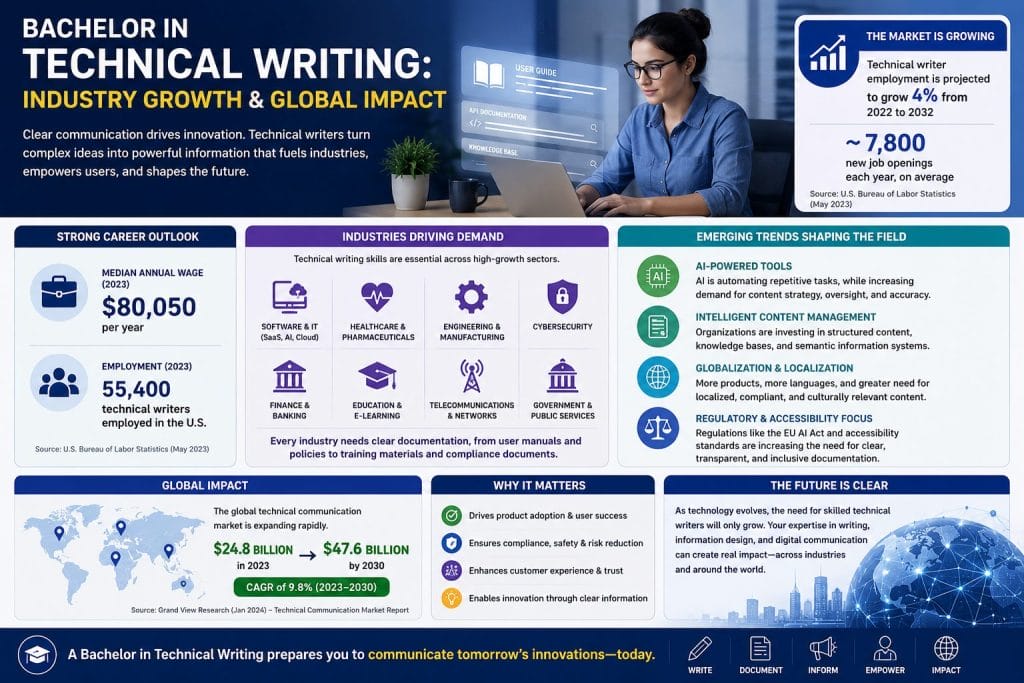
Technical writing is more important now than ever due to its ability to help organizations develop user-friendly content from complex technical information for the digital economy. The increase in demand for accurate and high-quality online technical writing degree documentation, user guides, compliance documents, and knowledge management supporting industries such as software development, artificial intelligence (AI), cybersecurity, healthcare, engineering, and manufacturing is a direct response to the continued growth of these industries.
As organizations face increasing pressure to meet product adoption goals, comply with technical writing degree regulations, achieve customer success, and digitally transform, they are increasingly relying upon technical writers who completed bachelor degree in technical writing to create documentation supporting their operations. According to the U.S. Bureau of Labor Statistics, there are an estimated number of thousands of expected job openings for technical writers each year, with a median annual wage of more than $80,000, demonstrating the strong demand for technical writing across many industries.
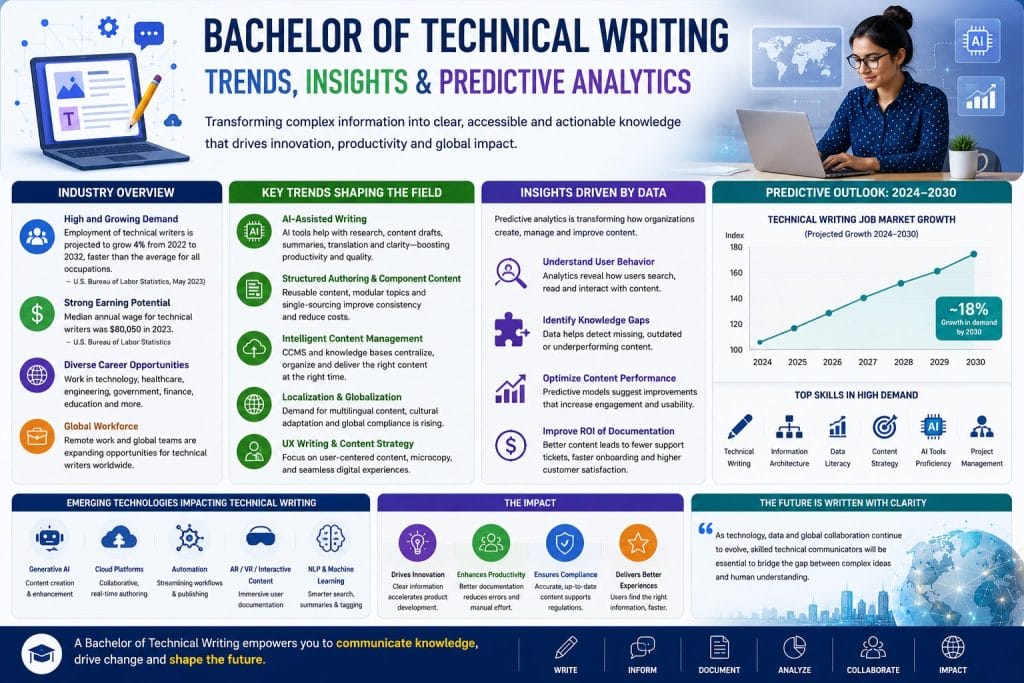
Technical writing is undergoing a transformation due to the rapid increase of organizations producing digital content along with the increased adoption of new technologies such as Artificial Intelligence (AI), Cloud Computing, Automation, and Advanced Analytics. Technical writers no longer only create technical manuals and end-user documentation — they are now also responsible for creating and managing Knowledge Management Systems (KMS), developing user-driven content strategies, facilitating an organization’s digital transformation, and creating a superior technical communication degree accredited online customer experience around the globe. Several trends have emerged in the last several years including AI writing tools, structured authoring, intelligent content management, localization techniques, and UX-based documentation.
Additionally, the use of predictive analytics has increased as organizations use the data to learn how their content is utilized by customers, understand their audience’s needs, and optimize the way they deliver their content. Industry forecasts indicate that the demand for technical writers who possess both technical writing competencies and skills in data literacy, information architecture, content strategy, and AI governance will continue to increase. As technical writers are becoming critical team members in supporting organizations around the world with the delivery of effective digital products, they are also key components in creating globally accessible and productive compliant and innovative solutions by collaborating globally using a knowledge-based approach.

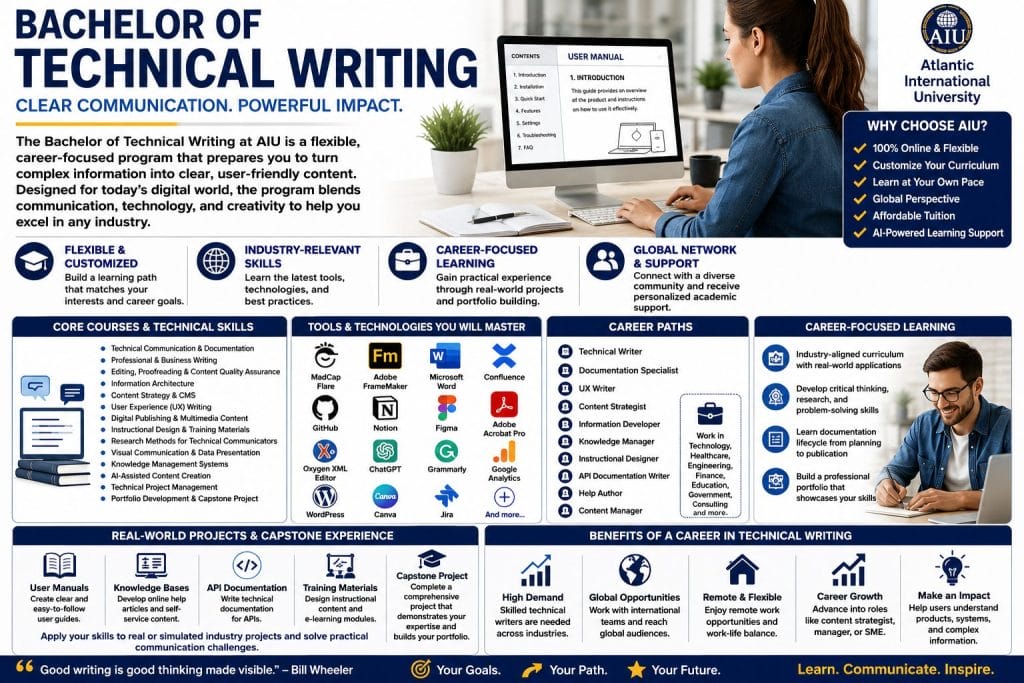
Graduate-level studies in Technical Writing prepare bachelor of technical writing students for many careers within technology, health care, engineering, manufacturing, government, education & consulting. Graduates can go into any number of diverse technical writing jobs areas to work including as Technical Writers, Documentation Specialists, Content Strategists, UX Writers, Information Developers, Knowledge Management Specialists, Proposal Writers and Technical Editors.
There is a growing need for skilled technical communicators due to the increasing reliance on clear communication, digital documentation and artificially intelligent enabled content systems. In addition, the bachelor of technical writing program also offers professional development in the areas of Content Strategy, Information Architecture, Project Management, Data Literacy, and Emerging Documentation Technologies thus providing a bachelor of technical writing pathways to leadership and specialized communication roles across global industries.
Artificial Intelligence is changing how technical information is created, delivered, and stored which means that technical writers will gain a skill set that will be of increasing importance—namely their ability to work with AI. New areas for technical writers include AI assisted content creation, intelligent documentation systems, content automation, natural language processing (NLP), chatbot and conversational AI design, Knowledge Management or KM and developing user guides for AI powered products, creating ethical and transparent AI documentation and managing global digital platforms. Using strong communication skills as well as emerging technologies, graduates can assist organizations in providing accurate, accessible and user-friendly content in a highly automated and AI driven world.
Begin Your Journey!
AIU’s Summer of Innovation and Growth gives you the ability to earn up to $5000 in tuition credit by completing free lessons and courses.
Whether you’re looking to acquire new skills, advance your career, or simply explore new interests, AIU is your gateway to a world of opportunities. With free access to 3400 lessons and hundreds of courses the ability to earn credits and earn certificates there’s no better time to start learning.
Join us today as a Guest Student and take the first step towards a brighter, more empowered future.
Explore. Learn. Achieve.
Students’ academic freedom includes giving them the freedom to select their own way to learn by taking courses that meet their individual needs or career goals. A tailored Technical Writing course allows students to explore particular areas of interest like technical communication careers , UX writing, content strategy, document management, AI driven content creation, digital publication and information design. Through a flexible learning environment of bachelor of technical writing, interdisciplinary learning is promoted and helps and develops skills and knowledge that meet the developing needs of their best technical writing degree program industry as well as the specific career goals of each student.
Bachelor of Technical Writing combines many types of communication, analytical skills, and skills focused on technology into one unique skill set used across nearly all industries. It allows someone to take complex information and turn it into easily readable, and understandable material to improve the understanding, productivity, and decision-making of the person receiving the material. Additionally, those who have a Bachelor of Technical Writing background in technical writing have developed their research ability, technical writer degree online critical thinking skills, content strategy skills, editing skills, and digital communications ability.
A background in technical writing will also open doors to new job opportunities in the fields of technology, health care, engineering, government agencies, education, and business. As companies continue to expand their digital products and improve their knowledge systems, and increase the globalization of their operations, a technical writing program career in technical writing offers strong long-term security, work-from-home options, technical writing bachelor’s degree opportunities to create professionally, and to create and produce material that takes complex information and presents it in a useful and meaningful manner for a variety of target audiences.
A conventional technical writing education model includes rigid curricula, courses offered at the same time, and standardized outcomes for students to achieve during their studies; therefore, this type of education provides the student with a strong base in the concepts of writing and communicating. However, this type of model provides the student with little to no ability to explore new or emerging topics or tailor his/her/their education specific to his/her/their goal of future employment. Most education follows a predetermined course sequence and specialization requirements established by the institution.
A flexible Bachelor’s of Technical Writing provides students with an opportunity to customize their educational path according to areas of interest based on the needs of the industry (e.g., technical writing, user experience writing (UX), content strategy, information architecture, digital publishing, artificial intelligence (AI) documentation, and knowledge management) while allowing the students the flexibility to work at his/her/their own pace; integrate real-life projects into the learning process; and balance educational requirements with their professional and personal obligations. This type of education encourages cross-disciplinary studies, assists the development of job-related skills, and prepares graduates to be current with the fast-changing/ever-growing digital and technology-oriented workforce.
At AIU, the Bachelor of Technical Writing takes on an “evolving” ie., student centered experience which allows them to create a path that fits their individual career goals and the needs of the industries. Instead of taking a usual bound by rigid curriculum, see how a lot of autonomy is given to the students when building a flexible academic path around key areas such as technical communication, content strategy, UX writing, digital publishing, information design, knowledge management, and AI-assisted documentation.
Students have opportunities to apply their learning in real-world contexts through hands-on application, independent research, and critical thinking; while being encouraged to explore other areas of study – as part of a comprehensive learning experience. Students gain foundational knowledge and skills that help them communicate effectively, think critically, and use analytical tools to create high-quality, effective documents and content solutions for both the knowledge economy and today’s digitally driven industries through AI-powered resources, global networking opportunities, virtual learning environments, and personalized academic support.
Important: Below is an example of the topics or areas you may develop and work on during your studies. By no means is it a complete or required list, as AIU programs do not follow a standardized curriculum. It is meant solely as a reference point and example. Want to learn more about the curriculum design at AIU? Check here: Course and Curriculum
The Bachelor of Technical Writing course provides students with an opportunity to study both communication fundamentals and technical editing and skills needed for a career as a technical writer and content manager.
Students will learn the principles of technical communication; how to write professionally; the process of editing; how to proofread, create and implement a content strategy; how to design information architecture; how to publish digitally; how to use UX writing techniques; how to design instructional materials; how to use content management research methods; how to use visual communication techniques; and how to manage projects. In addition, students will be exposed to emerging technologies that are currently being used to create and manage knowledge content. Ultimately, this degree program prepares students to deliver complex messages clearly and concisely using a variety of media and will give them the tools necessary to succeed as technical writers.
A technical writer utilizes a variety of tools to create, manage, publish and enhance the content they create on various digital platform(s). Throughout the course, the student will work on delivering quality documentation, and collaboration through the use of industry-standard tools for documentation, content management, and a variety of design and AI writing technologies. These tools will provide the technical writer the ability to streamline content creation, improve quality, create an enhanced user experience (UX), and manage knowledge through the use of scale. Graduates of the program will be able to develop their skills with modern technical writing tools to be prepared to meet the ever-changing demands of technology, health care, engineering, software and business in terms of providing quality documentation.
Bachelor of Technical Writing career learning focuses on developing the skills and knowledge necessary to be successful in a workplace driven by communication (hands-on learning) through creating professional documentation, user guides, knowledge bases, training materials, technical reports, and digital content using modern company tools/workflows. It provides students with content strategy, UX writing, documentation management, research, editing and AI based content development for potential Bachelor of Technical Writing job opportunities in technology, health care, engineering, finance, government, education and consulting. Working on real world projects that result in an individual’s technical editing portfolio and real-life industry experiences will help students develop the communication skills, analytical abilities and technical proficiency needed to secure employment in a workforce that is becoming increasingly digital and reliant on information.
In the Bachelor of Technical Writing program, you will be able to apply hands-on learning and will work on real-world projects that are similar to those undertaken by working technical communicators. Possible projects include user manuals; software documentation; knowledge base articles; training materials; API documentation; instructional materials; and the creation of content strategies for various types of companies, either real or simulated. These projects are designed to allow students to practice research, writing, editing, information design, document design, and content management skills within the context of practical experience. The program culminates with a capstone experience in which students create a comprehensive technical communication project that demonstrates their ability to analyze complex information, develop content solutions for end-users, and develop a professional portfolio that will be used when applying for jobs after graduation.
The Bachelor of Technical Writing emphasizes research and innovation as critical components of the curriculum to help students understand ways to document information more clearly and easily in an increasingly digital environment. Students may study artificial intelligence (AI) documentation; UX writing; content strategies; knowledge management; accessibility standards; localization; and new forms of communication technology. Students will be able to demonstrate their critical thinking, problem solving, and analysis abilities through the development of appropriate research projects, as well as document specific solutions through innovative means; which allows them to contribute to advancements in technical communication. These types of experiences also provide students with the ability to develop impactful user-centered content; thereby helping to meet the needs of today’s industry by addressing real-world information-related issues.
Through the Thesis & Research Defense Process, students can demonstrate their proficiency in technical writing by completing an original research project or applied communications project. In this process, students select a topic or issue of interest to them, conduct research on that topic or issue, analyze the data collected during their research, and create a thesis or technical communication project that addresses a “real world” problem. The Thesis & Research Defense Process emphasizes critical thinking and problem-solving, research methodology, and professional writing standards.
Students also must provide a presentation of their work during the defense phase so that they can describe their research methodology, defend their recommendations, and answer questions from the academic reviewers. Through this process, students are able to show their expertise in technical communications, their ability to think analytically, and their ability to be prepared to begin to work as professionals in the field of technical communication.
The Student Experience & Virtual Campus create a flexible and dynamic learning environment for all students regardless of their location in the world providing them with everything they need to be successful academically. Students have access to a wide variety of virtual resources, such as online classes, research databases and collaboration tools, as well as opportunities to interact with faculty, other students and business professionals through networking and engaging in educational opportunities around the globe. Students will also be able to access their course materials and learn at their own pace to accommodate their academic responsibilities as well as their personal and professional responsibilities. Students will develop the skills they will need to succeed in the digital workplace today, such as communication, research and technical skills.
Live classes, symposiums and an opportunity to connect with peers and professionals globally will help the learning experience by connecting students/learners to faculty, industry professionals, researchers and each other around the world. In addition, with online interactive sessions, students can learn about current trends and happenings in the field of technical communication, content strategy, UX writing, digital publishing, and new technologies through experience.
Online virtual symposiums provide students with access to industry experts and new ideas on industry best practices, while enabling students to develop their network for future collaboration, sharing of ideas, and establishing and building professional relationships to help them build their long-term professional career in technical writing and associated areas.
The Bachelor of Technical Writing gives students many different types of online and print academic resources. These include digital academic libraries, newspapers that have scholarly articles, search engines for finding research material, e-books, writing resources/guides/templates, multimedia tools, and sharing platforms for knowledge, etc. There are also numerous AI-based learning tools available to students that assist them by giving them additional support when doing research, organizing content, refining their language, generating ideas, analyzing documents, and providing customized support when studying. Overall, by utilizing traditional academic resources along with new AI technologies, an individual will develop their communication and critical thinking skills, develop their skills in writing technical documents, and prepare themselves for the new challenges of creating content and information in today’s rapidly changing industries.
The Bachelor of Technical Writing program is intended to be accessible to individuals from different types of educational and work experiences. Applicants are typically required to have earned their secondary school degree, high school diploma/grade 12 certificate or equivalent. All prospective students are expected to demonstrate an interest in communicating effectively; writing well; using technology; conducting research; and managing information. Other factors such as relevant formal education, professional work experience, credentials (i.e. certifications), and the applicant’s potential for completing technical writing based on past experiences will also be taken into consideration at the time of admission. Because technical writing includes both written communication skills along with analytical reasoning skills, those applicants possessing good written communication skills and an enthusiasm for using technology are likely to do well (succeed) in completing this program.
The Bachelor of Technical Writing Application process at the Atlantic International University (AIU) offers a straightforward, flexible opportunity for prospective International Students to apply. The application process consists of an online submission process for applicants to upload the information needed; educational history, employment experience or work experience, and all other relevant personal information about themselves. Upon receipt of a completed application; the admissions adviser will review and assess applicant qualifications and guide/assist the applicant throughout the entire enrollment process. Additionally, applicants may be required to provide additional software documentation (digital communication academic transcripts, identification, and/or resume or CV) to complete the acceptance process.
Upon approval of future student(s) for acceptance into AIU’s Bachelor of Technical writing program; all admitted students will be provided with one Academic Advisor who will help the admitted student develop an appropriate customized instructional writing academic study plan that includes the admitted student’s academic interests and career objectives to provide the best support and flexibility as possible as the student embarks on their academic endeavor as a Technical Writer.
AIU places high importance on providing an accessible and affordable education to students worldwide. AIU also offers a number of different payment plans to help students earn their degree in Technical Writing without having high tuition costs. Students can choose between making scheduled payments, applying for different types of financial aid and/or scholarships dependent on their individual situations. The flexibility in AIU’s approach enables students to balance their educational commitments with their other responsibilities, which facilitate them financially investing in improving their careers. Advisors are also available to assist students determine the different ways they can fund their education and identify the resources available for financial assistance.
A Bachelor of Technical Writing is a four-year college degree in technical writing (creating understandable, precise, and usable documentation) designed for those entering the technical and professional communication industry. By completing courses in areas such as technical documentation, content strategy, editing, research and digital publishing/information design, students will have the ability to convert information from a variety of industries (e.g., technology, health care, engineering, business, and government) into material that is easy to comprehend.
Definitely! If you are someone who likes to write, communicate, work with technology, research and solve problems, technical writing is a solid career option. As more and more companies create digital products (e.g., websites, mobile apps), use digital content (e.g., knowledge management or user documentation) and utilize AI (artificial intelligence) in their operations, there continues to be a strong demand for skilled technical writers. Technical writing is found in many fields including technology, healthcare, engineering, finance, government, and education. There are a variety of different types of writing available with technical writers as well including, competitive salaries, remote working options, career advancement opportunities such as content strategy, user experience (UX) writing, documentation management and leadership.
A technical writing degree can prepare one for a variety of career opportunities such as a Technical Writers, Documentation Specialist, UX Writers, Content Strategists, Technical Editors, Information Developers, Knowledge Management Specialists, Proposal Writers, Instructional Designers, Content Managers, API Documentation Writers, Digital Content Developers. Professionals with a technical writing degree can find work within many industries including, but not limited to; Technology, Healthcare, Engineering, Financial Services, Government Agencies, Education, Manufacturing Enterprises, as well as other industries that require effective and efficient communication targeting the end user demographics.
A Bachelor in Technical Writing degree takes three years to complete online.
"*" indicates required fields