Bachelors in Quantum Computing

School of Science and Engineering

Academic Freedom to Discover Your Purpose

Open Curriculum Design at Atlantic International University

Quantum Computing refers to a new area consisting of three bachelor of quantum computing separate disciplines, Computer Science, Mathematics and Quantum Physics, working together to solve complex problems that are typically far too complex for traditional computers to handle alone. A bachelors in quantum computing provides students with an understanding of Quantum Mechanics, Algorithms, Programming, Cryptography, and Advanced forms of Computing Technology.

As various industries begin to explore the possibility of implementing quantum technology for use in Cyber Security, Financial Services, Health Care, Logistics and Artificial Intelligence, there is a growing need for professionals with specific expertise in Quantum Computing. Graduates of a degree program in Quantum Computing will have both the academic quantum computing degree theoretical basis and practical experience needed to play a quantum computing bachelor’s degree integral role in developing new online quantum computing degree technologies and in creating new scientific discoveries within a collaborative environment.

Bachelors in Quantum Computing : Industry Growth & Global Impact

Quantum Computing refers to a new area consisting of three separate disciplines, Computer Science, Mathematics and Quantum Physics, working together to solve complex problems that are typically far too complex for traditional computers to handle alone. A Bachelor’s Degree program in Quantum Computing provides quantum information science students with an understanding of Quantum Mechanics, Algorithms, Programming, Cryptography, and Advanced forms of Computing Technology.

With the rise of Quantum Computers, there has been an exponential rise in investments by Governments, Research Institutions and many Technology Corporations worldwide to advance Quantum Technologies in their development and commercialisation. As more and more businesses are searching for new quantum computing careers solutions which will help them to address the increasing challenges associated with complex optimization, simulation, encryption and data-processing, the overall size of the Global Quantum Computing Market with bachelors in quantum computing is projected to experience significant growth over the next 10 years.
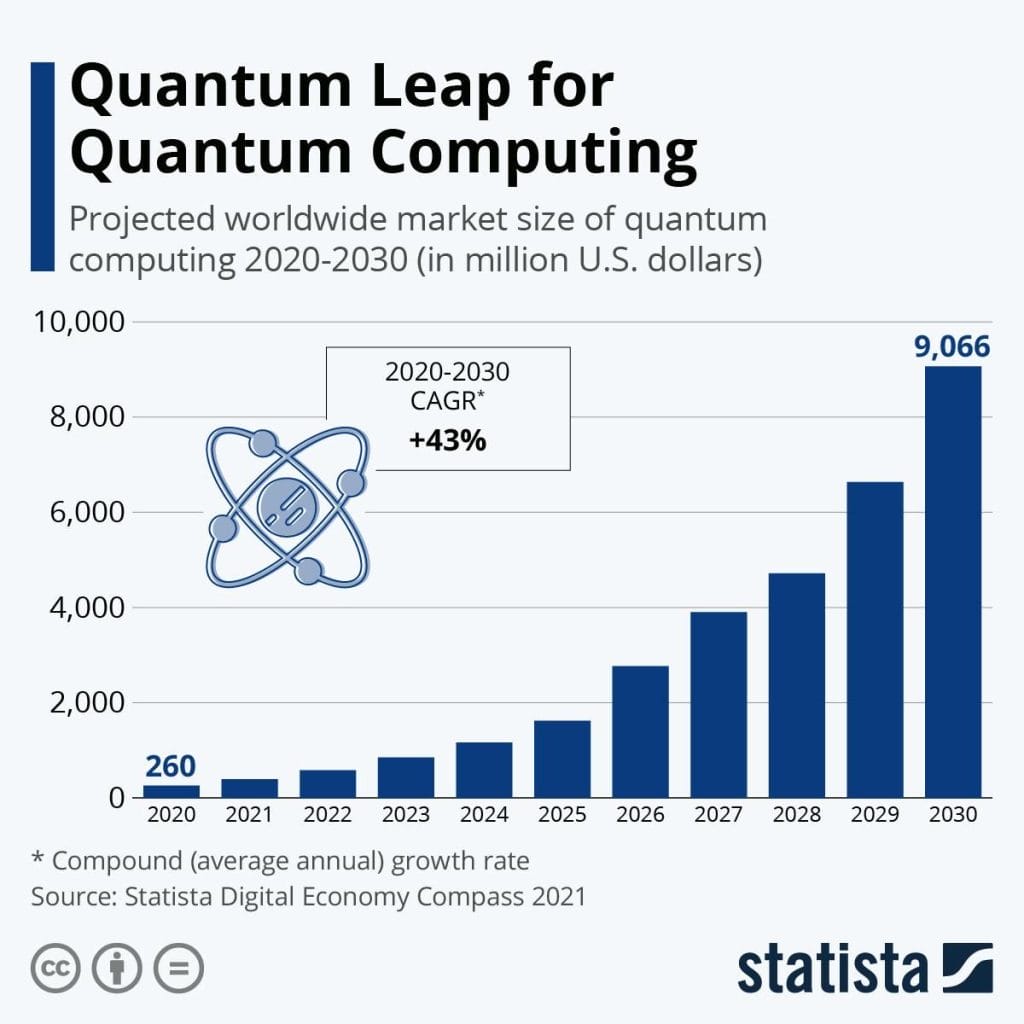
Quantum Leap for Quantum Computing
This graphic depicts the accelerated growth of the Quantum Computing sector and its increasing impact on the worldwide marketplace. The graphic captures how Qubits are beginning to be adopted into key sectors, many of which include Healthcare, Financial Services, Cybersecurity, Supply Chain / Logistics, and Science / Research. The visual provides a high-level look at the various elements associated with Quantum Technology such as Technological Advancement, International Collaboration, and Increased Investment in Quantum Computing. Quantum Computing is altering the future of all sectors, economies, and ways to advance problem solving on a global scale.
Bachelors in Quantum Computing : Trends, Insights & Predictive Analytics

Quantum computing is growing rapidly because of new developments in quantum hardware, error correction technology, quantum algorithms, and quantum cloud platforms. Many businesses are starting to look into how they can use the capabilities of quantum computing to improve their quantum programming degree driven businesses in predictive analytics, machine learning, risk modeling, optimization, and complex simulations. 

Emerging trends of bachelors in quantum computing that are being seen in the field of quantum computing today are hybrid classical-quantum computing, quantum-augmented AI, quantum cybersecurity, and industry-specific quantum solutions. As quantum systems grow stronger and become more readily available to businesses and organizations, it is anticipated that many organizations will utilize the insights obtained through quantum systems to make more informed decisions, speed up the pace of innovation, and become more competitive. 

By obtaining a Bachelor’s degree in Quantum Computing, students will learn about these new developments, evaluate large-scale computational problems, and develop the necessary quantum computing jobs skillset required to apply quantum computing technology towards the development of the future’s analytical and predictive applications across the spectrum of industries.

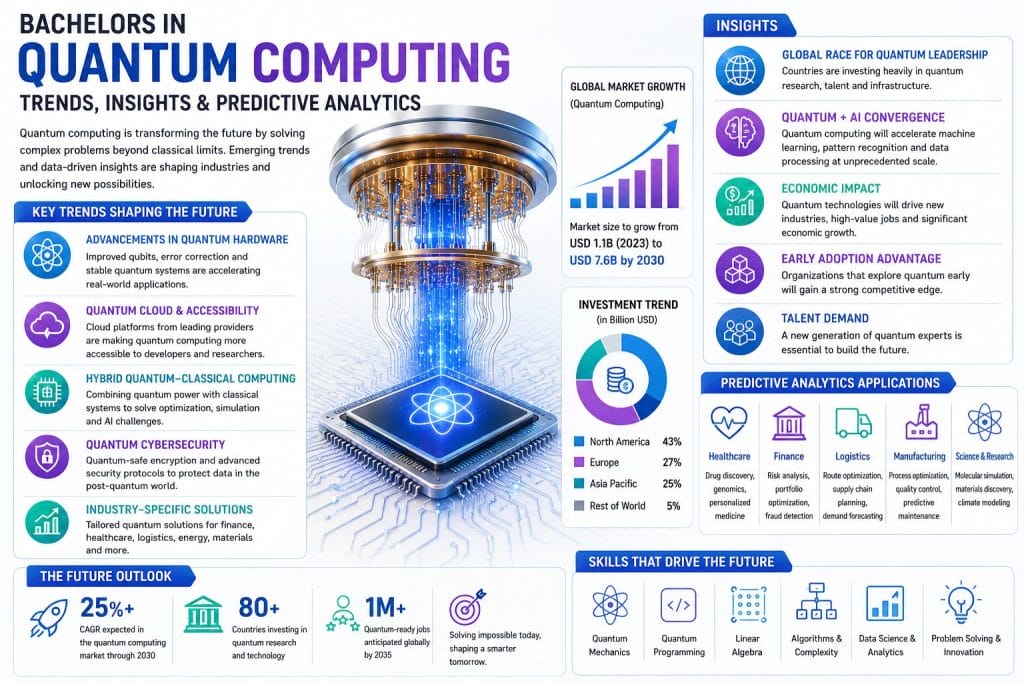
Bachelors in Quantum Computing
This infographic uses a streamlined approach to show the quantum computing industry’s changing future. Areas covered include trends, predictions, industry use cases, and potential for growth. The graphics include types of quantum computer (hardware), projected markets (size), projected investments, and projected workforce (hiring) associated with quantum technologies as they relate to the following sectors: healthcare, finance, cybersecurity, logistics (supply chain management), and science in the world’s economy.

Career Opportunities & Professional Development

A Bachelor of Science in Quantum Computing can provide opportunities for employment in an enormous array of growing and high impact quantum technology education industries; technology, research, finance, health care, cyber security, aerospace and advanced manufacturing are just a few! Career paths for Bachelor of Science in Quantum Computing graduates include: Quantum Computing Engineer, Quantum Software Developer, Quantum Algorithm Researcher, Data Scientist, Cryptography Specialist, Research Associate and Technology Consultant. Professionals who have experience with Quantum technologies will be in very high demand as companies continue to increase their use of Quantum technologies. 

In addition to gaining technical skills in their field of study, students develop critical skills that are transferable across industries: such as problem-solving, mathematics, programming, analytical thinking and a commitment to innovation/creativity. 

Graduates are prepared for a lifetime of continuous professional development through completing quantum engineer career research projects, obtaining certifications, collaborating with industry and attending conferences/continuing education in one of the fastest growing technological fields.
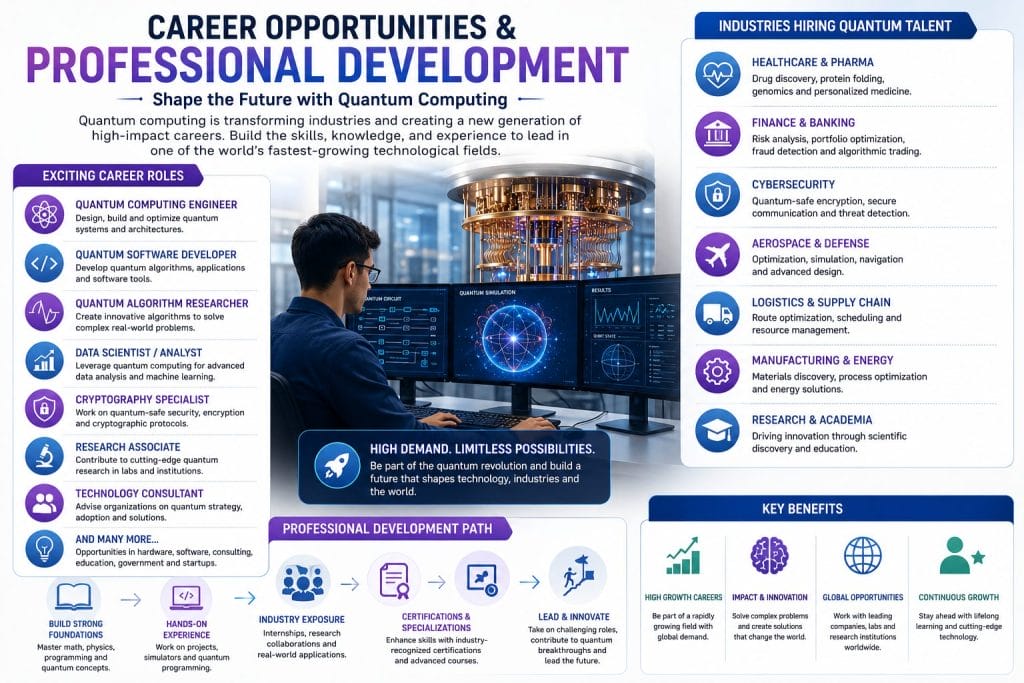

Career Opportunities & Professional Development
The infographic displays an array of possible career paths within quantum computing along with your complete professional growth plan to eventually succeed. High demand jobs, industries that need these jobs, necessary skills and certification requirements, research opportunities, and job advancement are all included in this visual representation. The visual representation showcases the worldwide increase in the demand for quantum professionals by showing how graduates can help drive innovation, technology growth, and scientific innovations to support many different types of industries.

The AI Experience: Future-Focused Areas in Quantum Computing

As artificial intelligence continues to advance rapidly, the use of these capabilities and the power of quantum computing will offer new opportunities to address many of the world’s most complex problems. A student earning a bachelors in quantum computing will be immersed in a number of emerging fields that include Quantum Machine Learning (both QML and QML-AI), quantum-enabled optimization techniques, intelligent simulation systems, quantum cybersecurity, as well as AI-based scientific quantum mechanics for computing discoveries. 

These emerging technologies will have a significant impact on the way that industries operate through accelerated data analysis, enhanced predictive modeling, optimization of supply chains, and improvements to both drug discovery and materials research. Students will gain a variety of skills through hands-on experience and by engaging in quantum hardware engineering current technology, which will allow them to work at the convergence of artificial intelligence (AI) and quantum, equipping them for a future where they can contribute to the groundbreaking advancements that will advance the next wave of computing and intelligent systems.

Contact Us Today!

Begin Your Journey!
AIU’s Summer of Innovation and Growth gives you the ability to earn up to $5000 in tuition credit by completing free lessons and courses.
Whether you’re looking to acquire new skills, advance your career, or simply explore new interests, AIU is your gateway to a world of opportunities. With free access to 3400 lessons and hundreds of courses the ability to earn credits and earn certificates there’s no better time to start learning.
Join us today as a Guest Student and take the first step towards a brighter, more empowered future.
Explore. Learn. Achieve.

Academic Freedom & Customized Curriculum

A bachelors in quantum computing provides an individualized educational experience that lets the student develop an academic path tailored to the student’s interests, career goals, and anticipated changes in the job market. Rather than following a fixed course sequence, students are encouraged to explore various disciplines, including quantum algorithms, AI, computer security, data science, mathematics, physics, and advanced computing. 

Academic flexibility encourages students to be creative independent thinkers and to pursue research in areas of specialization longer than with a structured academic program. By allowing quantum cryptography studies’ students to select coursework, research projects, and learning objectives based on their strengths and needs, Bachelor students will have developed expertise in those quantum machine learning areas most pertinent to each student’s career goals, while also possessing a broad base of knowledge on the rapidly-emerging field of quantum computing.

Why Study Bachelors in Quantum Computing at AIU?

Benefits of Bachelors in Quantum Computing

A bachelors in quantum computing will give you specialized training in one of the newest and most cutting-edge areas of technology available today: Quantum Computing. The program focuses on developing your fundamental knowledge of Quantum Computing through training in the areas of math, physics (quantum mechanics), computer programming, problem-solving skills, and computational thinking to help you develop quantum information science degree  skills in flow of ideas, innovation, and analytical thinking. 

Graduates have many opportunities to enter into new and developing jobs within the Quantum Computing industry, such as research, Artificial Intelligence (AI), Cybersecurity, Financial Industry, Healthcare Industry, and other Advanced Technology Industries. The interdisciplinary nature of this degree allows for a more adaptable and lifelong learning mindset to work across many different disciplines. With continued growth of investments in Quantum Technology worldwide, students with this degree will be at the forefront of scientific investigation and technological innovation.

Traditional vs Flexible Education : Bachelors in Quantum Computing

When it comes to conventional formal education programs, there is usually an established curriculum of courses that must be completed in a specific order and at a certain pace, which provides good support for developing some solid foundation in theoretical knowledge; however, this type of approach limits students when they want to explore different subjects as they relate to quantum computing.

Flexible learning allows the student more options when it comes to creating an individualized program that includes other disciplines such as AI (Artificial Intelligence), cybersecurity, data science, mathematics, and advanced computing that can be combined with their quantum studies. The level of flexibility will also enable students to work at their own speed, follow up on any research interests, and gain success in the relevant industries with skills relevant to the field they want to be involved with in the future.

By combining general foundational knowledge of quantum computing with tailored opportunities for learning about quantum computing, students will have an opportunity to develop an extensive and future-proofed body of expertise concerning quantum computing.

Key Strengths of the Bachelors in Quantum Computing at AIU

AIU’s Bachelors in Quantum Computing Degree is taught through the lens of Quantum Technology. The Bachelor of Science degree allows students to learn in a flexible way, academically innovative, as well as part of a multi-discipline degree program. The goal of the program is to give you knowledge about all the core concepts of quantum mechanics, computer science, mathematics, AI and Cyber-Security, and how you can utilize these domains to develop a knowledge base in Quantum Computing. The curriculum can be tailored to fit the needs and goals of each student to meet their goals and interests for their degree and beyond. 

Emphasis on independent study and developing critical thinking, as well as applying prior learning to real-world situations, will enable graduates to produce theoretical knowledge as well as develop practical skills for solving emerging technological problems. Graduates will have the capability to adjust and apply their educational background to the fast-paced evolution of Quantum Technology and will play major roles in helping advance the Quantum Technology field in their prospective industries. 

Want to Become an AIU Guest Student ?

Click Here 

Core Courses & Technical Skills

Important: Below is an example of the topics or areas you may develop and work on during your studies. By no means is it a complete or required list, as AIU programs do not follow a standardized curriculum. It is meant solely as a reference point and example. Want to learn more about the curriculum design at AIU? Check here: Course and Curriculum 

A bachelors in quantum computing gives students a solid background in Quantum Science, advanced math, programming computers, and computational theory. The curriculum is designed to give students a solid understanding in both the theory and application of quantum technology and allows them to use emerging quantum technologies and next-generation computing systems. Students will develop proficiency in quantum algorithms, quantum information processing, cryptography, artificial intelligence and data analysis, while also strengthening their ability to program computers, use logical reasoning and conduct scientific research. Through a combination of technical classes and practical experience, graduates will be prepared to address complex computational problems and help to innovate in technology related industries.

  • Introduction to Quantum Computing
  • Fundamentals of Quantum Mechanics
  • Calculus and Mathematical Methods
  • Quantum Algorithms and Complexity
  • Quantum Programming Languages
  • Quantum Circuit Design
  • Quantum Cryptography and Security
  • Ethics in Quantum Technology

Tools You Will Master

During their time pursuing a Bachelors in Quantum Computing, students receive hands-on training with many different kinds of tools and technologies that relate to the field of quantum computing; this means they will learn how to create quantum circuits and how to simulate quantum systems, as well as develop code to run on a quantum computer using the quantum programming environment. While using the tools mentioned above, students also have a chance to develop their coding skills by working with other forms of technology, such as data analysis, artificial intelligence, cloud computing, etc. Thus, students will develop a broad range of technical skill sets which can be used in both research and industrial settings.

  • IBM Quantum Platform – You can create, implement and measure the execution of quantum circuits on both real (physical) and simulated (virtual) hardware systems.
  • Qiskit – You can create, implement and measure the execution of quantum circuits on both real (physical) and simulated (virtual) hardware systems.
  • Microsoft Azure Quantum – Cloud-based resources will allow you to use cloud-based resources (i.e. computer resources) effectively to support the development of algorithms, design and execute quantum circuits, and develop and evaluate quantum ML applications.
  • Google Quantum AI Cirq – Cloud-based resources will allow you to build and create hybrid (quantum/classical) applications as well as developing new ways to apply quantum computing and ML technologies for building intelligent quantum models.
  • Amazon Braket – You can also use quantum annealing hardware to solve optimization problems and/or solve complex problems.
  • PennyLane – You can access resources through the cloud that allow you to simulate and monitor quantum systems and analyze quantum dynamics.
  • TensorFlow Quantum – Create intelligent quantum models by combining quantum computing with machine learning.

Career-Focused Learning in Quantum Computing

Through quantum computing, learners will connect theory with reality when learning about careers associated with quantum computing programs. Quantum computing students will be able to participate in activities that reflect real-world applications, such as quantum algorithms, quantum programming, machine learning, cryptography, optimization and cloud-based quantum multiple-access systems, among others, and gain a better understanding of how these technologies are changing industries. 

In addition to providing students with knowledge about these technologies, the curriculum will prepare students directly for future careers by covering topics such as problem-solving, research, innovative thinking and emerging trends in technology. The use of industry-inspired projects, simulations and computational challenges in this course will also provide students with the practical experience needed for employment in research, software development, cybersecurity, data science, finance, healthcare or any of the advanced technology industries that will require quantum computing expertise.

Real-World Projects & Capstone Experience

Hands-on Learning Projects & Capstone Experience are essential components of a bachelor degree program in quantum computing. These projects give students an opportunity to not only apply their theoretical knowledge, but also provide them with real-world challenges to solve. With real-world projects, students will have the ability to work on developing various types of projects that utilize quantum computing concepts; such as quantum algorithms, optimization problems using quantum computers, quantum machine learning models, cryptography systems utilizing quantum computing technology and quantum circuit design through industry standard platforms. 

Participating in these types of projects will help foster creativity, develop critical analysis skills, enhance teamwork and promote research-based approaches to problem solving. The culminating project (capstone) provides students the opportunity to demonstrate what they’ve learned through their academic studies, investigate a specific quantum computing problem, design and implement a solution(s), and to use their technical, analytical and communication skills in a research and professional environment.
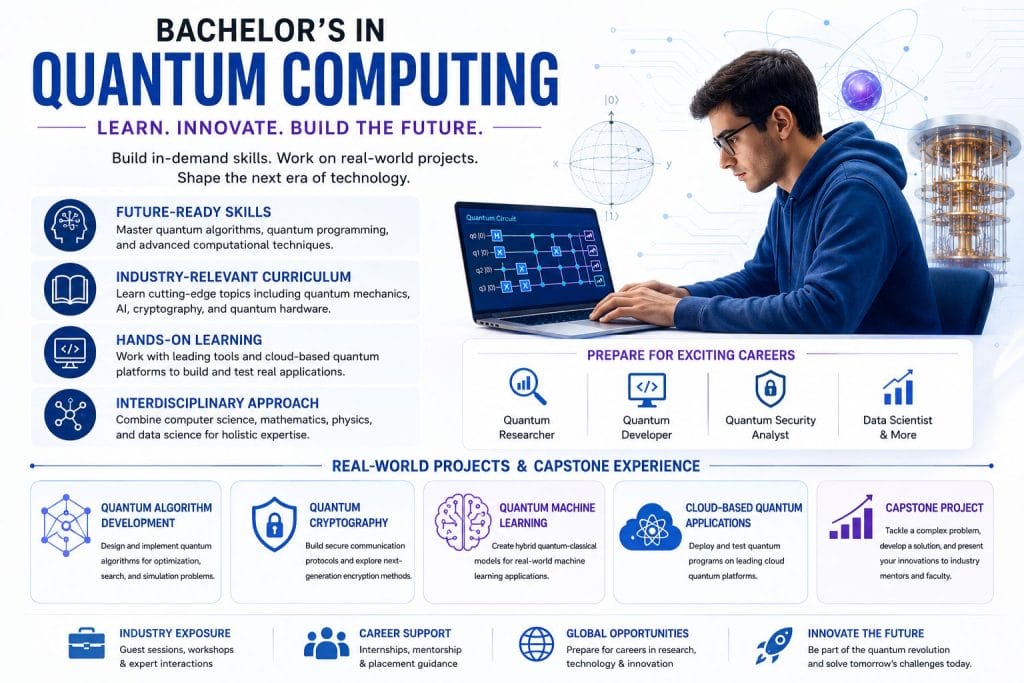
Bachelor's in Quantum Computing
The graphics represent the practicality and employability of a Bachelor of Quantum Computing. It features contemporary designs that illustrate skills that will be applicable in the future (future-ready), learning that correlates with employment needs (industry-related), an interdisciplinary approach to education (interdisciplinary), as well as providing hands-on project experience (hands-on projects.) . Developed algorithms using quantum computing, concepts and principles of cyber security, machine learning, cloud-based applications of quantum computing, as well as a capstone project, the graphics clearly show how to prepare for careers in the new quantum technologies.
Bachelors in Quantum Computing : Research Projects & Innovation

The graphics represent the practicality and employability of a Bachelor of Quantum Computing. It features contemporary designs that illustrate skills that will be applicable in the future (future-ready), learning that correlates with employment needs (industry-related), an interdisciplinary approach to education (interdisciplinary), as well as providing hands-on project experience (hands-on projects.) . Developed algorithms using quantum computing, concepts and principles of cyber security, machine learning, cloud-based applications of quantum computing, as well as a capstone project, the graphics clearly show how to prepare for careers in the new quantum technologies.

Transform Your Success Story with AIU

Begin Your Journey

Thesis & Research Defense Process

By providing students the opportunity to use a hands-on approach, the program promotes experiential learning and allows for the application of quantum computing concepts to real-world challenges and new technologies. In addition to completing extensive research and projects that require experiential learning through collaboration with individuals outside of their discipline, students will have numerous opportunities to develop advanced analytical, technical, and problem-solving skills using a hands-on approach. 

This experiential approach not only provides bridges between theoretical concepts and implementation, but also prepares students to be contributors to next-generation technology solutions, innovations in artificial intelligence, cybersecurity, optimization, scientific computing, and quantum computing.

Student Experience & Virtual Campus

The Student Experience & Virtual Campus has been developed for quantum computing students to provide flexibility, engagement and collaboration. Digital learning resources, interactive course content, virtual labs, and discussion forums are available to students wherever they are located around the world via the internet. The virtual learning experience enables students to study independently from home while remaining connected with fellow students, faculty, and industry professionals. Students build their technical knowledge through a variety of supporting academic services such as collaborative projects and technology-based classroom support when obtaining their degree in Quantum Computing.

Live Classes, Symposiums & Global Networking

Connecting student learning to global communities creates a connection between students and researchers, educators, professionals, and experts in the field. Guest speakers at events like virtual seminars, conferences, and educational events provide students with access to the latest advancements in quantum technologies, including artificial intelligence, cyber security, and emerging technologies, through meaningful and collaborative exchanges between students and professionals.

In addition, students have the opportunity to network with their peers and establish contacts within a global academic community to pursue research opportunities and stay informed about innovations that will shape the future of quantum technology.

Academic Resources & AI-Powered Learning

Through a wide range of academic resources and AI-driven learning tools; students have access to an assortment of learning materials, intelligent learning tools, and advanced digital resources that support the study of quantum computing. Students can access online Libraries, research databases, virtual laboratories, simulations and the latest AI learning platforms allowing them to study more effectively and receive customized learning support on their journey to understanding more complex concepts. 

Additionally, the use of AI technologies will improve the speed and accuracy of research, knowledge discovery, and personalized learning experiences by providing adaptive learning opportunities based on the individual needs of the learner. The appropriate use of these resources will also foster independent learning, critical thinking skills and the continual acquisition of skills, in addition to enabling students to continuously update their knowledge about advancements in quantum science and computing, as well as emerging technologies.

Explore AIU’s Mundi Magazine to Stay Updated on Latest News 

Get Started

Admission Requirements

To qualify for admission to a Bachelor of Science degree program in Quantum Computing, students must have received their high school diploma or equivalent from an approved institution. Applicants who are interested in mathematics, physics, computer science, or developing technologies will be able to demonstrate their eligibility for the program. In order to be admitted to the program, one must submit academic transcripts, proof of identity, and any additional documentation requested by the university. 

Although algebra, calculus, or programming may be helpful in most cases, many universities have an introductory class in quantum computing for students with a wider variety of academic experiences. The objective of the admissions procedure is to identify motivated students who wish to learn more about this rapidly changing field of study and have a desire to participate in and be part of the continued development of new technologies.

How to Apply ?

To make the process easier for prospective applicants for the Bachelors in Quantum Computing, the application process has been designed to be straightforward. The online application will include relevant academic documents (i.e. transcripts, ID, etc.) as well as any other paperwork required by the institution, and all necessary will be included. After the application has been received and reviewed, applicants will be contacted and notified of their program admission requirements, course selection and registration information, and other resources to assist them in their educational endeavors. 

For all of these reasons, it is critical for prospective students to thoroughly review the admission criteria, gather and prepare all necessary documentation and submit their application in order to comply with applicable deadlines as soon as possible. By preparing in advance of time, prospective students will help facilitate a seamless admission process which will allow them to begin to pursue the incredible possibilities that a quantum computing degree can provide them.

Tuition, Financial Support & Scholarships

Depending upon institution, degree program set up and course delivery format , Bachelors in Quantum Computing can have different associated costs or range of monetary values. The majority of universities provide various ways of helping students pay for their degree through flexible tuition options that attempt to level the playing field for students regardless of background, ethnic status, income level or other barriers to education. 

These tuition options typically combine tuition with other forms of student aid including but not limited to: scholarships/awards; grants; tuition reimbursement or assistance by employers ; military benefits; loans/educational financing; etc. Students considering a Quantum Computing degree need to research different financial aid programs and talk to Admissions Advisors about what types of financial aid might be available based on graduation date, previous degrees held, and service commitment. 

Investing at this time in an education in Quantum Computing will likely provide lifetime benefits since entry-level jobs generated from all areas of this dynamic technology area are expected to be some of the fastest growing & highest paying positions worldwide!

FAQs

What is a Bachelor's in Quantum Computing?

Bachelor’s Programs in Quantum Computing are undergraduate degrees that blend quantum physics, computer science, mathematics and information technology; to provide an understanding of how quantum computers work, and how they can be used to solve intricate problems. 

Courses are offered on quantum mechanics, quantum algorithms, quantum programming, cryptography and newer quantum technologies with the purpose of providing an adequate foundation for moving into research, developing software for quantum environments, protecting the cyber realm and working in advanced computing sectors.

What can you do with a quantum computing degree?

Graduates of a degree program focused on quantum computing will be able to pursue careers in such fields as software development, algorithm design, research and development, cybersecurity, and data science. As they enter the workforce, graduates will have the opportunity to contribute to the advancement of quantum computing technologies through their employment at technology firms, research institutions, federal and state agencies, financial services firms, and healthcare innovators.

Is quantum computing a good career?

With heavy investment flowing into the development of quantum technologies, many companies will be searching for talented individuals skilled in quantum algorithms and programming, cybersecurity and research. In addition to high-level work and salaries, quantum computing can provide opportunities for individuals to contribute to solving some of today’s largest challenges in computation.

What jobs are available in quantum computing?

Graduates with a degree in quantum computing can take on different jobs, including: Quantum Software Developer; Quantum algorithm engineer; Quantum research scientist, Quantum hardware engineer; Quantum machine learning specialist; Quantum cryptography specialist, Data scientist; AI engineer; Computational physicist, and Research analyst; In the field of technology, research institutions, government agencies, and centers for advanced innovation.

How long does it take to earn a bachelor's in quantum computing?

Approximately 3 years.

Let us know your goals and aspirations so we can chart a path at AIU to achieve them!
//
Admissions Counselor
Rene Cordon
Available
//
Admissions Counselor
Jessica Garcia
Available
//
Admissions Counselor
Sandra Garcia-Fierro
Available
//
Admissions Counselor
Prof. Emmanuel Gbagu
Available

"*" indicates required fields

This field is for validation purposes and should be left unchanged.
Name*

"*" indicates required fields

This field is for validation purposes and should be left unchanged.
Name*

"*" indicates required fields

This field is for validation purposes and should be left unchanged.
Name*

"*" indicates required fields

This field is for validation purposes and should be left unchanged.
Name*

"*" indicates required fields

This field is for validation purposes and should be left unchanged.
Name*

"*" indicates required fields

This field is for validation purposes and should be left unchanged.
Name*

"*" indicates required fields

This field is for validation purposes and should be left unchanged.
Name*

"*" indicates required fields

This field is for validation purposes and should be left unchanged.
Name*

"*" indicates required fields

This field is for validation purposes and should be left unchanged.
Name*

"*" indicates required fields

This field is for validation purposes and should be left unchanged.
Name*

"*" indicates required fields

This field is for validation purposes and should be left unchanged.
Name*

"*" indicates required fields

This field is for validation purposes and should be left unchanged.
Name*

"*" indicates required fields

This field is for validation purposes and should be left unchanged.
Name*

"*" indicates required fields

This field is for validation purposes and should be left unchanged.
Name*

"*" indicates required fields

This field is for validation purposes and should be left unchanged.
Name*

"*" indicates required fields

This field is for validation purposes and should be left unchanged.
Name*

"*" indicates required fields

This field is for validation purposes and should be left unchanged.
Name*

"*" indicates required fields

This field is for validation purposes and should be left unchanged.
Name*

"*" indicates required fields

This field is for validation purposes and should be left unchanged.
Name*

"*" indicates required fields

This field is for validation purposes and should be left unchanged.
Name*

"*" indicates required fields

This field is for validation purposes and should be left unchanged.

Submit your data.

After submitting, a widget will appear at the bottom-left corner so you can start your training.

Name*

Do you hate spam? Don’t worry, we hate them too. Your email is 100% secure with us.

"*" indicates required fields

This field is for validation purposes and should be left unchanged.

Submit the form below to begin your interview.

After submitting, a widget will appear at the bottom-left corner so you to start your AI interview.

Name*
Accepted file types: docx, pdf, Max. file size: 500 MB.

Do you hate spam? Don’t worry, we hate them too. Your email is 100% secure with us.