
Trends, Insights & Predictive Analytics in Semiconductor Technology
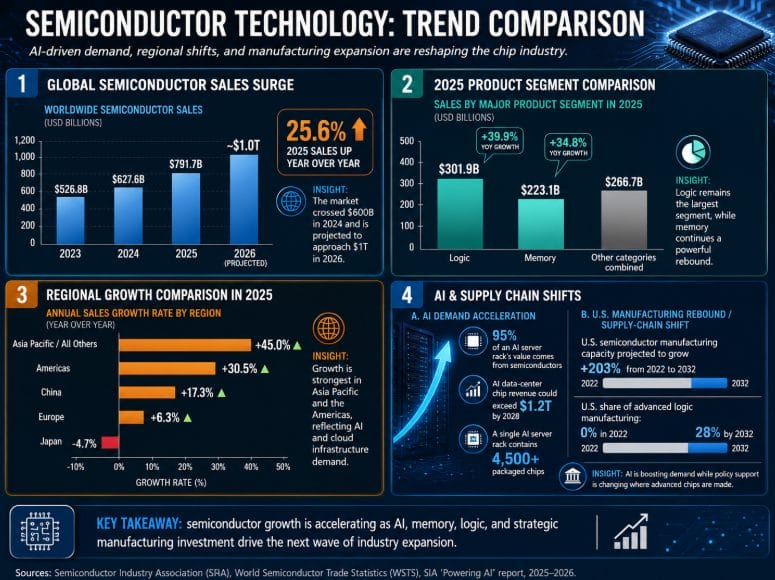
The semiconductor industry is the foundation of all electronics in today’s world, covering consumer devices, data centers, automotive, and industrial automation among other fields. The most recent estimates (2024-2025) of the market size show that the total value is estimated at around $600-$800 billion. It is recovering strongly from any supply chain disruptions. There is a winner-take-most situation, in which advanced nodes (leading logic and high bandwidth memory) generate value, whereas mature nodes concentrate on cost-effectiveness and production volumes.
Segments include integrated circuits (logic, memory, analog), discrete components, sensors, and optoelectronics. Leading companies control design (fabless), fabrication (foundry companies such as TSMC), and tools for manufacturing. Geopolitical issues, resiliency of the supply chain (such as CHIPS Act funding), and skill shortages are some of the key issues along with fast technological development.
Future Trends
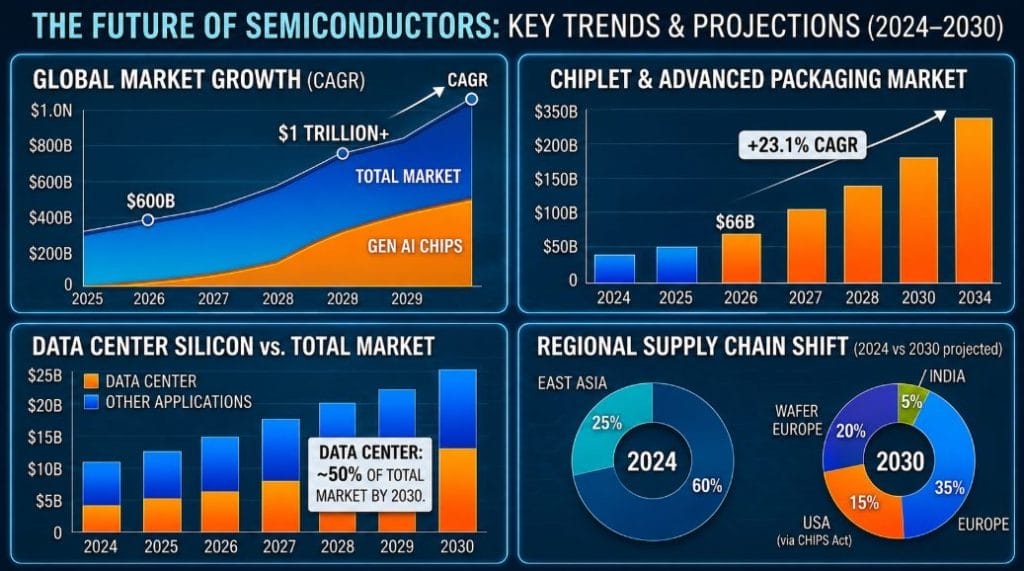
Driven by an unprecedented AI infrastructure boom, the global semiconductor market is projected to skyrocket past $1 trillion by the end of 2026 (up from ~$600 billion in 2025). Half of these total industry revenues are expected to come directly from Generative AI chips alone.
Here is the refined, data-driven breakdown of the future trends shaping this explosive growth:
- Shift to “Chiplets” & 3D Advanced Packaging
- The Trend: Traditional horizontal scaling (Moore’s Law) is hitting physical limits. Manufacturers are pivoting to stacking smaller, specialized dies vertically.
- The Data: The global chiplet market is projected to surge from $66.6 billion in 2026 to over $350 billion by 2034, maintaining a massive 23.1% CAGR.
- The Benefit: Shifting from single monolithic chips to multi-die chiplet architectures cuts manufacturing costs by up to 30% while isolating structural defects to improve wafer yields.
- Explosive Memory and AI Hardware Demand
- The Trend: AI training and continuous real-time inference are forcing a massive structural repricing of data center components, with a major focus on High-Bandwidth Memory (HBM).
- The Data: Driven overwhelmingly by hyperscaler demand, overall memory revenues are expected to hit $200 billion to $226 billion in 2026. Data center semiconductors will make up nearly half the total market by 2030, reaching $843 billion.
- The Constraint: HBM supply is highly constrained; major manufacturers report allocations are entirely pre-committed and sold out deep into 2026 and 2027.
- Move Beyond Silicon to Wide-Bandgap Materials
- The Trend: Silicon is hitting its thermal and voltage limits. Automotive and industrial sectors are swiftly migrating to alternative materials like Silicon Carbide (SiC) and Gallium Nitride (GaN).
- The Data: Driven by the shift to high-voltage (800V) electric vehicle powertrains, automotive applications are the fastest-growing segment in advanced material integration, charting a 10.1% CAGR into the 2030s.
- Geopolitical Reshoring & Supply Chain Diversity
- The Trend: Heavy regional concentration has turned semiconductor manufacturing into a national security priority, sparking massive domestic subsidy programs.
- The Data: Over $114 billion in direct grants and loan guarantees are being deployed via the US CHIPS Act to fund local fabrication and advanced packaging lines. India is injecting $17 billion into local ecosystems to buffer against future East Asian supply bottlenecks.
Trend Comparisons
Traditional trends (e.g., Moore’s Law scaling) are complemented or challenged by new paradigms:
- Dimensional Scaling vs. System Integration: Shrinking transistors continues but slows; emphasis shifts to 3D stacking, chiplets, and advanced packaging for performance gains.
- General-Purpose vs. Domain-Specific Chips: Rise of AI-specific accelerators contrasts with versatile CPUs; edge AI favors specialized, power-efficient designs.
- Data Center vs. Automotive/Industrial: Data centers show hyper-growth (potentially 10%+ CAGR in servers) driven by AI, while automotive offers steadier, high-volume growth with reliability demands. Consumer electronics remain moderate (~6% CAGR).
- Mature vs. Leading-Edge Nodes: Leading-edge captures most value and growth; mature nodes prioritize cost and legacy support.
AI and digitalization accelerate all segments, but unevenly—top innovators in AI/memory benefit most.
Predictive Analytics
Predictive models in the industry leverage AI/ML for:
- Yield Optimization and Defect Prediction: Real-time process control, anomaly detection, and root-cause analysis to boost manufacturing efficiency.
- Demand Forecasting: Analyzing AI/data center investments, automotive trends, and geopolitical signals for better inventory and capacity planning.
- Predictive Maintenance: Reducing downtime in fabs through sensor data and ML.
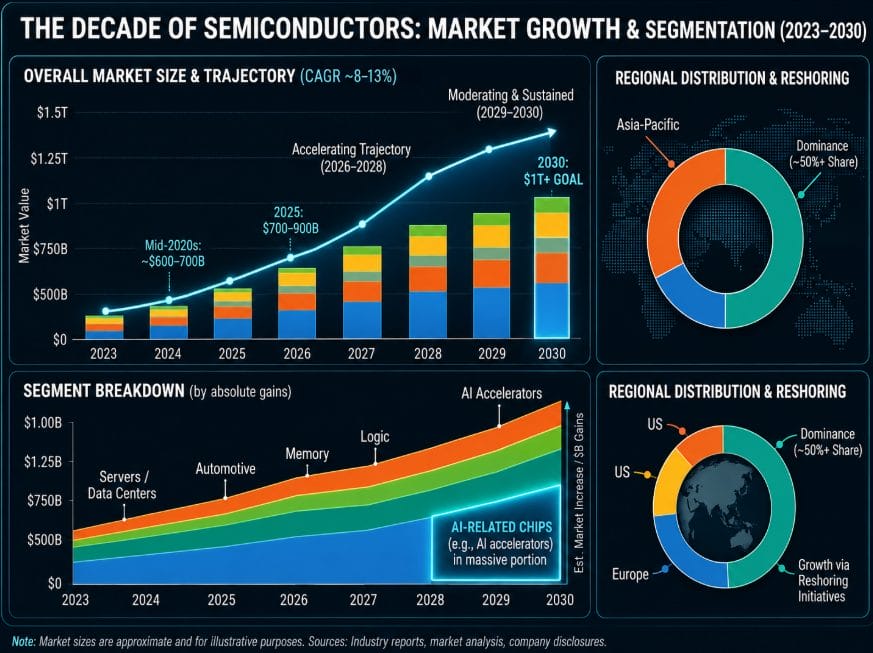
- Market Projections: Consensus points to the industry reaching ~$1 trillion by 2030 (some estimates $1.5-1.8T), with CAGRs of 8-13% depending on AI acceleration. Longer-term (to 2035+), values could exceed $1.5-2T+ with sustained AI/automation drivers.
Industry Growth Charts
- Overall Market: From ~$600-700B (mid-2020s) to $1T+ by 2030 (CAGR ~8-13%). Steep upward curve post-2024, fueled by AI.
- Segment Breakdown: Servers/data centers and automotive lead; memory/logic see highest absolute gains. AI-related chips could represent a massive portion (e.g., accelerators TAM estimates in hundreds of billions).
- Regional: Asia-Pacific dominance (~50%+ share), with US/Europe growth via reshoring.
- Text Representation Example (Market Size Projection):
2025: ~$700-900B
2030: $1,000-1,600B
Growth trajectory: Accelerating through 2026-2028, then moderating but sustained.
Insights on Future Technologies & Smart Industries
Future technologies include:
- Neuromorphic and Photonic Computing: Brain-inspired chips and light-based processing for energy-efficient AI.
- Quantum Semiconductors: Supporting quantum computing advancements.
- Wide-Bandgap (SiC/GaN): For high-power, high-efficiency applications in EVs and renewables.
- 6G and Beyond: Ultra-high-speed connectivity chips.
Smart Industries: Semiconductors enable Industry 4.0/5.0—smart factories with robotics, predictive maintenance, IIoT, and digital twins. Automation and AI integration create “lights-out” manufacturing with real-time optimization. This extends to smart cities, healthcare (wearables/implants), and sustainable energy systems.
Impact of AI on the Field
AI is a dual-force multiplier:
- Demand Side: Massive need for AI chips (GPUs, TPUs, accelerators) drives industry expansion; data center AI could dominate growth.
- Supply Side: AI enhances design (faster verification, generative AI for layouts), manufacturing (process optimization, yield improvement), and testing. It reduces time-to-market and costs while improving power efficiency.
- Challenges: Concentrated benefits (top firms), high energy demands, and talent needs. AI in semiconductors is projected to grow significantly (e.g., AI-in-semiconductor market CAGRs in double digits).
Overall, AI is reshaping the industry from “silicon squeeze” (concentrated gains) to broader transformation.
Scope of Automation
Automation in semiconductors is advanced but evolving toward “full automation” and smart manufacturing:
- Current: High in wafer fabs (robotics for handling, process tools) to minimize contamination and human error.
- Future Scope: AI/ML for closed-loop control, digital twins, predictive systems, and end-to-end integration (sub-fab to packaging). Focus on zero-defect for automotive-grade, adaptive processes, and sustainability.
- Benefits include higher yields, lower costs, scalability, and resilience. Challenges: Complexity of processes and integration costs. This supports smart industries by enabling precise, data-driven production at scale.
Future Career Demand in Evolving Digital Economies
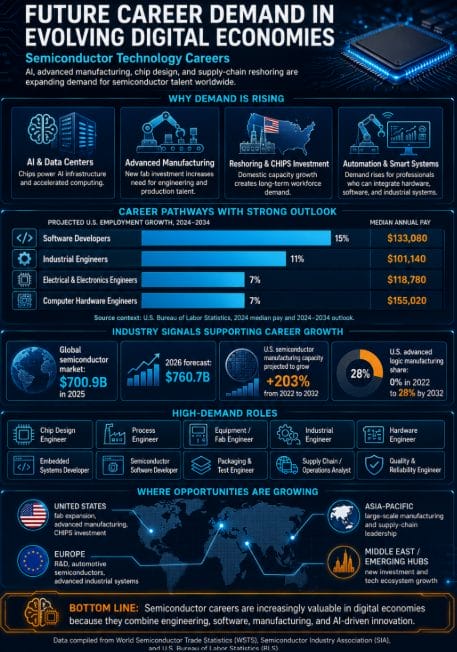
Demand is robust and growing. The US alone may need ~115,000 additional semiconductor jobs by 2030 (33% growth), with many technical roles at risk of going unfilled without expanded education pipelines. Globally, talent shortages could exceed 1 million by 2030.
High-Demand Areas:
- Design engineers (VLSI, AI chips, advanced nodes).
- Process/Equipment engineers (fabrication, yield).
- AI/ML specialists for chips and manufacturing.
- Automation, robotics, and smart manufacturing experts.
- Materials scientists (new compounds), test engineers, and supply chain specialists.
- Emerging: Quantum, photonic, neuromorphic, cybersecurity for chips.
A Bachelor’s in Semiconductor Technology positions graduates well for these roles in a high-growth, high-paying field tied to digital economies (AI, EVs, IoT, automation). Skills in hardware-software co-design, data analytics, and sustainability will be key. Programs should emphasize hands-on fab experience, AI integration, and interdisciplinary training to meet industry needs.
Bachelor’s in Semiconductor Technology provides the necessary technical skills to work in different semiconductor technology occupations in various industries around the world. In a semiconductor technology program, students acquire knowledge in semiconductor devices, integrated circuits, wafer processing, chip production, and electronic systems.
A degree in semiconductor technology, bachelor of semiconductor technology, semiconductor engineering degree, microelectronics engineering degree, chip design degree, VLSI technology degree, semiconductor manufacturing degree, or semiconductor studies degree – allows graduates to seek occupations in semiconductor engineering related to chip design, testing, production, research, and development. Also, the industries that hire professionals with expertise in electronics and semiconductor technology ensure expertise in – semiconductor manufacturing, consumer electronics, automotive, telecommunications, aerospace, and health care technology.
Future-oriented areas like nanoelectronics technology, AI hardware, semiconductor materials science, and semiconductor fabrication technology present great opportunities for career growth – fantastic opportunity for professionals. Students can enhance their portfolio by participating in the following – integrated circuit design study projects, completing internships, getting certified, and even earning a microelectronics degree online under the guidance of mentors and academic advisors. In fact, AIU even helps to advance careers through career counseling, resume support, networking, and professional development.
Career Salary Trends
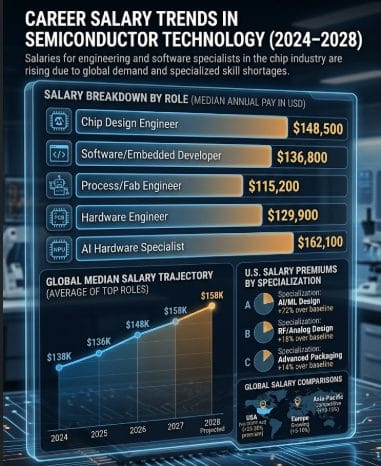
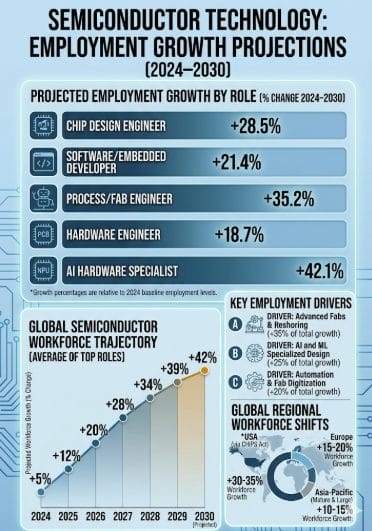






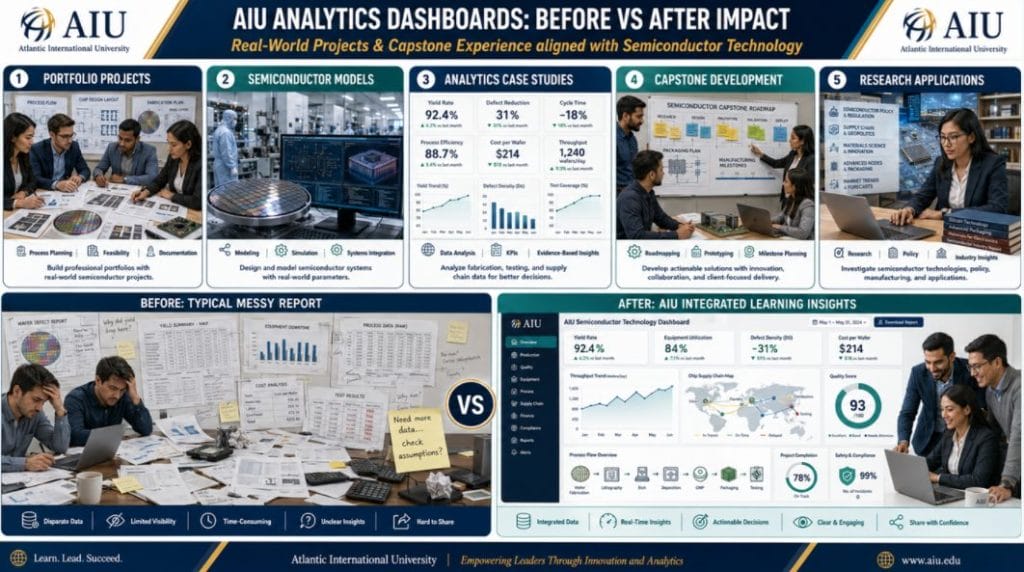
In AIU, bachelors in semiconductor technology program connects theoretical concepts and industrial practices with practical projects and capstones. In the semiconductor technology degree and bachelor of semiconductor technology programs, the students develop portfolios based on semiconductor devices, integrated circuits, electronic systems and nanoelectronics technology.
The semiconductor technology program includes AI models, data analytics case studies and research-based assignments to enhance the learners’ abilities that will be useful in their semiconductor engineering degree, microelectronics engineering degree and VLSI technology degree. The learners study semiconductor materials science, wafer fabrication, chip manufacturing, and semiconductor fabrication technology in solving engineering problems.
The focus of the capstone projects is on the studies of integrated circuit design, process optimization, manufacturing analytics and applications in electronics and semiconductor technology. The capstone projects will help the graduates who wish to earn a chip design degree, chip manufacturing degree, semiconductor manufacturing degree and semiconductor studies degree.
With the applied research and industry projects, AIU helps the learners gain practical experience in the rapidly developing area of semiconductor technology, including semiconductor engineer jobs and semiconductor manufacturing careers. The learning flexibility allows the students to get a microelectronics degree online for career-based developments in microelectronics engineering and semiconductor technology through the right academic resources.
Research Projects & Innovation in Bachelors in semiconductor technology
Research Projects & Innovations form an essential part of a bachelors in semiconductor technology, as students will gain practical knowledge of the latest trends and technologies in the field of semiconductor technology and advanced electronics. A degree in semiconductor technology or a Bachelor of Semiconductor Technology offers students the opportunity to take up projects related to integrated circuits, semiconductor devices, wafer fabrication and chip manufacturing process. In a contemporary semiconductor technology program, students learn about the fields of semiconductor materials science, nanoelectronics technology and applications in electronics and semiconductor technology in a unique and unrepeatable approach.
Students who take up a degree in semiconductor engineering, microelectronics engineering or VLSI technology focus their research on integrated circuit design, semiconductor fabrication technology and novel electronic systems. Such research projects help develop the necessary skills for a chip design degree, chip manufacturing degree or semiconductor manufacturing degree.
The course also provides adequate preparation for a range of semiconductor technology jobs, such as semiconductor engineer jobs and careers in semiconductor manufacturing. Whether enrolled in a conventional program or a microelectronics degree online, students with a semiconductor technology degree will have sufficient knowledge to revolutionize the world of semiconductors.
- MBM300 Thesis Proposal
- MBM302 Bachelor Thesis (5,000 words)
Publication: At AIU, we prioritize cutting-edge graduate research here, fostering academic excellence through the dissemination of groundbreaking discoveries. In the field of Semiconductor Technology, we empower graduate students to present innovative ideas, enriching scholarly dialogues. Our commitment to publishing student research enhances their academic impact, laying a solid foundation for budding scholars and driving the field forward.