Doctor of Hydrology

School of Science and Engineering

Academic Freedom to Discover Your Purpose

Open Curriculum Design at Atlantic International University

A Doctor of Hydrology is the highest level of educational credential that can be earned by an individual working to advance water science and sustainable resource management. The program focuses on research-intensive study of surface water and groundwater systems, watershed systems, hydrogeology, climate change and its associated effects, drought and flood management, water quality, and advanced hydrologic modeling. 

As part of their doctorate in hydrology education, students learn how to analyze complex water systems, use GIS and other geospatial technologies related to water, apply their skills through the completion of original research on global water issues, and develop scientific knowledge of water systems. Graduates of the Doctor of Hydrology program develop PhD in Hydrology skills that will prepare them for leadership positions in academia, government, conservation organizations, research organizations, consulting businesses, and multilateral organizations where they will develop innovative hydrology doctoral degree ways to solve the problems of water security, ecosystem preservation, and climate change adaptation.

Doctor of Hydrology : Industry Growth & Global Impact

An increased global need for experts in hydrology is arising due to the growing commitment of governments, industry and international groups in the field of water sustainability and resilience against the impacts of climate change. Among many others, the rapid urbanisation, increasing number of doctor of water resources areas without adequate water supply, the rise of extreme weather incidents within a short time frame; all contribute to making this area of doctorate in hydrology expertise very important across sectors such as infrastructure, agriculture, mining, energy production, consulting on environmental matters and managing disaster risks. Significant advances in technology with respect to remote sensing using satellites as well as GIS hydrology degree mapping toolkits, AI-based doctor of hydrology software tools and predictive hydrology modelling enabling a much-improved ability to monitor how we manage our water resources. 

By earning their Doctor of Hydrology , professionals/researchers will be well positioned to lead innovative research, drive changes in water-related policies, create new methods for managing water resources and foster global partnerships devoted to providing access to clean drinking-water, restoring and maintaining ecosystems, adapting to climate change, and promoting sustainable development initiatives around the world.
doctor of hydrology
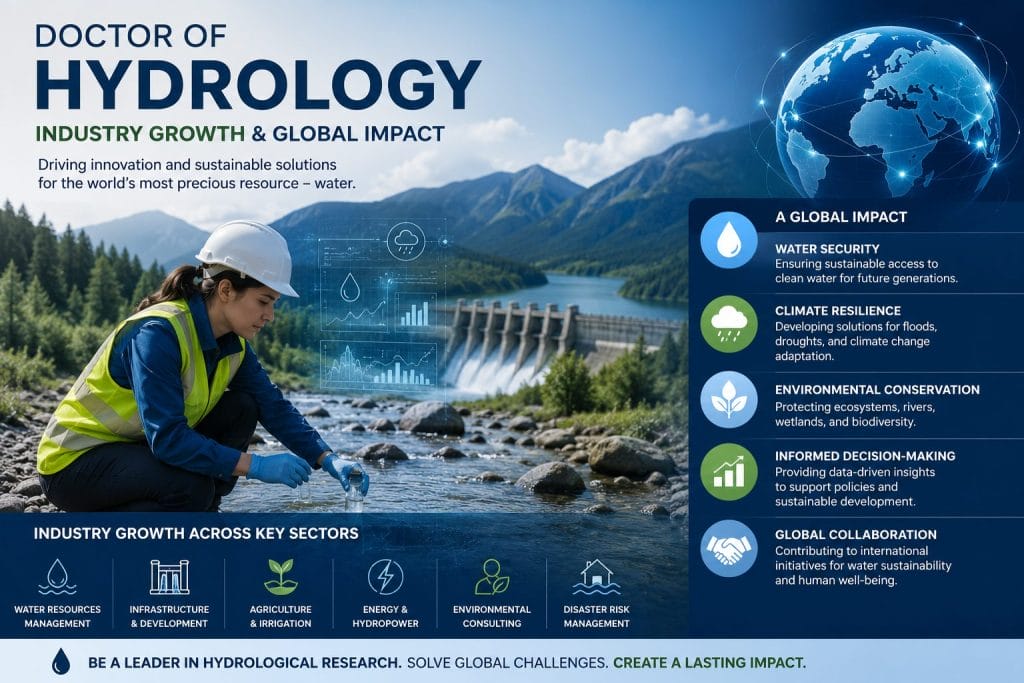
This photo shows a Hydrologist working next to a river and a dam collecting water samples to represent research in Water Resource Management. The image contains digital analytics, connecting a global network, and industry icons that illustrate how hydrology supports climate change adaptability; preserving the environment; planning for infrastructure; and providing sustainable methods for managing water resources on a global basis.
Doctor of Hydrology : Trends, Insights & Predictive Analytics

New advancements in technologies used in data science, AI, Remote sensing and Geospatial, are modernizing Hydrological services with more detailed information on monitoring & predicting water systems. By using online doctorate in hydrology satellite images; Geographic Information Systems (GIS); IoT-type sensors; various climate models; and machine learning, present day Hydrologists can forecast flooding, draughts, ground water depletion and changes in water quality with much greater accuracy. 

Predictive analytics allow government, industry and environmental organizations to make more educated decisions regarding water allocations, disaster preparation, planning infrastructure, and maintaining or improving the health of the surrounding ecosystems. A Doctor of Hydrology can develop researchers who specialize in utilizing advanced analytical tools along with traditional scientific water resource management degree research into creating innovative and data driven methods for improving water security and enhancing resiliency to both environmental and climate based challenges.

doctor of hydrology trends insights predictive analytics
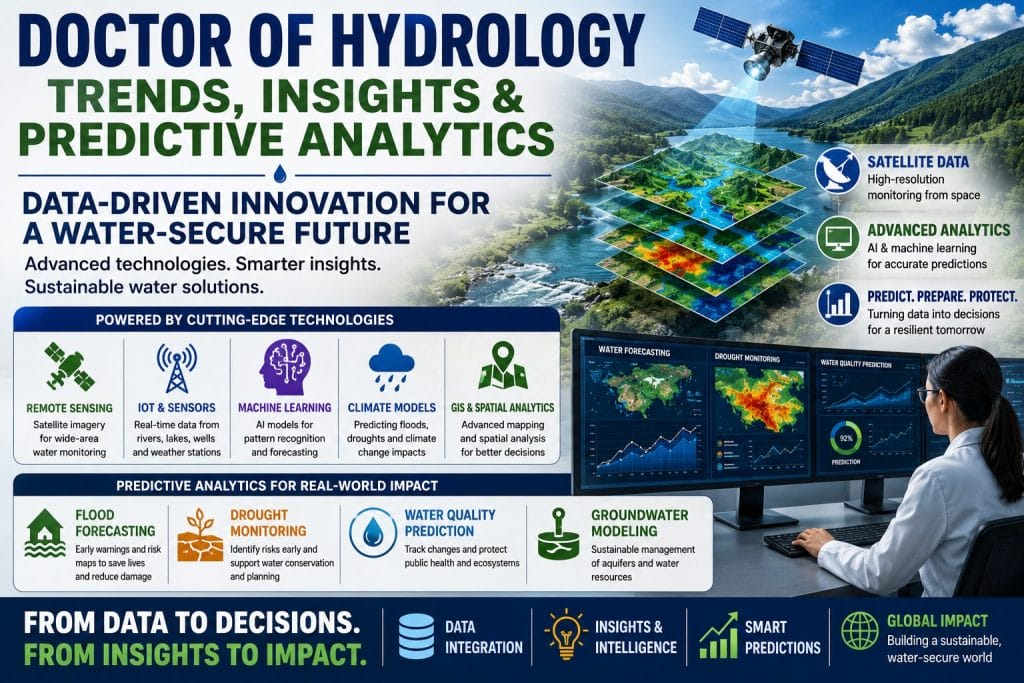
This visual summary shows the application of new technologies to enhance hydrology utilizing methods such as predictive analytics, satellite monitoring, AI, IoT sensors and GIS mapping. The infographic illustrates how data is used in forecasting flood events, droughts, groundwater levels, and water quality which leads to more insightful decision-making, better management of natural resources, and creates conditions where we are better prepared for climate changes and able to protect the environment globally.

Career Opportunities & Professional Development

With a best Doctor of Hydrology program, graduates are well prepared for positions as hydrologists, hydrogeologists, water resource scientists, environmental researchers, watershed managers, climate risk analysts, GIS and remote sensing specialists, or professors at the university level. Increasingly, due to growing investment into sustainable water infrastructure and managing climate change impacts, hydrologists have become very desirable experts capable of developing innovative online doctorate in hydrology solutions, providing guidance to public policy makers and managing complex water delivery systems (public, private and governmental), as well as contributing significantly to ongoing research within the scientific community. A doctor of hydrology also provides professional development and opportunities for involvement through interdisciplinary collaboration, advanced research, scholarly doctorate in hydrology publication and participation in international and professional organizations/conferences.
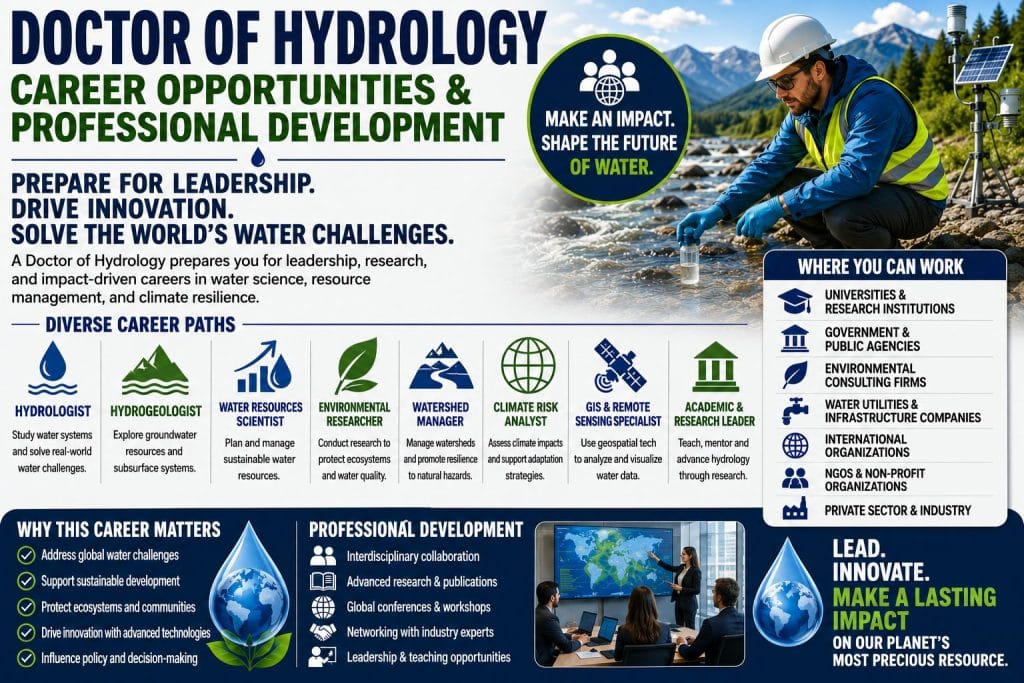

doctor of hydrology career opportunities professional development
The graphic depicts different career paths available within the field of hydrology, as well as individuals performing different kinds of field studies and employing advanced tracking technologies. Graphic design elements, such as bold graphics, highlight the key elements of the profession – being a leader, innovating, having a commitment to the environment, and providing various pathways to a career through academia, government, consulting, research, and global agencies committed to managing water resources in a sustainable way.

The AI Experience: Future-Focused Areas in Hydrology

By using Artificial Intelligence methods and advanced water resources research degree tools to derive doctor of hydrology solutions from environmental data collected with satellite imagery, drone imaging, IoT sensing, weather station measurement, and careers with a doctorate in hydrology with hydrologic monitoring networks, we can analyze hydrological systems and systems quickly and accurately. With AI based analytical doctorate in hydrology models able to provide predictive predictive analyses of the likelihood of flood, drought, depletion of groundwater supplies, and changes in quality of water within seconds or minutes instead of weeks or months; Machine Learning Algorithms can be used to strengthen existing Watershed Model predictive analytic capabilities, create improved operational efficiencies associated with reservoir management, identify outliers in water distribution systems, economize on predictive capability related to the adaptation of climate, automating the process of research projects through automated data analysis, improving Geospatially Based Analysis, and discovering patterns in empirical (actual) data that traditional or manual analytical methods may not be capable of identifying.

The Doctor of Hydrology prepares future researchers to be able to integrate the use of Artificial Intelligence with existing hydrological science in order to create innovative and data driven solutions for maintaining water security and improving disaster preparedness, effectively managing natural resources sustainably while addressing the increasing challenges related to climate change, environmental conservation, and ultimately enhancing the accredited PhD in hydrology health of hydrological systems during periods of high volume precipitation or drought conditions.

Contact Us Today!

Begin Your Journey!
AIU’s Summer of Innovation and Growth gives you the ability to earn up to $5000 in tuition credit by completing free lessons and courses.
Whether you’re looking to acquire new skills, advance your career, or simply explore new interests, AIU is your gateway to a world of opportunities. With free access to 3400 lessons and hundreds of courses the ability to earn credits and earn certificates there’s no better time to start learning.
Join us today as a Guest Student and take the first step towards a brighter, more empowered future.
Explore. Learn. Achieve.

Academic Freedom & Customized Curriculum

With a Doctorate of Hydrology, you have complete autonomy to create a personalized learning experience through a learning and research pathway that is uniquely tailored to your research interests and career goals. Students will have the opportunity to focus on specialized topics such as surface and groundwater hydrology, hydrogeology, integrated watershed management, hydroinformatics, water quality, adaptation to climate change, flood and drought forecasting, remote sensing, spatial analysis/GIS, environmental modeling and the sustainable management of our water resources. 

The flexibility of the degree program helps to foster interdisciplinary watershed management studies research, through the integration of environmental science, engineering, geospatial technologies, data analytics and public policy. As a result, doctoral students engaging in original research will have opportunities to work collaboratively across disciplinary boundaries, as well as develop new and creative environmental hydrology research solutions to address complex water-related issues, while simultaneously developing the skill set needed to pursue a career in academia, government, business, or international research institutions.

Why Study Doctor of Hydrology at AIU?

Benefits of Doctor of Hydrology 

The Doctorate in Hydrology offered by AIU is geared towards those taking classes in Hydrology who wish to expand their knowledge and skillsets while continuing to balance family and work commitments. For students of surface water hydrology pursuing their doctorate in Hydrology, the distance learning format offers students the ability to complete individualized doctor of hydrology study based on their goals and interests through a research-oriented curriculum which includes practical experience and application.

AIU provides a global learning environment that connects students to faculty, researchers, and fellow students from around the world to facilitate international cooperation and multi-disciplinary hydrology doctoral program perspectives. AIU also provides access to climate and water resources, digital academic resources, virtual water resources doctorate educational resources, research assistance, and opportunities to publish academic work that develop the analytical, leadership, and scientific research capabilities of graduates. The hydrologic modeling studies program will prepare professionals for management positions in academia, governmental agencies (federal, state, or local), consulting firms, research institutions, and international agencies and organizations, along with other companies whose mission is to promote sustainable water resources and environmental conservation.

Traditional vs Flexible Education : Doctor of Hydrology 

Most traditional hydrology doctoral programs are set up with a structured academic pathway that includes a set curriculum, is required by the school to be attended onsite, and is limited to a pre-decided research timeline. Although they do provide students with some level of academic structure, many of these programs provide limited support for working professionals, international students, or researchers that have to balance their careers and other life commitments.

A flexible Doctorate of Hydrology provides a personalized hydrology research  program for each student based on his or her individual needs. By being able to pursue their area of research interest in relation to their professional goals and schedule, graduate students have greater opportunity for specialisation in areas such as groundwater hydrology, hydroinformatics, watershed management, climate change resilience, remote sensing (RS), GIS, and water resource policy, while also being able to make academic strides towards that goal even if they have daily work obligations.

This flexibility is provided through the incorporation of digital learning tools and resources for online collaboration, independent research activities, and ultimately creates a more flexible learning environment in which innovation, cross-discipline research, and practical solutions can be developed to help address global water and environmental problems.

Key Strengths of the Doctor of Hydrology at AIU

The Doctor of Hydrology (D.Hydrol.) degree program at AIU combines flexibility with the ability to conduct advanced research that prepares students for leadership roles in the areas of water sciences and environmental sustainability. Emphasizing independence and collaboration, as well as practical solutions, this program allows students to carry out their own research on various topics including climate change, groundwater systems, watershed management, hydroinformatics, and ecosystem conservation; to investigate complex problems that relate to water resource issues; and to develop their research skills.

The opportunity to customize the degree according to students’ professional backgrounds and experiences, and research interests makes it unique compared to other programs. Further, as an international and global university, AIU offers students worldwide access to numerous digital resources and technologies, and provides experienced faculty and advisors to guide them through their educational journey.

Through the use of innovative technology, such as GIS, remote sensing, artificial intelligence, predictive analytics, and environmental modeling, the Doctor of Hydrology program uses innovation to stimulate and develop students’ critical thinking, scientific inquiry, and evidence-based decision-making. Graduates of this program will have been equipped with the skills necessary to conduct impactful research, influence environmental policy, and lead sustainable water management initiatives in academia, governments, private enterprises, and international organisations.

Become a Doctorate in Hydrology from AIU 

Get Started

Core Courses & Technical Skills

Important: Below is an example of the topics or areas you may develop and work on during your studies. By no means is it a complete or required list, as AIU programs do not follow a standardized curriculum. It is meant solely as a reference point and example. Want to learn more about the curriculum design at AIU? Check here: Course and Curriculum.

This curriculum in hydrology will provide you an advanced degree to study and examine the scientific, technical, and analytical components of the hydrological system while pursuing specialized doctoral-level research. Coursework provides hydrology-related courses such as hydrological processes; groundwater hydrology; hydrogeology, watershed management; surface water hydrology; hydroinformatics; modeling of the environment; remote sensing, water-quality assessment, climate change and hydrology, statistical and predictive hydrological analysis, research methodologies, advanced data analytics, environmental policy, and dissertation research. 

These courses will prepare the student to provide findings from their innovative and meaningful research and solutions to complex water-related issues, as well as utilize their expertise and research to support the continued development of sustainable water resource management and the resiliency of the environment.

  • Advanced Hydrological Systems & Earth Processes
  • Surface Water Hydrology & River Basin Dynamics
  • Climate Change, Water Security & Resilience
  • Artificial Intelligence in Hydrological Modeling
  • GIS, Remote Sensing & Geospatial Water Analytics
  • Digital Twin Technology for Water Infrastructure
  • Smart Watersheds & IoT-Based Water Monitoring
  • Satellite Hydrology & Earth Observation Systems
  • Environmental Fluid Mechanics
  • Water Quality Engineering & Pollution Control

Tools You Will Master

Ph.D. candidates in Hydrology become proficient with the newest geospatial and hydro-modeling software applications and data-analysis tools for research purposes; as well as geospatial application development platforms and programming languages commonly utilized by researchers, environmental agencies, engineering companies, and Global Water Resource Organizations. These technologies will be able to enable Ph.D. Students to create watershed models from observed and predicted rainfall data, analyze groundwater/surface water systems, process satellite images, predict flooding/droughts, assess water quality and perform data-driven research to support sustainable water management and resiliency to climate change.

  • ArcGIS Pro – Maps in detail, analyses the space, and helps with planning for waterways through the extensive use of GIS applications. 
  • QGISGIS applications will aid in analysing watersheds, evaluating the topography of an area, and creating environmental visuals using GIS. 
  • HEC-HMS –  Through the use of GIS applications, rainfall-runoff will be simulated, and flood forecasting in river basins will be provided. 
  • HEC-RAS –  Hydraulic modelling for rivers, floodplains, sediment transfer, and dam operations for both river and water resource management. 
  • MODFLOW – Groundwater flow and behavior of aquifers, which are required for the management of water resources, can also be modelled. 
  • SWAT+ – Watershed processes, land use changes, and water quality changes in rivers will be evaluated and tracked over time using GIS applications. 
  • MIKE Powered by DHI  –  Integrated modelling of rivers, groundwater, coastal areas, and urban drainage is made easily accessible through the use of GIS software.
  • Google Earth Engine   –  Satellite images from space and the world’s eco system database can be analysed on the cloud through the uses of GIS applications. 
  • Python  –  Hydrological modelling, machine learning, and scientific data processing can all be completed automatically using GIS applications.
  • R Project   – Numerical modelling, hydrological simulation, and optimisation of water systems can all be conducted using GIS applications. 
  • MATLAB  – Sentinel satellite images can be processed through GIS applications for Earth Observation and remote sensing. 
  • SNAP (ESA Sentinel Application Platform)  – The use of GIS applications can provide terrain modelling, hydrological modelling, and advanced geospatial processing capabilities for applications in the water sector.
  • GRASS GIS  – Stormwater runoff from urban areas and the drainage systems of those areas can be modelled through GIS applications and provide valuable guidance for the management of flooding.

Career-Focused Learning in Hydrology

At the heart of Hydrology’s Career-Focused Learning program is creating a career for students focused on the science of water and its management. The program offers the scientific knowledge, technical skill and analytical ability for working in a variety of fields, including watershed management, groundwater evaluation, flood forecasting and water quality evaluation; providing students Real World experience through the use of modern tools and technologies in hydrology and hydrologic modeling.

In creating a graduate who has the capacity to take on leadership roles in environmental consulting, water resource management, infrastructure development/management, disaster mitigation, climate adaptation as well as in academia and/or policy research, students have the ability to make significant contributions towards global water security and sustainable development.

Real-World Projects & Capstone Experience

Students can gain hands-on experience to apply theoretical knowledge they’ve acquired throughout their education by providing real-world application to their learning process, using methodologies such as case studies, projects that were developed using the same principles as those in the student’s area of study, and as evidence of their ability to think critically and creatively through research, technology, and by adhering to best industry practices. Through these methods, students will develop capabilities including critical thinking, solving problems collaboratively or independently, and innovatively when faced with real-life challenges that require them to apply their academic knowledge to develop a solution. The capstone project brings together all of the educational experiences of the students into one final project that demonstrates the student’s technical skills, research ability, and ability to work within a team or independently in solving complex problems in the fields of work for actual business owners, entrepreneurs, and/or academics.
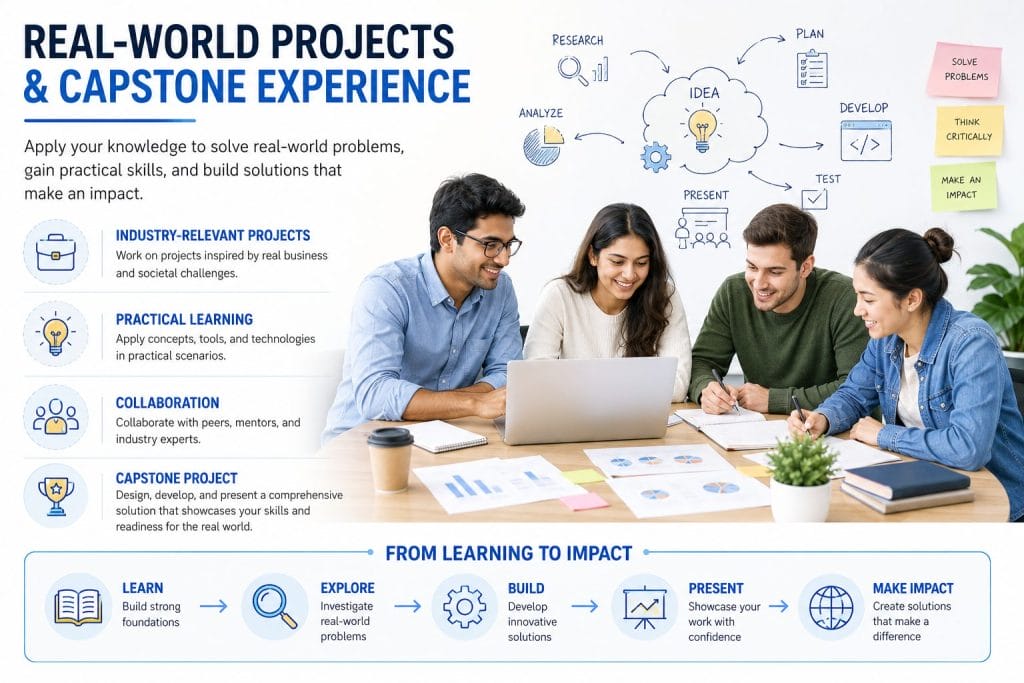
real world projects capstone experience
The image depicts students working together to develop a final project inspired by an industry. These projects are based on research, analytic skills, and technical abilities of the team members to solve real-world problems. The visual represents collaboration, innovation, project development and presentation of their work in a way that shows how experiential learning prepares graduates for successful careers with leadership opportunities and meaningful involvement across various industries.
Associate in Maritime Management : Research Projects & Innovation

A Doctorate in Hydrology provides research and innovation opportunities for researchers to solve/innovate ways to overcome major global water issues through advanced scientific research. Doctoral students conduct original research work on important topics, for example, Watershed Management, Groundwater Management, Flood/Drought Forecasting, Climate Change, Hydroinformatics, Water Quality Measurement, Remote Sensing, and Integrated Water Resource Management are only some of the areas of research conducted by Hydrology PhD students. Students use numerous modern analytical tools, geospatial technologies, hydrological modeling, artificial intelligence, and data-based methodology to provide evidence-based solutions to support sustainable management, environmental resilience, and provide information for policy-making to develop new programs or policies. 

Hydrology PhD students’ research projects not only result in interdisciplinary collaboration and contribute to the advancement of scientific knowledge, but they will also allow graduates/doctoral degree holders to be leaders in developing innovative solutions in academia, government agencies, environmental organizations, private consulting firms, and worldwide water resource initiatives.
Want to Read AIU Mundi Magazine ?

Read the Latest Edition

Thesis & Research Defense Process

A Doctor of Hydrology provides students with the ability to perform research and develop scientific solutions in response to some of the most urgent global water problems. For example, doctoral students may conduct original research on watershed management, groundwater sustainability, flood and drought prediction, the effects of climate change, hydroinformatics, measuring water quality, remote sensing technology, and integrated water resource management. Soundness of solutions is achieved through the application of modern analytical methods, geospatial tools, hydrologic models, artificial intelligence, and other data-driven ways of knowing in order to develop scientifically based approaches to sustainable water use, environmental sustainability, and ultimately, sound public policy. 

In addition to advancing knowledge through their research, these graduate projects require collaboration across disciplines; produce new knowledge for science; and prepare graduates to provide leadership in innovation within the fields of education, government, the environment, and the provision of consulting services related to water resources beyond the United States through international water resources initiatives.

Student Experience & Virtual Campus

The Doctor of Hydrology program is designed to provide a flexible and technological based educational experience that allows working professionals, researchers, and future educators throughout the world to obtain their doctorate in hydrology in a way that fits into their schedules. Doctoral candidates can access course materials, digital libraries, recorded lectures, research publications, and collaborative resources anytime and anywhere through an interactive online virtual campus. While engaging with faculty mentors, students participate in scholarly discourse, virtually attend seminars/workshops, and cooperate/coordinate with fellow students who are from around the globe and have a variety of professional backgrounds. 

There is an emphasis on independent research, while at the same time developing a global community of scholars to facilitate sharing of knowledge, cross-disciplinary collaboration, and the continued professional growth of students and faculty alike. With all-encompassing academic support and modern digital resources available to students, those pursuing a Doctor of Hydrology will be able to maintain their other commitments while making strides towards conducting research that has an impact on society as well as advancing in their careers.

Live Classes, Symposiums & Global Networking

The Doctorate in Hydrology offers students opportunities throughout the program to enhance their learning by providing interaction with world-renowned hydrologists and environmental scientists, including leading experts on freshwater and water resources from around the globe. Interactive webinars, guest lectures, panel discussions, research presentations, and international conferences are all part of the doctoral student experience, providing students with exposure to cutting-edge trends, developments, and current issues in Hydrology and Water Resource Management so they gain knowledge of emerging trends, cutting-edge technologies, and current real-world challenges facing the field.

Doctoral students will engage in collaborative experiences that promote scholarly discourse, interdisciplinary collaboration, and the exchange of multiple points of view while they create valuable professional networks, broaden their global influence, and enhance the leadership skills necessary to help develop sustainable solutions for Water Resource Management at both the national and international levels.

Academic Resources & AI-Powered Learning

Doctoral Candidates in Hydrology will have access both to a wide variety of teaching tools that include a vast amount of literature sources that are institutionally supported (books and electronic journals) paired with artificial intelligence (AI) derived learning systems to assist them in increasing the productivity of their academic research and analysis activities. The ability for Doctor of Hydrology students to access electronic library resources; peer-reviewed journal articles; and GIS-based technologies gives them confidence to conduct in-depth independent research on complex and long-standing water resources issues. 

The use of AI-supported power technologies will assist hydrology students with developing literature reviews, interpreting and analysing data, producing models, writing software, performing statistical calculations, producing academic writing documents, & supporting other organizational functions/tasks. The combination of faculty contacts (through mentoring relationships) & educational programs that utilize digital interactive methods help to create academic resources for Doctoral Candidates in Hydrology that support the creation of innovative, high-quality, evidence-informed & Doctoral Scholarly research.

Begin Your Journey of Perpetual Evolution with AIU

Get Started

Admission Requirements

A Doctor of Hydrology Program candidate must demonstrate his/her interest in research related to water science and sustainability as well as his/her professional background related to hydrology to be considered for acceptance into this program. The candidate must be a qualified professional who has received a Master of Science or its equivalent from an accredited institution by the date of application (therefore meeting university admission criteria). The admissions committee will consider the overall academic performance of the candidate, including the grade(s) received in the core coursework of the master’s program, as well as other evidence that can confirm a candidate’s capability of performing at a high level of academic achievement in order to gain acceptance into the Doctor of Hydrology Program. 

AIU has its own specific requirements for admission, e.g., statement of purpose, detailed research interests, and CV, but it is strongly recommended that candidates submit any and all of these documents as part of their application package to assist the admissions committee in evaluating the candidates’ qualifications for admission into the Doctoral Program in Hydrology. In addition to candidates providing documentation of their general understanding of hydrology through study and/or research, it would be beneficial for their qualifications as candidates for the Doctoral Program in Hydrology to show evidence of conducting research, policy and/or program development, etc.

How to Apply ?

The procedure of applying for the Doctorate in Hydrology is a simple process aimed at enabling prospective students to successfully start their doctoral program with confidence. The first step in the application process is selecting the program and completing an online application. Students then prepare and submit all required documentation which shall include: academic transcripts; current résumé/CV; statement of purpose outlining both research interests; and career goals; together with any additional or supporting materials requested from the admissions office. 

After the application has been reviewed by the admissions office, students may be called for further academic evaluation/discussion, regarding their proposed research area of interest. After the applicant receives their admission decision, they will have to complete the enrollment process, and pay any applicable fees in order to gain access to the virtual learning environment where they can interact with faculty mentors, find course materials to begin their Doctorate coursework.

Tuition, Financial Support & Scholarships

With the Doctorate of Hydrology education programs at many institutions, the area of finance and helping to provide affordable access is highlighted primarily as being for people across borders who are wanting to achieve their PhD while also having their own requirements met based on regional differences and first-world to second-world lifestyles. 

As such, many institutions have programmed out flexible payments for tuition that allow for a long-term payment arrangement for tuition throughout the duration of your degree. Depending on what university and their specific guidelines for financial aid, scholarships, or grants, there are many different types of financial support available including employee sponsorship, research funding, loans, etc. Therefore, you should explore the various opportunities that exist for funding your education through your university or directly, and also coordinate with your institution’s admissions office for assistance to help you identify the best options available to support your goals, both academically and financially.

FAQs

What is a Doctor of Hydrology?

A doctor of hydrology is an advanced degree whereby the student conducts advanced research into the science of hydrology and its management, with a specific focus on research and development as it relates to water resources, ground waters, surface water, the effects of climate, and sustainable methods of managing water. The Doctorate is designed for those who are preparing for leadership positions in research, academia, government, environmental consulting, and international water resource organizations.

What can I do with a doctorate in hydrology?

If you have a PhD in Hydrology you are ready for jobs such as Research Scientist at a University, Hydrologist, Environmental Consultant, Water Resource Manager, Climate Resilience Specialist, Groundwater Expert or an Advisor on Policy. You will work on research and new ideas within the government, Non-Government Agencies, Engineering Companies and International Organizations regarding sustainable management of our water resources.

Is a PhD in hydrology worth it?

If you want to pursue a career in academia, environmental consulting, advanced research, public policy or water resource management then getting a PhD in Hydrology will be beneficial. It builds skills and knowledge specific to the field, allows for the development of advanced research and leadership capabilities as well as creating opportunities for solving the world’s problems related to water security, climate change, issues related to flood control and issues related to sustainable development of resources.

What careers are available with a Doctor of Hydrology?

Depending on your degree and experience as well as how many people work in these areas, you might be able to find jobs with the above titles. You may want to consider pursuing further education to advance within this industry after getting your Hydrology Doctorate.

How long does it take to earn a doctorate in hydrology?

Minimum 3 years.

Let us know your goals and aspirations so we can chart a path at AIU to achieve them!
//
Admissions Counselor
Boniface Onimu
Available
//
Admissions Counselor
Rene Cordon
Available
//
Admissions Counselor
Prof. Emmanuel Gbagu
Available
//
Admissions Counselor
Juan Mejia
Available
//
Admissions Counselor
Sandra Garcia-Fierro
Available

"*" indicates required fields

This field is for validation purposes and should be left unchanged.
Name*

"*" indicates required fields

This field is for validation purposes and should be left unchanged.
Name*

"*" indicates required fields

This field is for validation purposes and should be left unchanged.
Name*

"*" indicates required fields

This field is for validation purposes and should be left unchanged.
Name*

"*" indicates required fields

This field is for validation purposes and should be left unchanged.
Name*

"*" indicates required fields

This field is for validation purposes and should be left unchanged.
Name*

"*" indicates required fields

This field is for validation purposes and should be left unchanged.
Name*

"*" indicates required fields

This field is for validation purposes and should be left unchanged.
Name*

"*" indicates required fields

This field is for validation purposes and should be left unchanged.
Name*

"*" indicates required fields

This field is for validation purposes and should be left unchanged.
Name*

"*" indicates required fields

This field is for validation purposes and should be left unchanged.
Name*

"*" indicates required fields

This field is for validation purposes and should be left unchanged.
Name*

"*" indicates required fields

This field is for validation purposes and should be left unchanged.
Name*

"*" indicates required fields

This field is for validation purposes and should be left unchanged.
Name*

"*" indicates required fields

This field is for validation purposes and should be left unchanged.
Name*

"*" indicates required fields

This field is for validation purposes and should be left unchanged.
Name*

"*" indicates required fields

This field is for validation purposes and should be left unchanged.
Name*

"*" indicates required fields

This field is for validation purposes and should be left unchanged.
Name*

"*" indicates required fields

This field is for validation purposes and should be left unchanged.
Name*

"*" indicates required fields

This field is for validation purposes and should be left unchanged.
Name*

"*" indicates required fields

This field is for validation purposes and should be left unchanged.

Submit your data.

After submitting, a widget will appear at the bottom-left corner so you can start your training.

Name*

Do you hate spam? Don’t worry, we hate them too. Your email is 100% secure with us.

"*" indicates required fields

This field is for validation purposes and should be left unchanged.

Submit the form below to begin your interview.

After submitting, a widget will appear at the bottom-left corner so you to start your AI interview.

Name*
Accepted file types: docx, pdf, Max. file size: 500 MB.

Do you hate spam? Don’t worry, we hate them too. Your email is 100% secure with us.