Master in Unmanned Aerial Systems Engineering (UAV and Drone Technology)

School of Science & Engineering

Academic Freedom to Discover Your Purpose

Open Curriculum Design at Atlantic International University

Unmanned Aerial Systems Engineering Masters Program is an advanced course designed to educate people interested in drone technology, UAV engineering, and other modern aerial engineering topics. The unmanned aerial systems engineering degree is aimed at providing participants with an array of information from aerospace engineering to autonomous aircraft, control systems, flight mechanics, remote sensing, and autonomous vehicles.

This UAV engineering masters course or drone technology master degree or master in drone technology course includes studying UAV, drone technology program, unmanned aircraft engineering, and unmanned aerial systems engineering. As part of the program, students are provided with both theoretical knowledge and practical experience related to designing, developing, and managing drones and unmanned aircrafts. During the course, students are also trained in an equivalent to masters in instructional design and AI technology to enhance their understanding of AI technology and its application.

One of the significant advantages of the study program’s structure is flexibility in the process of learning. It allows students to combine work, academic activities, and research to obtain a degree of autonomous aircraft system. Consequently, it becomes possible for working professionals to improve their qualifications and develop skills needed to manage drones operations, robotics, and commercial drone programs.

The growing integration of AI, machine learning, and analytics is transforming UAV technology studies and aerial surveillance technology. Modern industries increasingly rely on intelligent unmanned aircraft for data collection, predictive analysis, and autonomous decision-making. As a result, graduates are well positioned for drone engineering careers, including drone systems engineer, UAV technology jobs, and advanced roles in aerospace drone engineering. A drone engineering master’s degree provides the expertise needed to shape the future of unmanned aviation.

Important: Begin a captivating journey to discover potential study areas and subjects as you navigate through your academic adventure. It’s crucial to highlight that this list is not exhaustive or obligatory, highlighting AIU’s commitment to personalized learning experiences rather than rigid course work or degree requirements. Consider this sample as an illustration of the wide range of options at your disposal. If AIU’s unique, flexible curriculum and comprehensive exam structure piques your interest, does it inspire you to delve further for a thorough understanding?

Master in Unmanned Aerial Systems Engineering Industry Growth & Global Impact

The Master of Unmanned Aerial Systems Engineering at Atlantic International University (AIU) trains individuals for employment in one of the world’s fastest growing technological industries. The worldwide drone industry is anticipated to reach an estimated value of over USD 182 billion in 2033 – whereas the artificial intelligence-powered drones’ industry is forecasted to rise from its current USD 14.3 billion value in 2025 to USD 51 billion by 2033 owing to autonomous flight, intelligent analytical features, and sophisticated navigation capabilities. 

Individuals studying towards their UAV engineering degree, drone technology master’s degree, master’s in drone technology, or unmanned aerial systems degree acquire skills in drone technology, UAV engineering, unmanned aerial system, autonomous vehicles, flight control, remote sensing, and navigation systems as part of the program goals. Students studying towards their UAV and drone technology, autonomous aerial systems, or drone engineering master’s degree learn how to design and operate drones, aerospace drone engineering, robotics and drone technology, aerial surveillance technology, and unmanned aircraft systems engineering.

Demand for professionals with an unmanned aerial vehicle degree is rising across defense, logistics, agriculture, and smart infrastructure, creating opportunities in drone engineering careers, UAV technology jobs, and roles such as drone systems engineer. Graduates of a commercial drone technology program and UAV technology studies benefit from strong salary growth as organizations accelerate AI adoption in drone operations and unmanned aircraft engineering.

Trends, Insights & Predictive Analytics in Unmanned Aerial Systems Engineering

The domain of UAS Engineering, including drone technology, is an amalgamation of aerospace engineering, robotics, electronics, computer sciences, and data analytics. UAS Engineering involves the study of design, manufacture, implementation, operations, and maintenance of unmanned aircraft. Applications include surveillance, transportation of goods, agricultural activities, infrastructure monitoring, disaster relief services, environmental monitoring, and warfare.

A graduate degree in UAS Engineering enables graduates to possess interdisciplinary knowledge in aerodynamics, sensor systems, flight control, artificial intelligence, compliance with legal norms, and system integration. These capabilities prepare the graduates to enter into an increasingly dynamic sector where drones go beyond being remotely piloted systems to becoming advanced autonomous vehicles.

Future Trends

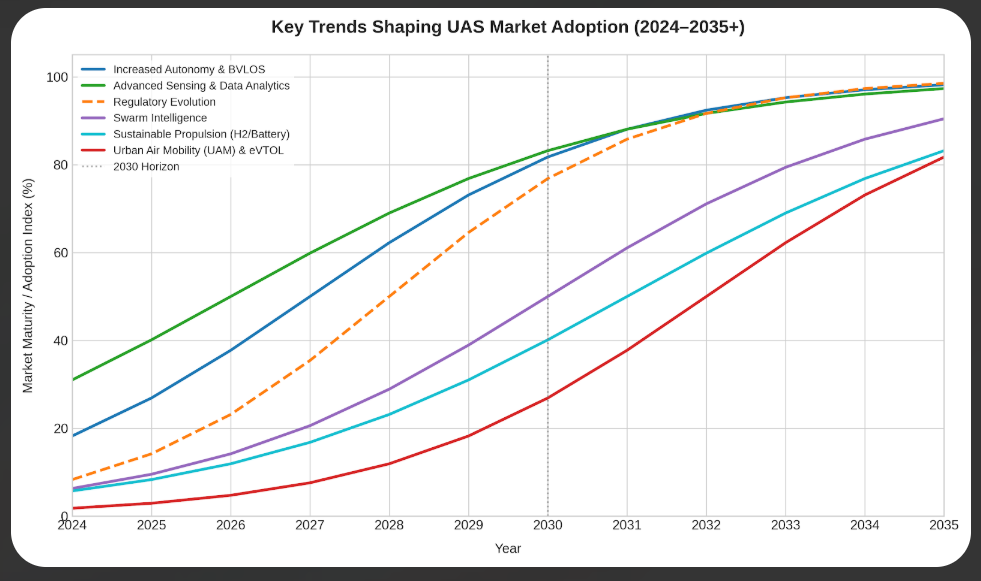
Key trends shaping UAS through 2030 and beyond include:

  • Increased Autonomy and BVLOS Operations: Beyond Visual Line of Sight (BVLOS) flights will become mainstream, enabling long-range inspections, deliveries, and monitoring with reduced oversight.
  • Swarm Intelligence: Coordinated drone swarms for reconnaissance, search-and-rescue, transport, and agricultural tasks.
  • Urban Air Mobility (UAM) and eVTOL Integration: Integration with flying taxis, cargo corridors, and advanced air traffic management.
  • Sustainable Propulsion: Advances in battery efficiency, hydrogen fuel cells, and hybrid systems for longer endurance and lower emissions.
  • Advanced Sensing and Data Analytics: Hyperspectral imaging, LiDAR, and real-time AI processing for actionable insights.
  • Regulatory Evolution: Harmonized global standards for safety, cybersecurity, and integration into national airspace.

These trends position UAS as foundational to smart cities, Industry 4.0/5.0, and resilient infrastructure.
Key Trends Shaping UAS Market Adoption
Here is a realistic macro-trend graph tracking the projected market maturity and adoption curves for the key drivers shaping Unmanned Aircraft Systems (UAS) through 2030 and beyond.
Key Takeaways from the Data Trends
  • The Early Enablers (2024–2028): Advanced Sensing & Data Analytics and Increased Autonomy & BVLOS lead the charge. These technologies are already mature in testing environments and will see rapid commercial scaling as immediate ROIs are realized in infrastructure inspection and logistics.
  • The Regulatory Tipping Point (~2027–2029): Regulatory Evolution acts as the ultimate gatekeeper. Notice the steep acceleration in adoption between 2026 and 2029; this represents global aviation bodies establishing harmonized, secure frameworks for national airspaces. Once this peaks, it unlocks the remaining trends.
  • The 2030 Horizon & Beyond (2030–2035): Technologies like Swarm Intelligence, Sustainable Propulsion (Hydrogen/Advanced Solid-State Batteries), and Urban Air Mobility (eVTOL) feature a delayed, longer runway. They cross the 50% adoption threshold right around 2030, transforming from niche/highly specialized use cases into mainstream foundational elements of smart cities and Industry 5.0.
Trend Comparisons

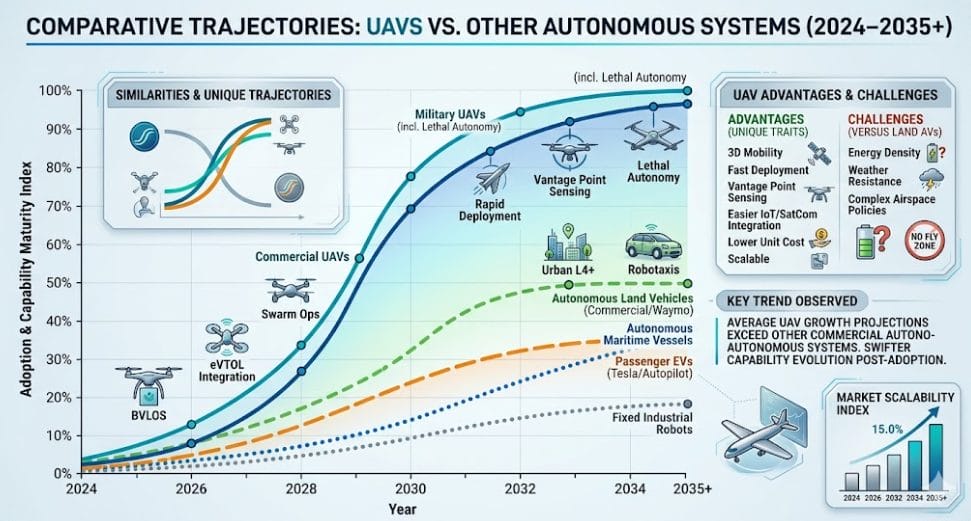
Trends for UAVs follow similar trajectories to other autonomous vehicles such as autonomous land vehicles and autonomous maritime vessels, though they have unique traits such as three-dimensional mobility, fast deployment, and vantage point sensing. As opposed to autonomous vehicles such as Waymo/Tesla’s, autonomous UAVs have problems with energy density, weather resistance, and airspace policies, but they evolve swifter in their capabilities.

Autonomous UAVs excel in remote/hazardous environments such as infrastructure inspections and outperform autonomous robotic systems in terms of easier integration into IoT/Satellite communications. Military applications see an even quicker adaptation of lethal autonomy by unmanned aircraft than by manned ones. On average, UAVs have been experiencing higher growth projections within the commercial market, being more scalable at lower unit cost.
Comparative Trajectories UAVs vs. Other Autonomous Systems
This infographic charts growth from 2024–2035+, comparing military and commercial UAV adoption against land, maritime, and automotive autonomous systems. It highlights unique UAV advantages, scalability, and specific adoption challenges.
Predictive Analytics

Predictive Analytics in UAS makes use of AI, machine learning, and sensor fusion for:

  • Predictive maintenance like monitoring vibrations to predict structural integrity.
  • Forecasting crop yields and detecting anomalies in agriculture.
  • Risk assessment in inspections like cracks in bridges and leakage from pipelines.
  • Disaster prediction and traffic management through aerial data analysis.

Real-time decision-making is possible through onboard edge computing and cloud integration, resulting in lower latency and more accurate predictions compared to conventional approaches. The application of AI makes object detection, path planning, and swarm behavior more efficient.

Industry Growth Charts 

The global UAS/drone market shows robust expansion:

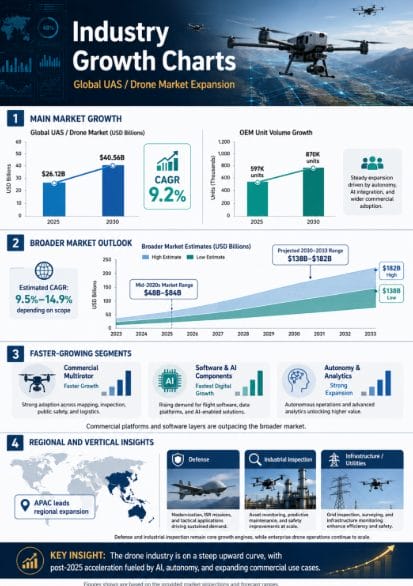
  • One projection: ~USD 26.12 billion in 2025 to USD 40.56 billion by 2030 (CAGR 9.2%). OEM unit volume from ~597k to ~870k.
  • Broader estimates: USD 48–84 billion range in the mid-2020s scaling toward USD 138–182 billion by 2030–2033 (CAGRs of 9.5–14.9% depending on scope).
  • Commercial segments (e.g., multirotor) and software/AI components grow even faster.

Visualize growth as a steep upward curve with acceleration post-2025 driven by autonomy and AI, with APAC leading regional expansion. Defense and industrial inspection remain strong verticals.
Industry Growth Charts
The image presents key industry growth charts for the global drone market, forecasting substantial revenue and unit expansion from 2025 to 2030, driven by autonomy, AI.
Insights on Future Technologies & Smart Industries

Future UAS technology will feature AI-natively autonomous systems, 5G/6G connection for real-time control, quantum-proof security, and bio-inspired innovation. For Smart Industry (Industry 4.0/5.0) applications, UAS can be used to perform tasks such as:

  • Inventory management and building surveillance in manufacturing/warehousing sectors.
  • Precision agriculture and intervention.
  • Inspection within infrastructure and energy industries (such as renewable energy and pipelines).
  • Optimization of logistics and last mile delivery.

The synergy between UAS and IoT, digital twins, and robotics results in smart ecosystems characterized by proactive actions and sustainability.

Impact of AI on the Field

AI turns UAS into semi- or fully autonomous systems, able to perceive, make decisions and adapt. Major implications are as follows:

  • Autonomy: In-flight navigation, collision avoidance, mission re-planning.
  • Data processing: Instant analysis of images to detect, classify and draw conclusions (e.g., damage assessment).
  • Efficiency: Efficient flights, energy consumption and swarm cooperation.
  • Applications: In particular, military (target identification), agriculture, rescue operations and inspection.

Challenges comprise ethical issues (autonomous killing machines), difficulties associated with full autonomy regulation, and insufficient computational resources of small unmanned aerial systems. Generally, AI speeds up development and implementation.

Scope of Automation

Automation within UAS encompasses vehicle autonomy, mission planning, data processing, and integration with other systems. Scope includes:

  • Full automation in a controlled environment.
  • Human-in-the-loop when required due to complex or critical circumstances.
  • Automated processes end-to-end from flight to analysis.

This minimizes human resource requirements in mundane/difficult/dangerous applications while increasing skilled supervision, engineering, and maintenance workloads. Within the intelligent industry, UAS automation complements the automation of other equipment types like ground robots.

Future Career Demand in Evolving Digital Economies 

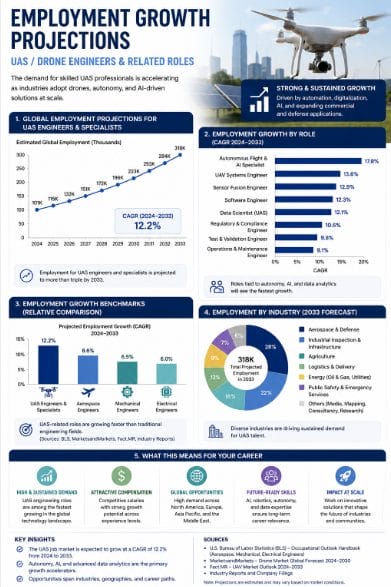
The demand for UAS engineers will be very high and on an upward trend due to automation, AI, and digitalization. Some of the positions are UAV system engineer, specialist on autonomous flight and AI, sensor fusion engineer, software engineer, regulatory and compliance engineer, and data scientist.

Engineering and automation in general have positive growth forecasts (for instance, mechanical and aerospace engineering between 6-9% per year depending on timeframes). The knowledge base acquired during the studies fits perfectly into the highly demanded field of AI, robotics, and intelligent manufacturing. Employment prospects range from tech companies to aerospace and defense companies, agriculture, energy, logistics, consultancy, startups, and many more. Salaries are also quite generous, as well as global job mobility (opportunities in Asia Pacific region, Europe, Middle East, etc.).
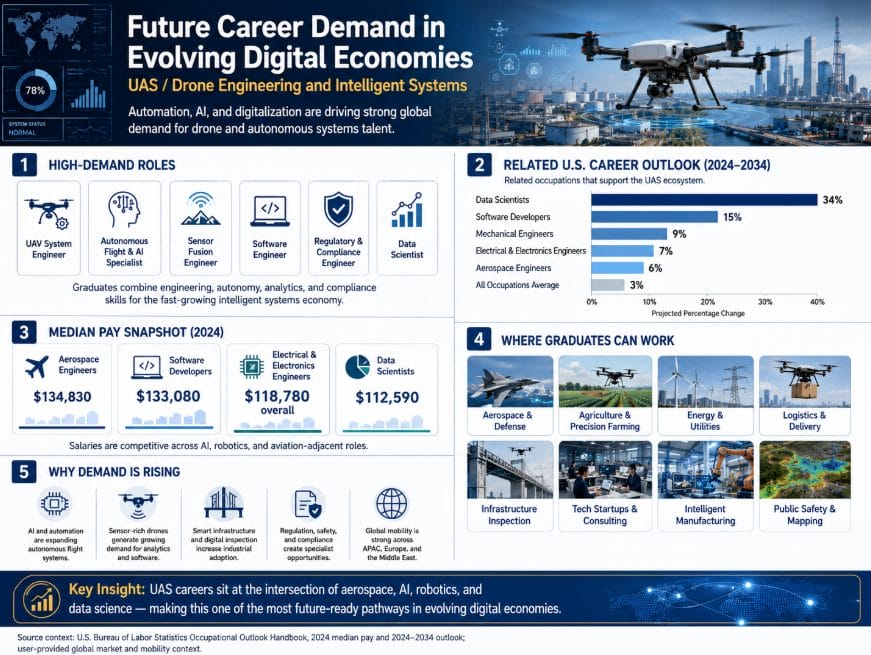
Future Career Demand in Evolving Digital Economies
The image outlines the rising demand for UAS and intelligent systems engineers, projecting high-growth roles, diverse career applications, and competitive median salaries in the digital economy through 2034.

Career Opportunities & Professional Development of a Student with Master in Unmanned Aerial Systems Engineering

A Master in Unmanned Aerial Systems Engineering at AIU is designed to equip students for career prospects that are diverse and future-oriented in various fields including aerospace engineering, defense sector, logistics, agriculture, infrastructure survey, and smart mobility industries. With the help of an UAV engineering masters and a UAV technology masters degree, the learners acquire skills in drone technology, UAV engineering, aerial systems, UAV flight controls, navigation systems, remote sensing and unmanned aircraft engineering under the guidance of mentors and academic advisors

Careers that can be pursued by the graduates include UAV systems engineer, UAV developer, drone systems management professional, aerial data analyst, and autonomous systems designer with numerous job openings for UAV engineers and drone technology professionals. 

Fields such as autonomous vehicles, UAV technology with artificial intelligence, robotics and drones technology, as well as advanced UAV design and development represent areas where graduates may pursue their careers. Additionally, through the UAV technology and drones master’s degree program, the learners are able to develop industry-oriented portfolios through hands-on projects in UAVs engineering and aerospace drone engineering.

Career Salary Trends
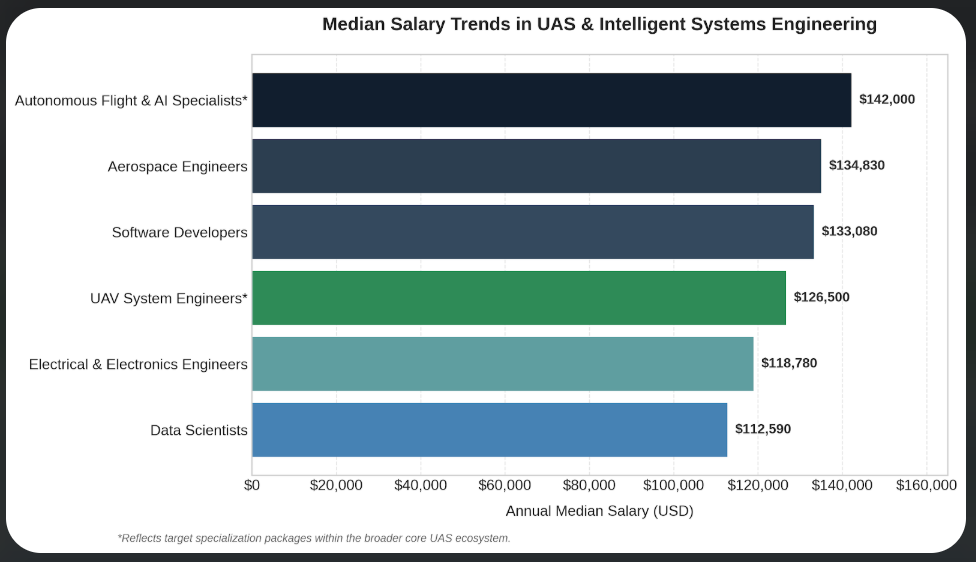
Median Salary Trends in UAS & Intelligent Systems Engineering
The horizontal bar graph displays median annual salaries for six roles in UAS and intelligent systems engineering. Earnings scale from $112,590 up to $142,000 for AI specialists.

Employment Growth Projections

Employment Growth Projections
The infographic outlines global employment growth projections for UAS and drone engineers through 2033, highlighting a 12.2% CAGR, fast-growing AI/autonomy roles, and major industry sector distributions.

Contact Us Today!

Begin Your Journey!
AIU’s Summer of Innovation and Growth gives you the ability to earn up to $5000 in tuition credit by completing free lessons and courses.
Whether you’re looking to acquire new skills, advance your career, or simply explore new interests, AIU is your gateway to a world of opportunities. With free access to 3400 lessons and hundreds of courses the ability to earn credits and earn certificates there’s no better time to start learning.
Join us today as a Guest Student and take the first step towards a brighter, more empowered future.
Explore. Learn. Achieve.

Academic Freedom & Customized Curriculum

The master in unmanned aerial systems engineering at AIU offers exceptional academic freedom through a customized curriculum designed to match individual career goals and industry demands. Students pursuing a UAV engineering degree or drone technology master’s degree can select specialized courses in drone technology, UAV engineering, aerial systems, autonomous vehicles, flight control, navigation systems, and remote sensing. This master’s in drone technology and unmanned aerial systems degree enables learners to focus on areas such as drone design and development, aerospace drone engineering, drone operations management, and unmanned aircraft engineering.

As a comprehensive UAV and drone technology program, it integrates robotics and drone technology, aerial surveillance technology, and advanced drone operations. The autonomous aerial systems degree prepares graduates for diverse UAV technology jobs, including roles as a drone systems engineer. Through hands-on UAV technology studies, students gain expertise in unmanned aircraft systems engineering and aerospace engineering. This unmanned aerial vehicle degree, commercial drone technology program, and drone engineering master’s degree creates strong pathways to rewarding drone engineering careers in the rapidly expanding unmanned aviation sector.

Why Study Master in Unmanned Aerial Systems Engineering at AIU

Enrolling in the Master of Unmanned Aerial Systems Engineering Program at AIU presents a unique and forward-looking career choice that enables professionals to become highly skilled in drone technology, UAV engineering, and aerial systems engineering. The innovative approach taken by AIU facilitates the achievement of academic success through individual learning pace that enables candidates to earn a UAV engineering degree without compromising professional and personal commitments.

Another strong advantage offered by AIU is a customized curriculum. Students have an opportunity to choose courses related to the topics of interest, which include drone design, drone operations, remote sensing, drone flight controls and navigation systems, aerial surveillance technology, and autonomous vehicles among others. Such flexibility ensures acquisition of knowledge in diverse areas ranging from aerospace engineering, robotics, and drone technology to unmanned aerial systems engineering in a unique and unrepeatable way.

AIU offers students AI-based education, which gives them personal learning, making them proficient in research, innovations, and technological advancements. Through the global learning environment, students work with their colleagues from different countries to acquire international exposure in UAV technology studies and unmanned aircraft systems engineering.

As a graduate from AIU in a master’s in drone technology, autonomous aerial systems, or unmanned aerial systems degree, graduates will be in a better position to secure themselves future drone engineering jobs like drone systems engineer jobs. AIU’s UAV and drone technology program prepares learners for leadership in the rapidly expanding commercial drone industry and advanced drone operations worldwide.

Shape the Future of Autonomous Aerial Systems with AIU

Apply Now for Admission

Core Courses and Topics in Master in Unmanned Aerial Systems Engineering

A Master in Unmanned Aerial Systems Engineering equips students with advanced knowledge in drone technology, UAV engineering, and aerial systems. Core courses in this UAV engineering degree and unmanned aerial systems degree typically cover flight control, navigation systems, autonomous vehicles, remote sensing, aerodynamics, avionics, and unmanned aircraft systems engineering. Students enrolled in a drone technology master’s degree or master’s in drone technology gain expertise in drone design and development, mission planning, data analytics, and drone operations management through the academic resources.

The UAV and drone technology program also emphasizes robotics and drone technology, AI-powered autonomy, cybersecurity, and aerial surveillance technology applications. As part of an autonomous aerial systems degree, learners develop practical skills in system integration, simulation, testing, and unmanned aircraft engineering. This commercial drone technology program blends aerospace engineering principles with real-world drone operations and UAV technology studies. Graduates of this drone engineering master’s degree are prepared for drone engineering careers, including drone systems engineer, UAV technology jobs, and roles in aerospace drone engineering and advanced unmanned aircraft development.

  • Unmanned Aircraft Systems Engineering
  • Navigation Systems and Autonomous Guidance
  • Aerospace Engineering for Unmanned Aircraft
  • Remote Sensing and Aerial Data Analytics
  • Drone Operations Management and Regulations
  • Flight Control Systems for UAVs
  • Drone Design and Development
  • Robotics and Drone Technology Integration
  • Autonomous Aerial Systems and AI Applications
  • Aerial Surveillance Technology and Mission Planning

Tools & Technologies You Will Master

Students pursuing a Master in Unmanned Aerial Systems Engineering gain proficiency in UAV simulation platforms, flight control software, navigation systems, autonomous mission planning tools, remote sensing technologies, GIS applications, drone design and modeling software, AI and machine learning frameworks, embedded systems, robotics platforms, and aerospace engineering analysis tools for advanced aerial systems development.

  • MATLAB & Simulink: Used for UAV modeling, flight control system design, simulation, and performance analysis of unmanned aerial systems.
  • PX4 Autopilot: An open-source flight control platform used to develop, test, and deploy autonomous drone systems.
  • QGroundControl: A ground control station used for mission planning, vehicle configuration, and real-time flight monitoring.
  • ROS (Robot Operating System): Provides software libraries and tools for building autonomous UAVs and integrating robotics capabilities.
  • Gazebo: A powerful simulation platform used to test drone navigation, flight dynamics, and autonomous operations in virtual environments.
  • ArcGIS: Used for geospatial analysis, mapping, aerial surveying, and remote sensing applications.
  • SolidWorks: A 3D CAD software used for drone airframe design, prototyping, and mechanical engineering analysis.
  • CATIA: Widely used in aerospace engineering for advanced UAV design, structural modeling, and product development.
  • TensorFlow: Supports artificial intelligence and machine learning applications such as autonomous navigation and object recognition.
  • OpenCV: An open-source computer vision library used for image processing, aerial surveillance, and target tracking.
  • Mission Planner: A mission planning and telemetry software that helps manage UAV operations and flight paths.
  • UAV Toolbox: Provides algorithms and simulation capabilities for UAV design, testing, and autonomous mission development.

Career-Focused Learning in Unmanned Aerial Systems Engineering

Students enrolled in a master in unmanned aerial systems engineering gain industry-relevant expertise that prepares them for a rapidly evolving aviation and technology landscape. A comprehensive UAV engineering degree combines theoretical knowledge with hands-on applications, ensuring graduates are ready to contribute across multiple sectors where drone technology and autonomous aerial systems are transforming operations.

Practical Skills for Industry Roles

A modern drone technology master’s degree equips students with technical competencies required for high-demand UAV technology jobs and engineering positions.

  • Develop expertise in drone design and development for commercial, industrial, and defense applications. 
  • Gain hands-on experience with flight control systems, avionics integration, and autonomous mission planning. 
  • Learn advanced navigation systems used in modern unmanned aircraft and intelligent aerial platforms. 
  • Apply principles of aerospace engineering to create efficient and reliable aerial systems. 
  • Build proficiency in remote sensing, aerial data collection, and geospatial analysis. 
  • Understand system architecture for unmanned aircraft systems engineering and large-scale UAV deployments. 
  • Work with emerging technologies in robotics and drone technology to improve automation and operational efficiency. 
  • Prepare for careers as a drone systems engineer, UAV developer, flight systems specialist, or autonomous systems engineer. 
Practical Skills for Entrepreneurship

A master’s in drone technology helps aspiring entrepreneurs identify opportunities within the growing commercial drone market.

  • Learn how to design scalable drone-based business models. 
  • Develop expertise in commercial drone technology program applications across agriculture, infrastructure, logistics, and inspection services. 
  • Understand regulatory compliance and operational requirements for drone operations management. 
  • Gain experience in product development, prototyping, and commercialization of UAV solutions. 
  • Explore innovation opportunities in aerial surveillance technology, environmental monitoring, and smart city applications. 
  • Build skills in project management, budgeting, and technology deployment for startup ventures. 
  • Leverage knowledge from a UAV and drone technology program to create customized industry solutions. 
Practical Skills for Remote Careers

Graduates of an unmanned aerial systems degree are increasingly positioned for flexible and remote work opportunities.

  • Operate and manage drone missions through cloud-connected control systems. 
  • Analyze aerial imagery and sensor data from remote locations. 
  • Perform mission planning, risk assessment, and operational coordination for global clients. 
  • Use advanced software platforms for drone operations, mapping, and analytics. 
  • Support organizations through virtual UAV consulting and technical advisory services. 
  • Apply remote sensing technologies to sectors including agriculture, mining, construction, and environmental management. 
  • Contribute to distributed engineering teams working on autonomous vehicles and UAV software development. 
Practical Skills for Consulting Careers

A specialized autonomous aerial systems degree provides the interdisciplinary knowledge needed for advisory and consulting roles.

  • Evaluate UAV implementation strategies for organizations adopting drone technology. 
  • Recommend operational frameworks for safe and efficient drone operations. 
  • Assess technology readiness, performance metrics, and deployment risks. 
  • Advise businesses on integrating aerial systems into existing workflows. 
  • Develop expertise in regulatory compliance, safety management, and industry best practices. 
  • Support clients in selecting appropriate platforms for surveillance, inspection, mapping, and logistics missions. 
  • Provide strategic guidance on future investments in UAV engineering and autonomous technologies. 
Preparing for Future AI-Driven Workplaces

A drone engineering master’s degree prepares students for workplaces where artificial intelligence, automation, and connected systems drive innovation.

  • Design intelligent unmanned aircraft capable of autonomous decision-making. 
  • Integrate AI algorithms with flight control and navigation systems. 
  • Work with machine learning models for object detection, tracking, and aerial analytics. 
  • Develop advanced solutions that combine robotics and drone technology with real-time data processing. 
  • Understand the role of autonomous vehicles within smart transportation and logistics ecosystems. 
  • Build capabilities in predictive maintenance, autonomous mission execution, and swarm technologies. 
  • Contribute to next-generation innovations in unmanned aircraft engineering and aerospace automation. 
  • Prepare for leadership roles in emerging fields such as aerospace drone engineering, intelligent mobility, and AI-enabled UAV systems. 
Career Outcomes

Graduates of an unmanned aerial vehicle degree or drone engineering master’s degree are equipped for diverse career pathways, including:

  • Drone Systems Engineer 
  • UAV Software Engineer 
  • Autonomous Systems Developer 
  • Flight Control Engineer 
  • Remote Sensing Specialist 
  • Drone Operations Manager 
  • Aerospace Systems Engineer 
  • UAV Research and Development Engineer 
  • Aerial Data Analytics Specialist 
  • Drone Technology Consultant 
  • UAV Program Manager 
  • Autonomous Aviation Solutions Architect 

Through rigorous UAV technology studies, practical projects, and industry-focused training, students gain the skills necessary to excel in drone engineering careers, launch innovative ventures, support remote operations, provide expert consulting, and thrive in the future of AI-powered unmanned aircraft systems engineering.

Real-World Projects & Capstone Experience

At AIU, the Master in Unmanned Aerial Systems Engineering emphasizes hands-on learning through real-world projects, advanced research, and industry-focused capstone experiences. Students enrolled in this UAV engineering degree and drone technology master’s degree build professional portfolios featuring drone design and development, flight control systems, navigation systems, remote sensing, and aerial surveillance technology applications.

Through practical coursework, learners develop AI-powered solutions for autonomous aerial systems, predictive analytics models, and data-driven case studies related to drone operations management, unmanned aircraft engineering, and robotics and drone technology. Capstone projects allow students to address real industry challenges in drone technology, UAV engineering, aerial systems, and autonomous vehicles, integrating concepts from aerospace engineering and unmanned aircraft systems engineering.

Research applications within this UAV and drone technology program explore emerging innovations in commercial drone technology, unmanned aircraft, and intelligent navigation platforms. This experiential approach helps graduates gain expertise valued in UAV technology jobs, drone systems engineer roles, aerospace drone engineering, and other growing drone engineering careers. The program equips students with the technical and analytical skills needed to lead advancements across the global unmanned aviation sector.
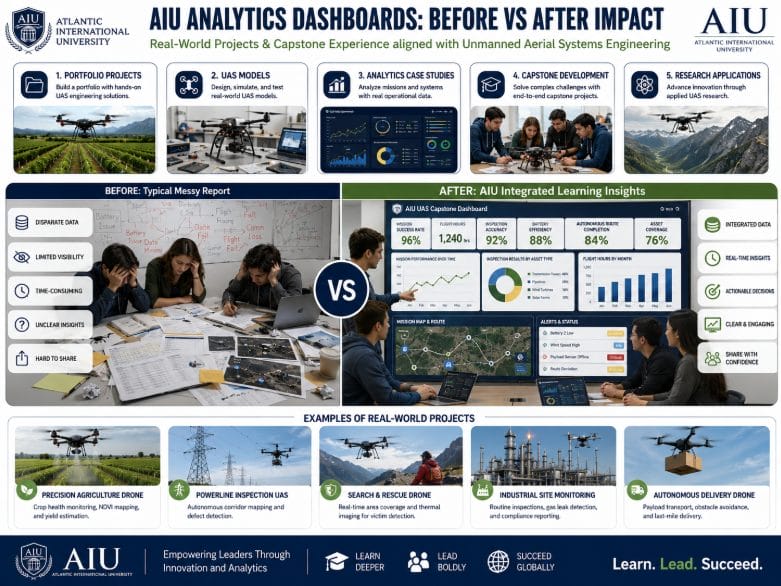
AIU Analytics Dashboards Before vs After Impact
The infographic image_46a702.jpg contrasts chaotic, manual drone reporting with AIU’s integrated analytics dashboard. It highlights real-world capstone projects in agriculture, inspection, and rescue, showcasing streamlined data transformation for UAS engineering.
Research Projects & Innovation in Master in Unmanned Aerial Systems Engineering

Research Projects & Innovation are at the core of a Master in Unmanned Aerial Systems Engineering, preparing students to lead advancements in drone technology and aerial systems. This specialized UAV engineering degree combines aerospace engineering, robotics and drone technology, flight control, and navigation systems to solve real-world challenges. Through a cutting-edge drone technology master’s degree and master’s in drone technology, students engage in drone design and development, autonomous mission planning, remote sensing, and intelligent drone operations in a holistic and asynchronous way. 

The unmanned aerial systems degree and UAV and drone technology program emphasize innovation in autonomous vehicles, aerial surveillance technology, and advanced unmanned aircraft systems engineering. Learners gain hands-on experience with unmanned aircraft engineering, commercial applications through a commercial drone technology program, and emerging UAV technology studies. 

Graduates of this autonomous aerial systems degree and drone engineering master’s degree are prepared for drone engineering careers, including drone systems engineer, UAV technology jobs, and leadership roles in drone operations management, UAV engineering, and next-generation unmanned aircraft development.

  • MBM300 Thesis Proposal
  • MBM302 Master of science degree Thesis (5,000 words)

Publication: At AIU, we prioritize cutting-edge graduate research here, fostering academic excellence through the dissemination of groundbreaking discoveries. In the field of Unmanned Aerial Systems Engineering, we empower graduate students to present innovative ideas, enriching scholarly dialogues. Our commitment to publishing student research enhances their academic impact, laying a solid foundation for budding scholars and driving the field forward.   

Build Your Future in Drone Technology with the Right Course

Unlock Your Potential

Dissertation & Thesis Defense

In the final stage of the Unmanned Aerial Systems Engineering course at AIU, students are presented with a unique chance to demonstrate their proficiency and creativity through an extensive thesis proposal. This critical stage marks the culmination of their journey, providing a venue to delve into complex topics within the curriculum.

The thesis defense, a fundamental element of the program, enables students to exhibit their research abilities, analytical thinking, and literary knowledge, highlighting their preparedness to make significant contributions to the field after graduating from AIU.

Student Experience in Pursuing Master in Unmanned Aerial Systems Engineering

Studying a master in unmanned aerial systems engineering at AIU is a transformative student experience. Through this UAV engineering degree, one can gain advanced knowledge of drone technology, UAV engineering, and aerospace engineering while working on real-world aerial systems projects. The drone technology master’s degree curriculum combined flight control, navigation systems, remote sensing, and autonomous vehicles with hands-on laboratories. 

As part of the master’s in drone technology and unmanned aerial systems degree, one can explore drone design and development, unmanned aircraft engineering, and robotics and drone technology. The UAV and drone technology program also covered aerial surveillance technology, drone operations management, and commercial drone technology program applications. 

During my UAV technology studies, students can even design unmanned aircraft systems engineering solutions and collaborate with peers on aerospace drone engineering challenges. This autonomous aerial systems degree prepared me for drone engineering careers, including roles as a drone systems engineer and opportunities in UAV technology jobs. 

The program also strengthened skills for emerging drone engineering careers. Overall, the drone engineering master’s degree and unmanned aerial vehicle degree pathway provided strong technical, analytical, research, and industry-ready skills.

Live Classes

AIU introduces an innovative approach to virtual learning by incorporating dynamic live sessions twice daily. One can also access these live classes from the archive that hosts 100s of classes that can be combined to personalize the academic journey of a student. Led by seasoned former faculty members and experts from various industries, these sessions offer real-time discussions, interactive Q&A segments, and collaborative problem-solving, enriching your comprehension of the community.

Participating in these sessions augments your expertise, equipping you to shape policies and refine your skills in Unmanned Aerial Systems Engineering. AIU’s live classes promise intellectually engaging dialogues, up-to-the-minute industry perspectives, and individualized instructor feedback, guaranteeing a rewarding journey through the study of Unmanned Aerial Systems Engineering. You can access 700+ live classes, 2000+ assignments and projects, 3400 mini courses free of cost as a Guest Student to learn new skills, new abilities, and earn certificates to grow and access new opportunities in your field of interest. In fact, one can earn up to $5000 credit towards their tuition fee by completing 5 Mini-courses and/or Live classes as a Guest Student.     

Feel free to glance through some of our recorded live sessions on related subjects

Academic Resources

At AIU, the Virtual Campus, on campus, serves as an innovative center equipped with more than 25 specialized tools, all geared towards supporting and empowering students throughout their educational endeavors in real and digital world. Our newest feature, the Virtual Reality 3D immersive online learning and teaching experience here, elevates community engagement and interaction, nurturing growth, motivation, and inspiration among our diverse student population.

Also, AIU includes the leading Artificial intelligence (AI) teaching tools such as ChatGPT, Dall-E and Midjoruney, PDF Executive Assistance, Slide Generator Slide Generator plus others and is adding new AI tools to ensure students are fluent in this emerging trend in computer science and benefit from the major boost in productivity they bring.

Within our extensive online library, comprising 260,000 books and 30 million articles, journals, and peer-reviewed articles, alongside 109,000 resources co-curated by the AIU community, we establish an unmatched academic setting dedicated to fostering the growth, development, and success of our students.

Get Started Today

Our Guest Student Access

Admission Requirements for Master in Unmanned Aerial Systems Engineering

Admission to a master in unmanned aerial systems engineering typically requires a bachelor’s degree in aeronautical studies or aerospace engineering, electronics, mechanical engineering, computer science, or a related unmanned aerial vehicle degree field. Applicants seeking a UAV engineering degree, drone technology master’s degree, or master’s in drone technology should demonstrate strong academic performance in mathematics, programming, flight control, and navigation systems. Many universities prefer candidates with prior exposure to drone technology, UAV engineering, robotics and drone technology, remote sensing, or autonomous vehicles.

For an unmanned aerial systems degree, UAV and drone technology program, autonomous aerial systems degree, drone engineering master’s degree, or unmanned aircraft systems engineering pathway, applicants may need recommendation letters, a statement of purpose, and proof of English proficiency. Experience in drone design and development, drone operations management, aerial surveillance technology, UAV technology studies, drone operations, and unmanned aircraft engineering is advantageous. Graduates are prepared for drone engineering careers, including drone systems engineer roles and UAV technology jobs in commercial drone technology program sectors and aerial systems development.

How Can You Apply for a Master in Unmanned Aerial Systems Engineering?

To apply for the online Master in Unmanned Aerial Systems Engineering at AIU, visit the official AIU website and navigate to the admissions section. 

  • Complete the online application form with your academic background, professional experience, and a statement of purpose. 
  • Submit required documents such as transcripts, a resume, and identification. No standardized test scores are typically required, making the process more accessible. 
  • Once submitted, your application will be reviewed by the admissions team. If accepted, you’ll receive enrollment instructions and access to the university’s online learning platform. 

This flexible, self-paced program is ideal for professionals aiming to advance in Unmanned Aerial Systems Engineering.

Financial Support & Scholarships

We are thrilled to offer a broad range of scholarships, online graduate school programs tailored for our own undergraduate degree, graduate degree or master’s degree students here. Please provide your information to explore various distance education and scholarship opportunities designed to support your academic pursuits. Let us assist you in achieving your educational and professional goals and nurturing your scholarly ambitions.

FAQs

What is a Master's in Unmanned Aerial Systems Engineering?

A Master’s in Unmanned Aerial Systems Engineering focuses on drone design, autonomous flight, navigation systems, remote sensing, and aerospace technologies, preparing students to develop, operate, and manage advanced UAV platforms.

What can you do with a UAV and drone technology degree?

A UAV and drone technology degree enables graduates to work in drone operations, aerial surveying, remote sensing, aerospace engineering, autonomous systems development, infrastructure inspection, logistics, agriculture, research, and consulting.

Is drone engineering a good career?

Yes, drone engineering is a growing career field driven by increasing demand for autonomous aerial systems, commercial drone applications, AI integration, aerospace innovation, and skilled professionals in UAV technology.

What jobs are available in the drone industry?

The drone industry offers roles such as drone systems engineer, UAV pilot, flight control engineer, remote sensing specialist, drone operations manager, aerospace engineer, research scientist, and technology consultant.

How long does it take to earn a master's in UAV engineering?

A master’s in UAV engineering typically takes one to two years to complete, depending on program structure, study mode, research requirements, internships, and academic institution policies.

Let us know your goals and aspirations so we can chart a path at AIU to achieve them!
//
Admissions Counselor
Prof. Emmanuel Gbagu
Available
//
Admissions Counselor
Juan Mejia
Available
//
Admissions Counselor
Sandra Garcia-Fierro
Available
//
Admissions Counselor
Boniface Onimu
Available
//
Admissions Counselor
Rene Cordon
Available

"*" indicates required fields

This field is for validation purposes and should be left unchanged.
Name*

"*" indicates required fields

This field is for validation purposes and should be left unchanged.
Name*

"*" indicates required fields

This field is for validation purposes and should be left unchanged.
Name*

"*" indicates required fields

This field is for validation purposes and should be left unchanged.
Name*

"*" indicates required fields

This field is for validation purposes and should be left unchanged.
Name*

"*" indicates required fields

This field is for validation purposes and should be left unchanged.
Name*

"*" indicates required fields

This field is for validation purposes and should be left unchanged.
Name*

"*" indicates required fields

This field is for validation purposes and should be left unchanged.
Name*

"*" indicates required fields

This field is for validation purposes and should be left unchanged.
Name*

"*" indicates required fields

This field is for validation purposes and should be left unchanged.
Name*

"*" indicates required fields

This field is for validation purposes and should be left unchanged.
Name*

"*" indicates required fields

This field is for validation purposes and should be left unchanged.
Name*

"*" indicates required fields

This field is for validation purposes and should be left unchanged.
Name*

"*" indicates required fields

This field is for validation purposes and should be left unchanged.
Name*

"*" indicates required fields

This field is for validation purposes and should be left unchanged.
Name*

"*" indicates required fields

This field is for validation purposes and should be left unchanged.
Name*

"*" indicates required fields

This field is for validation purposes and should be left unchanged.
Name*

"*" indicates required fields

This field is for validation purposes and should be left unchanged.
Name*

"*" indicates required fields

This field is for validation purposes and should be left unchanged.
Name*

"*" indicates required fields

This field is for validation purposes and should be left unchanged.
Name*

"*" indicates required fields

This field is for validation purposes and should be left unchanged.

Submit your data.

After submitting, a widget will appear at the bottom-left corner so you can start your training.

Name*

Do you hate spam? Don’t worry, we hate them too. Your email is 100% secure with us.

"*" indicates required fields

This field is for validation purposes and should be left unchanged.

Submit the form below to begin your interview.

After submitting, a widget will appear at the bottom-left corner so you to start your AI interview.

Name*
Accepted file types: docx, pdf, Max. file size: 500 MB.

Do you hate spam? Don’t worry, we hate them too. Your email is 100% secure with us.