Distance Learning at AIU is enhanced by vast academic resources and innovative technologies build into the Virtual Campus: Hundreds of self-paced courses with video lectures and step by step lessons, thousands of optional assignments, 140,000 e-books, the Social Media & Networking platform allowing collaboration/chat/communications between students, and MYAIU develop students holistically in 11 areas beyond just academics.
The world is YOUR campus!”, that is the message of AIU’s month magazine Campus Mundi. Hear the voices and see the faces that make up AIU. Campus Mundi brings the world of AIU to you every months with inspirational stories, news and achievements by AIU members from around the world (students and staff are located in over 200 countries).
The masters in digital humanities and AI ethics is aimed at helping adult learners develop their skills and knowledge through flexible, learner-centered education models that encourage students to be independent researchers and make critically informed decisions about their future. With a focus on an andragogical learning model, this master’s in digital humanities program allows students to learn independently, apply what they learn in the real world, and create interdisciplinary AI ethics master’s degree research products that provide ethical AI studies and solutions to ethical dilemmas related to artificial intelligence.
The digital humanities and AI ethics degree program provides adult learners with a variety of opportunities for studying in an engaging online environment at their own pace while balancing their academic, personal and professional lives while they learn about issues related to the following areas of study: digital culture, AI governance, data ethics, digital preservation, human-centered technology, and responsible innovation. This will enable digital culture studies’ participants to build advanced analytical, research, and leadership abilities for responsible artificial intelligence and apply them to the ever-changing digital and social landscape.
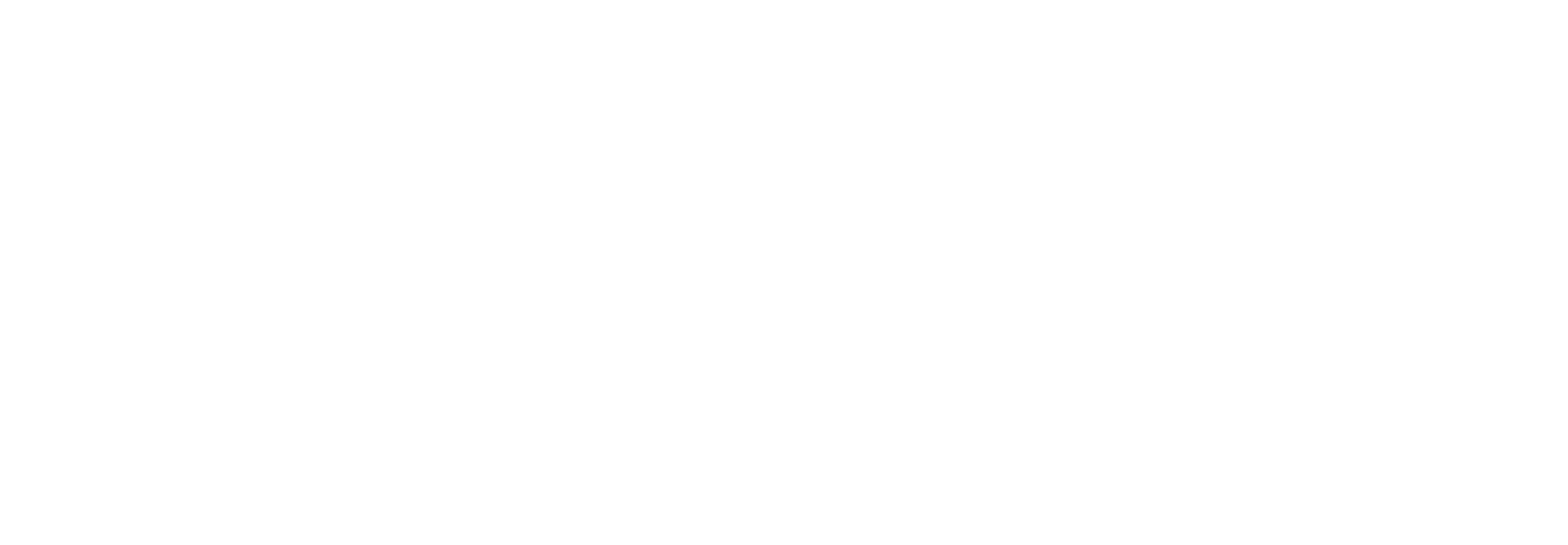
Digital humanitarianism along with the development of AI ethics is creating a large number of opportunities in areas that include academia, government, technology, healthcare, media, cultural institutions, and international organizations. With the rapid growth of the incorporation found in our everyday lives, professionals now need to have the skills necessary to deal with these issues relating to the ethical challenges of AI, such as: algorithmic bias, data privacy, digital rights, cultural representation, transparency, and responsible governance of AI.
Governments encouraging AI ethics careers globally are now creating regulations on the implementation of AI; in addition, many organizations are establishing an ethical framework for AI, along with developing policies for digital governance in order to ensure that the use of technology aligns with values that citizens of the world share. Additionally, museums, archives, libraries, educational institutions, and creative industries continue to use AI and digital technologies to preserve, analyze, and distribute cultural heritage. This masters in digital humanities and AI ethics interdisciplinary graduate program will provide those students who graduate with the ability to connect the two disciplines by bridging technology with the humanities and using that new connection to create new policy, encourage responsible innovation, and have a direct impact on how digital and technological changes are implemented globally in a moral and socially just manner.
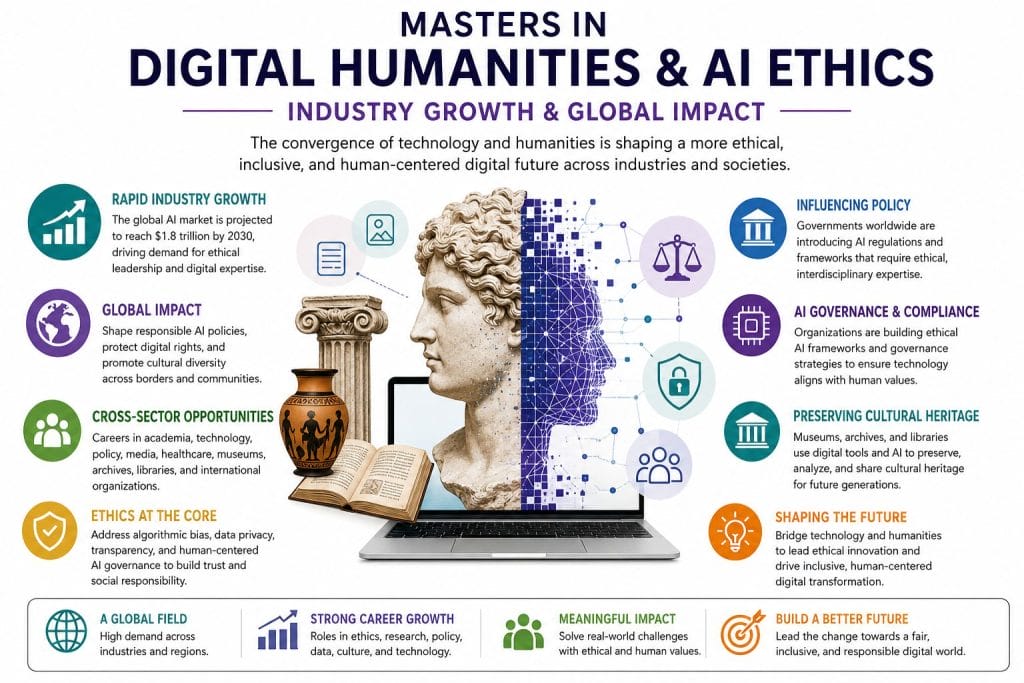
Both Digital Humanities and Ethics of AI are expanding very quickly due to how artificial intelligence is changing the way that research, learning, public policy, media and cultural institutions operate. Trends are developing in: Explainable AI; Algorithmic Accountability; Digital Preservation; AI-Assisted Humanities Research; Ethical Data Governance; Global AI Regulations; and Predictive Analytics for Historical Records, Cultural Trends, Social Behaviors and Public Opinion (enabling better, evidence-based decisions to be made by researchers and/or organizations).
In the future there will be more ways for Generative AI to innovate how content is created and discovered through knowledge; therefore, it is essential that those with responsible AI degree experience in both developing new technologies and governing such technologies ethically work together to ensure that AI systems will operate transparently, equitably, inclusively and with human values. Graduates with digital humanities careers with this interdisciplinary experience will be prepared to meet anticipated future challenges and influence policy as they help lead responsible digital transformation across all sectors.
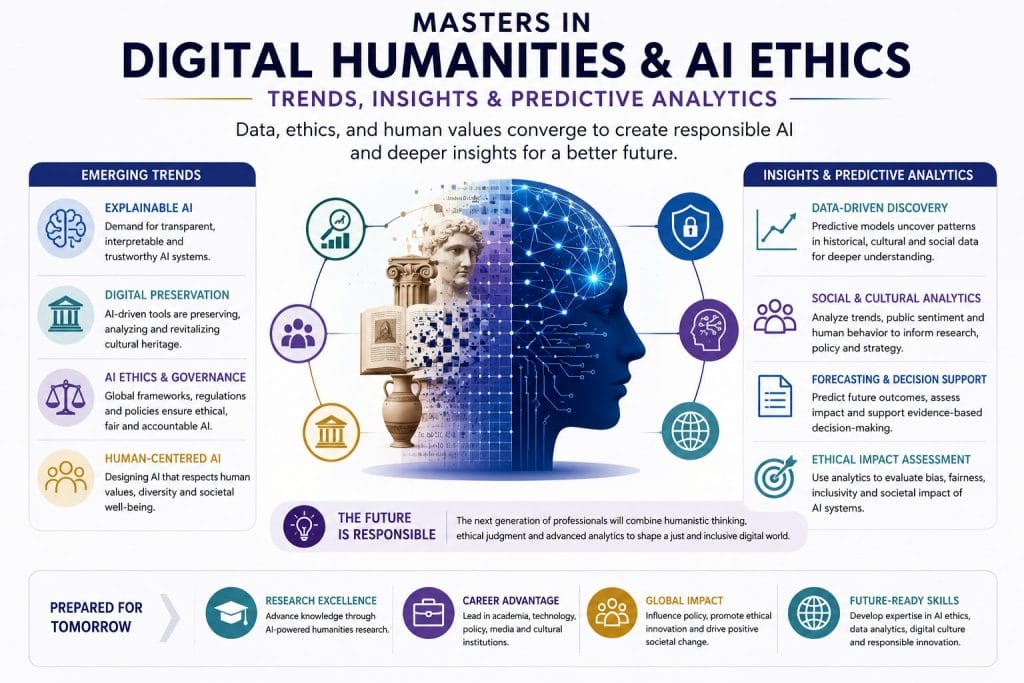
Graduates with a Master of Digital Humanities and Artificial Intelligence Ethics Degree are qualified for a myriad of career possibilities where technology, ethics, and culture intersect with public policy.
The masters in digital humanities and AI ethics fields of AI governance, digital strategy development, academic and non-academic research, public policymaking, digital ethical AI education capital structures, digital archives, cultural institutions and museums, mass media, for profit and non-profit organizations, business consulting, and technology include the types of organizations where graduates may work. Graduates of masters in digital humanities and AI ethics fill specific position titles within these fields such as AI Ethics Specialist, Digital Humanities Researcher, Responsible AI Consultant, Digital Policy Analyst, Data Governance Manager, Cultural Heritage Technologist, UX Ethics Analyst, and Digital Transformation Strategist; however, the interdisciplinary pedagogy of the degree qualifications also leads to job opportunities in international organizations, think tanks, and government agencies pursuing ethics and responsible innovation.
Graduates can continue developing their professional AI governance degree skills through ongoing AI governance program research, certification programs, attending technology ethics conferences, and through advancements in AI technology resulting in continued advancement towards leadership, consulting, and academic positions in an increasingly AI focused society.
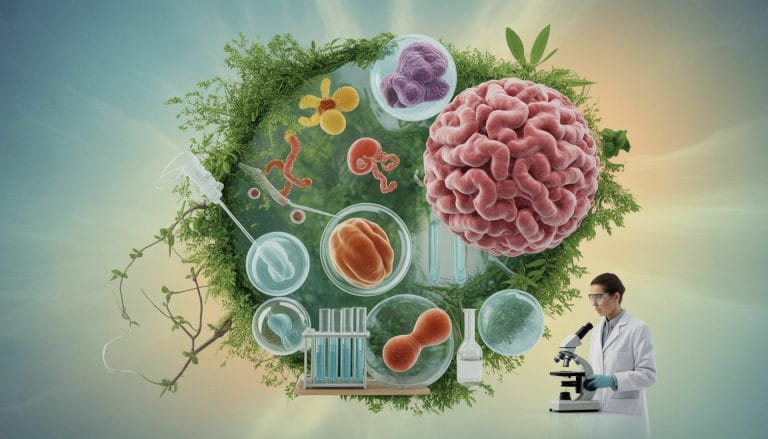
By redefining how societies conserve their culture, create knowledge, and make decisions, artificial intelligence is altering the way future leaders must comprehend AI to become literate in AI and responsible in it. The masters in digital humanities and AI ethics introduces students to an area of study that is rapidly evolving by investigating emerging topics of humanities and technology including generative AI, explainable AI; responsible machine learning; digital storytelling; computational humanities; AI governance; algorithmic fairness; human-centered design; digital preservation; and ethical data analytics.
Through this investigation of the benefits and challenges of employing AI technologies for enhancing research and education, protecting cultural heritage, guiding public policy, and developing creative industries, students examine the various means by which AI technology can be used to enhance these activities whilst addressing concerns including bias, privacy, transparency, accountability, and intellectual property. Students of masters in digital humanities and AI ethics who graduate from the program will have integrated technological innovation with humanistic inquiry, developed a level of expertise in how to assist digital ethics program organizations in implementing AI in a manner that will support ethical, inclusive, sustainable, and value-oriented future digital ecosystems.
Begin Your Journey!
AIU’s Summer of Innovation and Growth gives you the ability to earn up to $5000 in tuition credit by completing free lessons and courses.
Whether you’re looking to acquire new skills, advance your career, or simply explore new interests, AIU is your gateway to a world of opportunities. With free access to 3400 lessons and hundreds of courses the ability to earn credits and earn certificates there’s no better time to start learning.
Join us today as a Guest Student and take the first step towards a brighter, more empowered future.
Explore. Learn. Achieve.
A masters in digital humanities and AI ethics provides a unique blend of technology knowledge, ethical reasoning, and human-centered problem-solving to professionals working in these fields. Graduates will have developed the capability to assess the societal implications of Artificial Intelligence (AI), create responsible AI strategies, and connect the worlds of technology, culture, and public policy.
Through an interdisciplinary technology and society degree curriculum, students will enhance research skills, critical thinking skills, digital analysis skills, and communications skills while preparing students to engage with complex issues such as algorithmic bias, digital privacy, AI governance, and protecting cultural heritage. In addition to increasing their career opportunities within academia, government, technology, consulting, media, museums, non-profit organizations, and international organizations, graduates with a Master’s degree in Digital Humanities and AI Ethics can have a positive impact on responsible innovation; ethical policymaking; protecting digital heritage; and leading efforts to ensure that new technologies are used fairly, transparently, and inclusively to benefit all of humanity.
Traditional educational models limit flexibility for adult students who are often balancing work, family responsibilities, and personal commitments because they utilize a fixed schedule, standardized curriculum, and in-person learning environment. However, this flexible andragogical learning model will provide opportunities for adult learners to achieve their goals through the application of their knowledge to real-world ethical and technological issues by enabling them to discover new areas of knowledge (such as AI governance, digital culture, computational humanities, and responsible innovation) through a personalized pathway of study, while also supporting critical thinking and lifelong learning within adult learners.
AIU’s Master of Digital Humanities and AI Ethics prepares students for a fully individualized, cross-disciplinary course of study that merges cutting edge digital technologies with ethical and human-centered approaches. The masters in digital humanities and AI ethics pro
gram employs andragogy-driven education principles, which allow professional learners to develop a personalized academic curriculum, based both on their long-term career paths and their research interests.
Flexible online learning arrangements, AI-assisted academic support resources, personalized, one-on-one guidance from faculty members and independent research opportunities are available to all students, in addition to connection with a worldwide learning community. Students’ courses also cover content concerning AI ethics, digital culture, computational humanities, data governance, digital preservation and responsible innovation while promoting critical thinking skills, creativity and solutions to real-world issues. This learner-centric digital humanities degree approach prepares artificial intelligence ethics degree graduates to be ethical leaders, scholars, consultants, teachers and policymakers who will help lead the way towards an ethical digital transformation for the future of technology and society.
Important: Below is an example of the topics or areas you may develop and work on during your studies. By no means is it a complete or required list, as AIU programs do not follow a standardized curriculum. It is meant solely as a reference point and example. Want to learn more about the curriculum design at AIU? Check here: Course and Curriculum
Through the masters in digital humanities and AI ethics studies, students receive an interdisciplinary and flexible curriculum that combines humanities, technology, ethics, and digital innovation. In addition to acquiring advanced analytical, research and technical competencies, graduates from this program will have the skills to analyze and develop new ways to use digital technologies in the areas of society, culture, governance and the complexities of human behaviour, as well as possess the digital humanities and artificial intelligence tools and knowledge necessary to evaluate, design and manage ethical artificial intelligence (AI) systems and to conduct research, communicate and preserve cultural artefacts with various digital media-related technologies.
Through the Master of Arts degree in Digital Humanities and AI Ethics, students gain hands-on experience with industry-relevant digital research, analytics, visualization, and collaborative tools utilized in numerous industries (academics, technologies, cultural institutions, and public policy). Students may be able to utilize different platforms which focus on qualitative analysis or quantitative analysis for their individual interests and project goals. These platforms may include Natural Language Processing (NLP), Artificial Intelligence (AI) Development, Digital Archives/Data Visualization, Citation Management/Collaborative Research/Quantitative Analysis. By utilizing these technologies, the student can analyze large data sets, interpret text and culture, interpret the outcome of artificial intelligent systems, create interactive digital projects, and support ethical decision making based on evidence.
In completing a Master’s degree that has both a technical component and human-centered critical theory component, graduates will acquire the Digital Competencies necessary to conduct meaningful research and promote responsible use of AI and support innovation throughout the global economy and across disciplines.
The Masters in Digital Humanities and AI Ethics focuses on career-oriented learning, incorporating both theoretical knowledge and practical application across technology, research, public policy, education, media and cultural outlets. Students address real-world concerns such as responsible AI usage, digital governance, algorithmic fairness, data ethics, digital preservation, and creating human-centered innovations through case studies, research projects and problem-solving from multiple perspectives.
The program provides opportunities for developing critical thinking skills, leadership skills, communication skills, and analytical skills while exposing students to the tools and processes used by professionals in the field. This type of application oriented program prepares students to accept positions in AI ethics, digital transformation, policy development, consulting, research, and cultural heritage management, thereby allowing them to lead innovative ethical developments as well as make informed decisions in a world that is becoming increasingly reliant on digital technologies and AI.
The Masters in Digital Humanities and AI Ethics consists of applying interdisciplinary knowledge to practical applications through individual project-based work and culminating in a comprehensive capstone. Some of the topics researched by learners are AI governance and regulation, preservation of digital heritage, algorithmic fairness, ethical data practices, digital storytelling, public policy and responsible technology adoption using both case studies as well as research-driven projects. Through the use of both theoretical frameworks and practical solutions, learners are encouraged to evaluate the potential of emerging technologies, develop ethical AI strategies, and solve complex social issues. Throughout their project work, graduates gain skills in research, analysis and problem solving, while also building a professional portfolio that proves their preparedness to lead responsible digital transformation work in academia, industry, government and the not-for-profit sector.
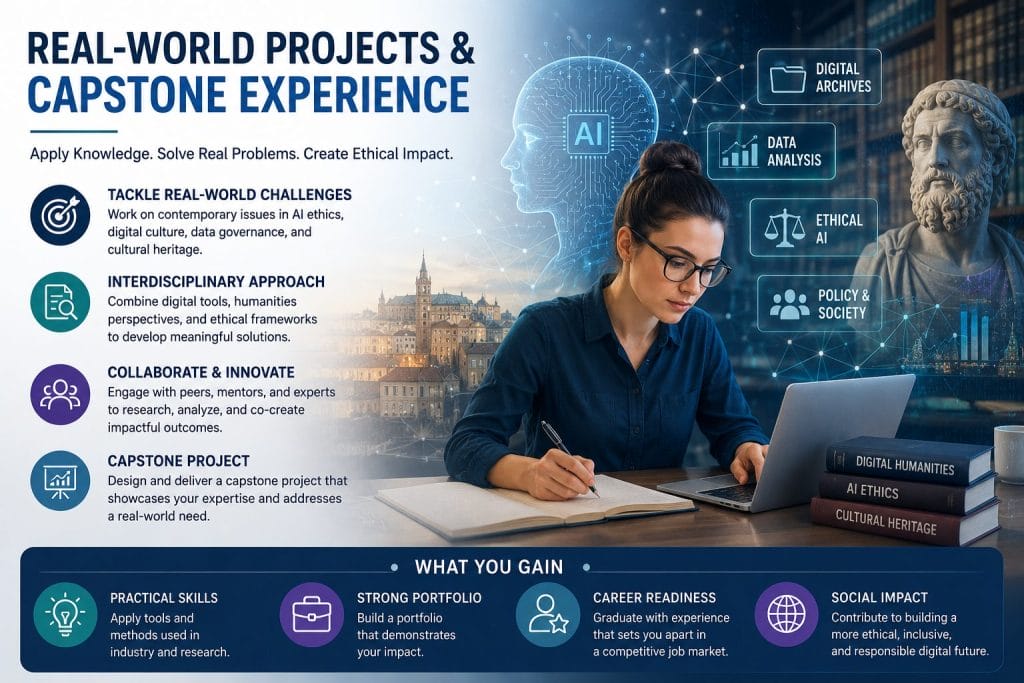
This Master’s program focuses on Digital Humanities and AI Ethics. Interdisciplinary studies of ethical governance, responsible AI, digital culture, data ethics, digital preservation and computational humanities are all encouraged at this institution. This program helps students create innovative, evidence-based solutions to actual problems while developing applications of emerging technologies that emphasize ethics, inclusiveness, and human-centered approaches to technology.
The Masters in Digital Humanities and AI Ethics creates an arena for research to take place while students conduct research in regard to the social, mental, and ethical aspects of the emerging technologies of our day.
As students engage in collaborative, interdisciplinary research projects that focus on relevant topics such as responsible use of Artificial Intelligence through the lens of fairness, developing good practices for long-term digital preservation, using technology and computation to study the Humanities, creating ethical data governance models, producing ethical digital narratives, following AI governance best practices, designing human-centric technologies, etc., they will be encouraged to employ both qualitative and quantitative methods of research to analyze complex problems, make unique solutions, and provide valuable information to those that work in academia, industry, government, or non-profit organizations.
By combining the perspective that Humanities provides and the learning and use of Advanced Digital Tools and Artificial Intelligence Technologies, graduates develop the ability to lead in developing ethical innovation, improve policy, protect cultural heritage, and positively affect responsible equity in advanced digital transformation in an Artificial Intelligence driven society.
The Digital Humanities and AI Ethics Master’s Program culminates in a thesis or a significant research project that lets students demonstrate their ability to explore the sophisticated issues of technology, ethics, and the humanities. In the course of this degree program, students will develop a research problem, approach the solution through interdisciplinary analyses based on accepted methods, and recommend execution of solutions based on evidence for areas of research, including but not limited to, responsible AI, digital governance, algorithmic fairness, digital preservation, or AI policy.
The student will ultimately present and defend their research project before academic evaluators, demonstrating that they are capable of thinking critically, analytically, ethically, communicating well, as well as preparing them for advancement to leadership positions, doctoral studies, and research-based careers.
The online Master’s degree program and training in AI Ethics & Digital Humanities offer students a lively virtual classroom and provide a unique platform for collaboration, independent research, and global interaction. You’ll be able to use interactive course content, and digital libraries, as well as utilize AI-based learning materials, engage in discussions through the classroom forums, and share with your instructor in a virtual classroom that has been specially designed for working adult learners.
You’ll enjoy the flexibility of using the online system which promotes a rich experience of learning and varies with respect to working with peers from different religions and cultures while also being able to participate in virtual seminar sessions, research discussion groups, and multi-disciplinary projects. The digital campus provides for the opportunity of academic excellence, international cultural exchange, and lifelong professional relationships in a global community of learners.
The Digital Humanities and AI Ethics Master’s Program offers students many ways to be involved through, for example, interactive workshops, live online courses (including symposiums with video conferencing), guest speakers from various expert fields, and opportunities to network with students internationally. These live experiences foster opportunities for discussion and exploration of topics such as responsible AI development, digital governance, preserving cultural heritage, innovating ethically, and using computational methods in the study of human cultures.
Students can work closely with faculty members, researchers, industry professionals, and other students from a variety of cultural and professional backgrounds while gaining insight into the many different ways people approach the same problems and use similar tools. The collaborative nature of this type of instruction provides each participant with opportunities to expand academic knowledge, enhance professional networks and conduct interdisciplinary research, ultimately equipping graduates with the skills necessary to provide ethical leadership in digitally transforming our world as it becomes increasingly connected.
An integrated digital learning environment with access to online library collections, scholarly journals, research databases, artificial intelligence (AI)-driven tools for learning, interactive course materials, and tailored academic assistance helps students improve their research skills, critical thinking skills, and use of interdisciplinary collaboration while having access to the most up-to-date developments in artificial intelligence (AI), digital humanities, ethical governance, and new technologies.
In addition to the above-listed resources, faculty mentoring through virtual conversations, and self-paced study opportunities further support students in developing advanced capabilities and conducting significant research to help them achieve success both in their academics and in their professions.
To be accepted into the Master’s Programme in Digital Humanities and AI Ethics applicants must possess a recognised undergraduate degree from a recognised/ accredited university. Students making an application could be asked to provide transcripts, a CV/resume, a statement explaining their interests both in terms of their academic and career goals, and any other documentation the institution may require. There is value in having experience working within the fields of the humanities, social sciences, computer sciences, information technology or other related fields, although students with different academic and/or professional backgrounds who are interested in digital innovation and ethics/interdisciplinary research are also encouraged to apply.
Fill out the online application with all of your personal details and academic information.
Submit all required documents to apply: academic transcripts, résumé, statement of purpose and any other documents requested by your school.
Show proof of prior qualifications and any other documents your school asks for during admission.
Once reviews of your application by the admissions team to see if you qualify for the program and if you are suitable for it; upon acceptance, you will need to finish enrolling in the Digital Humanities & AI Ethics program at the on-line campus.
You will have the chance to start your studies in Digital Humanities and AI Ethics after finishing the enrollment process and confirming your admission to the programme.
Tuition costs are going to differ for students earning a Master’s Degree in Digital Humanities and AI Ethics based on multiple factors: which college they choose to attend and how the specific program was designed. AIU provides numerous financial support options such as tuition payment plans (by the semester/minimum of two payments), merit scholarship funds, financial aid based upon financial need, employer tuition assistance, and other forms of funding assistance to make graduate education an affordable option for potential students. Potential students should research all available financial assistance and consult the admissions or financial aid office at their prospective colleges for detailed information regarding eligibility and application deadlines as well as payment arrangements.
The graduate program for a Master’s degree in Digital Humanities and AI Ethics integrates Humanities, Digital Technology, and AI to better understand the cultures, societies and moral/ethical considerations of using AI during the research and development of AI-based innovations, as well as to ready professionals for leading an innovative and digitally transformed world through ethics, culture and society.
You could have an exciting career in Artificial Intelligence Ethics, Digital Transformation, Public Policy, Research, Academia, Consulting, Digital Heritage, Data Governance, UX Ethics, and Technology Strategy within Government, Non-Profits, Cultural Institutions, or Private Organizations after earning your Master’s degree in Digital Humanities and Artificial Intelligence Ethics!
Yes. The field of AI ethics is growing rapidly as businesses begin to look for professionals that can keep their AI systems compliant, accountable, fair and transparent in the face of rapidly changing regulations. There are great opportunities in the areas of technology, health care, finance, government, academia and consulting.
Graduates will have access to a variety of job options ranging from AI ethics specialists and responsible AI consultants to digital humanities researchers, AI policy analysts/data governance managers/digital archivists/cultural heritage technologists/UX ethics advisors/digital transformation consultants/research analysts/academic researchers (across the tech sector, governmental agencies, educational institutions, consulting firms/organizations, and cultural institutions).
"*" indicates required fields