Masters in hydrogen energy systems

School of Science & Engineering

Academic Freedom to Discover Your Purpose

Open Curriculum Design at Atlantic International University

The Masters in Hydrogen Energy Systems is a highly specialized program aimed at preparing graduates in becoming proficient in the use of hydrogen-based energy systems that promote sustainable development and clean energy production. This hydrogen energy system program will involve learning about the production, distribution, storage, and consumption of hydrogen-based energy with a special emphasis on green hydrogen, blue hydrogen, fuel cells, energy storage, and renewable energy.

The need for decarbonizing industries around the world requires that more engineers be skilled in working in hydrogen-based energy. The hydrogen energy engineering masters program usually involves the study of different production processes, safety measures, hydrogen systems, and fuel cell energy among others.

The flexible format of an online masters in hydrogen energy systems in the form of academic freedom and open curriculum allows working professionals to advance their qualifications without interrupting their careers. The ease of access makes the renewable hydrogen energy degree, hydrogen fuel systems masters, clean energy systems master’s degree, and sustainable hydrogen energy program appealing choices for students who want to progress in their careers even while fulfilling their work responsibilities.

In addition, the increasing application of AI and analytics is revolutionizing hydrogen industries. Through data analysis and optimization, predictive maintenance, energy management, and modeling, efficiency is being improved in hydrogen production, storage, and transportation operations.

Important: Begin a captivating journey to discover potential study areas and subjects as you navigate through your academic adventure. It’s crucial to highlight that this list is not exhaustive or obligatory, highlighting AIU’s commitment to personalized learning experiences rather than rigid course work or degree requirements. Consider this sample as an illustration of the wide range of options at your disposal. If AIU’s unique, flexible curriculum and comprehensive exam structure piques your interest, does it inspire you to delve further for a thorough understanding?

Masters in hydrogen energy systems Industry Growth & Global Impact

A masters in hydrogen energy systems at Atlantic International University (AIU) provides graduates with great prospects in terms of the clean energy transition happening throughout the world. It is a fact that the demand for graduates with an education in hydrogen energy systems will continue to increase in parallel with governmental and industry investments in technologies such as – green hydrogen, blue hydrogen, fuel cells, and advanced energy storage. In fact, the global demand for hydrogen reached almost 100 million tons by 2024 and continues to increase as industries seek to reduce their carbon footprint. It is expected that the green hydrogen market is expected to grow at an annual rate of more than 30% through the next decade.

Studying an online masters in hydrogen energy systems, hydrogen energy engineering masters, or a master degree in hydrogen energy will provide graduates with knowledge in such areas as hydrogen systems, renewable energy, and sustainable energy technologies. Contemporary curriculums have already started to include AI-optimized energy systems management, maintenance, and management of energy resources. Graduates from a hydrogen technology master’s degree, renewable hydrogen energy degree, hydrogen fuel systems masters, clean energy systems master’s degree, or sustainable hydrogen energy master’s program will be able to join high-paying job positions around the globe creating unique success stories.

Trends, Insights & Predictive Analytics in Hydrogen energy systems

The hydrogen energy landscape is shifting rapidly from theoretical decarbonization roadmaps to real-world infrastructure deployment. However, because hydrogen is highly volatile, corrosive, and heavily dependent on variable renewable energy (VRE) like wind and solar, deploying predictive analytics has become a critical requirement for scaling the market.

The hydrogen predictive analytics market is projected to reach $1.45 billion by 2034, expanding at a steady CAGR of 6.2%. This growth is driven by the integration of AI, machine learning, and high-frequency edge data to optimize hydrogen production, transport, and consumption.

Key Trends
  • The “No-Regret” Prioritization Shift: Early hype suggested hydrogen could power everything from home heating to passenger cars. Current industry consensus has corrected this: hydrogen is now being strategically concentrated in “no-regret” heavy sectors—such as steel manufacturing, chemical refining, aviation, shipping, and long-duration grid storage—where direct electrification is functionally impossible. 
  • Infrastructure Parity with Natural Gas: Pipelines are emerging as the most cost-efficient distribution method, capable of carrying 10 times the energy of standard electricity transmission lines at an eighth of the cost. Predictive modeling is heavily focused on repurposing existing natural gas networks through blending analytics.
  • The CAPEX and Electrolyzer Scale-up: Driven by giga-scale projects in optimal renewable zones (e.g., the Middle East, North Africa, Australia, and Chile), green hydrogen production costs are projected to fall toward $1.40 to $2.30 per kg, aiming for cost parity with traditional “gray” fossil-fuel hydrogen.
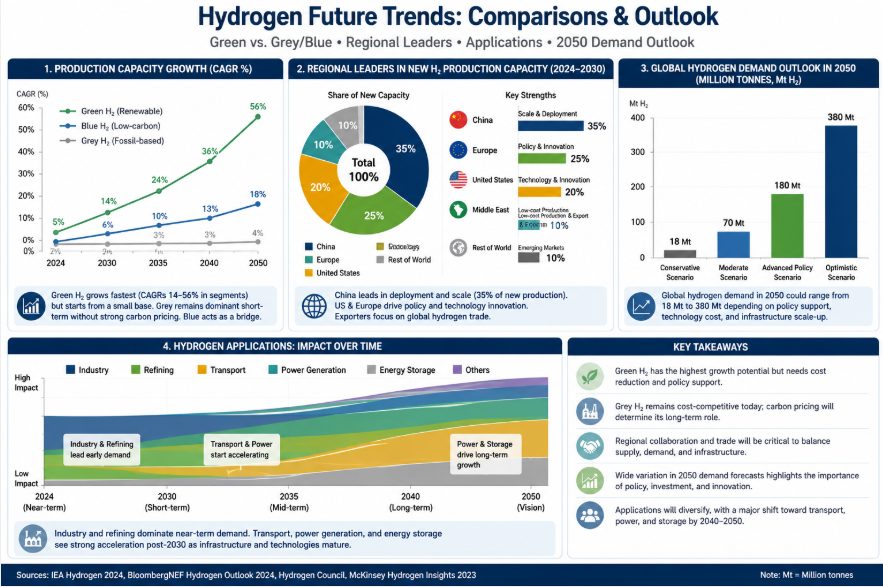
Hydrogen Future Trends Comparisons & Outlook
The image outlines hydrogen trends toward 2050. It shows Green $\text{H}_2$ production capacity leading growth (56% CAGR), China dominating new capacity (35%), 2050 demand peaking at 380 Mt, and applications shifting from industry to transport and power storage over time.
Future Trends (2026–2050)
  • Scaling & Competitiveness: Green hydrogen production costs continue declining (30%+ drop potential by 2030 via cheaper renewables/electrolyzers). Shift to execution phase with multi-GW projects, derivatives (ammonia, e-methanol), and hybrids (blue + CCUS).
  • Sector Coupling: Power-to-X for long-duration storage, grid balancing, and hard-to-abate decarbonization (steel DRI, chemicals, heavy transport, high-temp heat).
  • Global Trade & Hubs: Export hubs (MENA, Australia) and import strategies (Europe, Asia). >90 hydrogen hubs developing worldwide.
  • Policy-Driven Acceleration: National strategies, tax credits (e.g., US IRA), and mandates push low-emissions H₂ to 35–43 Mt by 2030 in ambitious scenarios.
Trend Comparisons
  • Green vs. Grey/Blue: Green H₂ grows fastest (CAGRs 14–56% in segments) but starts from a small base; grey remains dominant short-term without strong carbon pricing. Blue acts as a bridge.
  • Regional Leaders: China dominates deployment/scale (35% of new production); US/Europe emphasize policy/tech innovation; exporters focus on trade.
  • Applications: Industry/refining lead near-term; transport/power/storage accelerate post-2030. Optimistic scenarios project global demand 18–380 Mt by 2050 (wide variance by policy/tech).
Predictive Analytics

The core challenge of green hydrogen production is matching the volatile, intermittent nature of wind and solar power with the strict operational limits of electrolyzers (like Proton Exchange Membrane or Solid Oxide cells).

  • Coordinated Forecaster Systems: Predictive analytics engines combine numerical weather prediction (NWP) models with localized historical SCADA data. By running machine learning algorithms (such as Long Short-Term Memory networks), operators can forecast renewable power generation 24 to 48 hours in advance.
  • Dynamic Stack Scheduling: Electrolyzer stacks degrade faster if they are constantly cycled up and down violently. Predictive models calculate the optimal “sweet spot” for ramping production based on forecasted energy inputs and real-time power market pricing, maximizing degradation-adjusted return on investment.
Industry Growth Charts 

Overall Hydrogen Market (USD Billion): 2025: ~215 2026: ~226 2035: ~380 (CAGR 5.9%)

Green/Clean Hydrogen (USD Billion, varied forecasts):

  • Conservative: 2026 ~13–18 → 2033/35: 35–115 (CAGR 14–30%)
  • Optimistic: Significantly higher (up to 247+ by 2035 in aggressive projections).

Key Demand Projection (Mt, 2050 scenarios): Conservative ~19 Mt → Moderate ~100+ Mt → Optimistic 300+ Mt. Clean H₂ grows ~100x, mitigating >2 Gt CO₂/year.
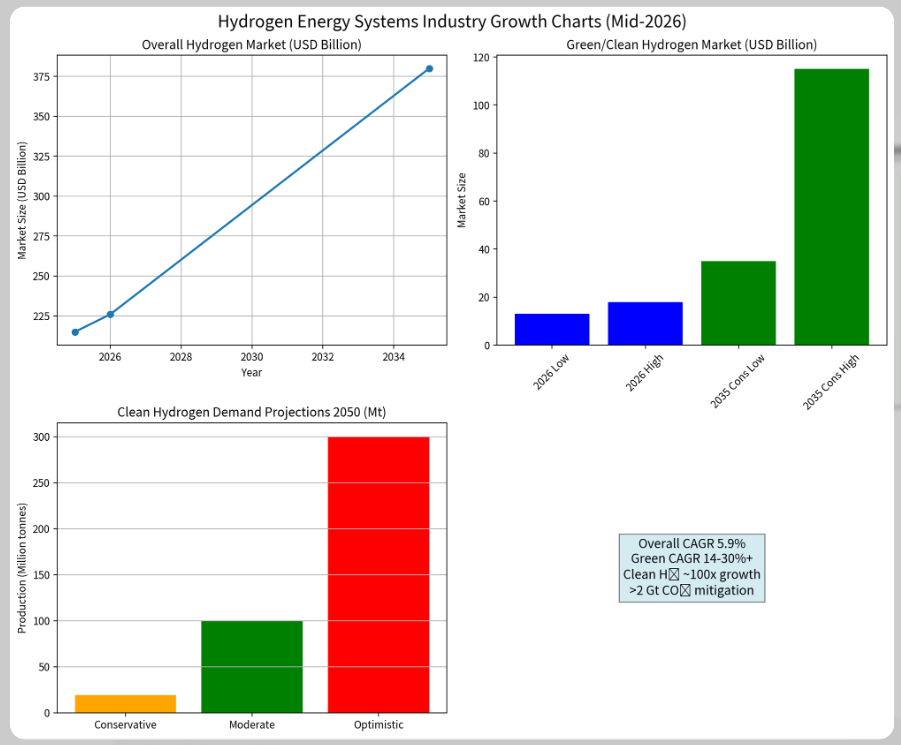
Hydrogen Energy Systems Industry Growth Charts
details mid-2026 hydrogen growth projections. The line chart shows the overall market approaching $380 billion by 2035. Bar charts project green hydrogen market size increasing significantly by 2035 and 2050 clean demand peaking at 300 Mt under optimistic scenarios.
Insights on Future Technologies & Smart Industries
  • Advanced Electrolysis & Materials: Next-gen PEM/alkaline/SOEC electrolyzers, AI-optimized catalysts, and durable membranes for higher efficiency/lower costs.
  • Smart Integration: Digital twins, IoT-enabled systems, Power-to-X (e-fuels), and hydrogen-ready infrastructure for smart grids/cities.
  • Smart Industries: Decarbonized steel/chemicals via H₂ DRI; hydrogen-powered data centers (synergizing with AI energy demand); autonomous transport/fuel cells; precision agriculture/robotics via clean H₂.
  • Smart Cities: AI-driven H₂ for resilient energy, zero-emission mobility, and sector coupling.
Impact of AI (Business Intelligence & Predictive Analytics – USA Focus)

AI enhances efficiency across the value chain: predictive maintenance (20%+ cost reduction), renewable forecasting for electrolyzer optimization, digital twins, leak detection/safety modeling, catalyst discovery, and dynamic energy management (e.g., route optimization for FCEVs).

In the US, AI supports IRA-driven projects, data center powering (H₂ for reliable backup), and operations platforms (e.g., Honeywell Protonium). It accelerates decision-making via BI dashboards for project viability, demand forecasting, and emissions tracking, reducing risks in scaling. Synergies with AI’s rising electricity demand position H₂ as a flexible clean power solution.

Scope of Automation

Automation via AI/ML, robotics, and control systems covers electrolyzer operations, predictive maintenance, safety monitoring, logistics optimization, and smart manufacturing of components. It enables scalable, low-cost production, remote operations, and integration with renewables/smart grids—critical for commercial viability and reducing human error in hazardous environments.

Future Career Demand 

Strong growth in evolving digital economies:

  • Roles: Hydrogen engineers/specialists, project managers, systems integrators, AI/data analysts for H₂ ops, technicians, policy experts, and R&D leads in electrolysis/fuel cells/storage.
  • US Outlook: Potential for hundreds of thousands of jobs by 2030–2050 (e.g., 700k+ by 2030 in some estimates), with above-average salaries. Demand spans engineering, digital skills (AI/ML, modeling), and cross-sector applications.
  • Masters Advantage: Positions graduates for high-demand technical/strategic roles in industry, hubs, utilities, consultancies, and tech-energy intersections (e.g., AI data centers). Skills in systems integration, predictive analytics, and automation are highly valued.
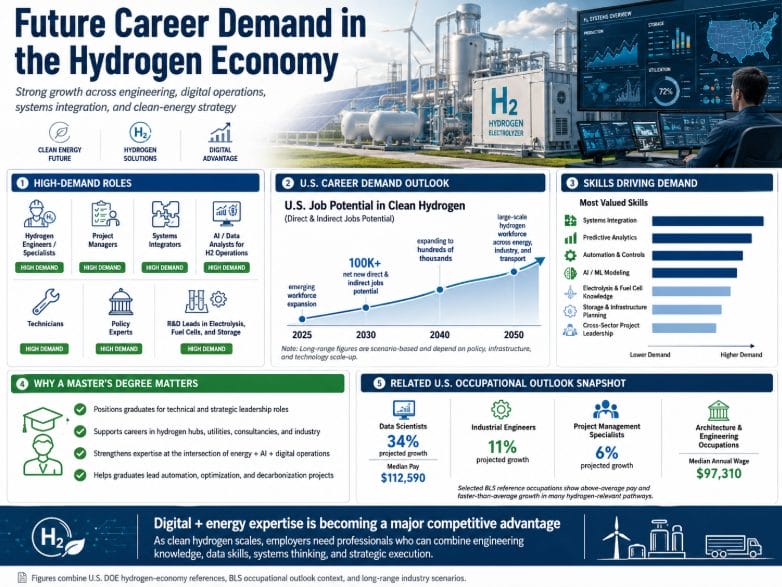
Future Career Demand in the Hydrogen Economy
Image Summary: The infographic highlights strong growth prospects in the clean hydrogen sector, with significant job creation projected through 2050. It emphasizes rising demand for technical, engineering, and data-focused roles, while showing how a master’s degree can enhance leadership opportunities, support expertise in energy and AI, and prepare graduates for high-growth careers in the clean energy transition.

Hence, it can be said that Hydrogen, powered by smart tech and AI, offers robust long-term potential despite near-term scaling challenges. A Masters program aligns well with high-growth career paths in the digital green economy. Monitor IEA/DNV updates for evolving trajectories.

Career Opportunities & Professional Development of a Student with Masters in hydrogen energy systems

A master’s program in hydrogen energy systems allows you to explore many possible career paths within the emerging hydrogen energy field. With a master’s in hydrogen energy systems, hydrogen energy engineering master’s, or master’s degree in hydrogen energy, you can work in green hydrogen, blue hydrogen, fuel cells, energy storage, and hydrogen systems development. Many organizations looking for skilled professionals in the renewable energy, utility, transportation, manufacturing, oil and gas, aerospace, and clean energy sectors require candidates with knowledge gained from hydrogen energy master’s program, renewable hydrogen energy master’s, hydrogen fuel systems master’s, clean energy systems master’s, or sustainable hydrogen energy master’s programs.

Prospective students can explore cutting-edge areas such as hydrogen energy infrastructure, digital energy management, smart grid technologies, carbon neutrality, and AI-driven energy optimization through the academic resources. Students can improve their career prospects by developing a project portfolio – participating in real-world industry projects, publishing research papers, interning, obtaining technical certifications, and more. Even the online hydrogen energy master’s degree is very convenient for professionals who want to enhance their skill set. At AIU, students are provided with academic guidance and professional career assistance, including networking and career advancement opportunities.
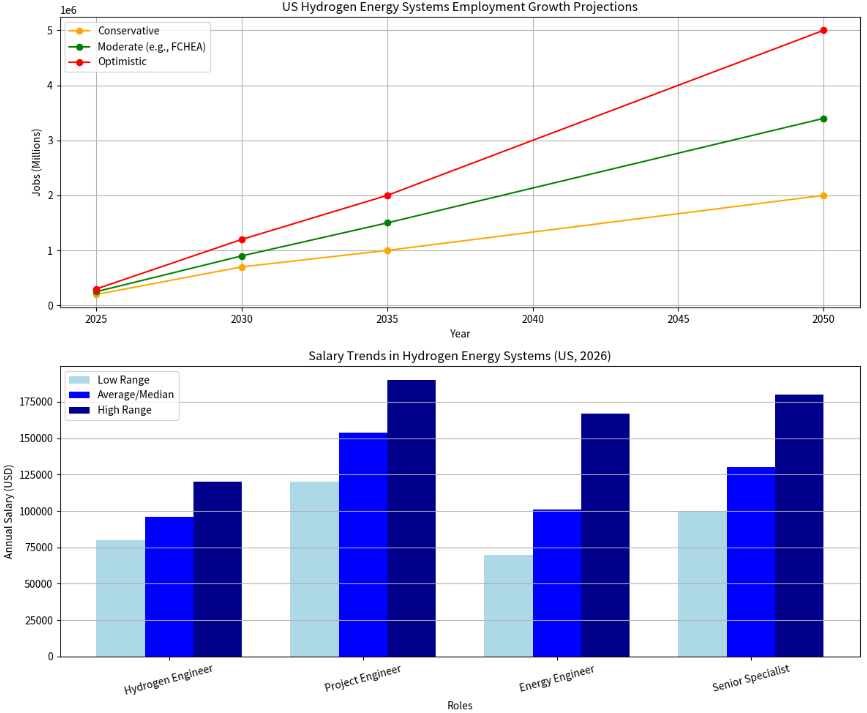
US Hydrogen Energy Systems Employment Growth Projections
The image features charts of US hydrogen energy systems employment. The top line graph projects job growth to 2050, ranging from 2 million (conservative) to 5 million (optimistic). The bottom bar chart details 2026 salary trends (low, median, high) across four specialized engineering and specialist roles.
Key Insights from Charts
Employment Growth (US Projections):
  • 2025–2030: Rapid ramp-up, with moderate scenarios projecting ~700,000 total jobs across the value chain (production, infrastructure, equipment) driven by IRA, hydrogen hubs, and industrial decarbonization.
  • 2035–2050: Strong scaling to 1–3.4+ million cumulative jobs in optimistic pathways, including direct, indirect, and induced roles. Hydrogen hubs alone could support hundreds of thousands of jobs.
  • Growth is concentrated in engineering, construction, operations, manufacturing, and tech/AI-integrated roles. Net positive impact despite some fossil-to-clean transitions.
Salary Trends (Annual USD):
  • Hydrogen Engineer: ~$80K–$120K (avg. ~$96K).
  • Hydrogen Systems/Project Engineer: ~$128K–$190K (median ~$154K).
  • Energy/Renewable Engineer (related): ~$70K–$167K (avg. ~$101K).
  • Senior/specialist roles often exceed $150K–$200K+ with experience in electrolysis, fuel cells, digital twins, or project management.

Salaries are competitive and above national engineering averages, reflecting high demand for specialized skills in a growing green sector. Premiums exist for AI/ML, predictive analytics, automation, and systems integration expertise.

Policy (IRA tax credits, hydrogen hubs), cost reductions in green H₂, and synergies with renewables/AI data centers. A Masters in Hydrogen Energy Systems positions graduates strongly for high-demand, high-pay technical and leadership roles in this evolving digital green economy.

Data synthesized from FCHEA, DOE studies, industry reports, and salary aggregators (ZipRecruiter, Glassdoor, etc.). Actual figures vary by location, experience, and company.

Contact Us Today!

Begin Your Journey!
AIU’s Summer of Innovation and Growth gives you the ability to earn up to $5000 in tuition credit by completing free lessons and courses.
Whether you’re looking to acquire new skills, advance your career, or simply explore new interests, AIU is your gateway to a world of opportunities. With free access to 3400 lessons and hundreds of courses the ability to earn credits and earn certificates there’s no better time to start learning.
Join us today as a Guest Student and take the first step towards a brighter, more empowered future.
Explore. Learn. Achieve.

Academic Freedom & Customized Curriculum

One unique feature of this master’s program is academic freedom, which allows students to customize their learning to take advantage of upcoming opportunities in the field of hydrogen energy. By earning a master’s degree in hydrogen energy systems, students will have the opportunity to study areas like green hydrogen, blue hydrogen, fuel cells, energy storage systems, and advanced hydrogen systems design. In this master’s in hydrogen energy systems degree program, online as well as campus based, there are many elective options that cater to different career paths.

Students can choose from a variety of research streams, projects, and interdisciplinary areas of learning by obtaining a master’s degree in hydrogen energy. A master in hydrogen technology contributes positively towards innovation in renewable energy, clean energy, sustainable energy solutions, and related fields. Whether you are working for a degree in renewable hydrogen energy, hydrogen fuel systems, or clean energy systems, you can expect academic freedom as well as flexibility in this program. The sustainability in hydrogen energy program gives students opportunities to gain practical skills in hydrogen energy technology.

Why Study Masters in hydrogen energy systems at AIU

Enrolling in a Masters in Hydrogen Energy Systems at AIU provides you with flexibility and a future-oriented study option for those who want to gain in-depth knowledge about the emerging hydrogen energy field. The innovative hydrogen energy systems program will provide you with both theoretical and practical information in hydrogen systems, green hydrogen, blue hydrogen, fuel cells, energy storage, and renewable energy systems.

The one major advantage that AIU can offer to any individual is the opportunity to learn at your own pace. The masters in hydrogen energy systems program is offered through an online platform allowing students from all around the world to take part in quality education regardless of geographical barriers. Students have the privilege to customize their course curriculum according to their career aspirations in the field.

In addition, AIU employs AI-driven educational tools to enable students to get a personalized learning experience that will allow them to acquire specialist knowledge in a hydrogen energy master degree program. The interdisciplinary nature of AIU enables students to combine various courses, including clean energy, sustainable energy, environmental management, and engineering.

The global learning platform offered by the university enables students from different regions to be exposed to different ideas. Students enrolled in a hydrogen technology master program, renewable hydrogen energy program, hydrogen fuel systems masters program, clean energy systems master program, or sustainable hydrogen energy master’s program stand to benefit immensely from the courses offered.

Start Your Hydrogen Energy Journey Today with AIU

Apply Now for Admission

Core Courses and Topics in Masters in hydrogen energy systems

Studying towards a masters in hydrogen energy systems means that the student acquires advanced understanding in hydrogen energy, hydrogen systems, and technology behind switching to sustainable and clean energy. A usual hydrogen energy systems degree involves mandatory classes on hydrogen production, distribution, utilization, fuel cells, energy storage, and the connection of hydrogen energy into renewable energy grid systems. The subjects taught at hydrogen energy engineering masters include, but are not limited to, green hydrogen, blue hydrogen, hydrogen process optimization, electrolysis, hydrogen safety, and energy economics.

A masters degree in hydrogen technology at AIU provides technical skills in systems modeling, data analysis, simulation programs, and the creation of hydrogen infrastructure in a holistic and asynchronous way. Irrespective of whether a candidate pursues his/her career path towards a renewable hydrogen energy degree, hydrogen fuel systems masters, or clean energy systems master’s degree, he/she acquires knowledge in creating large-scale low-carbon energy technologies. Nowadays, many universities have online masters in hydrogen energy systems to allow busy individuals to study.

  • Hydrogen Production Technologies (Green Hydrogen and Blue Hydrogen)
  • Fuel Cells and Hydrogen Fuel Systems
  • Hydrogen Transportation and Distribution Infrastructure
  • Electrolysis Technologies and Process Engineering
  • Sustainable Energy Economics and Hydrogen Markets
  • Hydrogen Storage and Energy Storage Systems
  • Renewable Energy Integration with Hydrogen Systems
  • Hydrogen Safety, Risk Assessment, and Regulations
  • Clean Energy Systems Design and Optimization
  • Advanced Modeling and Simulation of Hydrogen Energy Systems

Tools & Technologies You Will Master

Students pursuing a Masters in Hydrogen Energy Systems develop expertise in electrolysis technologies, fuel cells, hydrogen production systems, energy storage solutions, process simulation software, computational modeling, smart grid integration, renewable energy technologies, data analytics, hydrogen safety systems, carbon management tools, and advanced monitoring, control, and optimization platforms for clean energy applications.

  • MATLAB & Simulink: Used for modeling, simulation, control system design, and performance analysis of hydrogen production, storage, and fuel cell systems.
  • Aspen Plus: Used to simulate hydrogen production processes, chemical reactions, process optimization, and techno-economic analysis of hydrogen plants.
  • COMSOL Multiphysics: Enables multiphysics modeling of electrolyzers, fuel cells, hydrogen transport, heat transfer, and electrochemical systems.
  • ANSYS Fluent: Used for computational fluid dynamics (CFD) analysis of hydrogen flow, combustion, storage tanks, and fuel cell performance.
  • HOMER Pro: Helps design and optimize renewable energy and hydrogen-based microgrid systems.
  • AutoCAD: Used for engineering drawings, hydrogen infrastructure layouts, and system design documentation.
  • SolidWorks: Supports 3D modeling and mechanical design of hydrogen storage tanks, fuel cell components, and system assemblies.
  • Python: Widely used for data analysis, machine learning, optimization, and hydrogen system performance modeling.
  • LabVIEW: Used for instrumentation, data acquisition, monitoring, and control of hydrogen energy experiments.
  • OpenFOAM: An open-source CFD platform used for advanced simulation of hydrogen flow, mixing, and transport phenomena.

Career-Focused Learning in Hydrogen energy systems

A Masters in Hydrogen Energy Systems equips students with the technical expertise, industry knowledge, and practical problem-solving abilities needed to succeed in the rapidly growing hydrogen economy. Whether pursuing employment in industry, launching a startup, working remotely, offering consulting services, or preparing for AI-enabled workplaces, graduates develop skills that align with emerging opportunities across the global clean energy sector.

Practical Skills for Industry Roles

Students in a Hydrogen Energy Systems Degree gain hands-on experience that prepares them for technical and managerial positions in energy companies, utilities, engineering firms, and technology providers.

Design and optimization of hydrogen systems for industrial and commercial applications.

  • Understanding production pathways including green hydrogen and blue hydrogen technologies.
  • Operation and performance analysis of fuel cells, electrolyzers, and hydrogen infrastructure.
  • Integration of renewable energy sources with hydrogen production and distribution systems.
  • Energy modeling, simulation, and system performance assessment.
  • Safety management, risk analysis, and regulatory compliance in hydrogen projects.
  • Development of solutions for large-scale energy storage and grid balancing applications.
  • Application of engineering principles within a Hydrogen Energy Engineering Masters curriculum to solve real-world challenges.
Practical Skills for Entrepreneurship

A Hydrogen Technology Master’s Program also helps students identify business opportunities and create innovative solutions within the evolving hydrogen economy.

  • Evaluating market opportunities in sustainable energy and hydrogen technologies.
  • Developing business models for hydrogen production, storage, transportation, and utilization.
  • Understanding technology commercialization and innovation management.
  • Conducting feasibility studies for clean energy ventures.
  • Building startup strategies around green hydrogen, mobility, and industrial decarbonization.
  • Assessing investment opportunities and project financing for hydrogen infrastructure.
  • Creating scalable solutions that support the global transition to renewable energy.
Practical Skills for Remote Careers

An Online Masters in Hydrogen Energy Systems enables students to build digital competencies that support remote and globally distributed careers.

  • Using advanced software tools for hydrogen system design and simulation.
  • Performing remote monitoring and performance analysis of hydrogen facilities.
  • Managing virtual engineering projects across international teams.
  • Conducting digital research and technical reporting for energy organizations.
  • Leveraging cloud-based platforms for data analysis and project collaboration.
  • Supporting remote operations related to hydrogen fuel systems masters specializations.
  • Delivering technical solutions and recommendations to clients worldwide.
Practical Skills for Consulting Careers

Graduates of a Master Degree in Hydrogen Energy can pursue consulting opportunities that help organizations adopt hydrogen technologies and achieve sustainability goals.

  • Assessing organizational readiness for hydrogen adoption.
  • Conducting techno-economic analysis of hydrogen projects.
  • Developing decarbonization strategies using hydrogen energy solutions.
  • Evaluating infrastructure requirements for hydrogen deployment.
  • Advising clients on regulatory frameworks, policy developments, and market trends.
  • Performing lifecycle assessments for clean energy systems master’s degree projects.
  • Supporting energy transition initiatives across transportation, industry, and power sectors.
Preparing for Future AI-Driven Workplaces

A Renewable Hydrogen Energy Degree prepares students to work in increasingly digital and AI-enabled energy environments.

  • Applying artificial intelligence to optimize hydrogen production and distribution.
  • Using machine learning for predictive maintenance of fuel cells and hydrogen infrastructure.
  • Analyzing large datasets to improve operational efficiency and system reliability.
  • Integrating AI-driven decision support tools into energy management systems.
  • Automating performance monitoring for hydrogen systems and energy storage facilities.
  • Combining engineering expertise with digital technologies to enhance productivity.
  • Developing future-ready skills for smart energy networks and autonomous operations.
Career Outcomes in the Hydrogen Economy

A Sustainable Hydrogen Energy Program provides graduates with versatile skills applicable across multiple sectors of the energy transition.

  • Hydrogen Systems Engineer
  • Green Hydrogen Project Manager
  • Fuel Cell Technology Specialist
  • Renewable Energy Consultant
  • Energy Storage Analyst
  • Sustainability Advisor
  • Hydrogen Infrastructure Planner
  • Clean Energy Researcher
  • AI-Enabled Energy Systems Analyst
  • Hydrogen Technology Entrepreneur
  • Building a Future in Sustainable Energy

Through a comprehensive Masters in Hydrogen Energy Systems, students develop the technical, business, and digital capabilities required to lead innovation in hydrogen energy, green hydrogen, blue hydrogen, fuel cells, energy storage, renewable energy, clean energy, and sustainable energy industries. Graduates are prepared to contribute to global decarbonization efforts while pursuing rewarding careers across industry, entrepreneurship, consulting, remote work environments, and future AI-driven workplaces.

Real-World Projects & Capstone Experience

AIU’s Masters in Hydrogen Energy Systems places a special emphasis on applying the skills learned in practice through projects, industry research, and capstone development along side accessing virtual labs. AIU’s online hydrogen energy systems master’s students and those pursuing the degree in hydrogen energy systems can gain valuable practical experience through portfolio projects addressing current issues in hydrogen energy, hydrogen systems, and advanced renewable energy technologies.

Through the application of AI and data analysis skills, learners create predictive models for green hydrogen energy, blue hydrogen, fuel cell efficiency, and energy storage management. Analytics case studies help assess efficiency, sustainability metrics, and new trends in the industry.

Students studying in hydrogen energy engineering masters and hydrogen energy system master’s programs have a chance to work on a capstone project that allows integrating their technical skills with practical research. Capstones can cover topics like hydrogen infrastructure, decarbonization practices, smart energy networks, and scalable sustainable energy solutions.

All pathways leading to hydrogen technology master’s degrees, renewable hydrogen energy master’s degrees, hydrogen fuel systems masters programs, clean energy systems master’s degrees, and sustainable hydrogen energy masters aim to prepare students to create a professional portfolio.
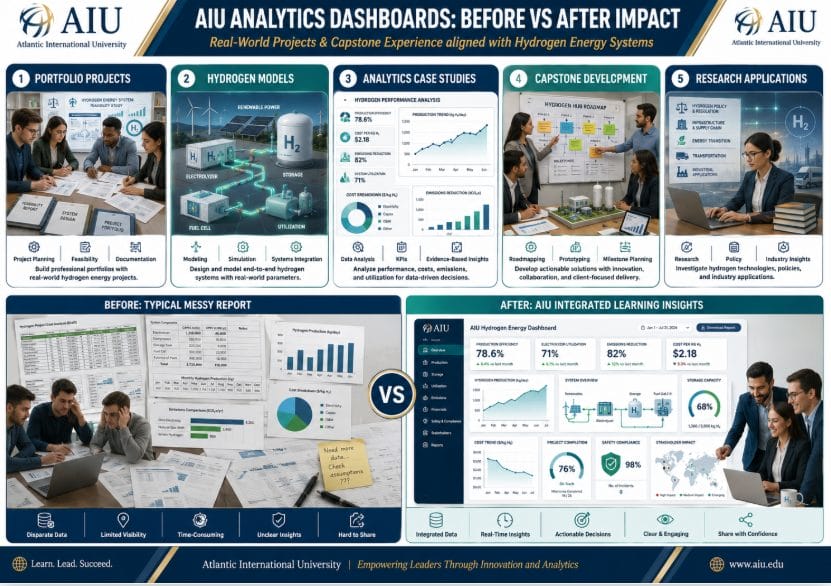
AIU Analytics Dashboards Before vs After Impact
AIU dashboards transform complex project data into clear, real-time insights, helping students analyze hydrogen systems, support research, and manage capstone projects more effectively. The integrated visualizations enhance decision-making, improve communication, and make project outcomes easier to present and share.
Research Projects & Innovation in Masters in hydrogen energy systems

A masters in hydrogen energy systems at AIU will enable you to be involved in research projects which will lead to the creation of innovations that will revolutionize hydrogen energy, hydrogen systems, and low-carbon technologies. Having a hydrogen energy systems degree enables you to gain an understanding of green hydrogen, blue hydrogen, fuel cells, energy storage, and renewable energy applications. A hydrogen energy engineering masters will see you undertake research on hydrogen production, distribution systems, hydrogen energy efficiency optimization, and hydrogen industry decarbonization.

A masters in hydrogen energy systems done via the online platform enables you to carry out innovative research projects and remain relevant to the industry as part of the program goal. An innovation project within a hydrogen technology master’s program may include working on electrolyzers, smart grids, and hydrogen-powered mobility. The renewable hydrogen energy degree will give you a lot of hands-on training skills needed to address some of the energy problems facing our planet. Being part of the clean energy systems master’s degree and sustainable hydrogen energy will give you the skills to be innovative.

  • MBM300 Thesis Proposal
  • MBM302 Master of science degree Thesis (5,000 words)

Publication: At AIU, we prioritize cutting-edge graduate research here, fostering academic excellence through the dissemination of groundbreaking discoveries. In the field of hydrogen energy systems, we empower graduate students to present innovative ideas, enriching scholarly dialogues. Our commitment to publishing student research enhances their academic impact, laying a solid foundation for budding scholars and driving the field forward.

Turn Research into Real-World Impact 

Unlock Your Potential

Dissertation & Thesis Defense

In the final stage of the hydrogen energy systems course at AIU, students are presented with a unique chance to demonstrate their proficiency and creativity through an extensive thesis proposal. This critical stage marks the culmination of their journey, providing a venue to delve into complex topics within the curriculum.

The thesis defense, a fundamental element of the program, enables students to exhibit their research abilities, analytical thinking, and literary knowledge, highlighting their preparedness to make significant contributions to the field after graduating from AIU.

Student Experience in Pursuing Masters in hydrogen energy systems

Getting a master in hydrogen energy systems at AIU gives the learner a unique chance to learn more about an increasingly important sector within the clean energy transformation. A master’s in hydrogen energy systems equips learners with knowledge and skills related to hydrogen energy, hydrogen systems, fuel cells, energy storage, and advanced renewable energy applications under the guidance of mentors and academic advisors. Online hydrogen energy systems master’s students or on-campus hydrogen energy engineering master’s students may undertake research on green hydrogen and blue hydrogen systems. 

By taking hydrogen energy systems masters programs or pursuing hydrogen energy systems master’s degrees, learners learn how to design, operate, and optimize hydrogen infrastructure. Studying hydrogen energy systems master courses and earning a hydrogen technology master’s degree makes the learner relevant in this industry. The hydrogen fuel systems master course alongside clean energy systems master courses will help tackle energy issues across the globe. The process of learning sustainable hydrogen energy systems is very beneficial for the learner’s career prospects.

Community & Social

The Masters in hydrogen energy systems at AIU cultivates an energetic educational community using cutting-edge technologies and collaborative tools, ensuring students complete a nurturing academic journey. Through platforms like the Virtual Campus, Mobile APP, MYAIU, AIULink, and AIUTV, students, faculty, and alumni come together, creating a network of interconnected minds. Engaging in thought-provoking symposiums, webinars, and conferences fosters global connections among the community.    

Accessing the Merlin Media Center provides a wealth of other academic and professional programs core courses and resources while staying linked through AIULink ensures ongoing internet connectivity. The AIU Virtual Campus, APP compatible with both Android and iOS, offers effortless access to online programs, tools and academic resources. These platforms facilitate the sharing of personal narratives, exploring holistic development, and contributing to the betterment of humanity, shaping an AIU experience that stands unparalleled.

Live Classes

AIU introduces an innovative approach to virtual learning by incorporating dynamic live sessions twice daily. One can also access these live classes from the archive that hosts 100s of classes that can be combined to personalize the academic journey of a student. Led by seasoned former faculty members and experts from various industries, these sessions offer real-time discussions, interactive Q&A segments, and collaborative problem-solving, enriching your comprehension of the community.

Participating in these sessions augments your expertise, equipping you to shape policies and refine your skills in hydrogen energy systems. AIU’s live classes promise intellectually engaging dialogues, up-to-the-minute industry perspectives, and individualized instructor feedback, guaranteeing a rewarding journey through the study of hydrogen energy systems. You can access 700+ live classes, 2000+ assignments and projects, 3400 mini courses free of cost as a Guest Student to learn new skills, new abilities, and earn certificates to grow and access new opportunities in your field of interest. In fact, one can earn up to $5000 credit towards their tuition fee by completing 5 Mini-courses and/or Live classes as a Guest Student.     

Feel free to glance through some of our recorded live sessions on related subjects

Academic Resources

At AIU, the Virtual Campus, on campus, serves as an innovative center equipped with more than 25 specialized tools, all geared towards supporting and empowering students throughout their educational endeavors in real and digital world. Our newest feature, the Virtual Reality 3D immersive online learning and teaching experience here, elevates community engagement and interaction, nurturing growth, motivation, and inspiration among our diverse student population.

Also, AIU includes the leading Artificial intelligence (AI) teaching tools such as ChatGPT, Dall-E and Midjoruney, PDF Executive Assistance, Slide Generator Slide Generator plus others and is adding new AI tools to ensure students are fluent in this emerging trend in computer science and benefit from the major boost in productivity they bring.

Within our extensive online library, comprising 260,000 books and 30 million articles, journals, and peer-reviewed articles, alongside 109,000 resources co-curated by the AIU community, we establish an unmatched academic setting dedicated to fostering the growth, development, and success of our students.

Build Expertise in Green Hydrogen 

Our Guest Student Access

Admission Requirements for Masters in hydrogen energy systems

For one to be eligible for admission to master in hydrogen energy systems at AIU, some of the necessary conditions may include a bachelor’s degree in engineering, chemistry, physics, or a related discipline. Applicants applying for the degree in hydrogen energy systems or masters in hydrogen energy engineering should show excellence in mathematics, thermodynamics, and energy-related subjects. Proof of English language proficiency is required by most universities from foreign students.

The applicant seeking enrollment in online master in hydrogen energy systems or masters in hydrogen technology should possess professional experience in renewable energy, clean energy, and sustainable energy. Necessary documents to prove eligibility include the candidate’s transcript, letter of intent, recommendation letters, and resume.

Some programs like master’s degree in hydrogen energy, renewable hydrogen energy degree, or masters in hydrogen fuel systems concentrate on hydrogen energy, hydrogen systems, green hydrogen, blue hydrogen, fuel cells, and energy storage among others. Some universities may interview the candidates for master in clean energy systems or sustainable hydrogen energy programs.

How Can You Apply for Masters in Hydrogen Energy Systems?

To apply for the online Masters in hydrogen energy systems at AIU, visit the official AIU website and navigate to the admissions section. 

  • Complete the online application form with your academic background, professional experience, and a statement of purpose. 
  • Submit required documents such as transcripts, a resume, and identification. No standardized test scores are typically required, making the process more accessible. 
  • Once submitted, your application will be reviewed by the admissions team. If accepted, you’ll receive enrollment instructions and access to the university’s online learning platform. 

This flexible, self-paced program is ideal for professionals aiming to advance in Hydrogen energy systems.

Financial Support & Scholarships

We are thrilled to offer a broad range of scholarships, online graduate school programs tailored for our own undergraduate degree, graduate degree or master’s degree students here. Please provide your information to explore various distance education and scholarship opportunities designed to support your academic pursuits. Let us assist you in achieving your educational and professional goals and nurturing your scholarly ambitions.

FAQs

What is a Masters in Hydrogen Energy Systems?

A Masters in Hydrogen Energy Systems is a specialized postgraduate program focused on hydrogen production, storage, distribution, fuel cells, renewable energy integration, and sustainable energy technologies for clean energy applications.

What careers can I pursue with a Master's in Hydrogen Energy Systems?

Graduates can pursue careers as hydrogen engineers, energy consultants, fuel cell specialists, renewable energy managers, sustainability analysts, project managers, researchers, and clean energy technology development professionals.

How long does it take to complete a Master's in Hydrogen Energy Systems?

Most Master’s in Hydrogen Energy Systems programs take one to two years to complete, depending on study mode, credit requirements, program structure, and full-time or part-time enrollment.

Can I earn a Hydrogen Energy Systems master's degree online?

Yes, many institutions offer online master’s programs in Hydrogen Energy Systems, providing flexible learning opportunities for working professionals while delivering industry-relevant knowledge and technical expertise remotely.

Let us know your goals and aspirations so we can chart a path at AIU to achieve them!
//
Admissions Counselor
Jessica Garcia
Available
//
Admissions Counselor
Rene Cordon
Available
//
Admissions Counselor
Prof. Emmanuel Gbagu
Available
//
Admissions Counselor
Sandra Garcia-Fierro
Available

"*" indicates required fields

This field is for validation purposes and should be left unchanged.
Name*

"*" indicates required fields

This field is for validation purposes and should be left unchanged.
Name*

"*" indicates required fields

This field is for validation purposes and should be left unchanged.
Name*

"*" indicates required fields

This field is for validation purposes and should be left unchanged.
Name*

"*" indicates required fields

This field is for validation purposes and should be left unchanged.
Name*

"*" indicates required fields

This field is for validation purposes and should be left unchanged.
Name*

"*" indicates required fields

This field is for validation purposes and should be left unchanged.
Name*

"*" indicates required fields

This field is for validation purposes and should be left unchanged.
Name*

"*" indicates required fields

This field is for validation purposes and should be left unchanged.
Name*

"*" indicates required fields

This field is for validation purposes and should be left unchanged.
Name*

"*" indicates required fields

This field is for validation purposes and should be left unchanged.
Name*

"*" indicates required fields

This field is for validation purposes and should be left unchanged.
Name*

"*" indicates required fields

This field is for validation purposes and should be left unchanged.
Name*

"*" indicates required fields

This field is for validation purposes and should be left unchanged.
Name*

"*" indicates required fields

This field is for validation purposes and should be left unchanged.
Name*

"*" indicates required fields

This field is for validation purposes and should be left unchanged.
Name*

"*" indicates required fields

This field is for validation purposes and should be left unchanged.
Name*

"*" indicates required fields

This field is for validation purposes and should be left unchanged.
Name*

"*" indicates required fields

This field is for validation purposes and should be left unchanged.
Name*

"*" indicates required fields

This field is for validation purposes and should be left unchanged.
Name*

"*" indicates required fields

This field is for validation purposes and should be left unchanged.

Submit your data.

After submitting, a widget will appear at the bottom-left corner so you can start your training.

Name*

Do you hate spam? Don’t worry, we hate them too. Your email is 100% secure with us.

"*" indicates required fields

This field is for validation purposes and should be left unchanged.

Submit the form below to begin your interview.

After submitting, a widget will appear at the bottom-left corner so you to start your AI interview.

Name*
Accepted file types: docx, pdf, Max. file size: 500 MB.

Do you hate spam? Don’t worry, we hate them too. Your email is 100% secure with us.