
Doctor of Engineering Systems (D.Sc)

School of Science and Engineering

Academic Freedom to Discover Your Purpose

Open Curriculum Design at Atlantic International University

Doctor of Engineering Systems (D.Sc) is a graduate-level interdisciplinary program designed for students who seek to solve difficult problems in technology, operations, and organizations by approaching them with a systems-based method. This area of study brings together principles of engineering, technology management, and data analysis to help make decisions about how to make a large system more effective. 

Students of Dsc in Engineering Systems will learn to understand how different pieces fit together within various industries, including manufacturing, transportation, energy, health care, defense, and information technology. Through the combination of doctorate in engineering systems research, innovation, and application of problem-solving skills, graduates of this program will be able to develop high-performing, robust, and sustainable systems that respond to today’s challenges while fostering development and growth within organizations by supporting new technologies.

Doctor of Engineering Systems : Industry Growth & Global Impact

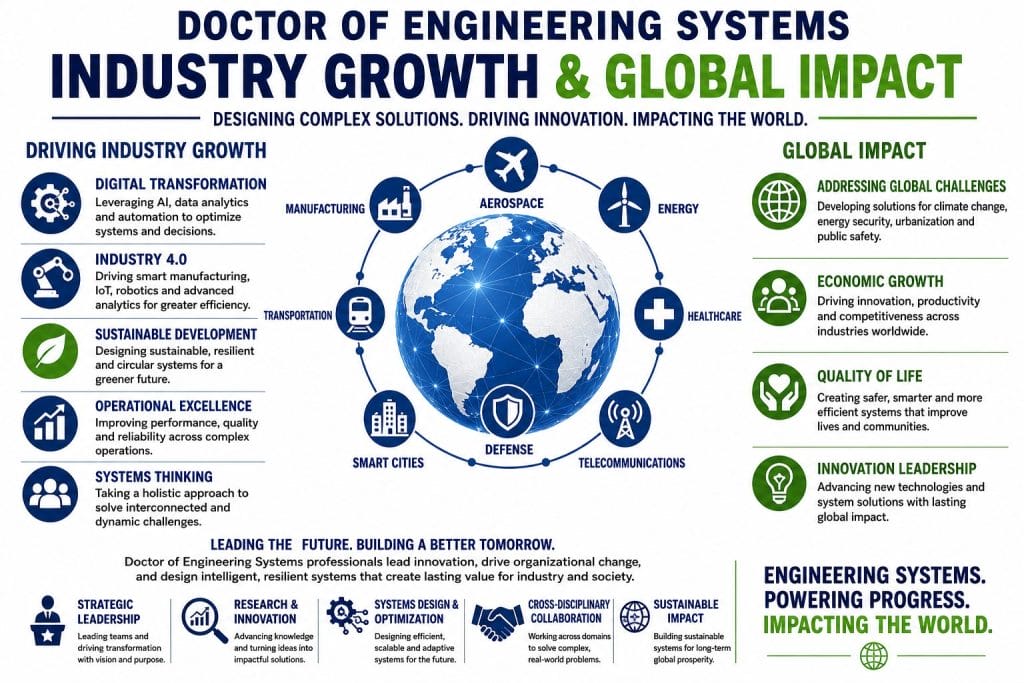
Modern industry relies on Engineering Systems to create and provide integrated systems engineering doctorate solutions through the incorporation of people, processes, infrastructure and technology into functional, sustainable ways. 

The rising complexity and interconnectedness of organizations means that there are increasing numbers of engineering systems careers professionals who can design, manage, and optimize large systems. Industries from aerospace to manufacturing to transportation to energy to healthcare to telecommunications to smart cities depend on engineers with complex systems engineering level expertise as they seek to improve performance, decrease costs, and improve reliability. 

The global trends of industrial systems engineering and engineering management degree and digital transformation and automation, Industry 4.0, artificial intelligence, and sustainability will only continue to create a need for systems level thinking. Professionals with a Doctorate of Engineering in Engineering Systems will be at the forefront of leading innovation, driving change in organizations, and developing solutions that address global issues in order to provide economic and societal benefits for the future.
Industry Growth & Global Impact
The infographic outlines that Engineering Systems will continue to see growth in the future as they relate to innovative and sustainablely-based solutions to improve society on a global scale. In addition, it shows that many different types of professionals in a variety of industries will use systems thinking, digital transformation, and industry 4.0 technologies to create higher levels of operational excellence.
Doctor of Engineering Systems: Trends, Insights & Predictive Analytics

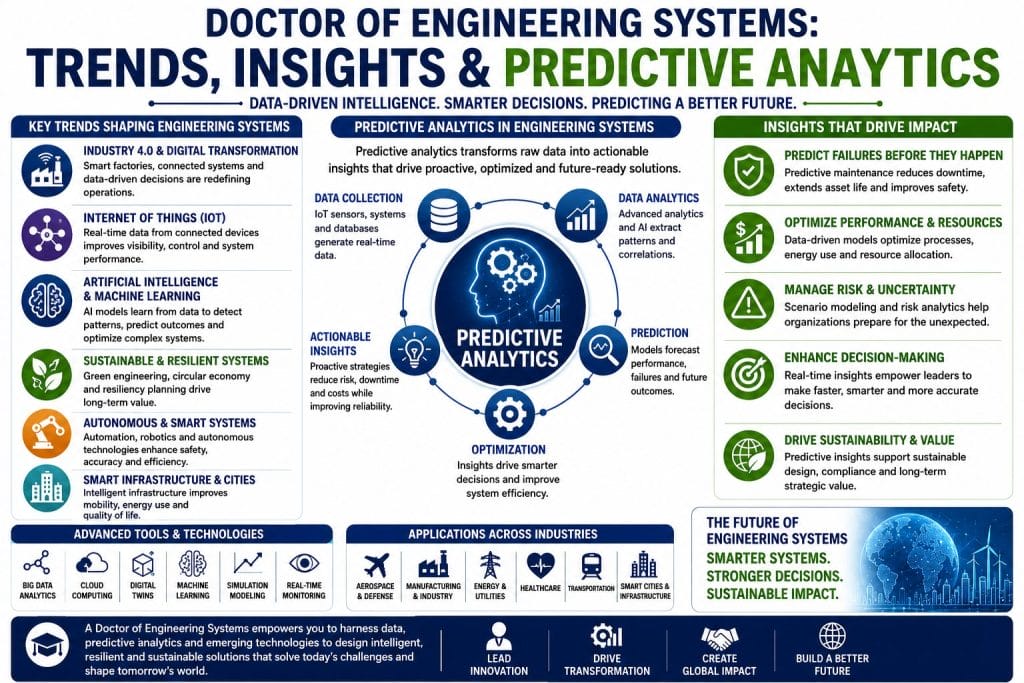
Increasingly, engineering systems depend on data, AI and predictives technologies to help organizations make decisions faster and smarter than ever before. To forecast the performance of an engineering research doctorate system, the doctor of engineering systems leader of modern engineering uses advanced analytics, digital twins, machine learning, simulation and real-time monitoring to find risk factors and improve efficiency before trouble occurs. 

Emerging trends like Industry 4.0, autonomous systems, smart infrastructure, IOT and sustainable engineering will change today’s complex systems to design and manage differently. A Doctor of Engineering Systems will provide professionals with skills to analyse vast amounts of data for actionable insight as well as provide the development of predictive engineering leadership degree models that increase productivity, improve reliability, improve resilience, and support long-term systems engineering doctorate online strategic planning for any industry.
Trends Insights & Predictive Analytics
This visual guide illustrates the transformative power of new approaches to analytics and technology on engineering based systems. There are several examples of current trends in the industry including: Industry 4.0, Artificial Intelligence (AI), Internet of Things (IoT), Smart Infrastructure and Sustainability. Each of these trends has resulted in an ability to use data to gain insight into potential future outcomes, improve overall system efficiency, manage risk through improved operational performance, and increase the effectiveness of decision-making processes in all industries – manufacturing, medical, transportation, power, aerospace, and “Smart City.”

Career Opportunities & Professional Development

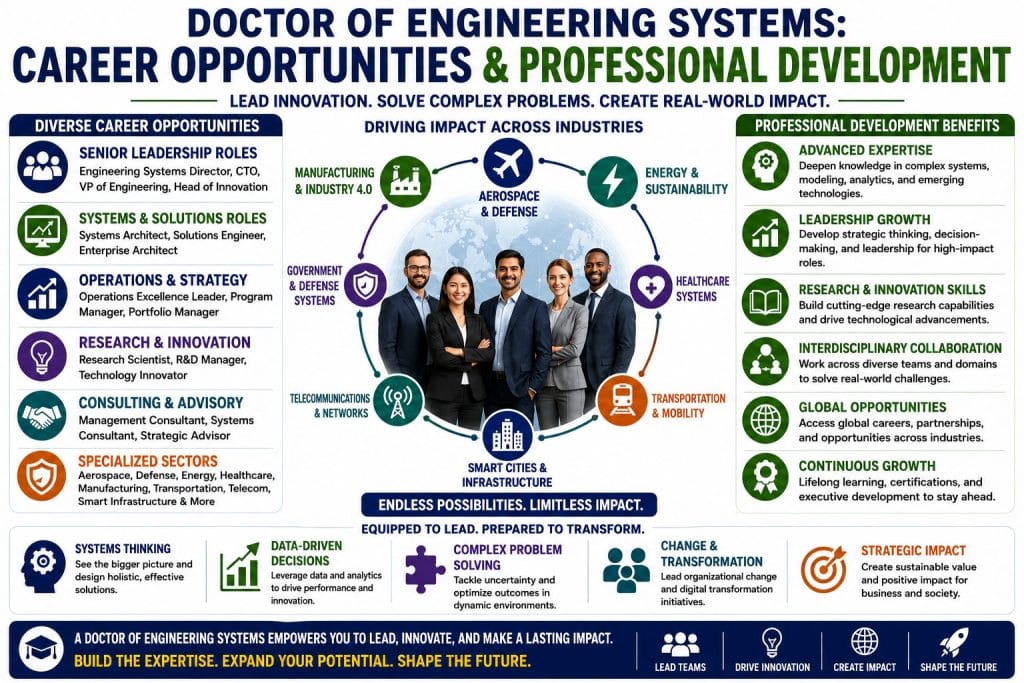
A Doctor of Engineering Systems provides postgraduates with the skills necessary for high-level positions like chief technical officer, director of engineering systems, consultant to engineering systems, operations excellence leader, digital transformation consultant, research scientist, program manager, and strategic technology advisor in many types of organizations. Graduates will work in a variety of industries including aerospace, manufacturing, energy, medical healthcare, transport, telecommunications, defense and smart infrastructures due to the interdisciplinary nature of the area.

In addition to developing their industrial systems engineering degree skills in advanced research, systems thinking, data-driven decision making and leadership development, advanced engineering education graduates will also develop the skills they need to lead complex projects; create and implement organisational transformation; influence public policy; and design and deliver innovative systems design engineering solutions that produce long-term business and social benefits.
Career Opportunities & Professional Development
This infographic provides an overview of the various job prospects available to individuals with a Doctor of Engineering Systems degree. The infographic illustrates the available jobs in various areas including: aerospace, healthcare, manufacturing, energy, and smart infrastructure; examples of job types include leadership, consulting, research, innovation, and systems architecture.

The AI Experience: Future-Focused Areas in Engineering Systems

The use of artificial intelligence is changing the methods of designing, managing and optimizing complex engineering systems. The Doctor of Engineering Systems program incorporates AI as an effective means of improving decision-making processes, predictive models, risk assessment, automation, and efficiency operations. 

In this regard, Research students learn how machine learning, digital twins, intelligent analytics, autonomous systems, and data-driven optimizations can have an effect on the doctor of engineering systems operation of large-scale engineering innovation degree operations. Through the integration between AI and applied research, students will be equipped with the knowledge and skills necessary to address complex problems and predict trends about systems, recognize trends that may emerge and create new ways in which to drive technological advanced engineering research progress in the various fields being studied by students enrolled in this program. Ultimately, systems integration engineering graduates will be well-versed in leading the evolution of future intelligent, adaptable and resilient engineering systems.

Contact Us Today!

Begin Your Journey!
AIU’s Summer of Innovation and Growth gives you the ability to earn up to $5000 in tuition credit by completing free lessons and courses.
Whether you’re looking to acquire new skills, advance your career, or simply explore new interests, AIU is your gateway to a world of opportunities. With free access to 3400 lessons and hundreds of courses the ability to earn credits and earn certificates there’s no better time to start learning.
Join us today as a Guest Student and take the first step towards a brighter, more empowered future.
Explore. Learn. Achieve.

Academic Freedom & Customized Curriculum

As such, the focus on learner-centeredness is very pronounced within the Doctor of Engineering Systems (DES) program. This allows students the opportunity to create their own curriculum based on their own online Doctor of Engineering Systems career goals and research objectives. They can develop an individualized learning plan to examine various areas of some specialty that are related to the student’s; interests, work experience in the workplace, and trends that are emerging in the industry. 

This allows for an interdisciplinary Doctor of Engineering Systems approach to engineering and technology through business strategy, data analysis, and innovation management in order to provide students with an effective means by which to select the research topics, projects, and areas of study, in order to develop an advanced skill set to solve difficult real-world problems. Through this method of designing a doctoral complex systems experience for engineering systems doctoral degree students, creativity, independent engineering systems doctorate thought, and professional development, with the goal being that every student who undertakes the DES program develops a doctoral experience that is unique and comparable to the student’s interests and professional aspirations.

Why Study Doctor of Engineering Systems at AIU?

Benefits of Doctor of Engineering Systems 

A Doctorate in Engineering Systems trains you to be an expert leader focused on creating solutions for complex problems faced by today’s Business organisations and industries. This Program develops a strong understanding of Systems Thinking; Strategic Decision Making; Innovation Management; & Integrating Technology to successfully improve the productivity of large scale operations & implement Business transformation. 

Thus creating a solid foundation for professional practices in a wide variety of industries including: Manufacturing; Healthcare; Energy; Transportation; Aerospace; Information Technology; and others. In addition to expanding technical competency, a Doctorate in Engineering Systems will improve one’s professionalism as well as extend their ability to provide effective leadership skills which create enhanced career advancement potential. As a result; Doctoral graduates will be able to play important roles in forming public policy; managing significant business initiatives; & contributing positively to the future of sustainable technology as well as economic development.

Traditional vs Flexible Education : Doctor of Engineering Systems

Conventional doctoral programs in Engineering Systems typically comprise a specific schedule, with specific requirements and core courses; are delivered solely on campus (not in an online environment); and have fixed research pathways. While these types of programs are well-structured, it can prove difficult for many working professionals to manage multiple commitments (for example, pay the bills, take care of family members, go to school). Flexible education provides another alternative to students who want to create their own learning path through the examination of topics based on their unique experiences and by creating their own schedule that gives them the option to blend both practical systems optimization experience and academic experience.

The learner-centered model of flexible industrial engineering education encourages all learners, regardless of where they live, to pursue their doctoral degrees without disrupting their careers and at the same time build the competencies, capabilities and skills they need to be successful in solving complex engineering and organizational problems.

Key Strengths of the Doctor of Engineering Systems  at AIU

Atlantic International University’s Doctor of Engineering Systems degree program is intended for industry professionals in search of an advanced skill set including systems -based analysis/innovation, and executive leadership. As a global programme, the DSC-ES has flexible scheduling options which provide students with the freedom to design an interdisciplinary education tailored to their own individual professional and academic goals as well as research interests and industry issues. The DSC-ES curricula emphasize integration between various disciplines (i.e., engineering, technology, management, analysis, and the emergence of new digital technologies). 

This includes project management opportunities for independent research, critical thinking, and hands-on applications that will allow the student to develop their ability to apply theoretical concepts to complex and dynamic real world problems. In addition to their emphasis on tailoring the curriculum to fit the student’s specific objectives and providing students with a global perspective, the DSC-ES will also help the student to enhance their professional development as they work toward completing their Doctor of Engineering Systems. Students of  engineering research will finish the program prepared to lead efforts to initiate changes in different types of business, producing new ideas and innovations throughout all industries and sectors.

Become a Proactive AIU Student 

Apply Now

Core Courses & Technical Skills

Important: Below is an example of the topics or areas you may develop and work on during your studies. By no means is it a complete or required list, as AIU programs do not follow a standardized curriculum. It is meant solely as a reference point and example. Want to learn more about the curriculum design at AIU? Check here: Course and Curriculum 

The curriculum of the Doctor of Engineering Systems is geared towards developing an advanced understanding of the analysis, design, management, and optimization of complex engineering systems. The program allows students to investigate numerous areas of study related to engineering principles, systems thinking, technology innovation and strategic leadership. Students will typically focus on course work in the following core areas: systems engineering, operations research, advanced analytics, project and program management, application of artificial intelligence, risk management, digital transformation, sustainability and engineering economics.

The program provides learners with multiple opportunities to develop their critical technical skills in data analysis, predictive modeling, simulation, decision support systems, process optimization, systems integration, research methodology and strategy for technology, so that they are prepared to effectively address complex problems and lead innovation and change in a rapidly evolving world.

  • Advanced Engineering Systems Design
  • Systems Thinking and Complex Problem Solving
  • Systems Architecture and Integration
  • Operations Research and Optimization
  • Engineering Project and Program Management
  • Decision Analysis and Strategic Planning
  • Artificial Intelligence for Engineering Systems
  • Internet of Things (IoT) and Cyber-Physical Systems

Tools You Will Master

The Doctor of Engineering Systems programme is an opportunity for students to be exposed to many different industry-leading tools and technologies used to create systems analysis; modelling; simulation; data analytics; optimisation, project management, and digital transformation capabilities through the use of numerous tools in order for professionals to evaluate complex systems; forecast system performance; manage large-scale projects; analyse operational data; provide support for strategic decision making.

  • AnyLogic –Allows for realistic representation and analysis of complex systems, supply chains, manufacturing processes & business activities.
  • Arena Simulation – Supports process optimization, workflow analysis, and operational performance modeling.
  • IBM SPSS Statistics – Is widely used throughout the areas of machine learning, automation, predictive analytics and engineering applications.
  • R Project – Allow you to create visual analytic dashboards to visualize your data for better decision making.
  • Python – Widely used for machine learning, automation, predictive analytics, and engineering applications.
  • Tableau – Offers engineering simulations for structural integrity of your products and performance testing of your systems.
  • Microsoft Power BI – Offers engineering design, technical drafting of designs and proper planning of systems.
  • ANSYS –Integrates the workflow between design, engineering and product development.

Career-Focused Learning in Engineering Systems

Career-oriented education in engineering systems targets the creation of specialized understanding, technical proficiency, and essential professional aptitudes to prepare students for jobs in the field and building with emerging technologies and the needs of industry. This model of learning connects knowledge gained through classroom lessons with the development of skills through project-based learning, work experience such as internships, lab assignments, and solving real-world technical problems as part of the student’s overall educational experience. 

Career-focused doctor of engineering systems education supports students’ comprehension of the many components of complex engineering processes, how to design systems, automate operations, enhance sustainability, and create innovative solutions while also helping develop teamwork, communication, and critical thinking competencies. By connecting academic and professional learning across multiple disciplines, career-focused engineering education prepares students for a successful future in an evolving workforce and provides students with the capabilities to be successful in diverse, interdisciplinary work settings for a technology innovation career in one of several industries, including manufacturing, energy, transportation, information technology, infrastructure development.

Real-World Projects & Capstone Experience

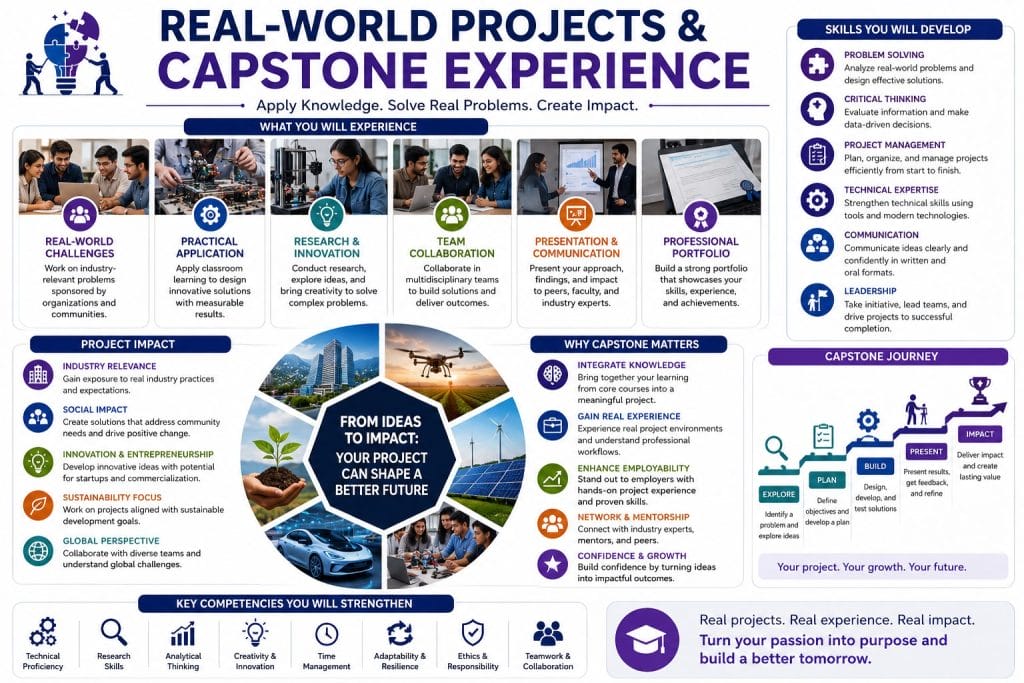
Through Real-World Projects and Capstone Experience, graduate students gain hands-on application of their knowledge to real industry, practical situations. In each phase of the program, students will have opportunities to apply their academic and theoretical skills to situations that replicate real-world business, technology, research and/or organisational environments and to develop the disposition of problem solving, analysis and decision-making. 

The capstone provides the ultimate experience for students, where they can research an unresolved or complex/complex topic, develop an innovative solution and demonstrate their ability to master their area of study. By integrating both academic theory with experiential application, students can create a professional portfolio and have experience that provides the foundation for positively impacting the evolution of a dynamic global workplace.
Real-World Projects & Capstone Experience
The infographic above displays how real-world projects and capstone experiences help bridge the gap between academic learning and real-world results. The hands-on and supportive nature of solving problems, conducting research, being innovative, working together as a team, communicating with others and building a portfolio are shown through the students’ progression through the structured project journey while gaining experience in the industry, developing professional skills, and building their self-confidence. The completed project will enable graduates to create a positive impact, address complex issues and advance their careers.
Doctor of Engineering Systems : Research Projects & Innovation

Innovation and research are foundational principles for the Physicist (Doctorate of Engineering Systems) Program. As innovations in engineering create opportunities for professionals to meet increased demands placed on organizations to solve complex problems associated with engineering, technology, and management, those enrolled in the program will conduct original research within a multidisciplinary project collaborating to collect data and analyze results in areas such as systems thinking, new technologies, data analytics, automation, sustainability, and digital transformation. 

In addition, the students will build innovative solutions to increase efficiency, resilience, and performance in a variety of industries, through working with industries, public, and academic communities. The Program supports the contribution of students to original engineering knowledge, develops students’ creativity and leadership skills, while providing opportunities to create technology solutions in a changing world.


Register Today & Get Access to AIU Resources 

Click here

Thesis & Research Defense Process

The Doctoral Dissertation and Research Defense (RRD) is the final milestone for completion of the Doctor of Engineering Degree. This is the process whereby students perform an original research study that requires a significant amount of engineering systems-based data to conduct the research study. 

The student must conduct an empirical study that contains all three of advanced analytical capability, technical capability and good leadership skills. The student will also work with both their dissertation advisor(s) and other qualified Subject Matter Expert (SME) members on the development of their final dissertation that will provide valuable knowledge providing practical solutions. The final milestone will be completed through a formal dissertation defense, which will be presented to the Academic Review Board to review/discuss the student’s findings, methodology and/or recommendations from their dissertation project.

Student Experience & Virtual Campus

This program of Doctor of Engineering Systems has a rich and dynamic virtual environment that meets the needs of both global learners and working professionals. The online campus provides access to the course materials, research materials, recorded lectures, online discussion, and academic resources/assistance from any location: This environment allows students to work collaboratively with peer students as well as with faculty mentors and the members of the profession through interactive projects, online seminar series and networking. The student-centered approach allows for independent learning while also providing the support of tools for research excellence, professional growth, and successful completion of doctoral studies, providing an abundance of resources and opportunities for completion of doctoral studies.

Live Classes, Symposiums & Global Networking

Through a variety of methods including live virtual classes, teacher-led symposiums & workshops and global networking events; The Doctor of Engineering Systems program aims to enhance the learning process for its students. There is an extensive amount of interaction between faculty, industry professionals, researchers and other doctoral students who represent a wide diversity of backgrounds and geographic locations. 

The interaction in these types of activities provides students with access to current engineering trends, advances in technology processes, systems theory and application practices in various industries. By participating in these discussions, presentations and collaborative activities, students have the ability to grow their professional network, share ideas with other doctoral students from around the world, further develop a connection that can contribute to their research efforts, prepare for future leadership positions, advance their career and establish possible opportunities for international collaboration.

The Doctorate in Engineering Systems supports doctoral research by offering the learner an extensive range of academic resources, including digital libraries and research databases, e-books, and other online learning materials for all disciplines of engineering systems.

AI-enhanced learning technologies improve students’ learning experiences by providing them with intelligent research and recommendations for personalized learning, as well as tools for automated content discovery and advanced knowledge management, all of which can be used by learners to find relevant literature, analyze complex data, improve research productivity, and speed problem-solving. Through the combination of comprehensive academic resources and cutting-edge AI technologies, the program provides a modern learning environment for students involved in conducting significant research, producing innovative solutions, and attaining excellence in their academic and professional careers.

Grow & Start Your Journey of Innovation with AIU

Start Today

Admission Requirements

Generally, to gain admission to the Doctor of Engineering Systems program, candidates are required to have either a bachelor’s degree or a master’s degree from an accredited institution and be deemed to have appropriate academic and professional experience. Test scores, academic transcripts, resumes, a statement of purpose, and other support documents may be requested to establish each candidate’s readiness for academic study and doctoral research. The admission committee evaluates an applicant’s relevant educational and/or professional accomplishment relative to potential for advanced-level research and leadership.

How to Apply ?

To get started with completing your application follow the steps below:

  1. Fill out the online Application Form by entering in all of your personal, academic and career information.
  2. Submit all of the required supporting documentation that will help with your application, including; official college/university transcript(s), your resume/CV, and any other materials required to support your application for admission
  3. State your academic area of interest, work experience, and research plans so that we can assist you in aligning your doctoral education with your career path.
  4. The admissions staff will assess your application based on your qualifications, past work history and readiness to perform as a doctoral researcher.
  5. If you’re accepted, you have to enroll and work with your academic adviser to create a plan of study and research that meets your needs.
  6. You will then enter into the Doctor of Engineering Systems program and start to develop your knowledge base through coursework and research and become part of an innovative academic community.

Tuition, Financial Support & Scholarships

As an advanced education program, Engineering Systems Doctorate provides flexible, accessible pathways to leadership and technical proficiency for professionals who are looking to advance their careers through formal education. There are multiple paths to accomplish this goal. Doctorate Degree Tuition may differ depending on the student’s course selection and degree requirements. Doctorate Degree education may be more affordable than previously thought with appropriate financial assistance options available to qualified applicants: employer tuition reimbursement, tuition payment plans and scholarships, etc. 

Potential students considering this field of study should contact their prospective student advisers prior to making a decision regarding their choice of employment, education or postgraduate opportunity; they ideally would work with their advisor(s) to identify what type(s) of funding may be available based upon the student’s specific situation.

FAQs

What is a Doctor of Engineering Systems (D.Sc)?

The advanced doctorate degree of Doctor of Science (D.Sc.) in Engineering Systems is for professionals who want to specialize in designing, managing, optimizing and integrating large complex technological systems. The student’s area of focus will be in systems thinking, innovation, research, strategic problem-solving and developing expertise in these fields. This program is designed to enable graduate students to lead large-scale projects, drive innovation through technology and create innovative solutions to complicated problems.

What can I do with a Doctor of Engineering Systems degree?

Having earned a Doctorate degree in Engineering Systems can help one move into leadership roles in various fields, including system architecture, technology management, research and development, consulting, or academic fields. Many individuals with this degree are employed as Engineering Directors, System Engineers, Chief Technology Officers (CTO), Operations Leaders, Research Scientists, Innovation Managers and/or University Professors; all of which are responsible for implementing and managing complex projects; driving digital transformation initiatives; and contributing to innovative organizational change within a variety of industry sectors.

Is a D.Sc in Engineering Systems worth it?

Indeed, obtaining a Doctor of Science (D.Sc.) in Engineering Systems provides significant value to individuals who are interested in pursuing advanced knowledge, leadership positions, research opportunities, or consulting opportunities. As a result of pursuing this degree, graduates will develop high-level expertise in systems thinking; innovation, technology management and complex problem solving; positioning themselves for executive leadership positions within academia as well as government agencies, and private sector firms. 

The D.Sc. degree also provides significant value for individuals that want to lead large-scale engineering projects; facilitate large-scale digital transformation projects; lead large-scale organizational efforts in an ever-changing global environment.

How long does it take to earn a Doctor of Engineering Systems?

3 years.

Can I study engineering systems online?

Yes, AIU offers engineering systems degrees online.

Let us know your goals and aspirations so we can chart a path at AIU to achieve them!
//
Admissions Counselor
Ariadna Romero
Available
//
Admissions Counselor
Adekunle Bamgbose
Available
//
Admissions Counselor
Juan Mejia
Available
//
Admissions Counselor
Sandra Garcia-Fierro
Available
//
Admissions Counselor
Prof. Emmanuel Gbagu
Available

"*" indicates required fields

This field is for validation purposes and should be left unchanged.
Name*

"*" indicates required fields

This field is for validation purposes and should be left unchanged.
Name*

"*" indicates required fields

This field is for validation purposes and should be left unchanged.
Name*

"*" indicates required fields

This field is for validation purposes and should be left unchanged.
Name*

"*" indicates required fields

This field is for validation purposes and should be left unchanged.
Name*

"*" indicates required fields

This field is for validation purposes and should be left unchanged.
Name*

"*" indicates required fields

This field is for validation purposes and should be left unchanged.
Name*

"*" indicates required fields

This field is for validation purposes and should be left unchanged.
Name*

"*" indicates required fields

This field is for validation purposes and should be left unchanged.
Name*

"*" indicates required fields

This field is for validation purposes and should be left unchanged.
Name*

"*" indicates required fields

This field is for validation purposes and should be left unchanged.
Name*

"*" indicates required fields

This field is for validation purposes and should be left unchanged.
Name*

"*" indicates required fields

This field is for validation purposes and should be left unchanged.
Name*

"*" indicates required fields

This field is for validation purposes and should be left unchanged.
Name*

"*" indicates required fields

This field is for validation purposes and should be left unchanged.
Name*

"*" indicates required fields

This field is for validation purposes and should be left unchanged.
Name*

"*" indicates required fields

This field is for validation purposes and should be left unchanged.
Name*

"*" indicates required fields

This field is for validation purposes and should be left unchanged.
Name*

"*" indicates required fields

This field is for validation purposes and should be left unchanged.
Name*

"*" indicates required fields

This field is for validation purposes and should be left unchanged.
Name*

"*" indicates required fields

This field is for validation purposes and should be left unchanged.

Submit your data.

After submitting, a widget will appear at the bottom-left corner so you can start your training.

Name*

Do you hate spam? Don’t worry, we hate them too. Your email is 100% secure with us.

"*" indicates required fields

This field is for validation purposes and should be left unchanged.

Submit the form below to begin your interview.

After submitting, a widget will appear at the bottom-left corner so you to start your AI interview.

Name*
Accepted file types: docx, pdf, Max. file size: 500 MB.

Do you hate spam? Don’t worry, we hate them too. Your email is 100% secure with us.