
Distance Learning at AIU is enhanced by vast academic resources and innovative technologies build into the Virtual Campus: Hundreds of self-paced courses with video lectures and step by step lessons, thousands of optional assignments, 140,000 e-books, the Social Media & Networking platform allowing collaboration/chat/communications between students, and MYAIU develop students holistically in 11 areas beyond just academics.
The world is YOUR campus!”, that is the message of AIU’s month magazine Campus Mundi. Hear the voices and see the faces that make up AIU. Campus Mundi brings the world of AIU to you every months with inspirational stories, news and achievements by AIU members from around the world (students and staff are located in over 200 countries).
The Master of Behavioral Analysis in Special Education is a graduate degree that offers educators, therapists, and other professionals a multi-disciplinary approach to supporting the needs of students with differing learning and developmental needs. The Master’s Program will teach behavior analysis in special education degree students to provide support to the student population by providing them with the master’s in behavior analysis knowledge and skills necessary to work with applied behavior analysis degree individuals with diverse learning and developmental needs, while providing the following areas of focus, Principles of Behavior Analysis, Evidence-Based Treatment/Intervention, Assessment Strategies, and Individualized Education Planning (IEP).
Also, the master in behavior analysis in special education will allow students to develop behavioral interventions and evaluate their implementation based on an individual’s achievement academically, Socially, Communicatively, and Independently through the combination of special education master’s degree research, application or use of, and ethical practice in creating inclusive learning environments for children and adults with special educational needs.
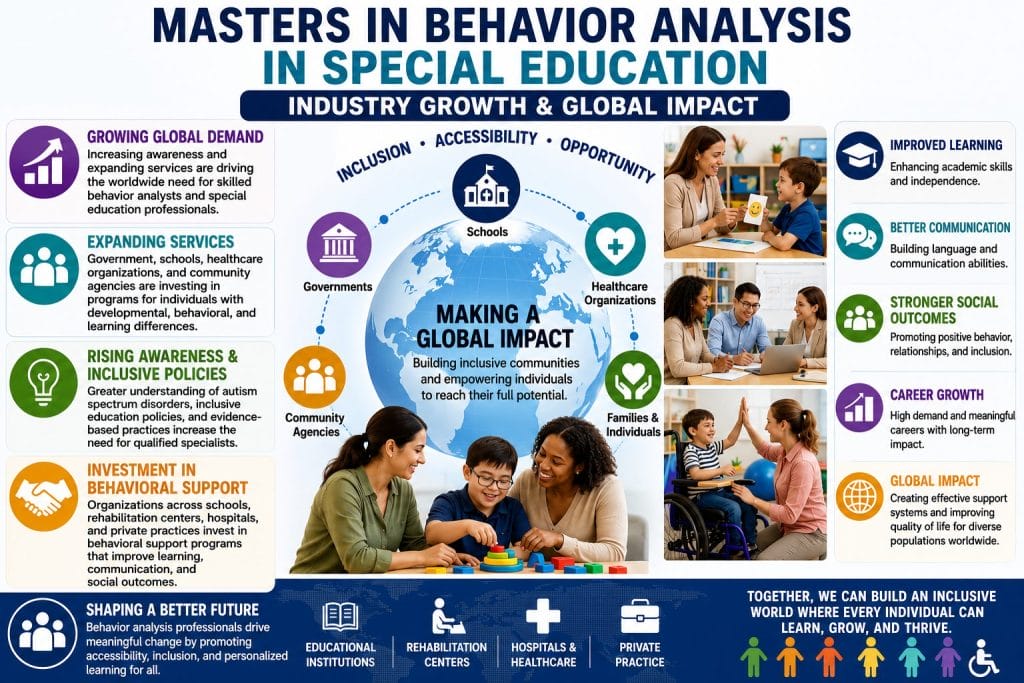
As an increasing number of governments, schools, healthcare providers, and community service providers expand their services for individuals with developmental, behavioural and learning disabilities, there is a growing need for behaviour analysts, and special education professionals worldwide. The increasing awareness of Autism Spectrum Disorder, inclusive education policies and evidenced-based intervention practices have created a greater demand for trained behaviour analysts and special needs education degree specialists in special education.
The rise of applied behavior analysis in education programs in educational institutions, rehabilitation centres, hospitals and private practice settings have resulted in many entities investing in these programs, resulting in a better way to learn, communicate and socially interact. As societies strive to provide more access, be inclusive and provide individualised learning opportunities, those trained in behaviour analysis provide important support in creating effective supports and increasing the quality of life for all individuals, throughout the world.

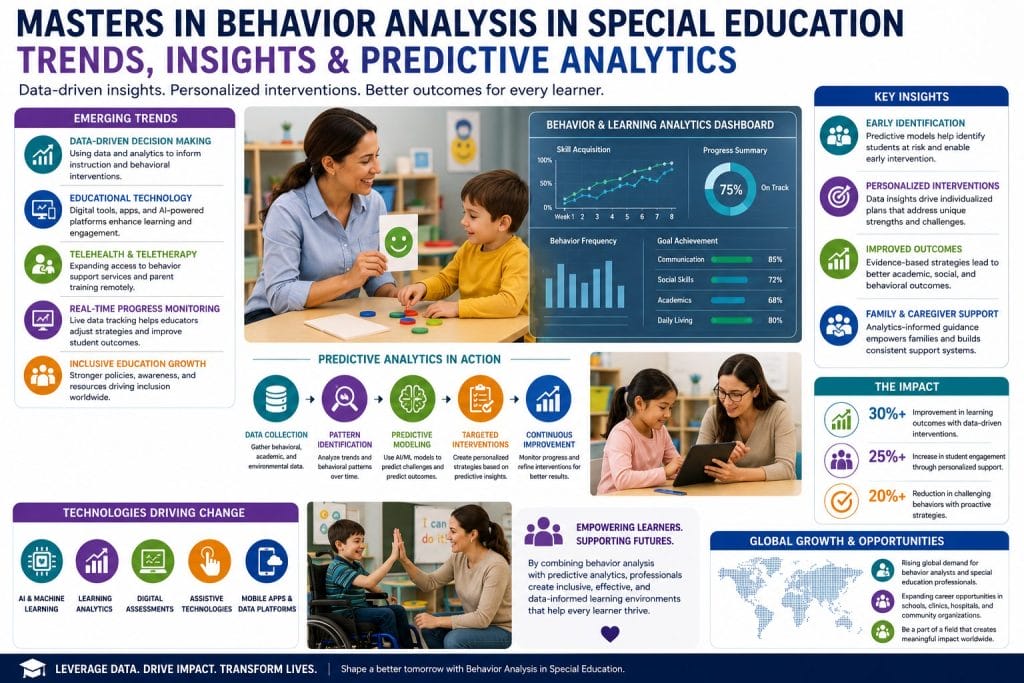
Changes in how we approach the field of behaviour analysis through data-based decision making, personalised interventions and technology are shifting the landscape of behaviour analysis in special education. The emergence of master in behavior analysis in special education digital assessments, teletherapy, assistive technology and real-time progress measurement systems will continue to give individuals with differing abilities a greater chance of achieving learning objectives.
The use of predictive analytics will allow behaviour specialists and educators to determine patterns of learning, predict challenges and provide educators with the tools they need to create targeted interventions before the problems develop. By using behavioural data to create meaningful interventions, improvements in communication, social development, academic achievement and independent living are all possible.
Furthermore, as inclusive master in behavior analysis in special education education continues to grow worldwide, competency in using analytics and evidence-based practices will result in increased demand from behaviour specialists and educators who can create an effective, reliable system of person-centred special education careers support programmes that will yield positive outcomes for learners.
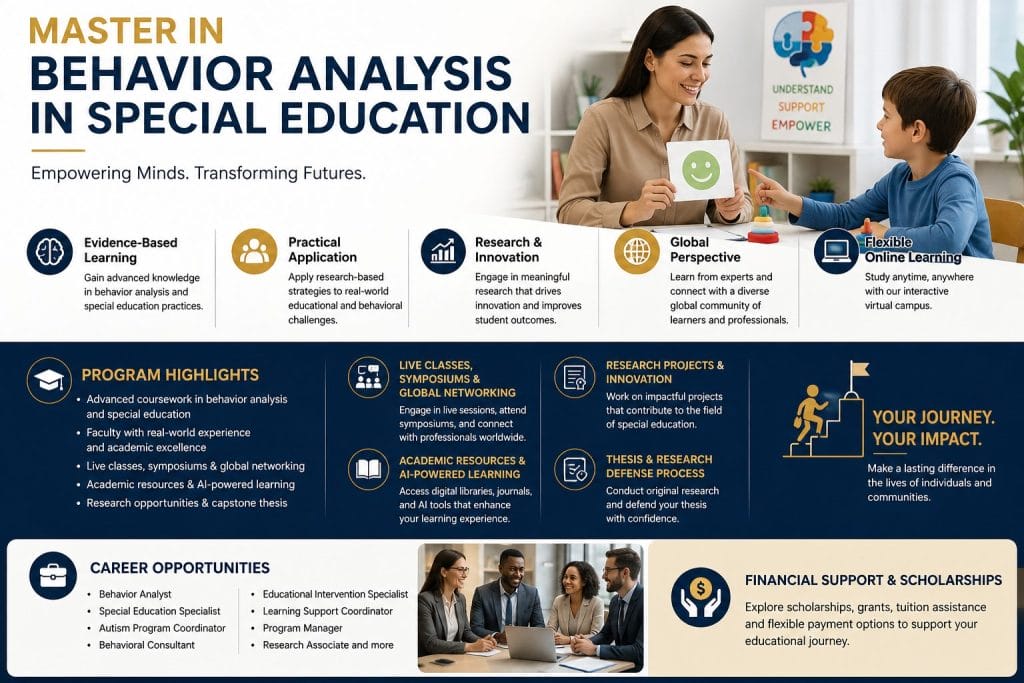
Those who complete a Master in Behavior Analysis in Special Education will be ready to take on careers that support people who have many different learning styles, behavioral difficulties and developmental disabilities.
Career paths may include working in schools, colleges and universities, medical and healthcare environments, rehabilitation centres, and non-profit organizations. In addition to the roles listed above, graduates could also take on positions such as a Behaviour Analyst, Special Education Specialist, Autism Program Coordinator, Behaviour Consultant, Educational Intervention Specialist, Learning Support Coordinator, or Program Manager, and Research Associate.

AI is changing how we will approach behavior analysis and special education by offering enhanced personalization, data-backed insight and a pro-active intervention model. Due to their ability to identify the manner in which students learn, anticipate potential behavioral issues and provide educators with individualised targeted supports; there are numerous applications that have emerged as a result of AI currently used in education including adaptive learning platforms, intelligent progress monitoring systems of autism intervention studies’ students, and both speech and communication technologies and predictive analytics that provide real time analysis to assist educators in making informed decisions regarding their students’ learning.
As master in behavior analysis in special education education institutions and support organizations increasingly engage in applied behavior analysis certification digital solutions, AI enhanced behavior analysts will be positioned to assist behavioral assessment program educators improve student’s education; support the inclusion of currently excluded children; and assist in creating innovative ways for all students to reach their potential regardless of their positive reinforcement diverse abilities.
Begin Your Journey!
AIU’s Summer of Innovation and Growth gives you the ability to earn up to $5000 in tuition credit by completing free lessons and courses.
Whether you’re looking to acquire new skills, advance your career, or simply explore new interests, AIU is your gateway to a world of opportunities. With free access to 3400 lessons and hundreds of courses the ability to earn credits and earn certificates there’s no better time to start learning.
Join us today as a Guest Student and take the first step towards a brighter, more empowered future.
Explore. Learn. Achieve.
A master’s degree in behavior analysis with a concentration in special education can be tailored to meet your personal professional development needs, as well as your specific area of expertise. The individualized course of study allows students to create a course of study that meets their personal goals and interests, while also providing the opportunity to explore various topics related to autism, behavior modification, and inclusion. Interdisciplinary study is encouraged through the integration of positive behavior support training, classroom management coursework, research projects, and real-world experience with one’s master in behavior analysis in special education career goals.
As a result of this individualized and flexible approach to studying behavior analysis, special education intervention strategies students will have a better chance of being successful in their careers in special education and behavior analysis.
The use of behaviour analysis provides essential assistance to people that exhibit differences in their ability to learn and develop. It is the implementation of evidence-based strategies that allows for the identification of the variables that may influence an individual’s behaviour as well as the design of targeted intervention strategies. Behaviour analysis benefits people who want to improve their ability to learn, communicate, engage socially, and be independent through the use of targeted and individualized support plans designed specifically around the person’s strengths and weaknesses.
Data that are measurable are gathered by educators and caregivers using behaviour analysis; therefore, they can use this data in order to make informed decisions, provide evidence of progress, and make adjustments to interventions as necessary. Behaviour analysis serves to create inclusive, high-quality master in behavior analysis in special education learning environments, improve a person’s quality of life, and empower people to reach their fullest potential.
The traditional educational system is one that has set requirements, fixed schedules, standardized master in behavior analysis in special education courses and teaches via classroom-based instruction to deliver the same to all students. This can often seem like a very good way to give everyone a chance to learn in the same structured manner with actual engagement with instructors.
However, the traditional educational system may not be as flexible for adult working teachers and adults who have numerous goals that need to be met through specific avenues of study. Flexible education gives students the ability to create their own educational behavior analysis path through various learning options, access to their own professional experiences in relation to their educational curriculum and to progress through their studies at a pace established by their employment and personal responsibilities.
In the specific case of students pursuing a Master in Behavior Analysis/Special Education, a flexible method of learning can, therefore, be used to conduct a more in-depth look at such areas as behavioral interventions, supporting those on the autism spectrum, inclusive education and the use of assistive technology all of which create a much more applicable and relevant educational experience for future careers in the field.
Important: Below is an example of the topics or areas you may develop and work on during your studies. By no means is it a complete or required list, as AIU programs do not follow a standardized curriculum. It is meant solely as a reference point and example. Want to learn more about the curriculum design at AIU? Check here: Course and Curriculum.
A master in behavior analysis in special education provides students with the theoretical and practical foundations to assist individuals with a variety of learning and developmental disabilities. Coursework typically consists of applied behavior analysis, behavioral assessment, intervention design, teaching methods used in special education, learning theories, professional ethics, implementation and analysis of learning disabilities education data, and individualized education program (IEP) development.
Students who pursue this program also develop technical competencies related to observing behavior, tracking progress, conducting functional behavior assessments, employing evidence-based intervention strategies, conducting research, and utilizing technology for educational purposes. Through these competencies, behavior analysis degree online graduates will have the skills needed to develop and implement effective support programs, assess results from those programs through data-based evaluation systems, and create inclusive classrooms that support academic, social, and behavioral success.
As they work with students, professionals in both behavior analysis and special education utilize many tools such as assessments, data collection systems, communication devices, and educational technologies to provide evidence-based interventions as well as measure student progress.
Students enrolled in this program will have opportunities to become proficient in using industry-standard tools to analyze behavioral data, create individualized learning plans, monitor outcomes of services provided to students, and promote collaboration between teachers, therapists, and families. In addition, this technology supports the ability of professionals to make sound decisions based on data as well as increase their special education and behavior analysis success and effectiveness in implementing behavioral and educational interventions.
The Master of Education Degree in Behavior Analysis with An Emphasis in Special Education is intended to give students the opportunity to use theory to address real-life educational and behavioral issues through hands-on, career-oriented experiences. Students gain knowledge in how to conduct behavioral evaluations, implement research-based intervention programs, and develop individualized instructional plans for all types of learners by learning how to conduct scientific and ethical research.
Students can apply their master in behavior analysis in special education to real life, whether they work in a school setting, health care facility, rehabilitation center, community organization, or private practice. With their understanding of research and its relationship to the application of behavioral science, students will be able to think critically about complex behavioral needs, create and implement successful interventions, and determine the success of those interventions based on data. The master of behavior analysis program prepares graduates to possess the skills, leadership qualities, and professional confidence to meet the needs of diverse learners and further inclusive education.
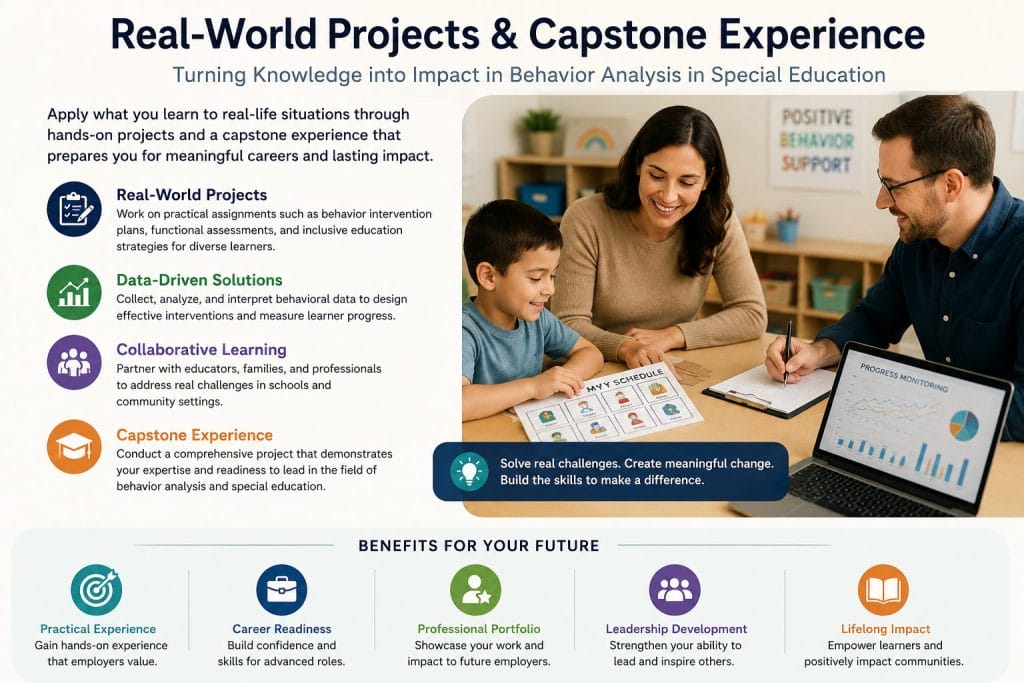
The master in behavior analysis in special education program in special education includes hands-on projects and a capstone that allows students to apply theory to actual behavioral and educational problems. For instance, students can create behavior intervention plans; conduct functional behavioral assessments; analyze learner progression data; create inclusive education strategies; or evaluate evidence-based support programs for individuals with diverse needs. In addition, the capstone project provides a practical issue for the student to conduct a solution-oriented investigation and demonstrate competence in behavior analytic principles in a real-world setting.
Through these real-world experiences, students will develop and/or enhance their research, problem-solving, leadership, and decision-making skills while developing a professional portfolio of their skills, abilities, and readiness for leadership positions in special education and behavioral support services.
Through research and innovation, we are able to develop and implement effective practices in the field of behavior analysis and special education. The research projects provide students with an opportunity to conduct an investigation into critical topics such as behavioral interventions, autism support programs, inclusive education, adaptive technology, communication development, and positive behavior support systems.
The research projects support the application of evidence-based practices to address real-life issues in education and behavior. Through these research projects, students will learn how to collect and analyze data, evaluate the effectiveness of interventions, and develop new and innovative ways to increase the success of learners and improve their quality of life. Students’ combined use of scholarly inquiry and practical application will enable graduates to contribute to more effective, inclusive, and data-informed approaches to the field that will help to shape the future of special education and behavior support services.
The Thesis and Research Defend Process (T&RDP) is an opportunity to demonstrate a higher level of knowledge, skills and competencies of students that are worthy of a degree in Special Education and Behavior Analysis. The T&RDP also requires the student to independently research a specific, relevant and related area of study; using accepted evidence-based methods and data analytical techniques (i.e., methods in research literature).
The result of the T&RDP is an original thesis that contains additional research findings, specific recommendations for practice, and identification of the contributions made to the field of Special Education and Behavior Analysis by the Student. Finally, Students will have the opportunity to formally present their findings (i.e. computer presentation), methodology (i.e. the manner in which the research was completed), results, and respond to academic questions from their Faculty Committee Members during the thesis defense.
The Master of Science in Special Education with a Concentration in Behavior Analysis offers students a dynamic, interactive, and flexible virtual campus. Sharing a common goal of engaging students across a wide variety of professional roles and locations, this virtual campus provides students access to engaging learning materials, academic support resources, collaborative learning environments that encourage active engagement with faculty and their peers, and a full range of technology-enhanced education resources.
Through a combination of independent study, collaborative projects, and technology-enhanced instruction, students acquire the knowledge, skills, and professional relationships necessary to succeed in a rapidly changing field of study: behavior analysis and special education.
A master in behavior analysis in special education offers enriched opportunities to learn from people through live classes/showcases, academic symposia and global networking, where you can participate with researchers and practitioners around the globe. This interactive learning allows you to share ideas, exchange information on thought-provoking/research and best practice strategies of behavior analysis and special education.
You will gain insight into new challenges facing you today, new methods for providing intervention and the direction that the field is headed based on global trends. As a result of participating in networking and collaborative learning opportunities, you can network and develop relationships to enhance your career development, share knowledge and receive ongoing professional development in the areas of educational/special education and behavior support.
Students enrolled in the master in behavior analysis in special education will have access to numerous academic platforms and artificial intelligence assisted learning tools that enhance the effectiveness of both instructors and learners. Learners will find digital libraries, e-research databases, scholarly journals, case studies and interactive e-learning materials (all of which are designed to support evidence-based practices in education) available to them via the Internet in order to support their professional development.
By taking advantage of the power of AI technologies, the delivery of personalized learning supports for learners through the provision of intelligent study aids as well as the use of adaptive content recommendations, providing ongoing assessments about learner’s progress, and generating statistical insights into how learner’s data are being used provides opportunity for student success through the exploration of complex ideas, keeping up to date with new developments in research and the acquisition of practical skills pertaining to assessments/intervention plans/behavioral analysis. The combination of academic resources and AI learning tools will deliver a flexible, engaging and forward looking educational experience to learners enrolling in the Master of Arts in Behavior Analysis in General Education.
A Bachelor of Arts (BA) or its equivalent is typically required for entrance into the Master of Behaviour Analysis in Special Education program, which accepts individuals who have completed an accredited BA or equivalent. Individual institutions may require additional application materials, including a résumé or CV, transcripts from educational institutions previously attended, statements of purpose detailing future goals and prior experience, and any other relevant documentation.
Individuals with backgrounds in related fields (e.g., psychology, education, social work, healthcare) generally seem suited to pursuing this type of graduate degree program. Each applicant’s academic preparedness, previous experience, and ability to assist those with differing levels of ability and development will all be considered during application review activities.
Tuition for a Master in Behavior Analysis in Special Education varies by the Institution offering the program (may be online/hybrid/analogous), type of program (may be traditional/online), length of time to complete the program (varies), etc. Many colleges and universities offer flexible payment plans to assist students in creating a method of paying for their education while juggling their family responsibilities, job responsibilities, etc.
In addition to flexible payment plans, many colleges and universities offer financial assistance to students through scholarships, grants, employer education benefits, discounts, and/or payment plans. Students should research different sources of financial aid, speak with their admissions representative about potential financing sources, and explore different financing options to reduce their overall cost of obtaining a Master’s Degree in Applied Behavior Analysis. Furthermore, through the investment of time and money into obtaining your degree, you will gain increased knowledge, credibility through professional certifications, and opportunities for a long-term career within the field of education and applied behavior analysis.
The Master of Behavior Analysis in Special Education is a graduate program designed to provide professionals with the knowledge and skills necessary to assess, analyze, and improve behavioral, social, communication and learning outcomes of individuals who are disabled or have different learning needs. This program combines established principles of Applied Behavior Analysis (ABA) with special education techniques and evidence-based seizures in order to allow students to develop independent living skills as well as academic success.
Upon graduation from this program, individuals will have the ability to develop behaviour support plans and conduct appropriate assessments. They can effectively collaborate with teachers, parents and others to ensure that they are able to use the services of schools, hospitals, community-based programs, and special education schools.
A Master’s Degree in Behavior Analysis in Special Education can help prepare for a wide range of careers related to education, behavioral health, and disability support services. You may find yourself working in many different fields as a Behavior Analyst, Specialist in Special Education, Autism Intervention Professional, Behavior Consultant, Program Coordinator, Education Consultant, or Manager of Support Services.
If so, your job will include developing behavior intervention plans, conducting assessments, supporting students who have a variety of learning needs, collaborating with families and educators, and improving outcomes in schools (academic), clinics (social), and community organizations (life skills), or private practice.
Yes, definitely ! A Master’s Degree in Behavior Analysis is a great investment for those with a passion for supporting learners with disabilities and/or behavioral challenges, as it provides the specialized knowledge to provide evidence-based interventions, assess students’ behaviors, and provide educational support to students with disabilities.
Graduates who earn a Master’s Degree in Behavior Analytical Special Education will be prepared for rewarding careers that involve working with individuals with disabilities in schools, clinics, healthcare organizations, and community programs globally. A master’s degree also offers a variety of career advancement opportunities for individuals pursuing a career as a behavioral or special education professional, both locally and internationally, and the potential to make a positive impact on the lives of others, both professionally and personally.
Educators, Special Education Teachers, School Counselors, Therapists, Psychologists and an array of other professionals working with people with developmental, behavioral or learning challenges will find this a great opportunity to advance their career. Those individuals looking for work in the field of behavior intervention, autism support, educational leadership or applied behavior analysis (ABA), this degree will give you the tools necessary to be able to assess an individual’s behavior, create an evidence based intervention and assist the individuals in obtaining positive outcomes to their unique learning and behavioral needs.
The most lucrative behavioral analysts are usually highly-qualified Board Certified Behaviour Analysts (BCBAs) who are advancing towards the roles of leadership, consulting, and specialized clinical roles. The following positions generally have the highest compensation: Clinical Director, Director of Behavioural Services, Chief Behavioural Officer, Senior Behavioural Consultant and Owner of Private Practice. Salaries vary based upon the following criteria: location, experience, industry, and level of certification. Entry level behaviour analysts may be compensated relatively low and senior behaviour analysts working within the areas of healthcare, autism services, and organisational behaviour management may be compensated substantially higher than their entry level counterparts.
"*" indicates required fields