
Doctor of Theater

School of Social and Human Studies

Academic Freedom to Discover Your Purpose

Open Curriculum Design at Atlantic International University

Doctorate in Theater is a higher academic level program aimed at performers, teachers, directors, scholars, and creative workers who aspire to enhance their skills in the field of theater. The course promotes independent research and critical thinking through studies in the areas of acting and acting theory, directing, writing plays, production design, history of theater, history of performances, and culture studies. Thanks to an interdisciplinary and flexible method, the Doctor of Theater students can study modern theater methodologies and create their own evaluation, which will broaden the knowledge base in the field.

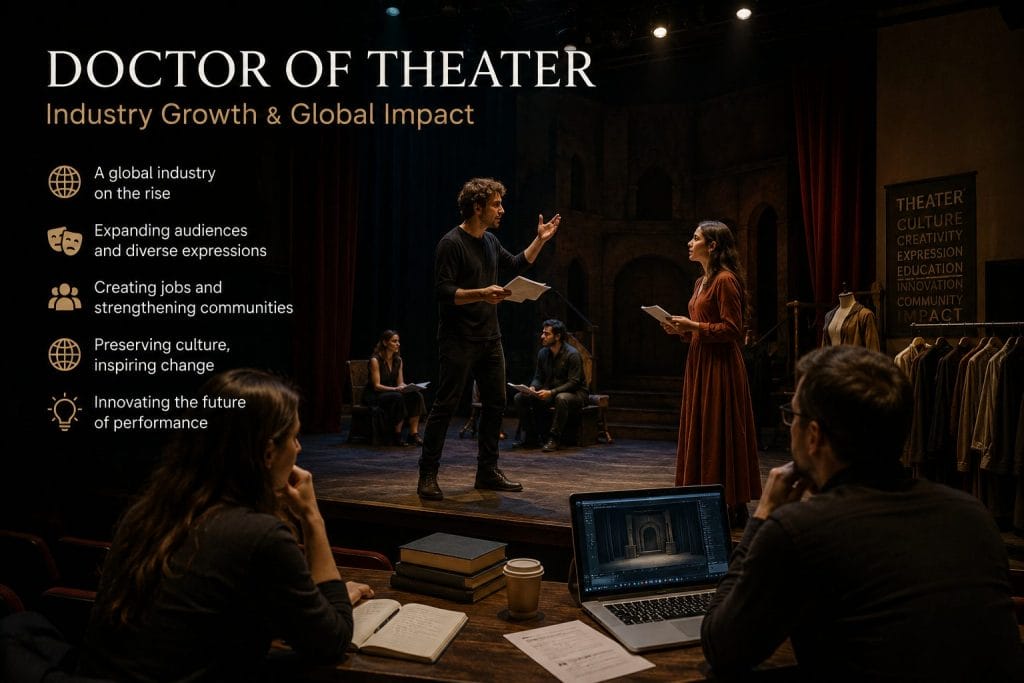
Doctor of Theater : Industry Growth & Global Impact

The performing arts industry continues to grow through the various forms of live performances, online performances, immersive narratives, culture-oriented events, use of streaming services, and collaboration between different disciplines. Increasingly, professionals working in theater apply their knowledge in the PhD in theater areas of film and television, and also in the fields of education, community development, tourism, and digital media. Got a doctorate degree in theater? You can study these changes and perform advanced research, engage in creative practices, learn concepts of performance theory, directing, dramaturgy, and production technologies.
doctor-of-theater
The image depicts an active theater rehearsal with actors, directors, and researchers working together under the lights. The visual elements indicate that there is a growth of an industry globally in terms of audience size, cultural preservation, job creation, engagement with the community, and innovation bring changes to the future of performance arts worldwide.
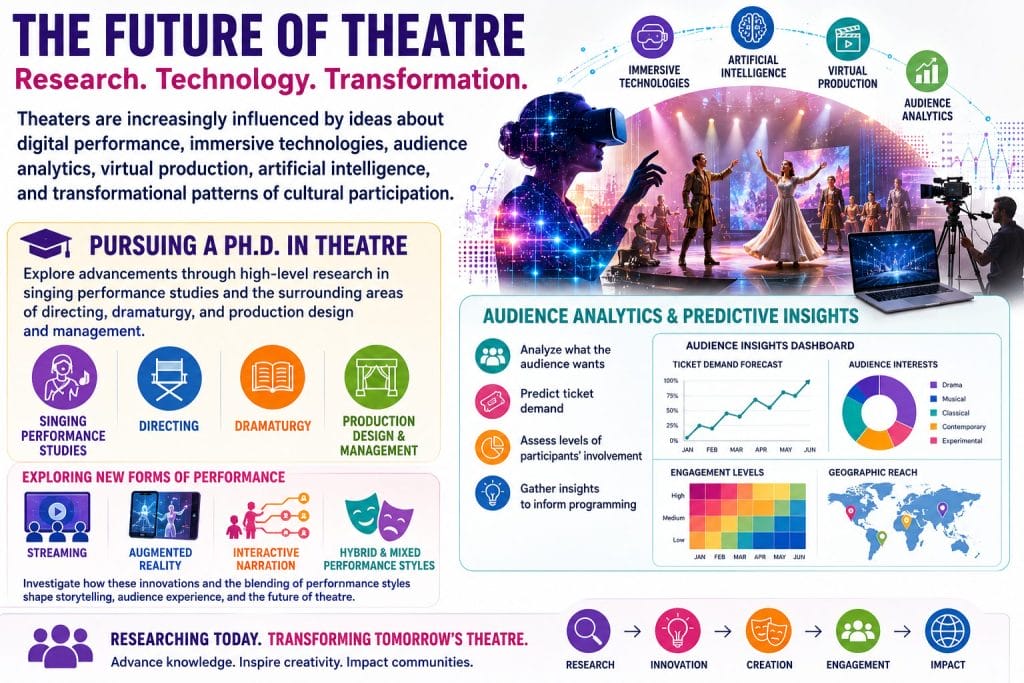
Doctor of Theater  : Trends, Insights & Predictive Analytics

Theaters are increasingly influenced by ideas about digital performance, immersive technologies, audience analytics, virtual production, artificial intelligence, and transformational patterns of cultural participation. Pursuing a theater doctorate degree allows students to explore these advancements by engaging in high-level research related to singing performance studies and the surrounding areas of directing, dramaturgy, and production design and management. Predictive analytics helps theaters analyze what the audience wants, predict ticket demand, and assess levels of participants’ involvement, while also providing them opportunities to gather insights related to programming. Moreover, it is also possible to investigate the effects of the use of streaming, augmented reality, interactive narration, and mixtures of various performance styles on creation of performances.
the-future-of-theatre
In this image, the future of theatre is shown through immersive technologies, artificial intelligence, virtual production, and audience analytics. There are Ph.D. research opportunities in performance studies, directing, dramaturgy, production design, predictive insights, streaming augmented reality interactive narration, cultural engagement, and innovation.

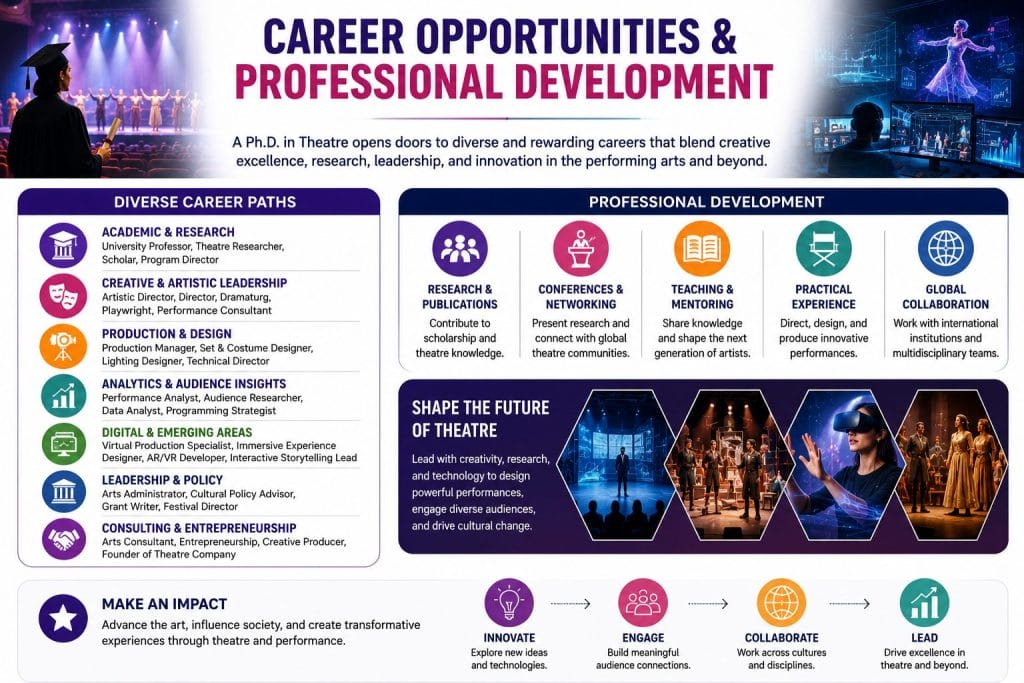
Career Opportunities & Professional Development

Having a Ph.D. in Theatre can help students attain advanced careers related to post-secondary education, performance research, directing, dramaturgy, production design, leadership in art, cultural policy, and creative technology. Graduates can be employed as university lecturers, researchers, directors of performance, dramaturges, performance analysts, production managers, curriculum designers, and advisors for cultural theater directing institutions and digital performance agencies. The emerging job market is also growing in the areas of virtual production, immersion storytelling, audience analytics, arts entrepreneurship, and interactive production design.

Professional development can be enhanced with help of participation in performing arts doctorate conferences, stage performance research articles, workshops, collaborations, teaching, and international theatre organizations. By developing expertise in traditional performance practices and technological innovations, PhD holders can contribute to academic research, lead friends, design new audience experiences, and contribute to the development of drama studies degree’s theatres and cultural engagement.

career-opportunity
This infographic is about jobs available for those who have a Ph.D. in theatre. It also discusses professional development opportunities in these areas like publishing, networking, teaching, gaining practical experience, collaborating with experts in the industry, engaging with audiences and many more.

The AI Experience: Future-Focused Areas in Theater

The AI experience in theater analyzes how innovative technology affects the way performances are created, produced, and displayed to the audience. Students learn about AI-assisted scripts, virtual actors, automated lighting and sound design, and digitized set design, and how such technologies are useful when performing modern plays. 

In addition, students study trends and technologies of the future such as virtual production, virtual and augmented reality, motion capturing, storytelling, and data-driven activities. They investigate how artificial intelligence can be beneficial for directors, playwrights, set designers, actors, and theater managers, and at the same time keep the artistic integrity of the work.

Contact Us Today!

Begin Your Journey!
AIU’s Summer of Innovation and Growth gives you the ability to earn up to $5000 in tuition credit by completing free lessons and courses.
Whether you’re looking to acquire new skills, advance your career, or simply explore new interests, AIU is your gateway to a world of opportunities. With free access to 3400 lessons and hundreds of courses the ability to earn credits and earn certificates there’s no better time to start learning.
Join us today as a Guest Student and take the first step towards a brighter, more empowered future.
Explore. Learn. Achieve.

Academic Freedom & Customized Curriculum

Doctoral students in theater enjoy a special policy called academic freedom which allows them to customize different aspects of their education. Importantly, they have a chance to research performance studies or directing and, if they wish, take classes on teaching, production design, or cultural theory. Academic freedom provides doctoral students with an opportunity to engage in interdisciplinary studies, valuable personal research, and the introduction of the latest technological innovations into theatrical practices.

Why Study Doctor of Theater at AIU?

Benefits of Doctor of Theater 

The Doctorate in Theater program equips its students with comprehensive understanding, research skills, self-assurance and leadership abilities necessary for those who strive to advance in the field of performance and theater. The goal of the program is to create new knowledge while looking for solutions in such areas as directing, dramaturgy, acting, production design, theater history, cultural studies, audience engagement and innovations in performance technologies.

Moreover, through this academic program students gain practical experience in the field of critical thinking, writing, art experiments as well as management and cooperation across disciplines. They can also get their research published and presented at conferences, take part in creative events and find their place in academic and cultural environments.

The program is of great help for people, who are willing to work in the field of teaching, research, directing, production management, administration and consulting, as well as digital performing arts. The knowledge obtained in the course of the program allows its graduates to lead theater companies, instruct young talents and propose original solutions to problems of modern society and culture.

Traditional vs Flexible Education : Doctor of Theater 

Typically, traditional doctorate programs in Advanced Energy Systems require students to attend classes on campus regularly and adhere to a predetermined curriculum of courses, labs, and research work. This approach enables students to communicate with their instructors in person and access research labs; however, it is logistically difficult for adult students, overseas students, and anyone trying to combine study and professional life. Flexible education offers various approaches, such as online learning, academic research with the help of digital tools, and online teamwork. As a result, students are able to obtain their doctorate in the fields of renewable energy, smart grid systems, energy storage, sustainable development, hydrogen energy, and energy policies. 

With the help of modern online labs, simulation software, and online consultations from instructors, candidates are able to carry out research wherever they are. Both types of education have something in common, that is they both promote innovation, critical thinking, and research in the energy sector. The only difference is that flexible education provides students more opportunities, giving them the chance to find an ideal balance between obtaining knowledge and fulfilling work obligations.

Key Strengths of the Doctor of Theater  at AIU

At AIU, the Doctor of Theater program incorporates educational freedom, distance education, and an andragogical approach designed for adult students and creative professionals. Participants in the program can choose courses in areas such as performance studies, directing, dramaturgy, theater history, digital performance, and arts administration. The focus of the project is on original research, critical reflection, critical thinking, as well as application of theater knowledge. Through personalized attention from the faculty and self-study, students can relate their doctoral project to their aspirations and interests.

Become a Transformative AIU Member 

Apply Now

Core Courses & Technical Skills

Important: Below is an example of the topics or areas you may develop and work on during your studies. By no means is it a complete or required list, as AIU programs do not follow a standardized curriculum. It is meant solely as a reference point and example. Want to learn more about the curriculum design at AIU? Check here: Course and Curriculum.

The program for a Doctor of Theater degree cultivates high-level knowledge and skills in research, performance, theatrical practice, innovative leadership, and new technologies in the production industry. The program of study can be altered to suit the student’s preferences and goals while lessons are delivered in a format that provides a good grounding in theater performance research and theory, methodology, and practical applications.

  • Advanced Theater and Performance Studies
  • Theater History, Theory, and Criticism
  • Directing Theory and Creative Practice
  • Dramaturgy and Script Analysis
  • Scenography and Production Design
  • Theater Management and Arts Administration
  • Audience Studies and Cultural Participation
  • Cultural Studies and Global Performance Traditions

Tools You Will Master

Theater PhD learners can choose from a variety of creative, research, production, and collaboration technologies that will help with performance creation and scholarship. The systems facilitate theater professor degree script composing, dramaturgical study, acoustics, lighting design, sound modification, virtual production, videography, audience survey, project administration, citation, and internet collaboration. Knowing such tools will help students carry out research, design performances, and run productions.

  • Final Draft – Facilitates the process of professional playwriting, script formatting, story creation, revision, and joint writing.   
  • Celtx –Assists in creating scripts, coordinating scenes, making production plans, and organizing pre-production processes.  
  • QLab – Monitors the audio and video, light, projections, and multimedia effects for live performances.   
  • Vectorworks Spotlight – Helps create various designs for stage, scenery, lighting, seating, and theater design in 2D and 3D formats.  
  • Blender – Creates the 3D models of the stage, animated background, digital scenery, special effects, and simulation of performances.   
  • Unreal Engine –Helps in immersing the environment, supporting real-time visualization, and applying augmented reality techniques. 
  • Audacity –Records, edits, sound mixes, and enhances dialogue, music, interviews, sound effects, and performance audio materials.  
  • Adobe Premiere – Edits documentaries, performance recordings, rehearsal tapes, commercials, and other digital theater pieces.  
  • Zotero – Organizes and gathers the various academic sources used in doctoral theater studies scripts.   
  • NVivo –Examines various qualitative research materials, including interviews, audience reviews, scripts, etc.  
  • Miro – Provides the common visual workspace for the storyboarding, production management, and cooperative research.  
  • Trello –Puts together tasks related to the production, research achievements, functions, deadlines, rehearsals, and project fulfillment.

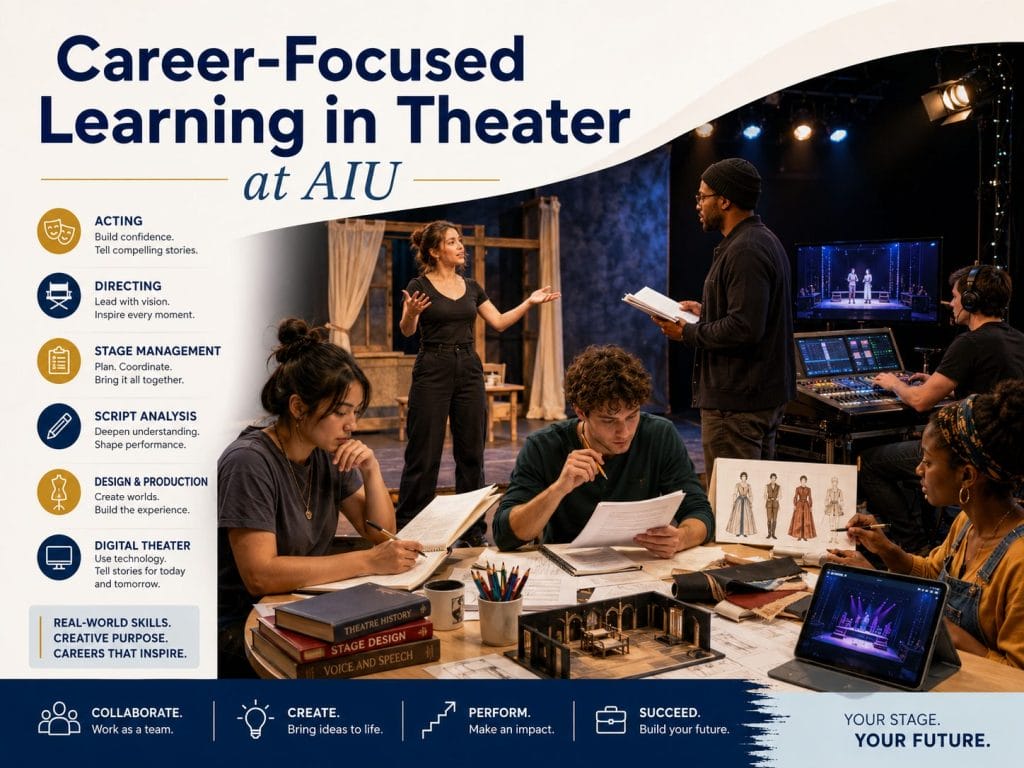
Career-Focused Learning in Theater

The emphasis on career-linked education in Theater at AIU combines theoretical learning with the practical needs of the performing industry. Students acquire acting, directing, dramaturgical, production administrative, and management skills by means of hands-on theater education careers assignments and independent studies. Students of performing arts doctorate online are urged to tackle actual problems in their creative work, create portfolios, improve leadership and communication skills, and familiarize themselves with the cutting-edge technologies used in modern theater.
career-focused
The picture shows vocational theater education involving acting, directing, stage management, script analysis, design, production and digital technology. The students work in rehearsals and creative workshops, acquiring skills, self-esteem, teamwork, and practical experience necessary for various careers in the performing arts around the world.

Real-World Projects & Capstone Experience

The Doctor of Theater program is about practice-driven learning with the help of advanced creative projects, production investigations, and the capstone project. Students can create original performances, oversee experimental productions, design community theater practices, create digital and immersive performance presentations, or research new ways of dramaturgy, acting, stage design, and audience involvement. This theater education doctorate process helps dramatic arts research students use various theoretical frameworks and research tools in practical theatre life.

Capstone project is a linkage of academic research and practical experience in the form of significant final work in terms of practice or performance portfolio, applied research, or practice work on the dissertation with the use of theoretical analysis and documentation. Through work and collaboration with theater studies doctorate performers, directors, artists, cultural organizations, and academic tutors candidates are provided with the possibility of gaining more Doctor of Theatre experience, completing new skills in leadership, problem-solving, project management, and academic communication, at the same time providing doctoral degree in theater new knowledge for modern theatre.
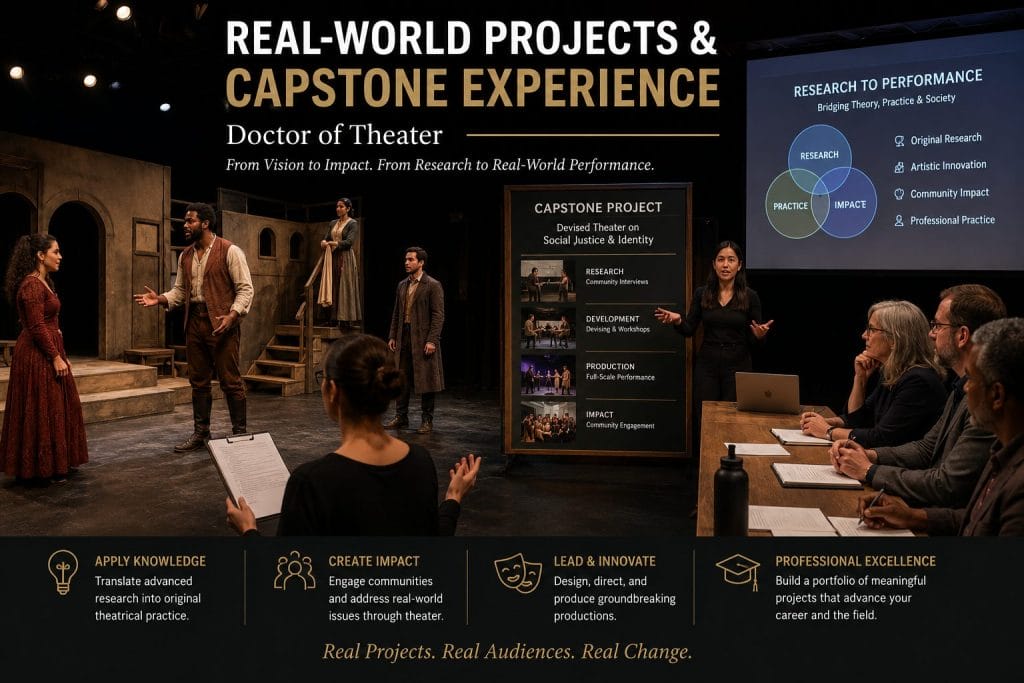
real-world
This photo depicts the process of the theater students making their research text into live performances via rehearsals, staging, production planning, presentations and expert assessment, thus showcasing the values of teamwork, creative ingenuity, community benefit, professionalism and effectiveness of the experience gained during the capstone project.
Doctor of Theater : Research Projects & Innovation

Research initiatives and discoveries carried out in a Theater PhD program provide students with a chance to conduct research to better understand how emerging theories, artistic processes, and technologies contribute to modern-day performance art. The students may specialize in areas, such as virtual theater, communicative storytelling, the involvement of artificial intelligence in production, and studies of audience involvement, among others.

The students apply their independent drama research degree research, hands-on conceptualization, and creative experimentation to formulate unique projects that bridge theory and practice in theatrical matters. This stage directing degree research may consist of running experimental performances, evaluating novel production technologies, documenting old styles of performances, designing tech-enabled stage shows, and studying audience experiences both online and offline. Such projects help to improve the critical thinking, artistic leadership, theater directing degree research techniques, and innovation skills of individuals graduating in the field.
Become a AIU Guest Student

Click Here

Thesis & Research Defense Process

The thesis defense is the final stage of Doctor of Theatre studies, demonstrating the candidate’s skill to conduct original and rigorous research to contribute to new knowledge in the field of theatre studies and performance practice. The candidate writes the dissertation by working with the supervisory committee throughout the thesis defense.

After completing the dissertation, it is sent for evaluation and the defense where the candidate presents the objectives and methodology, as well as findings and contributions of the research. Thus, the successful completion of the dissertation shows the candidate’s expertise in the field of theater studies.

Student Experience & Virtual Campus

The virtual campus that offers a Doctor of Theater has created a brain-stimulating academic atmosphere where it is possible to communicate and cooperate with other students as well as with professors and also with different professionals who come from various areas of culture and work. Different platforms and forms of learning such as online seminars and lectures, various discussions about the playproduction, access to online libraries of theater arts, listening to the recorded performances, and individual consultation with students help the students to gain all the expertise required for their career. 

The use of new technologies in online education encourages theater careers discussions about different questions and motivates students to dive into the world of critical thinking and creativity. Students may also make presentations of their research projects and receive some comments from specialists in this sphere. With the help of online study, students may study while being employed and take into account all the needs of their families.

Live Classes, Symposiums & Global Networking

Doctor of Theater students can interact closely with their mentor professors, theater experts, directors, performers, and professional artists through remote learning as well as interactive webinars and international networking.

By taking part in seminars, research presentations, workshops, and discussions with practitioners worldwide, students are able to explore present-day practices in theaters, share their ideas, and receive recommendations on the work they do.

Grow & Evolve with AIU

Get Started

Admission Requirements

It is typical for those who submit an application to the Doctor of Theater program to possess a pertinent master’s degree obtained from an accredited institution in theater, drama, performance studies, directing, acting, dramaturgy, production, cultural studies, or any other related field. Applicants may also be asked to provide a set of documents that may include academic transcripts, purpose statement, research proposal, professional résumé, and recommendation letters. 

Submitting a portfolio that contains performances, directing projects, production work, publications, or any other evidence of creative accomplishments may also be requested in order to show practical experience and research capabilities. Some applicants may need to attend an interview aimed at discussing their academic background, work experience, chosen area of study, and readiness for higher education level work in research and creativity.

How to Apply ?

To apply for the Doctor of Theater program, candidates are required to fill out and submit an online application form as well as provide the necessary documents such as transcripts, resume, personal statement, reference letters, research proposals, and portfolio that includes details about their performances, directing experience, productions, publications, and creative work. It is very important that applicants adhere to the rules for admission properly, provide good quality copies of the application documents, and pay the required fees, if there are any. Those who have been shortlisted may be invited to an interview by the admissions board to justify their selection.

Tuition, Financial Support & Scholarships

The cost for a doctorate degree in Theater differs in course layout, length of the program, and residency requirements. Students who plan to enroll need to carefully check the detailed fee list including tuition, expenses for technology, research, and other expenses associated with performances and capstone projects. There are chances to find financial aid in form of scholarships, grants, government study assistance, or external funding.

FAQs

What is a Doctor of Theater?

The Doctor of Theater is an advanced doctoral degree dealing with theatrical study, creative practice, performance, directing, dramaturgy, production, and arts leadership. It trains graduates for academic careers, careers in the theater industry as well as some of the cultural organizations of the world.

What can I do with a doctorate in theater?

Having completed a Ph.D. in theater, you can start a profession as theater researcher or director, university professor, scholar, playwright, theater production manager, cultural consultant, arts or cultural management professional, or expert in performance research or creative practice.

Is a PhD in theater worth it?

Obtaining PhD in Theater can lead to many career opportunities in teaching and research, directing, dramaturgy, artistic leadership and other cultural organizations. Its importance is determined by one’s academic and professional intentions, financial options, practical experience and readiness to make long-term commitments in terms of study and creative activities.

What careers are available with a Doctor of Theater degree?

Professions include university academic, researcher in theater, director, dramaturg, playwright, production director, administrator in arts, expert in performance studies, consultant in culture, manager in series of performances, theaters, festivals, and organizations involved.

Let us know your goals and aspirations so we can chart a path at AIU to achieve them!
//
Admissions Counselor
Rene Cordon
Available
//
Admissions Counselor
Femi Crown
Available
//
Admissions Counselor
Sandra Garcia-Fierro
Available
//
Admissions Counselor
Ariadna Romero
Available
//
Admissions Counselor
Judith Brown
Available

"*" indicates required fields

This field is for validation purposes and should be left unchanged.
Name*

"*" indicates required fields

This field is for validation purposes and should be left unchanged.
Name*

"*" indicates required fields

This field is for validation purposes and should be left unchanged.
Name*

"*" indicates required fields

This field is for validation purposes and should be left unchanged.
Name*

"*" indicates required fields

This field is for validation purposes and should be left unchanged.
Name*

"*" indicates required fields

This field is for validation purposes and should be left unchanged.
Name*

"*" indicates required fields

This field is for validation purposes and should be left unchanged.
Name*

"*" indicates required fields

This field is for validation purposes and should be left unchanged.
Name*

"*" indicates required fields

This field is for validation purposes and should be left unchanged.
Name*

"*" indicates required fields

This field is for validation purposes and should be left unchanged.
Name*

"*" indicates required fields

This field is for validation purposes and should be left unchanged.
Name*

"*" indicates required fields

This field is for validation purposes and should be left unchanged.
Name*

"*" indicates required fields

This field is for validation purposes and should be left unchanged.
Name*

"*" indicates required fields

This field is for validation purposes and should be left unchanged.
Name*

"*" indicates required fields

This field is for validation purposes and should be left unchanged.
Name*

"*" indicates required fields

This field is for validation purposes and should be left unchanged.
Name*

"*" indicates required fields

This field is for validation purposes and should be left unchanged.
Name*

"*" indicates required fields

This field is for validation purposes and should be left unchanged.
Name*

"*" indicates required fields

This field is for validation purposes and should be left unchanged.
Name*

"*" indicates required fields

This field is for validation purposes and should be left unchanged.
Name*

"*" indicates required fields

This field is for validation purposes and should be left unchanged.

Submit your data.

After submitting, a widget will appear at the bottom-left corner so you can start your training.

Name*

Do you hate spam? Don’t worry, we hate them too. Your email is 100% secure with us.

"*" indicates required fields

This field is for validation purposes and should be left unchanged.

Submit the form below to begin your interview.

After submitting, a widget will appear at the bottom-left corner so you to start your AI interview.

Name*
Accepted file types: docx, pdf, Max. file size: 500 MB.

Do you hate spam? Don’t worry, we hate them too. Your email is 100% secure with us.