Distance Learning at AIU is enhanced by vast academic resources and innovative technologies build into the Virtual Campus: Hundreds of self-paced courses with video lectures and step by step lessons, thousands of optional assignments, 140,000 e-books, the Social Media & Networking platform allowing collaboration/chat/communications between students, and MYAIU develop students holistically in 11 areas beyond just academics.
The world is YOUR campus!”, that is the message of AIU’s month magazine Campus Mundi. Hear the voices and see the faces that make up AIU. Campus Mundi brings the world of AIU to you every months with inspirational stories, news and achievements by AIU members from around the world (students and staff are located in over 200 countries).
A master in management information systems is a unique program created specifically for professionals interested in the intersection of business strategy and modern technology. The program studies the influence of information systems, data management, digital platforms, cybersecurity, analytics, and enterprise systems on management information systems degree organizations’ decision-making and operations, providing the skills necessary to impact the way businesses work. Holders of this degree learn to manage technology-related projects, develop technology-based services, implement projects, and prepare for the digital age.
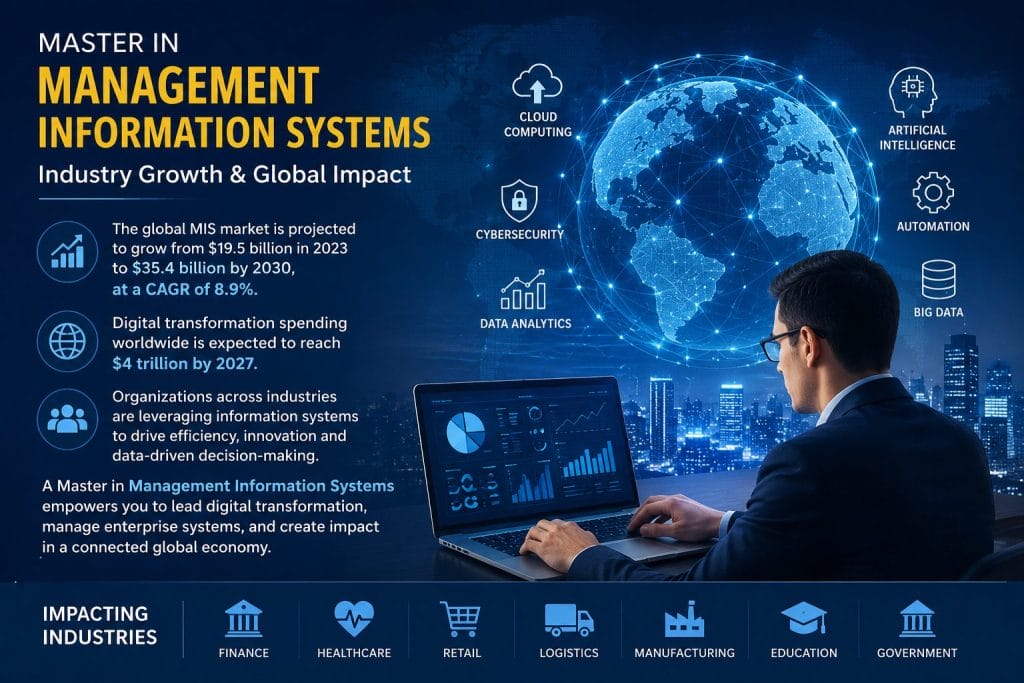
The Management of Information Systems sector is growing quickly due to the investment of organizations in digital transformation, cloud platforms, data analysis, cybersecurity, automation, and business systems that are powered by Artificial Intelligence. In fact, it is forecasted that the total IT spending will reach an amount of $6.15 trillion by 2026 indicating the increased need for MIS master’s degree management information systems degree professionals who are able to combine business goals and application of different technologies.
Additionally, it is expected that global spending in digital transformation will be approximately $4 trillion by 2027 meaning that the area of any information system affects various industries such as finance, medical care, education, trade, logistics, manufacturing, and government. That is why a person who takes a Master’s degree in Management Information Systems will be able to conduct this master of management information systems transformation by managing enterprise systems, improving data-driven decision-making and digital operations providing assistance to various organizations.
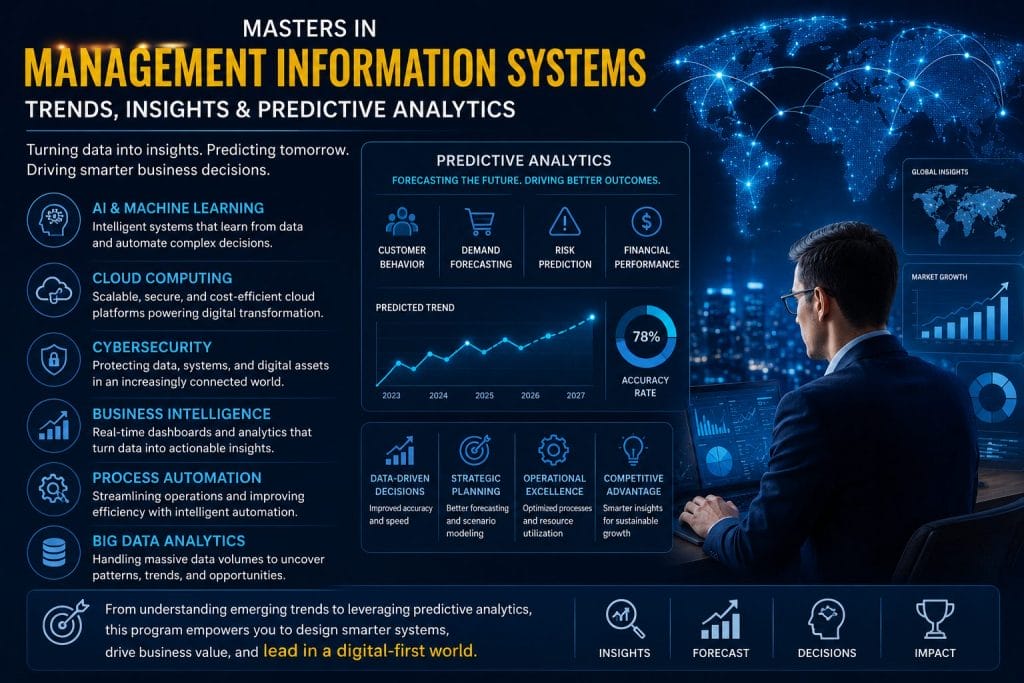
A Master in Management Information Systems trains individuals to perform and comprehend the new master in management information systems techniques influencing the electronic business field such as artificial intelligence, cloud computing, cybersecurity, business intelligence, automation, enterprise systems and data-based decision making. The biggest priority in this field is predictive analysis – employing master’s IT management degree statistical methods for analyzing the information for predicting enterprise information systems clients’ behavior or market demand, probability of certain business analytics degree operational problems taking place and future opportunities in business.
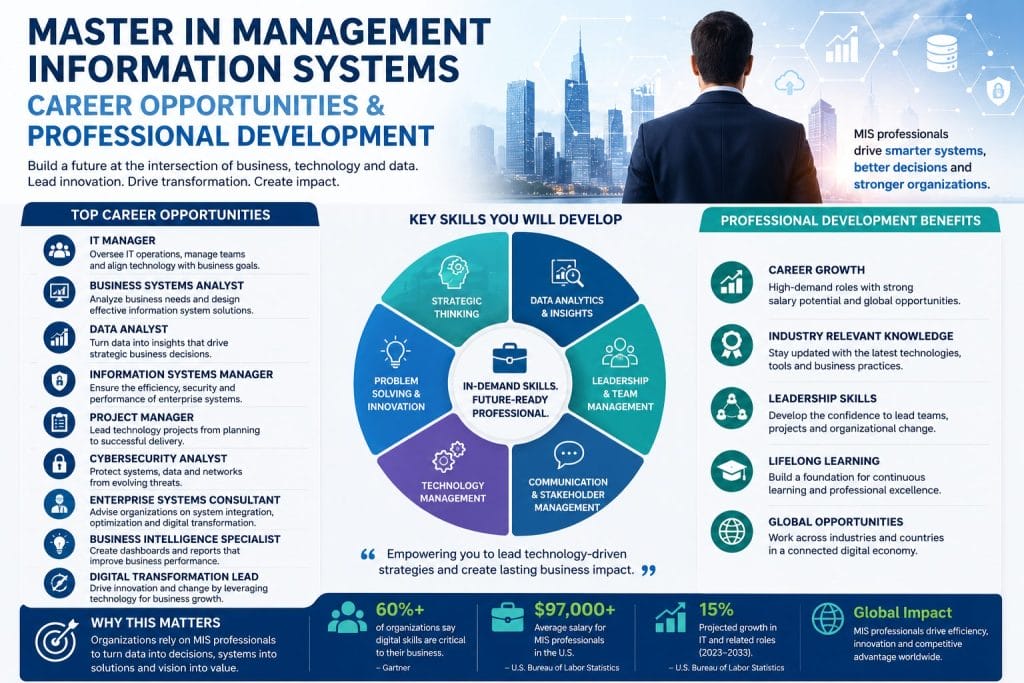
With a master in management information systems, you can choose among many possible career paths that can work at the interface of business, technology and data. Graduates can work as an IT manager, systems analyst, data analyst, information system manager, project manager, cybersecurity analyst, enterprise system consultant, intelligence specialist, etc. This program is also devoted to the development of leadership, analytical and communicational abilities. As long as data management program organizations need reliable and quick information systems, MIS specialists will have an increasingly important role in improving different information systems manager jobs processes.
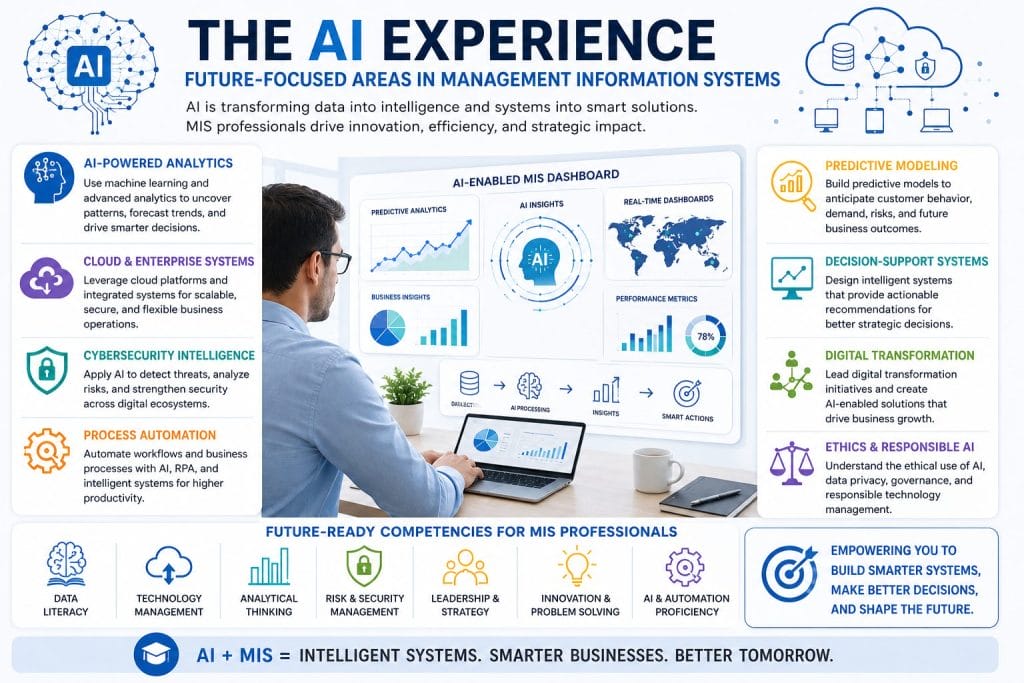
The AI Experience in the field of Management Information Systems aims to train professionals in how to use cutting-edge technologies which have changed the way organizations work, compete, and make decisions. Some of the promising areas for the business intelligence careers and future are AI-based analytics, machine learning services, cloud enterprise systems, cyber intelligence, process automation, forecasting, transformation of digital business, predictive model and decision support. They learn how artificial intelligence can help in making IT management master’s degree business better and more successful.
Begin Your Journey!
AIU’s Summer of Innovation and Growth gives you the ability to earn up to $5000 in tuition credit by completing free lessons and courses.
Whether you’re looking to acquire new skills, advance your career, or simply explore new interests, AIU is your gateway to a world of opportunities. With free access to 3400 lessons and hundreds of courses the ability to earn credits and earn certificates there’s no better time to start learning.
Join us today as a Guest Student and take the first step towards a brighter, more empowered future.
Explore. Learn. Achieve.
Through the Master in Management Information Systems program, students are granted academic freedom and the possibility to take courses of their choice towards their systems analysis and design degree. Students have the liberty to choose courses that relate to their career goals, preferred industries, and academic discipline. Students of information technology management will have an opportunity to take up different data analytics management specialization options in fields like business analytics, cybersecurity, digital transformation degree cloud solutions, project management, enterprise solutions, AI, and digital transformation.
When it comes to pursuing a course in Management Information Systems, there is no shortage of advantages. Those enrolling into this master in management information systems program will get an opportunity to acquire advanced knowledge and skills in the field. The Master in this course brings together various disciplines of study in technology, business, and data, thus helping to create a unique educational experience. It equips students with vital skills that will enable them to find solutions to complex real-world business challenges, promote effective decision-making, manage information technology-powered operations, and help different businesses innovate in their respective industries. As organizations become dependent on intelligent, secure, and information technology-based systems, there is no doubt that this online MIS degree course will help enhance the career potential of the learners.
The traditional education model of Management Information Systems includes strict attendance requirements, fixed programmatic trajectory and rather limited options for working adults to gain education. In contrast to the traditional education model, the flexible learning model allows students to learn at their own pace, draw connections between their studies and their career goals, and select specializations such as business analytics, cyber security, cloud computing, integrated systems, and artificial intelligence. This business information systems degree model works very well for busy professionals who must balance between their education and job responsibilities while acquiring the necessary skills. Flexible Master in Management Information Systems provides efficient learning opportunities and practical experiences for professionals in the field.
What makes the Master’s in Intelligence & Strategic Studies at AIU compelling is its flexible model, interdisciplinary approach, and the focus on global issues. Within the Master’s program, students can acquire knowledge in the fields of national security, intelligence, international relations, cybersecurity, counterterrorism, crisis management, military strategy, risk assessment, and other related aspects. Through academic inquiry, learning through case studies as well as customized study programs, students link theory with practice. AIU’s academic freedom allows students to think independently, specialize professionally, and acquire IT management business analytics analytical skills to analyze difficult situations occurring in the world today.
Important: Below is an example of the topics or areas you may develop and work on during your studies. By no means is it a complete or required list, as AIU programs do not follow a standardized curriculum. It is meant solely as a reference point and example. Want to learn more about the curriculum design at AIU? Check here: Course and Curriculum.
In the core courses and technical skills contained in the Master in Management Information Systems program, it centers around the study of how business technology, data management, and digital strategy could be effectively utilized. Among all the specific subjects studied may include that of database management, business analytics, information systems strategy, cybersecurity, enterprise resource planning, cloud computing, project management, systems analysis and design, IT governance, data visualization, artificial intelligence, and digital transformation.
Students pursuing a Master in Management Information Systems can build practical knowledge by working with tools used in business intelligence, databases, cloud computing, cybersecurity, enterprise systems, project management, collaboration, and digital transformation. These tools help learners understand how modern organizations collect data, manage systems, secure information, automate workflows, analyze performance, and make technology-driven database administration and business decisions.
Courses in Management Information Systems with a career-oriented focus allow students to learn how to put technological and data-based knowledge into practice through solving problems at work. Through this program, students acquire important skills that include systems analysis, database administration, management of intelligence systems, cybersecurity, cloud technologies, project administration, as well as the management of firm systems and the digital era. By providing connections between theoretical information from cybersecurity management classes and practical applications in work, students can get necessary knowledge, skills and abilities in order to solve business problems, increase operational efficiency, make data-backed decisions, and develop the ability to influence technological change. It equips students for various MIS careers and jobs in the area of IT management, management analysis, data analysis, consulting, cybersecurity and digital leadership.
By taking on actual tasks and gaining hands-on experience related to Management Information Systems, students can get practical insight on how to use knowledge of technology, data, and business. During the practical implementation of the curriculum, learners have a chance to work on business process analysis, information system design, Dashboard creation, assessment of cyber security threats, database development, and even cloud computing due to the capstone project where students manages to be completely involved in a research or practical project solving some contemporary social problem. The practical involvement will help boost students’ managerial thinking and gain technical skills, as well as rich and profound knowledge of project management techniques.
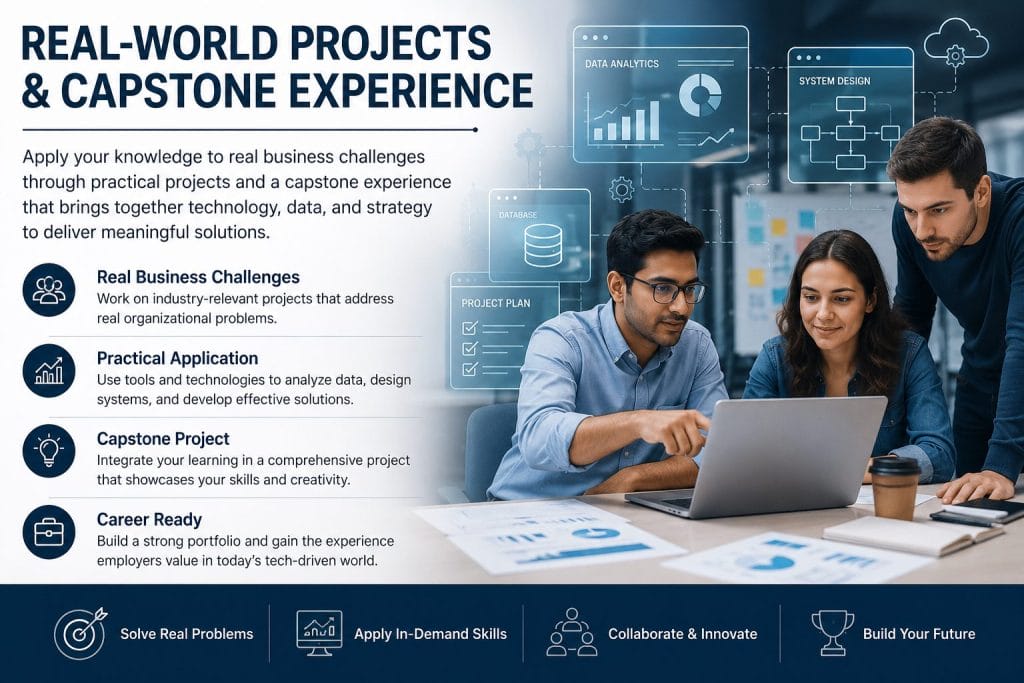
Innovative projects and research in Master of Management Information Systems encourages students to find out how technology can solve real problems and provide measurable value for the company. The study may concentrate on the following fields: business analytics, artificial intelligence, cybersecurity, cloud technology, enterprise systems, automation, digital transformation, data governance, decision support systems, and so on. Through innovative projects, the students will be able to study new enterprise systems technologies, analyze system efficiency, create technological solutions, and develop suggestions that will make the processes of decision making, ensuring efficiency, customer experience, and security more efficient.
A Master in Management Information Systems encourages research projects and innovation that connect business needs with advanced technology solutions. Students can explore how information systems, data analytics, artificial intelligence, cybersecurity, cloud platforms, and automation can improve organizational performance and solve real-world challenges. These projects may include designing business intelligence dashboards, evaluating digital transformation strategies, improving data security frameworks, developing database-driven solutions, or studying the impact of emerging technologies on business operations. Through this research-focused approach, learners strengthen their analytical thinking, innovation mindset, technical understanding, and ability to create practical solutions for modern digital enterprises.
The experience for the student as well as the virtual campus for the Master of Management Information Systems supports students with respect to flexible and interactive studies as well as career development and training. Students are taught about different learning methods which include information such as virtual libraries, online discussion forums, academic support, virtual classrooms, and access to academic information. The interaction within this virtual campus aims at promoting teamwork, professional networking, or working independently while using technological tools to achieve their learning goals.
The Master in Management Information Systems program’s student experience and virtual campus create an atmosphere that promotes flexible, participatory, and career-oriented learning. Students have the opportunity to make use of several online learning tools, including but not limited to online courses, e-libraries, virtual classrooms, discussion boards, and academic assistance. The virtual campus helps students interact with their professors, colleagues, and resources from anywhere.
This type of study environment enables a mixture of work and education while providing students with practical knowledge in the field of information systems, analytics, and digital transformation skills.
In regards to the mastery program in management information systems, both academic resources as well as Artificial Intelligence-powered education both offer students with opportunities whereby they can access digital libraries, research databases, journals, learning platforms, and materials in their respective fields of study. Through using AI-powered tools, learners can conduct research on complicated topics, critically think and do analysis of various pieces of information, engage in proper writing or creative process, provide relevant insights, among other capabilities. With respect to the combination of academic support as well as intelligent education techniques, students can improve their research skills through this combination of academic resources and intelligent learning techniques.
The requirement for admission to Master in Management Information Systems courses normally comprises a degree or its equivalent from an accredited institution in addition to an interest in technology, data, information systems or business. Other requirements include the provision of academic transcripts, resume/CV, identity cards, proof of proficiency in English and letter of intent among others. Some universities may require prior working experience in the field of information technology, project management, business intelligence among others as an added advantage before considering the application.
In order to obtain a Master in Management Information Systems, prospective students need to start with examining program information, eligibility criteria, and specialization options. Subsequently, online application needs to be filled in and submitted with supporting documentation being the academic records, resume or CV, statement of purpose, proof of identity, and English proficiency certification, if applicable. Candidates may also need to provide information on work experience, career objectives, and background in business, technology, or information systems. After the application has been processed, qualified applicants will get the information on the admission process, application procedures, and other assistance in starting studies.
Costs for obtaining a Master’s in Management Information Systems depend on the school you decide to attend. Moreover, you should check the fees of the program, the methods of repayment, including upfront payments and additional costs incurred through the course. Most institutions offer scholarships and financial aid based on the academic achievements of students as well as on the type of program they are enrolled into.
A postgraduate diploma called Master of Science in Information Systems consists of various perspectives and combines the techniques of business administration, knowledge about technology and management of data. The field prepares students for designing, performing and enhancing information systems within an organization.
Attaining a master’s degree in MIS enables you to enter a wide range of professions within the information technology (IT) sector, including working in IT management positions, analyzing business performance as a business analyst, performing data analytics, and consulting on systems issues. The degree also provides knowledge regarding the ability to connect organizations’ business needs with IT solutions.
Without a doubt, a career in Management Information Systems looks promising as it covers all aspects of business, technology and data. If you have knowledge in this area, you can apply for jobs in IT management, business analysis, importance of cybersecurity, analytics, cloud computing and digital transformation as such jobs are in high demand. There are expectations that according to U.S. BLS, there will be about 15% growth in the profession of computer and information systems managers over the next ten years.
There are several options available to students who have received their Management Information Systems degree. The list of careers include IT Manager, Solutions Manager, Cyber Security Manager, Business Information Analyst and Data Analyst. On top of these, people who have the degree can pursue Business Intelligence and Data Warehousing careers.
Approximately 2 years.
"*" indicates required fields