
Distance Learning at AIU is enhanced by vast academic resources and innovative technologies build into the Virtual Campus: Hundreds of self-paced courses with video lectures and step by step lessons, thousands of optional assignments, 140,000 e-books, the Social Media & Networking platform allowing collaboration/chat/communications between students, and MYAIU develop students holistically in 11 areas beyond just academics.
The world is YOUR campus!”, that is the message of AIU’s month magazine Campus Mundi. Hear the voices and see the faces that make up AIU. Campus Mundi brings the world of AIU to you every months with inspirational stories, news and achievements by AIU members from around the world (students and staff are located in over 200 countries).
The Doctorate in Advanced Energy Studies is a research program that needs interdisciplinary skills to address the global energy challenges using scientific methods, innovative technologies, and sustainable methods of development. The program contains subjects based on the study of renewable energy sources, energy storage, smart grids, energy efficiency, and climate technology. A candidate gets necessary research skills during the educational process. Such students can work in the educational system, the government, or the energy sector.
Candidates investigate the impact of engineering innovation, environmental sustainability, economic feasibility, and public policy on global energy transition. Doctoral students find viable solutions for energy security, emission reductions, infrastructure reinforcement, and sustainable development in their communities, industries, and countries through research, data analysis, experiments, and technology assessment.
The energy industry worldwide is changing swiftly due to the advanced energy systems doctorate efforts of governments, corporations, and communities to replace fossil fuels with other cleaner and more reliable sources of energy. The development of wind energy, smart grids, electricity storage, hydrogen projects, electric transport, and sustainable energy solutions aimed at reducing carbon emissions is stimulating the need for skilled energy researchers and specialists. A PhD in Advanced Energy Systems equips professionals with the knowledge necessary to solve problems of energy security, climate changes, renovation of infrastructure, as well as efficient use of resources. Thanks to advanced research and innovation, graduates will be able to influence energy policy, develop technologies, ensure industrial sustainability, and help in the process of global transition to sustainable low-carbon energy systems.
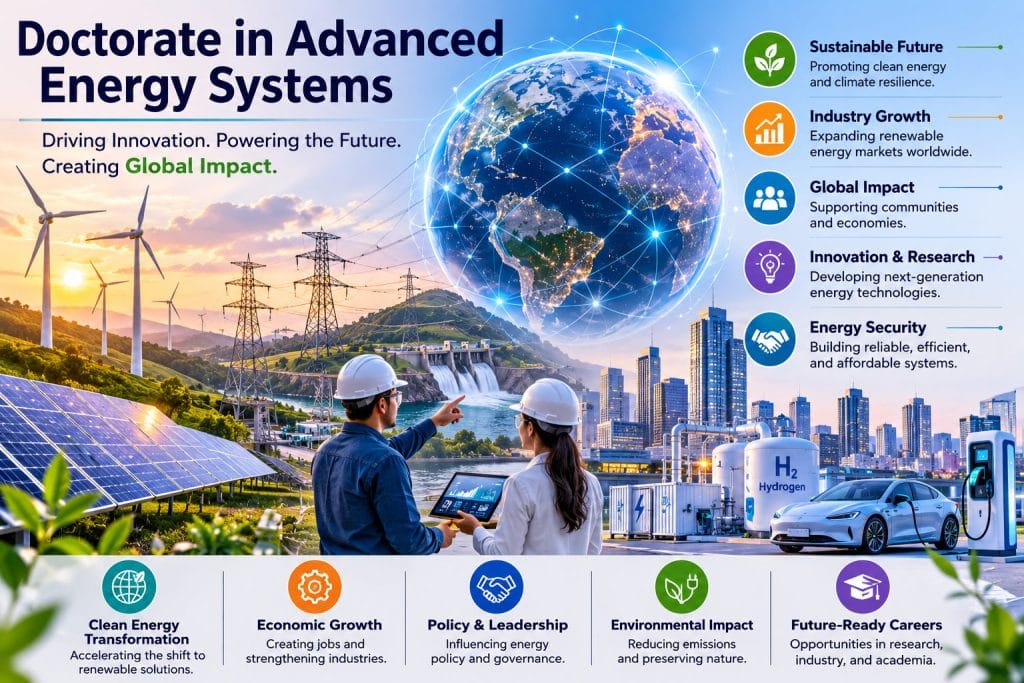
The doctoral program in Advanced Energy Systems analyzes new trends and key technologies in energy. The curriculum focuses on solar/wind energy generation, intelligent network systems, energy storage methods, grids in the distribution of hydrogen, electric transport and energy prediction systems, among others. The students will be trained to use natural intelligence techniques relying on massive amounts of data in the prediction of energy consumption and resource optimization. The research results will be obtained through the study of climate changes, market mechanisms, and new technology solutions. Thus the graduates are ready to provide smart and sustainable solutions in energy.

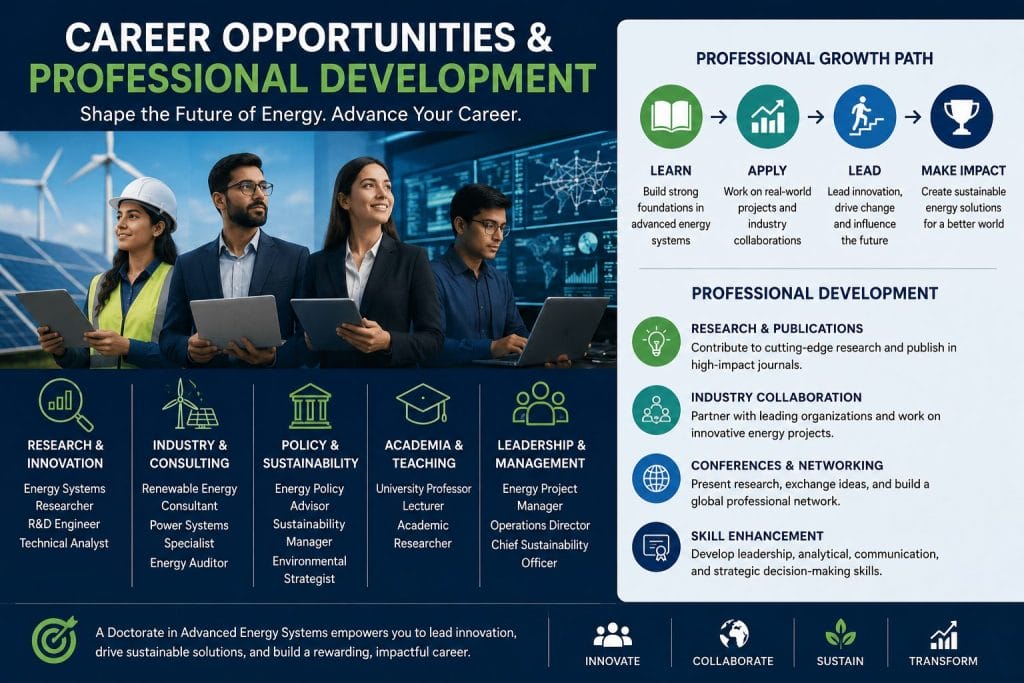
Earning a Doctorate in Advanced Energy Systems qualifies individuals for top positions in multiple fields related to renewable energy, such as power systems, smart grids, energy storage and sustainability, research and public policy. They can pursue careers as energy systems researchers, renewable energy consultants, power grid specialists, sustainability directors, energy policy advisers, university professors and research and development managers.
People pursuing this doctoral degree in advanced energy systems build on their professional skills through independent research, getting published in various journals, cooperating with companies, participating in conferences around the world and working on advanced analytical projects. These activities allow them to acquire important skills related to leadership, problem solving, project management and strategic decision making.

The AI Experience in Engineering Systems describes the way in which various applications of artificial intelligence—such as machine learning, predictive analytics, automation, digital twins, and intelligent control—revolutionize the design and control of complex engineering environments. The students investigate the potential of AI in system modeling, requisites forecasting, tracking of equipment, fault detection, risk evaluation, resource optimization, as well as in making data-driven decisions.
The vision of the future encompasses such domains as autonomous infrastructure, smart manufacturing, intelligent transportation, resilient energy networks, robotics, sustainable engineering, and AI-based maintenance. Through the combination of research and applied activities, learners develop the skills of analyzing new technologies, coping with ethical and management problems, as well as creating adaptive engineering solutions.
Begin Your Journey!
AIU’s Summer of Innovation and Growth gives you the ability to earn up to $5000 in tuition credit by completing free lessons and courses.
Whether you’re looking to acquire new skills, advance your career, or simply explore new interests, AIU is your gateway to a world of opportunities. With free access to 3400 lessons and hundreds of courses the ability to earn credits and earn certificates there’s no better time to start learning.
Join us today as a Guest Student and take the first step towards a brighter, more empowered future.
Explore. Learn. Achieve.
The concept of academic freedom and the availability of a personalized course allow students to align their education with their research interests and professional goals. Candidates can select their classes from a robust curriculum and also have the possibility of studying specialized areas, such as, for instance, systems modeling, automation, digital technology, and others. Modern curricula may include independent scientific work, interdisciplinary programs, and academic work. Such a flexible approach supports the development of innovative thinking and the critical approach in resolving engineering issues.
A Doctorate in Advanced Energy Systems provides learners with the advanced analytical, research, technical, and leadership abilities necessary to confront global energy issues. The program equips students with knowledge in fields such as renewable energy, smart grid technologies, energy storage, and emerging technologies. While completing the program, students will develop their ability to think innovatively, solve problems, make evidence-based decisions, and make their contribution to energy studies. After graduation, students would be qualified for senior positions in universities, research organizations, consulting firms, and utilities. Students will also have the opportunities to get credibility in their profession and cooperate with other fields.
In traditional doctoral education, students receive the education in the exact school structure, with the scheduled lectures, expected assignments, university research, and the continuous interaction with someone in person. This system ensures users access to laboratories, faculty staff, and sources from the school, but it can be quite difficult for many people to cope with it, especially for those who are working or studying from abroad. Doctorate in Advanced Energy Systems is a flexible course that gives students an opportunity to adjust their studying process to their employment and private life while getting knowledge connected with renewable energy, smart grids, energy storage, sustainability, and intelligent energy management. Flexible education supplies students with the ability to study with the new methods using all available technologies and online resources, while they do not need to limit themselves in academic achievements.
At AIU, the Doctorate in Advanced Energy Systems is centered on the student’s learning journey. The program is structured in accordance to the learner’s academic aspirations, prior experience, and professional goals. Its educational model encourages self-learning, creative thinking, and applicability of energy-related concepts. Candidates are exposed to the fields of renewable energy, smart grids, energy storage, sustainable development, forecasting analysis, energy politics, and management of intelligent systems. The flexible curriculum enables candidates to find connections between their research and real-life practical challenges. Along with that, the program provides learners with digital resources, expert support, interdisciplinary studies, and collaborations with other countries for successful research papers and better energy systems.
Important: Below is an example of the topics or areas you may develop and work on during your studies. By no means is it a complete or required list, as AIU programs do not follow a standardized curriculum. It is meant solely as a reference point and example. Want to learn more about the curriculum design at AIU? Check here: Course and Curriculum.
The Doctorate in Advanced Energy Systems encompasses a range of topics in renewable energy technologies, power system modelling, smart grids, energy storage, sustainable infrastructure, energy economics, predictive analytics and intelligent control systems.
Students of advanced energy systems degree develop knowledge in technical fields such as system simulation, data analysis, optimization, demand forecasting, performance assessment, risk assessment, and energy policy analysis. Depending on the nature of their research, students may also study artificial intelligence, digital twins, grid resilience, electric transport, hydrogen energy, carbon management or decentralized energy networks. The academic knowledge and competencies gained in the course of such studies allow doctoral students to understand complex energy issues, find solutions to them, and create effective, stable and sustainable energy systems.
Doctoral students in Advanced Energy Systems may use various software applications for the modelling of power systems, renewable energy studies, simulation, optimisation, forecasting and research visualisation. These tools enable them to assess grid stability, energy needs, storage efficiency, system performance, environmental implications and introduction of new technologies into current energy schemes.
The focus of Professional Learning in Advanced Energy Systems concerns the link of doctoral studies to the real-time requirements of the global energy market. The students tackle various issues including renewable energy use, smart technology, energy storage, decarbonization, power resilience, energy efficiency, and sustainable infrastructure. The students develop their abilities in modelling, forecasting, evaluating technology, strategic planning, and making decisions based on evidence through applied research, modeling, case studies, and projects related to the field of energy systems. This will help graduates to take leading roles in complex energy aces and advanced energy systems careers’ projects, give advice to the governments and organizations, make joint renewable energy engineering jobs research and development programs, impact policies, and develop innovative solutions for energy systems.
The application of advanced doctorate in advanced energy systems knowledge to complicated situations in the energy field is possible due to real-world projects and the capstone experience. Possible research areas include renewable-energy integration, smart-grid implementation, energy storage, hydrogen technology, electric grid stability, de-carbonization, demand assessment, and sustainable infrastructure development. The evaluation of the basic energy systems engineer issues of the projects occurs through case studies, simulations, data analysis, and independent sustainable energy research related to technical, economics, environmental, and legal aspects of the problems investigated.
The last stage of the renewable energy engineering degree capstone project is the implementation of learned skills and knowledge gained from the research which is directed toward solving the problem relevant to the industry. The whole course of an investigation secures skills of research, project management, innovative thinking and effective communication with the audience.
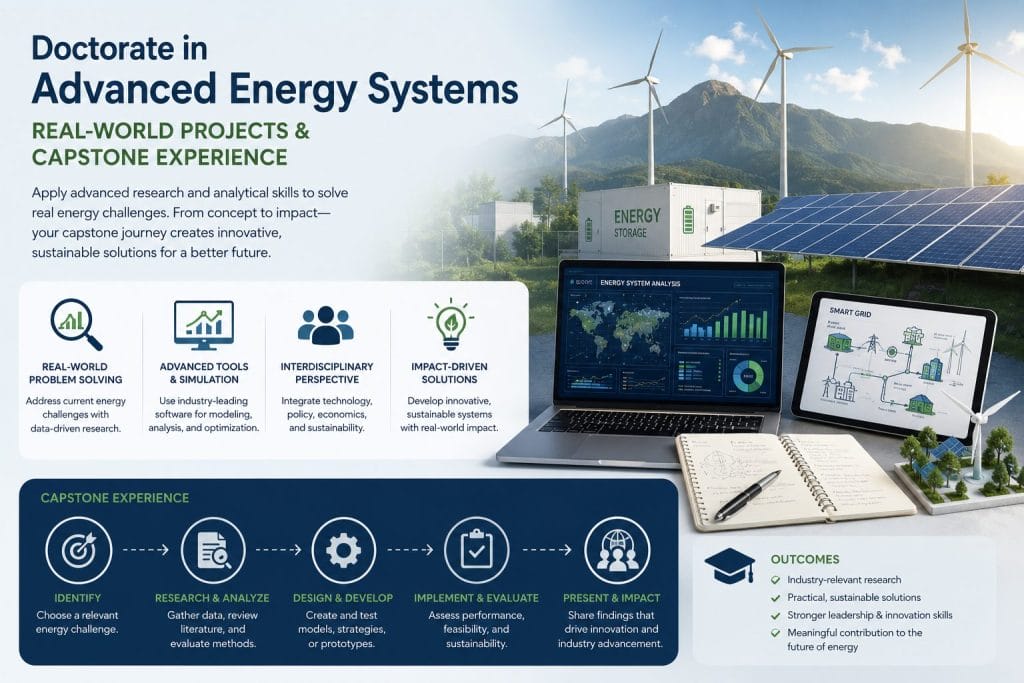
Research and innovation comprise one of the important aspects of the doctorate in advanced energy systems since this allows students to examine difficult energy problems and come up with innovative and evidence-based energy systems engineering solutions. Energy systems engineering research can address the clean energy technology topics of the integration of renewable energy, smart grids, energy storage technology, hydrogen technologies, decarbonization, grid resilience, energy efficiency, predictive analytics, and sustainable infrastructure.
Students may use advanced modelling and simulation techniques, advanced data analysis methods, and experimental techniques to provide smart energy sytems evaluation of system performance and find sustainable power systems areas for improvement. Interdisciplinary projects can also include the connection of engineering with economics, environmental science, social science, and artificial intelligence.
In the process of completing a Doctorate in Advanced Energy Systems, candidates are asked to defend their thesis which marks the last phase of the doctorate degree. This involves carrying out a comprehensive study on an original topic of power generation technology that deals with relevant issues related to renewable energies, smart grids, energy storage, hydrogen technology, sustainability, optimization of energy systems and similar fields. After this thorough research, candidates will put together a thesis that contains the problem statement, literature review, methods, data interpretation, obtained results, contributions to knowledge, limitations and recommendations for further development.
At the energy systems engineering doctorate defense stage, candidates will exhibit their research before a panel of experts. This gives the opportunity to clarify important aspects of the research and justify the importance of the findings obtained. Members of the panel will reflect upon the methodological, analytical and technical aspects of the study.
The virtual campus offers students pursuing their Doctorate in Advanced Energy Systems environment, where advanced studying, researching and professional activities become possible. Students can get access to educational material, academic databases, research support, recorded materials and communication tools online. Various forms of virtual activity provide an opportunity to create an intellectual international learning community for the students through online interactions with professors and classmates and online conferences.
Interactive sessions such as live classes, symposiums, and global networking opportunities give students in the Doctorate Advanced Energy Systems Program a chance to communicate and collaborate with faculty, researchers, industry professionals, and fellow students from all over the world. These sessions will help learners discuss various topics such as renewable energy, smart grids, energy storage and sustainability, as well as give them a chance to share their ideas and receive feedback on the matter.
Participation in academic and professional events helps enhance the communication and collaboration skills of all attendees while also improving their visibility in research as a scientist. Making connections with the global community helps with professional networking and the discovery of partners for research activities.
Most of the time, applicants to Doctorate of Advanced Energy Systems will need to have a relevant master’s degree in any of the following fields: engineering, energy studies, environmental science, technology, and related fields. The application for admission can be accompanied by several documents such as academic transcripts, CV or résumé, work experience details, personal identification documents, statement of purpose, and a brief outline of the student’s planned research proposal. Student applicants must be able to demonstrate their analytical score and ability to conduct research, along with technical knowledge in the field of energy. They must have an interest in solving complex energy issues as well.
Those wishing to apply to the Doctorate in Advanced Energy Systems program must complete the requisite online application and submit the required documents. Such documents may consist of academic transcripts, résumé, identification, purpose statement, recommendations, and research proposal. At the completion of the application process, candidates may then be judged according to their academic background, fields of research interest, work experience, and suitability for admission into the doctoral program.
Upon approval, candidates will subsequently be contacted with information regarding enrollment, curriculum, research plans, fees, and admissions.
Tuition fees for the Doctorate program in Advanced Energy Systems may greatly differ depending on the choice of academic path, duration of studies and requirements of a specific institution. Before enrollment, students must check the entire fee structure and payment schedule as well as any other prices related to academics or administration. Tuition payment options may be helpful for candidates. Possible finances include grants, sponsorship from employers, scholarships, funding in research, etc.
A Doctorate in Advanced Energy Systems is an advanced research degree focused on renewable energy, smart grids, energy storage, sustainability, and emerging technologies. It prepares graduates to develop innovative solutions for efficient, resilient, and low-carbon energy systems.
By obtaining a Doctoral degree in Advanced Energy Systems, you can find yourself working for top companies in energy research, renewable energy consultancy, leading smart grid projects, sustainability advocacy and leading initiatives in energy education and R&D. You could also be tasked with some of the most difficult tasks, such as dealing with energy storages and sustainable energy technologies, decarbonization etc.
For anyone interested in pursuing a career in research, academia or energy policy, obtaining a PhD in Advanced Energy Systems can be very useful. The value of having obtained this degree, however, will depend on many individual factors such as the professional goals and specialization of the person and the amount of effort put in by them.
The careers available are as an energy systems research expert, consultant on renewable energy, smart-grid professional, sustainability director, adviser on energy policies, leader in R&D, educator, analyst of energy and director of projects in firms dealing with utilities, government, research facilities and companies that use clean energy.
"*" indicates required fields