
Master of Material Science and Nanoengineering

School of Science & Engineering

Academic Freedom to Discover Your Purpose

Open Curriculum Design at Atlantic International University

The materials science and nanoengineering degree is an interdisciplinary program that investigates how materials can be designed, assorted, and utilized at the atom, molecular level, and also the nano level (those smaller than 1 nm). Because of the multidisciplinary basis of this program, students in this program will develop new materials for various industries (such as electronics, energy, health, aerospace, and manufacturing) through the investigations done using the principles of physics, chemistry, engineering, and nanotechnology to advance how we create and use materials in manufacturing and in our daily lives. 

From their work with nanomaterials and similarly developed materials, students in this program will gain an understanding of how these types of materials can be utilized in our society (e.g., electronic components, renewable energy sources, biomimetic materials, sustainable materials, etc.) and, upon graduation, have gained both technical knowledge and skills necessary to meet current and future challenges in master’s in materials science and nanoengineering as well as contribute to the development of technological advancements that will define the direction of science and industry in the future.

Materials Science and Nanoengineering Degree : Industry Growth & Global Impact

Materials science and nanoengineering degrees are leading to some of the most important technology developments of the 21st century. Examples of this progress include advanced semiconductors, renewable energy systems, medical products and devices, and smart materials that are changing industries on a global scale. Globally, the nanotechnology market is growing quickly as organizations across all sectors are investing in new materials that will be lighter, stronger, more efficient, and more environmentally friendly to support continued materials science master’s degree economic development, increased technological competitiveness and support sustainable objectives. 

To support continued economic growth and to achieve technological competitiveness and sustainability, governments, research institutions, and multinational corporations are increasing their investment in developing advanced materials. As demand for high-performance materials increases throughout a variety of industries, materials scientists and engineers with expertise in material science and nanoengineering will grow in global workplace value.
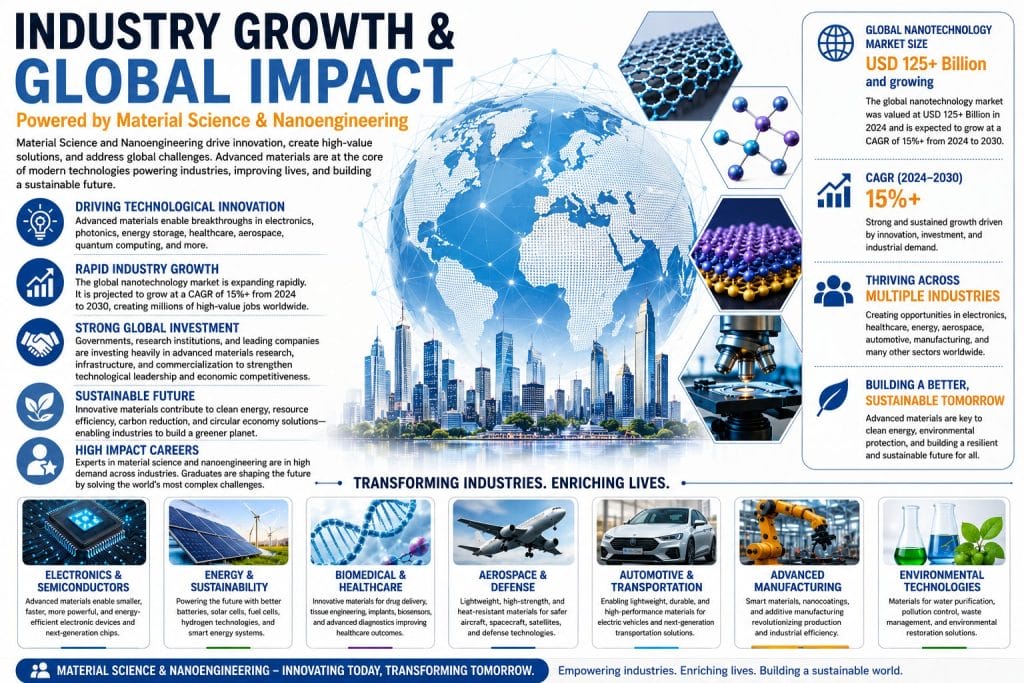
Industry Growth & Global Impact
The above infographic illustrates the increasing worldwide reach of Material Science and Nanoengineering within several different sectors including electronics, healthcare, aerospace, energy, automotive and advanced manufacturing. In addition to displaying the indication of new technologies, significant industry growth, sustainability initiatives and international investment patterns; the graphical elements of this infographic demonstrate how developed materials will facilitate economic growth.
Material Science and Nanoengineering Degree : Trends, Insights & Predictive Analytics

In the past several years the discipline of Material Science and Nanoengineering degree has been growing at an exponential rate due largely to new technologies that are changing the face of industries around the world. The emergence of new nanomaterials as well as the innovative development of smart materials, biomaterials, and quantum technologies, and the development of sustainable manufacturing techniques have all contributed to a significant increase in opportunity to innovate. 

The use of predictive analytics, artificial intelligence, and computational modelling to accelerate the rate of discovery of materials, improve the performance of products, and reduce the costs associated with research and development are becoming mainstream; therefore, industry leaders are leveraging data generated from these sources to help them predict how materials will behave, how to manufacture products more efficiently, and to develop the next generation of products for use in electronics, health care, energy, aerospace, and environmentally friendly applications. 

With the continuous global demand for advanced materials on the rise, there is a strong need for professionals who possess the analytical knowledge and engineering skills to create breakthrough nanoengineering master’s degree technologies that will impact the future of technology and sustainability.

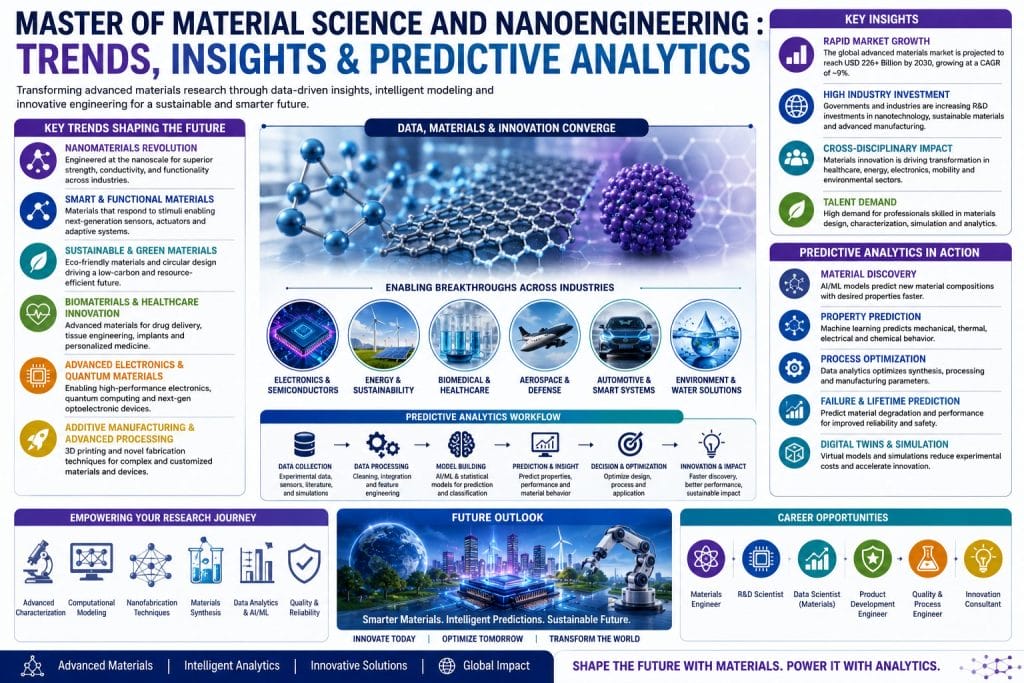
Master of Material Science and Nanoengineering
The purpose of this infographic is to highlight how data-driven materials science and nanoengineering innovation tools, including predictive analytics and advanced research methods, can accelerate the discovery of materials and improve their performance. Emerging trends including nanomaterials, smart materials, sustainable technologies, and AI-assisted modeling are presented as well as applications in all sectors, including electronics, healthcare, aerospace, energy, automotive, and environmental. Together, they create a broad career landscape globally.

Career Opportunities & Professional Development

A master’s degree program in material science and nanoengineering expands career opportunities for its graduates that typically involve a high degree of scientific innovation and technological development. Along with continuing to remain in areas of current and emerging demand, such as semiconductor, nanotechnology, aerospace, renewable energy, biotechnology, healthcare, automotive production, and advanced materials research, career opportunities for graduates include the movement into various roles (e.g., material engineer, nanotechnology specialist, research scientist, semiconductor process engineer, product design engineer, R&D manager, and materials data analyst). 

Graduates of materials science and nanoengineering degree will gain technical expertise as well as develop their leadership through exposure to the latest/new technologies, interdisciplinary collaborations, and solving research-based problems. This combination of specialized knowledge with professional development will allow graduates to continue pursuing cutting-edge innovations using their expertise while moving up the ranks into senior technical, research, consultative, or management types of jobs globally.
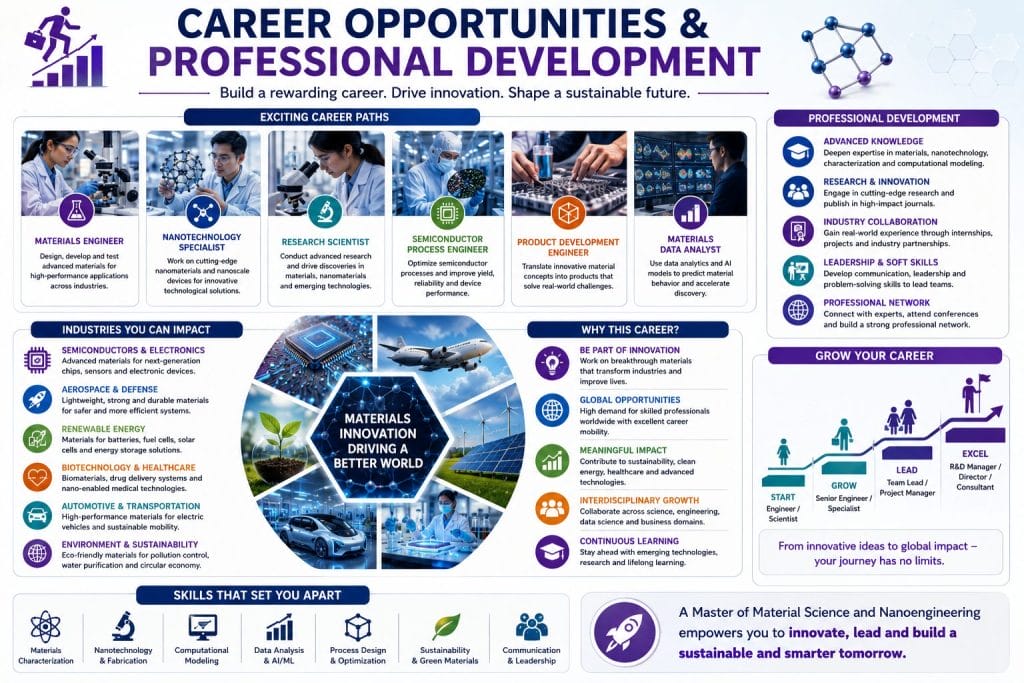

Career Opportunities & Professional Development
The infographic illustrates the wide range of careers and professional development opportunities offered within the fields of Material Science and Nanoengineering. Examples of such careers discussed in this presentation include those related to research, nanotechnology, semiconductor engineering, product development and data analytics. In addition, important technical, experiential and leadership competencies necessary for success within a given industry and global opportunities will be highlighted. It also illustrates how knowledge of advanced materials expertise (developing the fundamentals of innovation) promotes creativity, sustainability and long-term professional success in many of the world’s leading industries.

The AI Experience: Future-Focused Areas in Material Science & Nanoengineering Degree

The students of Material science and nanoengineering degree are undergoing a transformation through the use of artificial intelligence (AI). Research is accelerated with the use of AI for research of new materials and predictions regarding their properties. In addition, AI can be used to assist in the redesign and improvement of material creations so that each newly created material works at an optimum.

Some newly emerging uses for AI include the creation of intelligent nano-materials, smart sensors, quantum materials, next generation semiconductors, eco-friendly energy storage systems, bio-materials used in the health care profession, and automated material discovery systems. Professionals in the field of material sciences will now be able to utilise AI in the following ways; solve difficult scientific problems, decrease the time and money required to develop new/find new materials, and increase the number of breakthroughs related to technology, environmental sustainability, health care, and industrial innovation that occur annually.

Contact Us Today!

Begin Your Journey!
AIU’s Summer of Innovation and Growth gives you the ability to earn up to $5000 in tuition credit by completing free lessons and courses.
Whether you’re looking to acquire new skills, advance your career, or simply explore new interests, AIU is your gateway to a world of opportunities. With free access to 3400 lessons and hundreds of courses the ability to earn credits and earn certificates there’s no better time to start learning.
Join us today as a Guest Student and take the first step towards a brighter, more empowered future.
Explore. Learn. Achieve.

Academic Freedom & Customized Curriculum

AIU’s materials science and nanoengineering degree is designed to give students as much flexibility as possible when creating their educational pathway by way of degree requirements based on professional goals, interests in research, and/or future career aspirations. Additionally, students have the option to choose a primary area of specialization (i.e. nanotechnology; advanced materials; semiconductors; biomaterials or related areas) and focus coursework concentration throughout the program on that specialization (i.e. a student who is interested in nanotechnology can take the majority of his/her courses in nanotechnology while also taking advantage of the flexibility to include coursework in related areas such as methods of project management, etc.).

By providing this type of personalized educational experience, there will be an increased number of requests from students for independent study and/or research projects that foster creativity and problem-solving capabilities for each student, whether they use it in a scientific and/or engineering context. Therefore, as a result of their independent studies and/or research efforts, every student will gain a high level of competency in developing environmentally and commercially viable designs for practical solutions to real work place or other scientific or engineering problems.

Why Study Material Science and Nanoengineering Degrees at AIU?

Benefits of Material Science and Nanoengineering Degree

The fields of nanotechnology and materials science are essential to developing technologies, products, processes, and sustainable approaches to solve engineering challenges through advanced materials that are strong, lightweight, intelligent, and efficient. Materials science has the potential to transform all manufactured goods in the electronics, medical, energy, aerospace, and manufacturing sectors. 

Through this body of materials science and nanoengineering degree knowledge, professionals will develop the skills and expertise required to solve complex engineering problems, enhance product qualities, and provide sustainable solutions to take care of the world’s needs. Furthermore, the interdisciplinary nature of these two fields provides opportunities for innovation, research excellence, and analyzing solutions—creating numerous opportunities for graduates in rapidly growing areas of their industry. As the need for advanced materials continues, new graduate students will be able to play an important role in making scientific breakthroughs and advancing technology across the globe.

Traditional vs Flexible Education : Material Science and Nanoengineering Degree

Conventional education usually uses a set plan with the same syllabus and fixed amount of time in each class, limiting the possibility of individualizing your experience or studying for your career goals, research interests, or jobs, but by using flexible education you would have the ability to personalize your own Material Science and Nanoengineering degree learning experience based on your own career goals or research area and at your own pace within the fields of Material Science and Nanoengineering degree.

For example, those who take advantage of flexible education will be able to tailor their educational pursuits in various specialty areas of study, such as nanotechnology, high-tech materials, semiconductor processing, biomedicine, and eco-solutions as they progress toward their degree. Also, flexible learning encourages cross-disciplinary thought, independent research and practical use of knowledge to provide students with practical tools that can help them be successful in today’s fast-paced environment, as dictated by the rapid changes in technology.

Key Strengths of the Master of Material Science & Nanoengineering at AIU

With an innovative and holistic approach to engineering education, the Master of Material Science and Nanoengineering program at AIU provides students with flexible options for academic experiences while simultaneously addressing the industry’s need for future-oriented interdisciplinary specialization in advanced material science. Students will have the opportunity to personalize their educational experiences through coursework as well as by exploring different areas within Material Science & Nanoengineering including: Nanotechnology, Semiconductor Manufacturing, Biomaterials Science & Engineering, Advanced Manufacturing, and Sustainable Materials Science & Engineering. 

The emphasis of this materials science and nanoengineering degree program is on independent research, innovation, and real-world problem-solving; as such, it prepares students to solve actual engineering problems faced by today’s engineers. Additionally, by utilizing state-of-the-art technologies, innovation through data-driven approaches, and scientific exploration, AIU’s Master of Material Science and Nanoengineering program will give online materials science degree students the necessary technical knowledge, analytical skill set, and international perspective to succeed in today’s fast-changing engineering industries and nanoscale engineering program research environments.

Begin Your AIU Journey Today

Stay Ahead

Core Courses & Technical Skills

Important: Below is an example of the topics or areas you may develop and work on during your studies. By no means is it a complete or required list, as AIU programs do not follow a standardized curriculum. It is meant solely as a reference point and example. Want to learn more about the curriculum design at AIU? Check here: Course and Curriculum

The program of study for a materials science and nanoengineering degree focuses on material characterization, nanomaterials and nanotechnology, semiconductor materials, biomaterials engineering, advanced composites, materials thermodynamics, surface and interfacial science, and computational materials modeling. Other topics may include sustainable materials development and research methodologies. 

All of these materials science and nanoengineering degree topics will help you acquire technical skills in material analysis, nanoscale fabrication, microscopy, materials simulation, optimization of processes, interpreting data, and designing experiments. In addition to developing scientific knowledge, analytical skills, and problem-solving abilities, graduates will have an extensive foundation for innovation in such fields as semiconductors, health care, energy, aerospace, and advanced manufacturing.

  • Nanomaterials and Nanotechnology
  • Materials Characterization Techniques
  • Semiconductor Materials and Devices
  • Biomaterials Engineering
  • Advanced Composite Materials
  • Surface and Interface Engineering
  • Nanofabrication and Nanoelectronics
  • Smart and Functional Materials

Tools & Technologies You Will Master

Through the Master of Material Science & Nanoengineering, students will gain practical experience using modern-day technologies and tools that are meant to assist scientists on their research projects (advanced materials, nanotechnology innovations, and semiconductor development). By learning to analyze properties of materials, simulate complex structures, improve manufacturing processes, and use data-driven techniques to discover new materials, you will be prepared to combine both experimental and computational modeling in order to apply your skills across a variety of industries such as electronic devices, healthcare systems, sustainable energy sources, aerospace engineering, and advanced manufacturing processes. 

The Graduate of this program will have the knowledge necessary to create new technologies and innovate by combining both physical laboratory technologies with digital laboratory technologies in order to create solutions to engineering problems that exist within the real world.

  • MATLAB – The study of numerical computing and analyzing quantity data relating to materials
  • Python – Scientific Computer Simulation, Machine Learning, and Analytical Techniques for Predicting
  • COMSOL Multiphysics – Simulations of multiphysics and simulations of materials
  • ANSYS – Structural, thermal, and material performance simulations
  • Materials Studio – Atomistic modeling and materials design

Career-Focused Learning in Material Science and Nanoengineering Degree

The Material Science and Nanoengineering degree is focused on achieving career-focused learning by applying advanced science knowledge to real-world industry problems (e.g. how to use materials whole differently). The Program participants learn about materials, nanotechnology, semiconductors, advanced manufacturing, and sustainable innovation while solving problems faced by today’s economies.

The students with nanoengineering jobs gain hands-on experience with analyzing particular materials performance, improving production processes, developing new technologies through various forms of innovative approaches including – through biomaterials research class assignments & homework; existing research projects, and by solving case-based problems (case studies). This career-aligned curriculum will help develop participants’ technical skills; competencies for leadership and new innovative ways of thinking so that the graduate participants can attain materials science careers that are involved in the semiconductor technology research and development of products produced with the use of semiconductors; healthcare technology; energy systems; aerospace engineering; as well as within advanced manufacturing industries globally.

Real-World Projects & Capstone Experience

The master’s program in material science and nanotechnology focuses on authentic projects and culminating experiences, applying knowledge theory to real-world engineering and research problems. Students will examine advanced materials used for renewable energy systems, semiconductor devices, applications for biomedical devices, development of nanomaterials, smart materials and sustainable methods of manufacturing. These projects foster critical thinking, creativity and interdisciplinary/teamwork.

They also develop nanotechnology master’s degree online students’ hands-on technical skills through activities including characterization of materials, computational modeling, optimization of manufacturing processes and interpreting data. Working independently as part of a research effort or while researching industry-related problem-solving questions, students build an electronic portfolio that illustrates their ability to create practical solutions to technological problems and provide an effect on the industry in which they work.
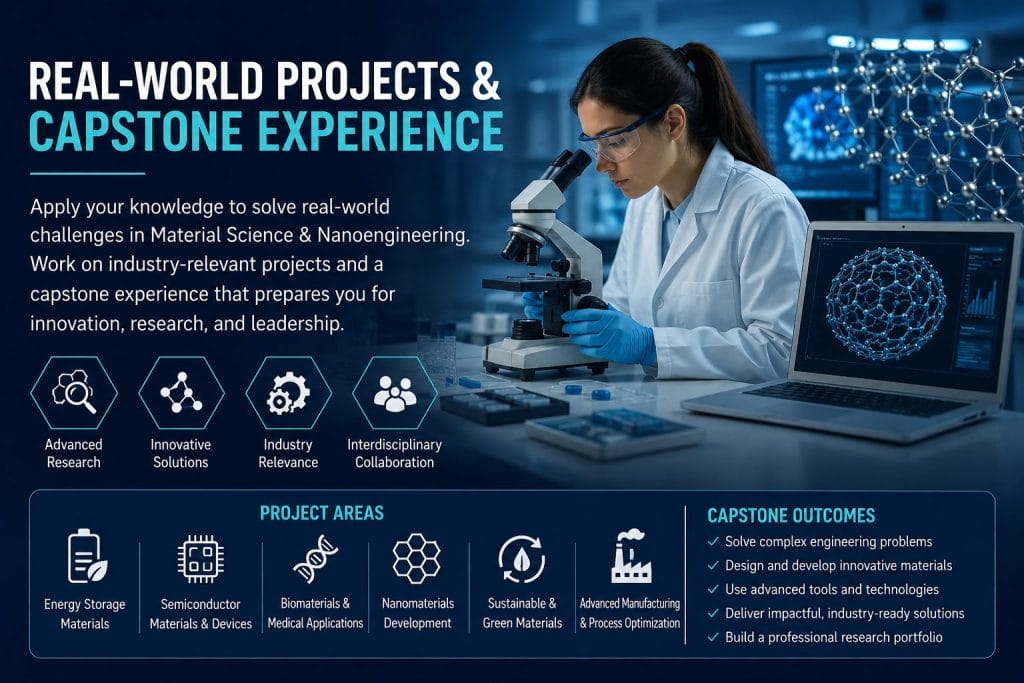
Real-World Projects & Capstone Experience
This infographic demonstrates how a student’s academic learning can be connected to an industry’s application in real-world projects and capstone experiences within the fields of Material Science & Nanoengineering. It presents research into nanomaterials, semiconductors, biomaterials, sustainable technologies, & advanced manufacturing; highlighting elements of innovation, interdisciplinary collaboration, problem-solving, & practical experience, which prepare students to create meaningful solutions & establish effective professional research credentials.
Material Science and Nanoengineering Degree : Research Projects & Innovation

Discover, innovate, and achieve global scientific excellence at the Master of Material Science and Nanoengineering where research-based learning creates an environment conducive to discovering new material science and nanotechnology. Study cutting-edge research areas, including: nanomaterials; advanced semiconductor materials; biomaterials; smart materials; energy storage technologies; and sustainable manufacturing techniques, through research focused on real-world application of material science and nanotechnology. 

Use advanced materials engineering degree experimental science and research (e.g., through material testing), computational simulations and modeling (e.g. by analyzing and predicting material properties), and advanced laboratory analytics (e.g., through material characterization), to develop innovative solutions to global challenges in engineering, materials science and nanotechnology. The nanotechnology engineering degree program encourages independent research and cross-disciplinary collaboration to solve complex technical problems of materials science and engineering master’s through the application of science and technology, while contributing to the development and sustainability of products and materials characterization processes that will improve the performance of existing products, support sustainable development practices, and create the means to produce new generations of advanced materials research and nanomaterials through nanotechnology.


Get a Guest Access to AIU Now

Click Here

Thesis & Research Defense Process

The Thesis & Research Defense Process allows students to show their expertise through an original research project focused on Material Science and Nanoengineering. Students perform extensive research, analyze their results and submit an nanomaterial design innovative solution to a Research Committee of Professors within the department.

This process enhances critical thinking, scientific communication, problem-solving, and research skills for students who have made significant contributions to the field as a result of this process.

Student Experience & Virtual Campus

Through the use of a flexible virtual campus, the Master of Material Science & Nanoengineering provides a stimulating, vibrant educational experience for all its student body. Students have access to all course materials and research resources, academic assistance tools, and peer-collaborative learning options from anywhere in the world! The online learning platform allows students to interact with faculty, research staff and other students. Additionally, the online platform allows for self-directed nanomaterials engineering study, as well as a variety of other activities, including discussion forums and project-based learning opportunities. This is an international educational community, where materials characterization studies’ students can innovate, share knowledge and build their professional networks, thus creating a positive academic experience while accommodating varied nanoengineering studies’ work schedules and career demands.

Live Classes, Symposiums & Global Networking

The Master of Material Science and Nanoengineering program utilizes real-time instruction, research symposiums, and connections worldwide to meet the needs of all learners; specifically, to support networking between students and faculty, other researchers, and industry leaders. 

Students will benefit from interactive programs and help each other develop new concepts, discuss new emerging technologies, and explore current advancements related to materials science, nanotechnology, semiconductors, and advanced manufacturing. In addition, by working together with members of an international team from various backgrounds, students will gain insight into potential careers, create a greater sense of community, and share their experiences while also gaining new viewpoints regarding the many issues that will define the future of all science and engineering fields.

Academic Resources & AI-Powered Learning

Access to the most extensive semiconductor materials engineering academic resource network for furthering your studies in these fields is provided through the Master of Material Science & Nanoengineering program. Online libraries of smart materials , scholarly journals/repositories of scientific articles, research databases, technical reports, and textbooks are among the many sources available to aid in advanced study and research related to materials and nano-science. 

AI applications developed specifically for education improve your learning experience by providing you with personal learning paths, tailored content recommendations, data-driven analytics, and resources/tools to facilitate your research. By combining the wide variety of available academic resources with cutting-edge digital technology, you will be able to expedite your acquisition of knowledge, increase the efficiency of your research, and remain on the cutting edge of new research and development in materials, semiconductors, and nanoscale engineering.

Start Your Journey of Innovation Today 

Explore AIU

Admission Requirements

To be accepted into the Master of MSNE (Material Science & Nanoengineering), applicants should ideally have an undergraduate (Bachelor’s degree) in a relevant engineering, chemistry, physics, or material science program from an accredited university; however, students with strong technical experience in other engineering, nanotechnology, or science disciplines who have shown a desire to learn about these fields will also be considered for admission. 

Candidates will also need to indicate a strong desire to participate in scientific research/inventions, innovation, and improvement. The Admissions Committee will use the applicant’s academic achievements, prior work experience, and future interest in the area of study, etc., to determine if they meet the admissions criteria and are ready for graduate study.

How to Apply ?

Atlantic International University (AIU) is currently accepting admission for the Master of Material Science and Nanoengineering program. The AIU program is aimed at students who have an interest in studying advanced subjects pertaining to materials, engineering, and nanotechnology. The minimum requirement for all applicants is either a current or comparable bachelor’s degree; or they must provide documentation of enough academic preparation. 

All biomaterials engineering degree candidates will be evaluated based on their professional experience, educational background, and career goals, as well as their commitment to independent study. The AIU application process is flexible and does not focus exclusively on standardized criteria; we assess each applicant based on how likely they are to succeed at the level of graduate education. 

We encourage students to submit official academic transcripts and any other documentation that would help demonstrate their ability to continue on from this point in their development as professionals through engaging in research and continuing to build their qualifications and skills in this rapidly growing field.

Tuition, Financial Support & Scholarships

Graduates of materials design and innovation education do not have to cost an arm and a leg. With flexible payment terms, as well as several financial aid opportunities available to new students who are interested in pursuing a graduate degree in Materials Science and Nanoengineering (MSN), graduate education has never been more affordable. 

Financial aid includes scholarships for graduate students; tuition assistance from employers or other organizations; customized payment plans created to fit the different needs of every student; and so much more. To find out about all available graduate scholarships, students are encouraged to talk to admissions advisors about their options.

FAQs

What is a Master's in Materials Science and Nanoengineering?

Master of Material Science and Nanoengineering is an advanced graduate program that deals with the scientific studies and research by applying designs, characterizing and utilizing materials found at the atomic, molecular and nanoscale levels. The program of study combines engineering, physics, chemistry, and nanotechnology to create and develop innovative materials and technologies which are used in many industries including semiconductor, healthcare, energy, aerospace and advanced manufacturing.

What can you do with a materials science and nanoengineering degree?

With a MSc in Materials Science and Nanoengineering you could work in advanced materials research, Nanotechnology and semiconductor Engineering, Product Development, Renewable Energy, Aerospace, Healthcare, Biotech, and Advanced Manufacturing. You could be employed as a Materials Engineer, Nanotechnology Specialist, Research Scientist, Semiconductor Process Engineer, R&D Manager or Innovation Consultant creating new and improved materials and technology which will facilitate scientific and industrial development.

Is nanoengineering a good career?

Yes, those who possess an interest in technology/advanced technologies, exploration/innovation and are familiar with research methodologies will find that pursuing a career in nanoengineering may offer great opportunities.

What jobs are available in materials science and nanoengineering?

Materials Science and Nanoengineering graduates may work in the following fields: materials engineering, nanotechnology engineering, semiconductor engineering, research scientist, biomedical materials specialist, product development engineer, quality/process engineer, energy materials researcher, and manufacturing engineering. Graduates of this program will work in multiple industries including electronics, health care, aerospace, renewables, automotive, and advanced manufacturing and will be involved in developing new materials, developing innovative technologies, and other similar activities.

Let us know your goals and aspirations so we can chart a path at AIU to achieve them!
//
Admissions Counselor
Sandra Garcia-Fierro
Available
//
Admissions Counselor
Boniface Onimu
Available
//
Admissions Counselor
Prof. Emmanuel Gbagu
Available
//
Admissions Counselor
Juan Mejia
Available
//
Admissions Counselor
Rene Cordon
Available

"*" indicates required fields

This field is for validation purposes and should be left unchanged.
Name*

"*" indicates required fields

This field is for validation purposes and should be left unchanged.
Name*

"*" indicates required fields

This field is for validation purposes and should be left unchanged.
Name*

"*" indicates required fields

This field is for validation purposes and should be left unchanged.
Name*

"*" indicates required fields

This field is for validation purposes and should be left unchanged.
Name*

"*" indicates required fields

This field is for validation purposes and should be left unchanged.
Name*

"*" indicates required fields

This field is for validation purposes and should be left unchanged.
Name*

"*" indicates required fields

This field is for validation purposes and should be left unchanged.
Name*

"*" indicates required fields

This field is for validation purposes and should be left unchanged.
Name*

"*" indicates required fields

This field is for validation purposes and should be left unchanged.
Name*

"*" indicates required fields

This field is for validation purposes and should be left unchanged.
Name*

"*" indicates required fields

This field is for validation purposes and should be left unchanged.
Name*

"*" indicates required fields

This field is for validation purposes and should be left unchanged.
Name*

"*" indicates required fields

This field is for validation purposes and should be left unchanged.
Name*

"*" indicates required fields

This field is for validation purposes and should be left unchanged.
Name*

"*" indicates required fields

This field is for validation purposes and should be left unchanged.
Name*

"*" indicates required fields

This field is for validation purposes and should be left unchanged.
Name*

"*" indicates required fields

This field is for validation purposes and should be left unchanged.
Name*

"*" indicates required fields

This field is for validation purposes and should be left unchanged.
Name*

"*" indicates required fields

This field is for validation purposes and should be left unchanged.
Name*

"*" indicates required fields

This field is for validation purposes and should be left unchanged.

Submit your data.

After submitting, a widget will appear at the bottom-left corner so you can start your training.

Name*

Do you hate spam? Don’t worry, we hate them too. Your email is 100% secure with us.

"*" indicates required fields

This field is for validation purposes and should be left unchanged.

Submit the form below to begin your interview.

After submitting, a widget will appear at the bottom-left corner so you to start your AI interview.

Name*
Accepted file types: docx, pdf, Max. file size: 500 MB.

Do you hate spam? Don’t worry, we hate them too. Your email is 100% secure with us.