Associate in Maritime Management

School of Business and Economics

Academic Freedom to Discover Your Purpose

Open Curriculum Design at Atlantic International University

An associate in maritime management will give you the necessary background in business, operations, and logistics within the global maritime industry. This associate in maritime management area has been designed for people who want to enter the maritime industry at an entry-level position or continue their maritime management degree education in this field and will support students by introducing them to basic concepts related to shipping operations, port management, shipping logistics, international transportation, supply chain management, and maritime regulation. It will also give the students a practical understanding of how and where goods and vessels move throughout the international marketplace and will also provide a basic understanding of the associate degree in maritime management, commercial factors, legal factors, and technological factors that affect the operations of modern maritime companies. 

Because the success of associate in maritime management of global trade is dependent on the efficiency of shipping networks, the graduates of this program will have the skills necessary to pursue a career within the maritime industry in many different areas such as; ports, shipping companies, logistics companies, freight forwarding, and international business.

Associate in Maritime Management : Industry Growth & Global Impact

According to the UN Conference on Trade & Development (UNCTAD) and the International Maritime Organization (IMO), the shipping industry is a vital component of international commerce, with approximately eighty percent of volumes being shipped by sea and over seventy percent of value shipped by sea. In addition, online maritime management degree e-commerce growth and increased global supply demand for goods have resulted in strong demand for fleet management people with skills essential for maritime logistics, shipping and port operations. 

The industry is uniquely suited to benefit from ongoing investment in technology related to smart ports and terminals, autonomous vessels, digital freight platforms and more environmentally sustainable associate in maritime management practices, as well as new job creation as a result of such investments. As different levels of governments and the private sector expand the world’s maritime infrastructure, creating smart ports and maritime management associate degree terminals, and developing eco-friendly technology to comply with international environmental obligations, there will be a tremendous demand for professionals skilled in maritime management.
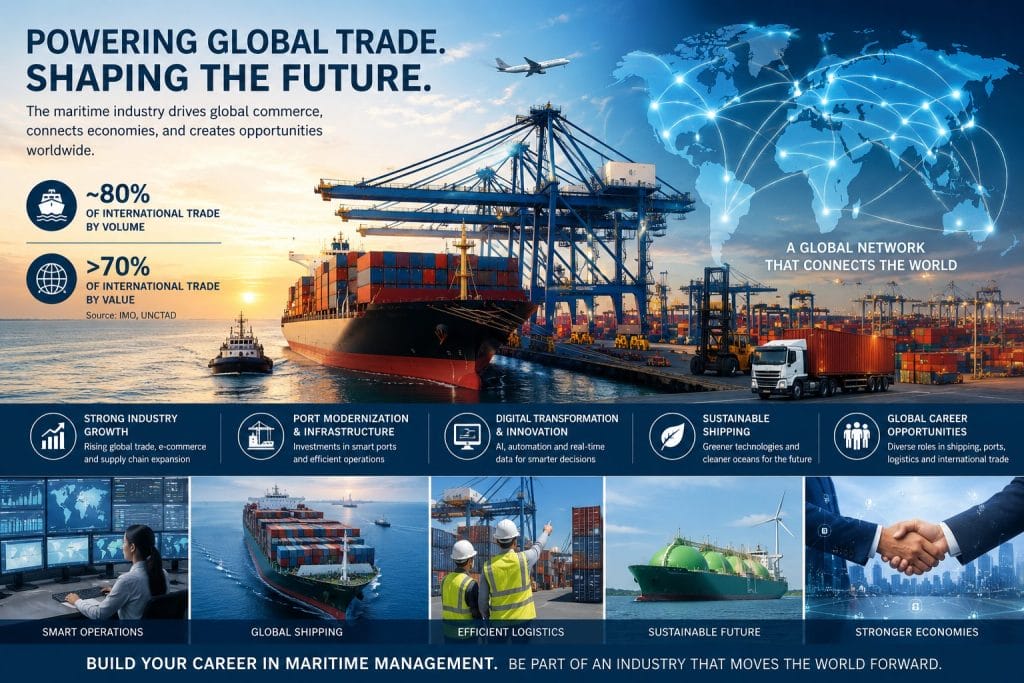
powering global trade shaping the future
The image depicts how large the global maritime industry is, using modern smart ports; shipping containers on global shipping vessels; cargo logistics; e-commerce and digital trade networks; and technology related to sustainable shipping. The image also provides evidence of international trade, port modernization and automating all aspects of the port; increased connectivity around the globe; and the expanding career opportunities available in maritime management and globally oriented supply chain operations.
Associate in Maritime Management : Trends, Insights & Predictive Analytics

There is a considerable change taking place within the maritime sector as advances in digitally-based technologies, automation technologies and data-analysis based decision making redefine how goods are shipped globally as well as how shipping and shipping logistics operate collectively. Additionally, as artificial intelligence and predictive analytics become more widely used within logistics and shipping industries, IoT sensors, blockchain, as well as digital twin technologies will enable shipping companies and ports to anticipate demand, determine optimal shipping routes, reduce fuel usage, predict maintenance needs for equipment, and improve cargo visibility. Smart ports will be increasingly relying on real-time port management degree shipping and logistics management analytics to increase operational efficiency, enhance security, and decrease delays.

Coupled with the above, the acceleration of the adoption of green shipping technologies with a shipping management degree and alternative fuels is being driven by the need to reduce the overall impact that shipping has on the global environment, the development of decarbonization plans by various countries, and the implementation of more stringent international regulations regarding the environmental impact of shipping. Therefore, as organizations continue to utilize predictive analytics to enable more efficient, resilient and environmentally-friendly global supply chains, associate of maritime management individuals with maritime management careers and skills in maritime analytics, digital logistics, and operational forecasting will become vital within many organizations across the maritime shipping industry.
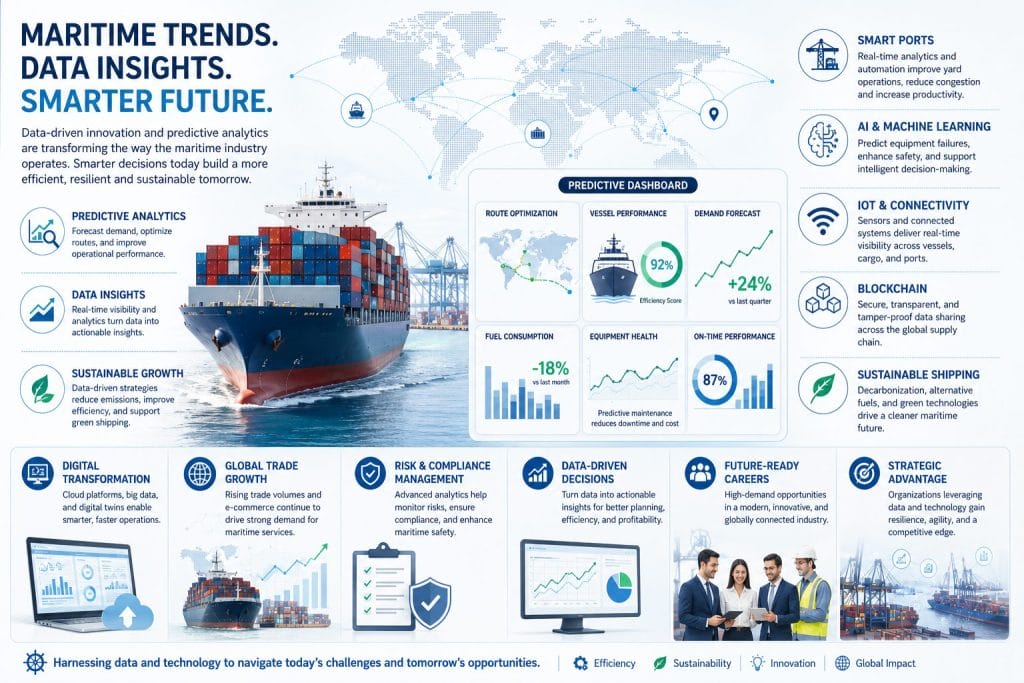
maritime trends data insights smarter future
This picture exemplifies a maritime future that includes futuristic technologies such as predictive analytics; AI; smart ports; IoT; digital dashboards; etc., which all emphasize utilizing data-driven approaches to manage shipping operations more effectively, sustainably, efficiently, safely, and to improve global trade through connectivity by utilizing digital platforms to demonstrate today’s advancements in maritime logistics and prepare professionals to be successful in the digital age of the maritime industry.

Career Opportunities & Professional Development

Graduates of the Associate in Maritime Management degree program with potential maritime operations careers can find employment in a variety of entry-level positions within the Global Shipping, Logistics, and Transportation industry. Entry-level positions available to graduates are: shipping coordinator, port operations assistant, freight forwarding executive, logistics coordinator, customs documentation specialist, vessel operations assistant, supply chain associate and maritime customer service representative. 

As professionals gain industry experience and obtain internationally-recognized certification from maritime associations or agencies globally, professions can advance to become port manager, shipping operations manager, fleet coordinator, maritime logistics manager, terminal operations supervisor or international trade specialist. The associate in maritime management  program provides graduates with the academic maritime logistics jobs and foundation and port management careers necessary to obtain a bachelor’s degree in maritime management, logistics, supply chain management, international business or transportation management, all supporting long-term marine transportation degree career advancement in one of the most important industries in the world.
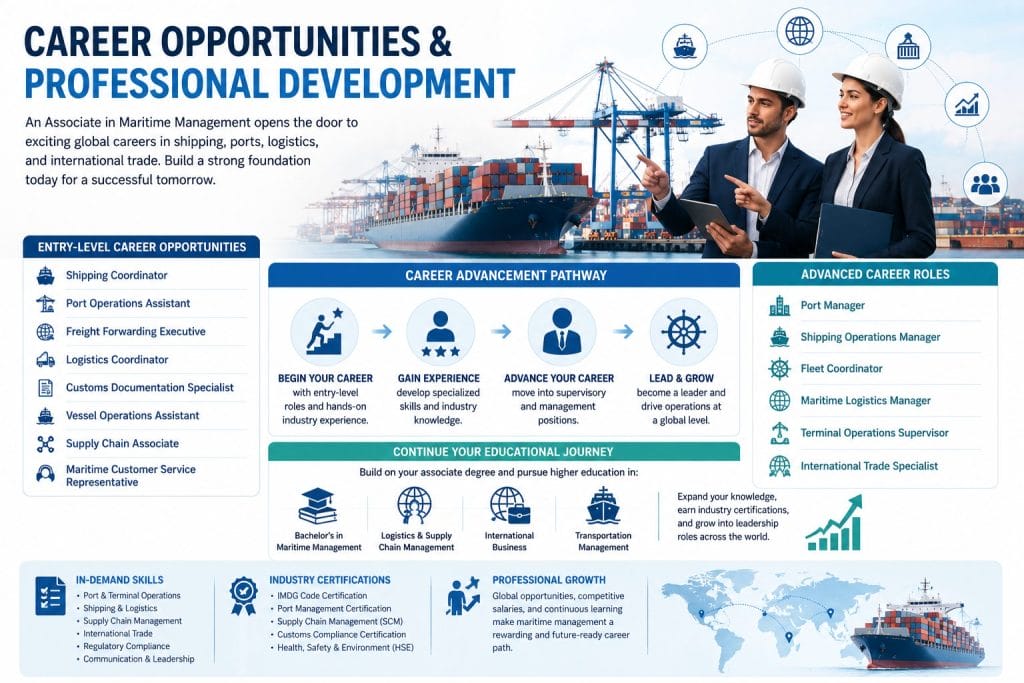

career opportunities professional development
This visual shows a variety of career pathways available in Maritime Management. Entry Level Positions; Professional Development; Higher Education Options; Industry Certificated. Skills development; job opportunities worldwide; development of leaders; and the many different types of careers available in the shipping, port, logistics, trade and supply chain sectors.

The AI Experience: Future-Focused Areas in Maritime Management

Maritime management has been changed through digital innovation utilizing Artificial Intelligence (AI), which is smarter, safer, and more productive than before throughout the global shipping industry. Professionals that are future focused with expertise in  supply chain and maritime logistics are benefiting from the capability of AI to increase their knowledge of various AI-driven solutions including route optimization, predictive maintenance, support systems for autonomous vessels, digital twins, smart port technology, and real-time cargo tracking. 

Machine learning has enabled the maritime industry to forecast demand, optimize fleet utilization, lower fuel consumption and improve supply chain resiliency; while using computer vision and Internet of Things (IoT) sensors have enhanced the international maritime business and maritime industry’s abilities regarding the inspection and maintenance of vessels and ports as well as enhancing operational monitoring and supporting regulations related to compliance and emissions reporting and environmental sustainability through the use of advanced analytical capabilities and automated decision-making. As the maritime industry continues to experience digital transformation; those global shipping industry and maritime professionals that understand AI, data analytics and intelligent logistics will be in a prime position to lead innovations related to shipping, port operations and global trade.

Contact Us Today!

Begin Your Journey!
AIU’s Summer of Innovation and Growth gives you the ability to earn up to $5000 in tuition credit by completing free lessons and courses.
Whether you’re looking to acquire new skills, advance your career, or simply explore new interests, AIU is your gateway to a world of opportunities. With free access to 3400 lessons and hundreds of courses the ability to earn credits and earn certificates there’s no better time to start learning.
Join us today as a Guest Student and take the first step towards a brighter, more empowered future.
Explore. Learn. Achieve.

Academic Freedom & Customized Curriculum

The Associate Degrees in Maritime Management is a flexible, learner-friendly program that gives students the opportunity to create a strong foundation through the study of maritime working conditions, while also reflecting their desired career aspirations. The core concepts of this program cover the fundamental areas associated with seaports, logistics, shipping transportation, international trade, maritime law, and supply chain management; all related to required career competencies through industry relevant experiences. Students will develop critical thinking, problem-solving, communication, and leadership attributes using research, case studies, and applied experiences. This unique and flexible learning method helps students to create their own educational journeys, along with preparing them for a continuously changing and growing global maritime environment or for moving to an advanced maritime, logistics, or business program.

Why Study Associate in Maritime Management at AIU?

Benefits of Associate in Maritime Management

The Associate in Maritime Management degree offers graduates a practical path toward becoming part of a global movement in one of the most important maritime safety industries worldwide, creating the opportunity to gain knowledge and skills to help support the logistics, port activities, and shipping industries. The programme helps develop expertise in maritime commerce, global trade, supply chain logistics, cargo handling and maritime studies degree documentation, and complying with industrial regulations combined with strong analytical, communication, and operational decision-making capabilities.

The graduate will find numerous opportunities to gain employment at the entry-level in companies that provide shipping services, handle cargo (ship, warehouse), and whom rely on other services for shipping transportation, eventually enabling all international shipping graduates to obtain their bachelor’s degrees along with professional certification allowing for continued development of long-term successful careers in this dynamic maritime business management degree community of developed and continuing global trade of maritime administration degree  with a shortage of qualified professionals to meet the industry’s increased demand due to technological development and growing demand of developed and developing nations’ increasing need for globally traded merchandise.

Traditional vs Flexible Education : Associate in Maritime Management

Conventional forms of Maritime Education should have a defined program created on a traditional campus system. These programs include standard classroom activities, predetermined hours of class, and a lack of flexibility for the previous experience of an adult learner. Adults entered to Maritime Education in order to get additional learning but the differences in adult students, such as the pace at which they learn, their level of learning or their other commitments and responsibilities, limits the quality of maritime education available to them.

The ability to offer a degree with flexibility will offer an Alternative Associate degree from an institution that allows an individual to participate in flexible programming from almost any site in the world via an internet-based digital education system. The degree will be developed to allow an individual to tailor their education to meet their work, family or other commitments, while at the same time, obtaining practical experience that applies to the following disciplines: shipping operations, port management, international logistics, international trade and international supply chain management. In addition, the program encourages independent learning, critical analysis, and the application of the theories and concepts developed in the maritime sector while preparing graduates for a dynamic and rapidly changing maritime industry with new opportunities for career advancement due to advances in digital technology, shifts to sustainable practices and global connectivity.

Key Strengths of the Associate in Maritime Management at AIU

The Associate in Maritime Management Degree Program at AIU provides a flexible, career-oriented educational program designed to prepare students for the changing global maritime industry. Students have the ability to personalize their learning experiences and choose courses that address their specific professional interests while also gaining a solid foundation in ship operations, port management, maritime logistics, international trade and chain supply management.

In addition to an academic program based upon an interdisciplinary curriculum, students engage in application of what they are learning with practical case study learning, along with access to extensive collection of digital resources related to current industry trends. Additionally, by focusing on developing higher order thinking skills such as: critical thinking; leadership; communication; and problem-solving abilities, graduates are prepared to enter into entry-level careers within the maritime industry or advance to higher level graduate degrees or confidently take advantage of new job opportunities through smart shipping systems, sustainable logistic operations, or global commerce.

Become a AIU Guest Student Today 

Start Your Journey

Core Courses & Technical Skills

Important: Below is an example of the topics or areas you may develop and work on during your studies. By no means is it a complete or required list, as AIU programs do not follow a standardized curriculum. It is meant solely as a reference point and example. Want to learn more about the curriculum design at AIU? Check here: Course and Curriculum 

The maritime management programme provides a solid background in all aspects of the maritime industry. This includes fundamentals of shipping; logistics; port operations; international trade; regulatory requirements applicable to the maritime industry; supply chain management; communications; and problem-solving. Students will learn to apply concepts in a variety of areas, and through this coursework students will develop the skills necessary to pursue entry-level employment or continue their education in areas related to maritime or logistics industries.

  • Introduction to Maritime Management
  • Port and Terminal Operations
  • Principles of Shipping and Logistics
  • Supply Chain Management
  • Freight Forwarding and Cargo Management
  • Maritime Law and International Conventions
  • Shipping Finance and Accounting
  • Customs Procedures and Trade Documentation

Tools You Will Master

The Associate in Maritime Management program provides students with practical experience using the latest digital tools and technologies that are employed throughout the shipping, logistics, port operations and supply chain management industries. These technologies are essential for providing students with a better understanding of cargo tracking, fleet management, route optimisation, port operations, trade documentation, enterprise resource planning and data analytics. By utilising today’s maritime software and business intelligence technologies, students will gain the practical digital skills required to drive operational efficiencies, enable data-driven decision making and prepare them for technology-intensive careers in the global maritime and logistics industries.

  • SAP S/4HANA for Logistics — Procurement Through Transportation: All Aspects of Supply Chain Management
  • Oracle Transportation Management (OTM) — Logistics and Supply Chain consist of many different types including transportation and distribution planning, execution and optimization of freight and all logistics operations.
  • CargoWise — Freight forwarding, Customs compliance and Total Logistics.
  • IBM Sterling Supply Chain Suite —Visibility of Supply Chain using AI-driven insights and Order Management.
  • MarineTraffic — Tracking of vessels in real time and their location including Port Intelligence and Marine Analytics.
  • Windward — A maritime AI platform to measure vessel risk and compliance and report Trade Intelligence.
  • Dataloy Systems —Voyage and chartering management and shipping operations.
  • Kaleris —  Terminal Operating System, Yard Management and Port Optimization.
  • Microsoft Power BI — BI, KPI dashboards and visual representation of Marine Data.
  • Tableau — Interactive analysis and reporting of Logistics and Supply Chain data.
  • ArcGIS — GIS – Port Planning, Analysis of routes and Mapping of Marine Locations.

Career-Focused Learning in Maritime Management

Career-oriented Education in Maritime Management provides students with the technical skills, practical knowledge and work readiness to succeed within the global shipping and logistics industry. The curriculum is focused on using a broad array of real-world examples from proper operation of ports, management of shipping lines and freight forwarding operations, using multiple sources to manage supply chain coordination, providing support for complying with maritime regulations, and complying with laws and regulations for international trade. 

Students of Associate in Maritime Management will develop knowledge of how to support global commerce by using case studies and projects from the maritime industry in combination with simulations, digital tools and problem-solving activities to manage maritime operations while optimizing the logistics process. In addition to developing the technical competencies necessary to succeed, the program also develops the essential communication, leadership, analytical, and decision-making skills needed by graduates to be successful within entry-level positions and as they advance their careers over the long term with shipping companies, ports, logistics service providers, government agencies and international trade organizations.

Real-World Projects & Capstone Experience

A student pursuing their Associate in Maritime Management will have the opportunity to take part in various practical projects throughout their industry experience as well as a capstone. Projects can be completed in areas ranging from shipping operations to cargo movement to developing solutions for the supply chain and much more. By utilizing common case studies, students will develop their critical thinking, teamwork, and problem-solving skills and gain first-hand knowledge of modern maritime operations. As part of the final project in the class program, the student has to be able to demonstrate an understanding of the key elements of the program and show that they are prepared for either entry-level positions or further academic pursuits in Maritime and Logistics.
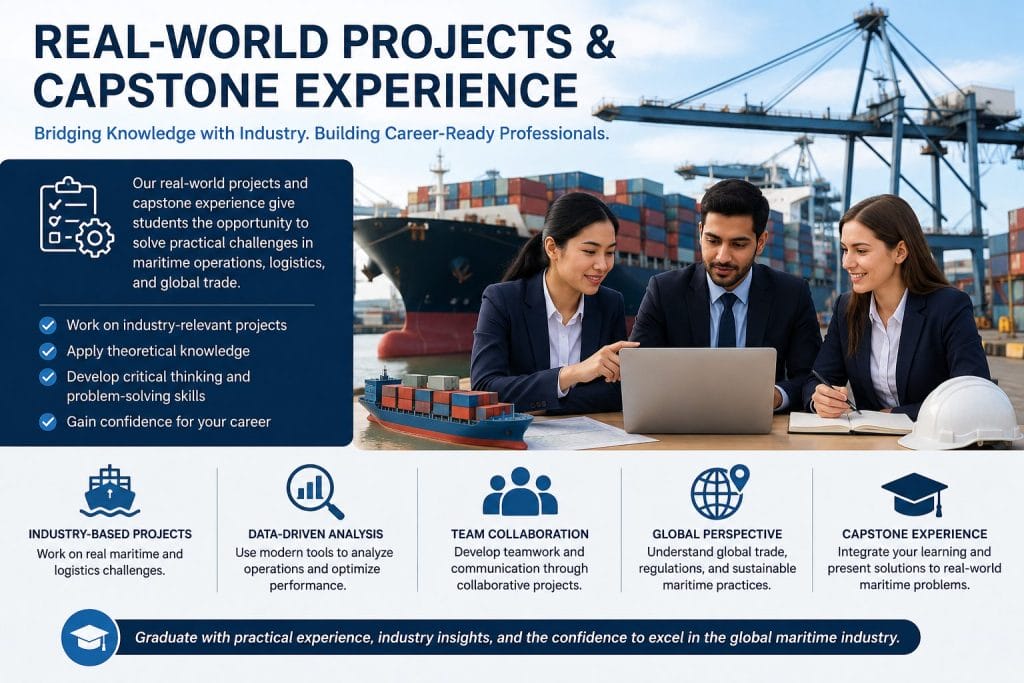
real world projects capstone experience
In this photo of students working together on projects within the Maritime Industry using tools related to Logistics, Shipping, and Operations, they are solving practical problems within a simulated working environment of a port. These activities require teamwork, utilize data and analytical thinking skills, develop the ability to think critically regarding global trade issues, and culminate in a capstone project that prepares them for a career in the Maritime Industry.
Associate in Maritime Management : Research Projects & Innovation

At AIU’s Associate in Maritime Management Program, students gain hands-on experience resolving current issues affecting the industry through project-based learning. Students also perform research in applied areas of the industry, such as; port operations, shipping logistics, safety, supply chain management, environmental management, and using emerging digital technologies within the maritime sector. 

The flexible course of study allows learners to review upcoming trends, examine operations data, and create innovative solutions to resolve contemporary issues facing both the global shipping industry and the logistics industry. By working on independent projects under the supervision of faculty members, students develop critical thinking, analytical, and problem-solving skills while gaining experience and academics that will help prepare them for future academic pursuits and/or careers in the global shipping/logistics industry, management of ports, and maritime operations.

Craft Your Success Story at AIU 

Make Your One Remarkable

Thesis & Research Defense Process

In the Associate in Maritime Management program, students have the opportunity to apply their learned knowledge of maritime principles through research and analysis as they defend their thesis and research. Under the direction of a faculty mentor, students choose a topic that interests them such as shipping operations, port administration or management, maritime logistics, global trade or supply chain optimization. 

The resulting recommendations will be based on evidence obtained during the investigative process. Students will present their findings before an academic evaluation panel by demonstrating the method used to conduct their research, analytical reasoning, communication skills, confidence in answering an array of questions related to their research findings, etc. Completion of the thesis and research component serves as a final milestone of academic progress and reinforces their professional capabilities, while validating their learning outcomes; therefore, all graduates’ academic knowledge is valued and will prepare them to begin their careers or continue further education at school within the domain of the maritime industry.

Student Experience & Virtual Campus

The Student Experience and Virtual Campus offer a flexible, engaging, and collaborative online learning community that supports students throughout their Associate of Maritime Management program. Students will be able to access course materials, recorded lectures, digital libraries, discussion boards, assignment information, and academic support services at any time and from anywhere via the online learning platform. Students will have a variety of interactive learning activities, virtual collaboration options, and faculty support available to them to facilitate knowledge sharing and provide opportunities for both personal and professional growth while working around different schedules. 

The virtual campus also allows for the creation of a global learning community. As a student in the online learning community, you can connect with other students, learn about real-world maritime issues, and develop the confidence, technical knowledge, and communication skills that you need to be successful in the international shipping and logistics industry.

Live Classes, Symposiums & Global Networking

Through real-time classes, symposiums, and networking opportunities with an international scope, the learning experience of an associate degree in maritime management is further enhanced through interaction with fellow students, professors, and experts in various fields from different parts of the world. 

Meaningful discussions can take place during live sessions, allowing for more in-depth conversations on topics such as maritime logistics or shipping operations, as well as discussions on current trends that are emerging within the maritime industry, such as international trade port management. In addition to providing the opportunity to learn from industry specialists through webinars and symposiums about new technology and sustainability programs, collaborative projects, virtual social events, and international networking opportunities enhance connections among students and allow students to interact with those within the maritime industry through the sharing of ideas to help facilitate career readiness in the global shipping and logistics sectors.

Academic Resources & AI-Powered Learning

The Associate’s Degree program in Maritime Management gives students access to a broad range of academic resources and Artificial Intelligence (AI)-enabled learning tools to enhance comprehension and improve educational outcomes. Digital libraries, scholarly journals, case studies, industry reports, multimedia materials, and interactive learning materials would support students’ ability to understand both foundational and advanced concepts in maritime management. AI Learning Technologies provide students with personalized study recommendations, intelligent tutoring, adaptive assessments, and real-time feedback to enable them to develop core competencies at their own pace. The overall experience of using these tools in conjunction with faculty support and collaborative online resources will create an engaging learning experience that prepares students for success in the now increasing digital and data-dependent maritime industry.

Want to Explore AIU’s School of Science and Engineering ?

Get Started

Admission Requirements

The Associate in Maritime Management program is structured to be an easily accessible option for individuals who want to enter the maritime industry, shipping, and logistics. The general expectation is that applicants have completed their secondary education or equivalent qualifications from an accredited institution. There can also be requirements for additional supporting documentation based on where you apply (academic transcripts, identification, personal statement, proof of language proficiency, etc.). Interest in international trade, shipping logistics, and businesses is an asset but is not always required. All motivated recent high school graduates, current employees, or adult learners are welcome to develop the fundamental knowledge necessary to begin developing skills that will create opportunities in the worldwide maritime industry.

How to Apply ?

The maritime management associate degree program is designed for new students and streamlined the application process which assists new students with their academic transition. New students need to fill out an online application and submit all necessary documents, including high school transcripts and identification cards, and the other documents indicated by the school. 

After your application is complete, you will receive an application confirmation from our admissions office and will be contacted regarding eligibility for the program and direction in registering for the program, if eligible. After receiving notification of your acceptance into the program, you will be able to register for courses, pay application fees, and gain access to the online learning system in order to view course materials, communicate with instructors and classmates, and acquire the knowledge and skills necessary for a career in the maritime sector.

Tuition, Financial Support & Scholarships

Tuition fees associated with the Associate’s degree program in Maritime Management differ by University, format of the program and whether the student is an in-state or out-of-state resident; however, several Institutions provide students with different methods of financing so that more individuals will have the opportunity to pursue post secondary education. To this end, there is always a portion of tuition associated with the Associate’s program in Maritime Management that is not completely covered by tuition assistance, therefore, students will likely also want to pursue other forms of financial aid, for example, scholarships, grants, employer tuition assistance and military and veteran assistance, etc. in order to meet their individual eligibility criteria (students will need to contact the officials working in the financial aid office of their Institution to obtain specific eligibility requirements). 

Students interested in pursuing an Associate’s degree in Maritime Management should carefully evaluate their entire financial aid picture and apply for financial aid/scholarship programs as soon as feasible. The use of flexible financial options allows students to invest into their future through education while ultimately easing them up for success within the world of maritime, shipping and logistics.

FAQs

What is an Associate in Maritime Management?

A marine management associate’s degree is an undergraduate qualification taught by the International College of Maritime and Oceanic Studies (IC-MOS) that will provide students with a broad understanding of shipping, port management, international trade, and supply chain logistics as they pertain to the marine industry. This course of study teaches students the fundamental skills necessary to begin their careers in the marine business sector or pursue further education in maritime or business-related fields.

What can you do with a maritime management degree?

A degree in maritime management can prepare you for a career with shipping companies, ports, logistics companies, freight forwarding companies, customs agencies, marine insurance companies, and international trade organisations. Careers for graduates include: shipping coordination officer, port operations officer, logistics consultant/specialist, supply chain assistant/associate, vessel operations officer, and executive for the customs documentation department. Students with this degree have executive opportunities based on their experience and continuing education.

Is maritime management a good career?

People who are interested in global trade/logistics/transportation will find that a career in marine management is very rewarding! The Marine Industry provides many opportunities through the areas of shipping, ports, logistics and international business. Also, many opportunities available within the marine industry will be provided due to the continued growth of global trade and the introduction of electronic technologies into marine operations (i.e. motorized vessels/use of tracking systems, etc.).

What jobs are available in maritime management?

A graduate with a maritime management degree can find employment in many different areas, including but not limited to those listed above (the first six provided), and with sufficient experience could eventually move to management-level positions including port manager or maritime logistics manager.

Let us know your goals and aspirations so we can chart a path at AIU to achieve them!
//
Admissions Counselor
Boniface Onimu
Available
//
Admissions Counselor
Sandra Garcia-Fierro
Available
//
Admissions Counselor
Juan Mejia
Available
//
Admissions Counselor
Prof. Emmanuel Gbagu
Available
//
Admissions Counselor
Rene Cordon
Available

"*" indicates required fields

This field is for validation purposes and should be left unchanged.
Name*

"*" indicates required fields

This field is for validation purposes and should be left unchanged.
Name*

"*" indicates required fields

This field is for validation purposes and should be left unchanged.
Name*

"*" indicates required fields

This field is for validation purposes and should be left unchanged.
Name*

"*" indicates required fields

This field is for validation purposes and should be left unchanged.
Name*

"*" indicates required fields

This field is for validation purposes and should be left unchanged.
Name*

"*" indicates required fields

This field is for validation purposes and should be left unchanged.
Name*

"*" indicates required fields

This field is for validation purposes and should be left unchanged.
Name*

"*" indicates required fields

This field is for validation purposes and should be left unchanged.
Name*

"*" indicates required fields

This field is for validation purposes and should be left unchanged.
Name*

"*" indicates required fields

This field is for validation purposes and should be left unchanged.
Name*

"*" indicates required fields

This field is for validation purposes and should be left unchanged.
Name*

"*" indicates required fields

This field is for validation purposes and should be left unchanged.
Name*

"*" indicates required fields

This field is for validation purposes and should be left unchanged.
Name*

"*" indicates required fields

This field is for validation purposes and should be left unchanged.
Name*

"*" indicates required fields

This field is for validation purposes and should be left unchanged.
Name*

"*" indicates required fields

This field is for validation purposes and should be left unchanged.
Name*

"*" indicates required fields

This field is for validation purposes and should be left unchanged.
Name*

"*" indicates required fields

This field is for validation purposes and should be left unchanged.
Name*

"*" indicates required fields

This field is for validation purposes and should be left unchanged.
Name*

"*" indicates required fields

This field is for validation purposes and should be left unchanged.

Submit your data.

After submitting, a widget will appear at the bottom-left corner so you can start your training.

Name*

Do you hate spam? Don’t worry, we hate them too. Your email is 100% secure with us.

"*" indicates required fields

This field is for validation purposes and should be left unchanged.

Submit the form below to begin your interview.

After submitting, a widget will appear at the bottom-left corner so you to start your AI interview.

Name*
Accepted file types: docx, pdf, Max. file size: 500 MB.

Do you hate spam? Don’t worry, we hate them too. Your email is 100% secure with us.