Doctorate in Sociocultural Anthropology

School of Social and Human Studies

Academic Freedom to Discover Your Purpose

Open Curriculum Design at Atlantic International University

The doctorate in sociocultural anthropology is a type of research degree that focuses on the relationship of culture, society, identity and people’s behaviour within different types of cultural communities throughout history. As a PhD in sociocultural anthropology doctoral student, you will be able to conduct in-depth ethnographic research, use critical thinking skills to analyse and investigate ethnographic material with a variety of disciplinary lenses in order to investigate how social structures, traditions, beliefs, economic systems, political institutions, etc., help to determine the lived experience of individuals within their respective cultural communities. 

This field of Doctor of Sociocultural Anthropology study provides an opportunity to address many of the global challenges of today; such as migration, inequity, globalization, preservation of culture, technology, social justice, and a variety of other relevant/important issues. Non-ethnic PhD graduates will have the opportunity to utilize their sociocultural anthropology doctorate experience with a qualitative doctoral degree in sociocultural anthropology research methods and cultural analysis to produce new information for use in policy development, education, community development, and cross-cultural relationships.

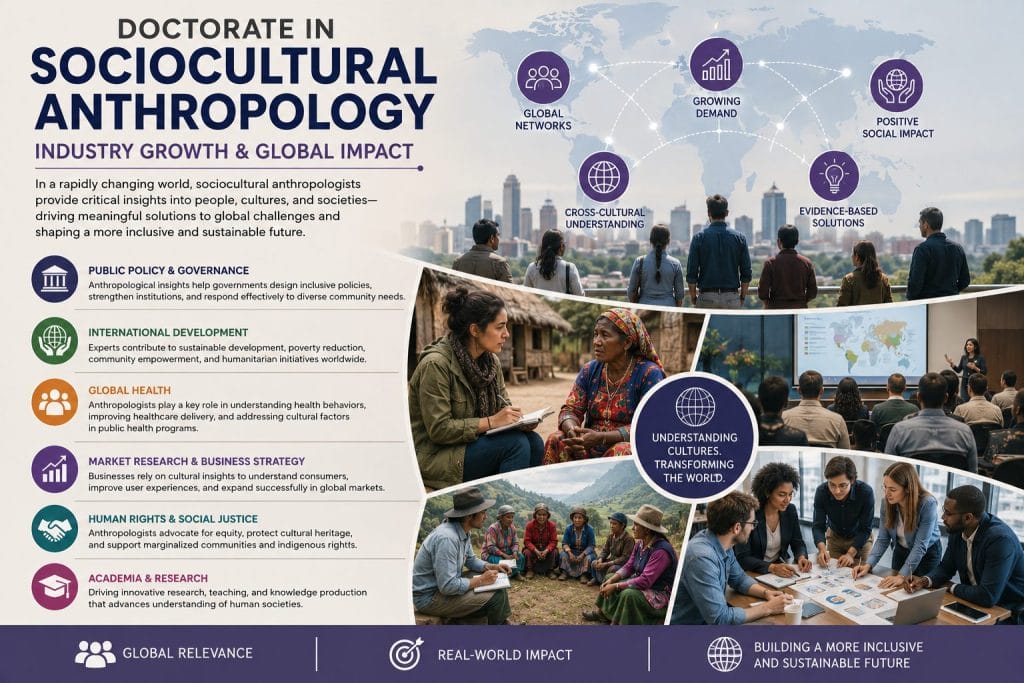
Doctorate in Sociocultural Anthropology : Industry Growth & Global Impact

Sociocultural Anthropology is becoming highly important in today’s world because globalization, migration and digital evolution have consistently transformed countries and cultures across the globe. Many types of institutions and organizations, including national governments, international organizations, research institutions, non-government organizations (NGOs), health care systems and multinational corporations are looking for analysts with expertise in examining human behaviour and cultural dynamics, the impact of social transformation on communities, and what communities need to improve their lives. 

Anthropological knowledge is central to developing public policies, sustainable development efforts, respecting and protecting human rights, improving the effectiveness of market research, developing user experience designs that better respond to the diverse needs of people, and improving global health initiatives. 

The need for professionals who are skilled at traversing various cultures while understanding the intricacies of social systems and can play a role in all of these types of global efforts has increased significantly as the world continues to expand into diverse cultural operating environments. In the face of many of the most critical issues facing the world today, such as income disparity, forced migration, environmental changes, social inclusion, and collaborative cross-cultural partnerships, Doctoral (PhD) graduates who have earned their degree in Sociocultural Anthropology will continue to play a vital role in confronting these global issues; thus, the discipline of Sociocultural Anthropology has the potential for worldwide influence and facilitating sound decision-making by society.
Doctorate in Sociocultural Anthropology
The picture shows how important and influential Sociocultural Anthropology is becoming and how it’s being used for research and community engagement to help with making policies, global development, health care, and building bridges between cultures. The image also depicts the work that anthropologists do with each other to help explain the complex nature of all societies and work together to address some of the very difficult challenges faced by many different cultures.
Doctorate in Sociocultural Anthropology: Trends, Insights & Predictive Analytics

As globalization, digital technology, migration, and changing cultural contexts continue to connect societies all over the world, the field of Sociocultural Anthropology has moved away from the more traditional ethnographic methods into a world of data-informed analysis and predictive social intelligence. Today’s anthropologists are employing qualitative field anthropology doctoral program research methods, combined with digital tools, geospatial mapping, social network analysis, and large behavioral data sets, to identify emergent social trends and shifts in culture. 

The areas of online doctorate in sociocultural anthropology research being published today include the social relevance of digital communities, the relationship between artificial intelligence and society, the effects of climate migration on populations at risk, public health behaviors, indigenous knowledge systems, and social inequality; these areas are expected to provide information and insight to government agencies, organizations and policy makers so they can anticipate future risks or opportunities. Patterns of human behavior, cultural adaptation, and social transitions are evident in the work produced by doctoral researchers in the field and serve to provide valuable evidence to assist organizations in making strategic decisions, implementing sustainable development initiatives, and developing culturally sensitive policies. 

The convergence of sociocultural anthropology degree with analytics and interdisciplinary research is bringing greater relevance to Sociocultural Anthropology as a critical discipline for understanding and responding to the challenges and opportunities presented by an increasingly diverse and rapidly changing world.
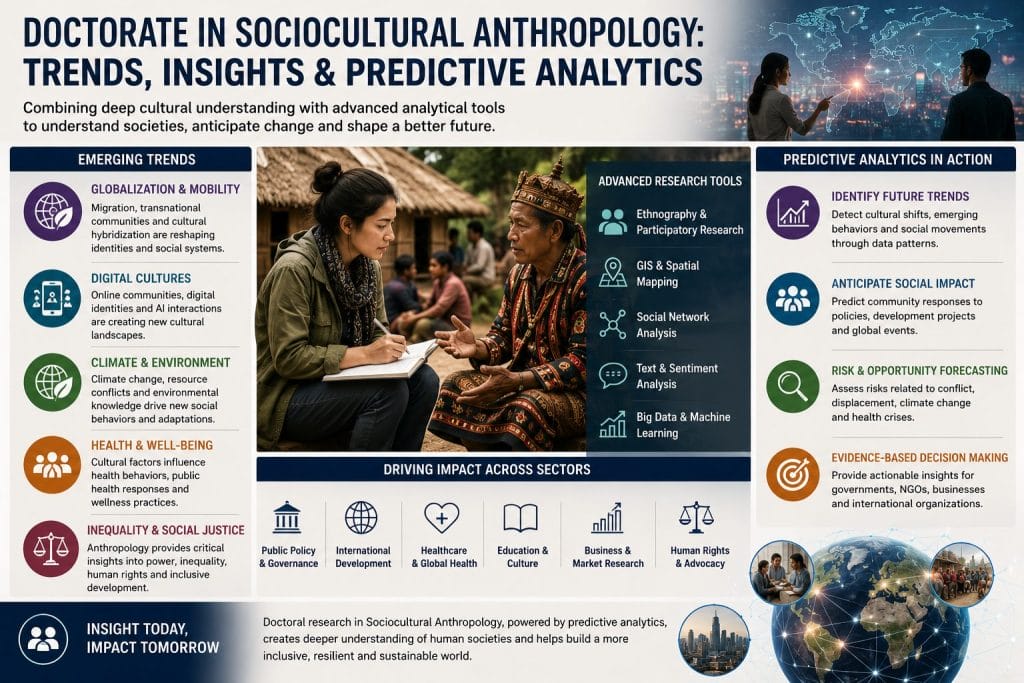
Doctorate in Sociocultural Anthropology Banner
This illustration shows how Sociocultural Anthropology blends together culture research and predictive analytics in order to track new social trends and global issues. Analysis of these new trends could cover topics such as digital cultures, migration, climate change adaptation, public health and social justice. In addition, advanced research tools are built into this image to assist in making evidence-based decisions, developing policies and promoting sustainable social development.
The AI Experience: Future-Focused Areas in Sociocultural Anthropology

Opportunities for sociocultural anthropologists to use AI to study how technology changes human behaviour, cultural characteristics, communication practices, and patterns of organisation are being enhanced through advances in artificial intelligence. PhD candidates in this area are now looking at topics like AI ethics and bias, digital identity and digital communities, human/AI interaction, and the governance of data (and the implications of automation on society as a whole). 

Additionally, more sophisticated cultural studies doctorate tools will enable anthropologists to use artificial intelligence to perform qualitative data analysis, identify patterns, analyse language, and study large-scale cultural patterns. To properly assess the cultural and social ramifications of artificial intelligence as it integrates into daily life, there is a need for experts who can work with local government, industry, and communities. A PhD in sociocultural anthropology trains sociocultural anthropology careers researchers to critically analyse emerging issues that will arise from the use of AI, and ultimately will lead to more ethical and human-centred methods for innovating technology in an increasingly digital society.

Contact Us Today!

Begin Your Journey!
AIU’s Summer of Innovation and Growth gives you the ability to earn up to $5000 in tuition credit by completing free lessons and courses.
Whether you’re looking to acquire new skills, advance your career, or simply explore new interests, AIU is your gateway to a world of opportunities. With free access to 3400 lessons and hundreds of courses the ability to earn credits and earn certificates there’s no better time to start learning.
Join us today as a Guest Student and take the first step towards a brighter, more empowered future.
Explore. Learn. Achieve.

Academic Freedom & Customized Curriculum

Students pursuing a Doctorate in Sociocultural Anthropology enjoy a great deal of academic independence by creating their own research and learning paths, allowing them to research topics that are of particular interest to them. Some of the research topics that students can pursue as part of their doctoral work include globalization, migration, identity, digital cultures, indigenous peoples, social inequality, environmental anthropology, public health, or human rights. Therefore, doctorate in sociocultural anthropology students will also build on their discipline-specific knowledge and will become experts in all areas of Sociocultural Anthropology.

As part of this flexible learning approach, students have the opportunity to cooperate with other disciplines (e.g., sociology, history, political science, economics, cultural studies, and new technologies) to develop their personalized programs of study. The ability to create a customized anthropology research degree program lends itself to independent research, innovative scholarship, and creating specialized knowledge to find solutions for current social and cultural issues at the local, regional, national, and international levels.

Why Study Doctorate in Sociocultural Anthropology at AIU?

Benefits of Doctorate in Sociocultural Anthropology 

A Doctorate of Sociocultural Anthropology (PhD) offers specialized, advanced knowledge of human cultures and societies, social systems, and the global forces at play in shaping communities around the world. This program develops many highly regarded skills including research, critical thinking, qualitative research analysis, and cross-cultural communication; all of which are important to academia, government sector, international development, public policy, health care, and the private sector. 

Graduates will learn to independently conduct research and create a meaningful impact on the social initiatives they work on; support evidence-based functional decision-making processes; and solve difficult problems related to inequality, migration, sustainability and cultural shifts. The doctoral degree also allows students to have a greater understanding of humankind’s diverse experiences and prepares them to provide meaningful insight into ways to create inclusive communities, develop cross cultural understanding, and make a positive impact in the rapidly globalizing world.

Traditional vs Flexible Education : Doctorate in Sociocultural Anthropology 

The normal PhD programs in Sociocultural Anthropology tend to be structured and have a fixed timetable for seminars and research opportunities; whereas the flexible doctoral degree allows for more freedom to integrate academia, career and personal life by allowing the student to conduct their research in a wider range of cultural environments than would normally be permitted. Flexible environments often provide opportunities for students to develop their own course of study, find digital resources, collaborate with others virtually, and incorporate actual fieldwork into their experience as a PhD student. This type of education allows for scholars to continue to develop their career while pursuing their research goals in the manner they choose without regard to the impact on their ability to progress in either field or to relocate.

Key Strengths of the Doctorate in Sociocultural Anthropology  at AIU

At AIU, our doctorate in sociocultural anthropology is a program created for independent scholars to develop an innovative, flexible way to earn their degree. This program focuses on self-directed learning, providing anthropological research program students with the opportunity to create their own academic paths based on specific areas of interest, like: Cultural Change, Migration, Identity, Globalization, Digital Societies, Human Rights, Indigenous Studies and Social Development.

AIU’s unique educational framework provides students with support in achieving critical thought, original research as well as multidisciplinary approaches, and access to extensive resources for all aspects of their academic journey; including guidance from faculty and international perspectives. Students can take advantage of the flexibility of the program to incorporate past professional experience into their current work, to conduct culturally relevant ethnographic research program fieldwork, and develop new solutions to current social concerns. Graduate students of cultural anthropology PhD online will benefit from this student-centered ethnographic research degree approach and develop advanced knowledge in their discipline; therefore, they will be able to contribute positively to the level of scholarship within their chosen area of social science research careers study, preparing themselves for leadership roles in academic, research, policy, and community development contexts.

Become a Part of AIU Today !

Click Here 

Core Courses & Technical Skills

Important: Below is an example of the topics or areas you may develop and work on during your studies. By no means is it a complete or required list, as AIU programs do not follow a standardized curriculum. It is meant solely as a reference point and example. Want to learn more about the curriculum design at AIU? Check here: Course and Curriculum 

A doctorate in sociocultural anthropology and theories will provide you with all the necessary skills to pursue your goals by providing both an analytical perspective on a wide range of issues involving anthropology and an opportunity to develop corresponding globalization and culture studies research methodologies. You’ll explore the relationship between identity, power, globalization and technology through interdisciplinary frameworks. The social and cultural anthropology coursework of cross-cultural studies degree will focus on developing analytical skills as well as providing new ideas and methodologies for conducting research; in conjunction with developing your own specialized human culture studies’ doctoral project area of study.

  • Advanced Sociocultural Anthropology Theory
  • Ethnographic Research Methods
  • Qualitative Data Collection and Analysis
  • Cultural Theory and Interpretation
  • Anthropology of Identity and Social Difference
  • Indigenous Peoples and Cultural Heritage
  • Religion, Ritual, and Symbolic Systems
  • Gender, Race, and Social Inequality

Tools You Will Master

Students receive practical exposure to using current industry applicable electronic technologies to perform research, analyze data, collaborate and perform academic writing, as well as manage projects. These platforms allow for streamlined work processes; greater productivity; support for making decisions based on evidence; and preparation of graduates for success in professional and research careers in institutions of higher education, governments, non-profit organizations, and commerce.

  • IBM SPSS Statistics – The individual will be responsible for performing complex statistical analyses, creating predictive models, and conducting quantitative research.
  • NVivo – They will also conduct analyses of qualitative sources (e.g., interviews, focus groups, and document reviews) as well as assist with the development of codes for qualitative data, theme development, and integration of qualitative and quantitative research methods.
  • ATLAS.ti – They will provide the software necessary to conduct statistical computing and visualizations, and will be involved in developing frequently reproducible analyses of data.
  • R Project –  In addition, they will automate the workflows for data production, machine learning, and research processes.
  • Python – The individual will develop interactive dashboards and ensure the highest quality visual representations of data.
  • Tableau – They will help create executive summaries of complex datasets and manage bibliography citations from literature references by providing tools to automatically generate citations..
  • Microsoft Power BI – Finally, they will assist with organizing bibliographic references while supporting literature review activities (e.g., brainstorming, improving writing quality, conducting research using artificial intelligence technology).

Career-Focused Learning in Sociocultural Anthropology

In Sociocultural Anthropology, students gain the necessary knowledge and tools to implement anthropological theory, conduct ethnographic research, complete cultural analysis, and find solutions to real-life issues in different areas of their profession. Ongoing development of these skills is achieved through coursework that is interdisciplinary in nature, and through field-based learning and practice-based research. 

Students will have the ability to perform qualitative cultural anthropology research, communicate cross-culturally, conduct policy analysis, engage with social anthropology communities, and assess social impact. Graduates of this program are prepared for careers in academia; international development; public policy; health care; cultural resource management; non-profit organizations; museums; market research; corporate diversity and inclusion; humanitarian organizations; and government agencies – where there is an increasing demand for evidence-based decision-making and cultural competence.

Real-World Projects & Capstone Experience

Through the Real-World Projects & Capstone Experience, students are given the opportunity to independently conduct research projects that explore contemporary issues of social and cultural importance. Students will work under the guidance of faculty to carry out ethnographic fieldwork or Cultural Impact Assessments; obtain data through Community Based Participatory Research (CBPR), Policy Evaluation, and/or Comparative/Cross-Cultural Studies. 

This capstone integration of anthropological theory into practical application reinforces the student’s skills in, but not limited to; Research Design, Qualitative Research / Data Collecting, Critical Analysis, Ethical Investigations, and Academic Communication. Once completed this capstone will produce a significant body of work or thesis leading to the student having created meaningful insights through evidence-based solutions of contemporary social/cultural issues.
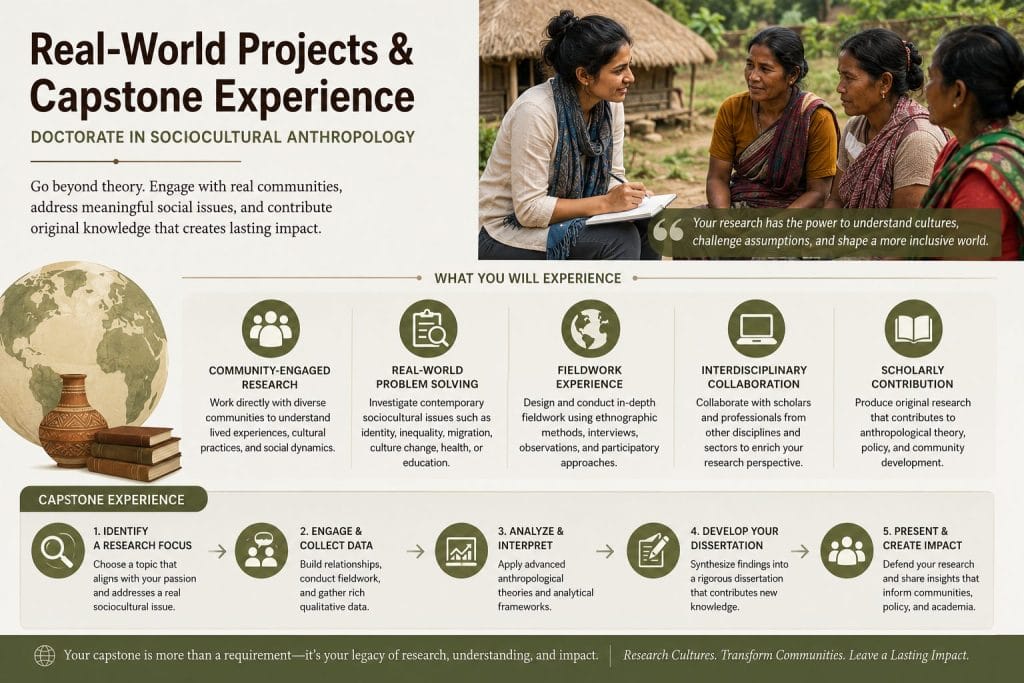
Real-World Projects & Capstone Experience
The image represents a collaborative effort between doctoral researchers and community members during fieldwork with an emphasis on ethnographic research, cultural involvement, interdisciplinary collaboration, and developing solutions to real-world issues. It demonstrates what doctoral researchers experience throughout the capstone project from the beginning – identifying a topic to research, collecting data, analysing what you found, completing a dissertation and having social impact.
Doctorate in Sociocultural Anthropology : Research Projects & Innovation

Research plays a pivotal role in obtaining a PhD degree in socio-cultural anthropology since it allows anthropologists to study a wide range of human behaviours and activities within the context of the broader body of anthropological literature through original research. Thus, scholars design and perform their own independent investigations on the basis of the type of question asked, using methodologies worldwide, such as qualitative cultural diversity research, ethnographic research, participatory, or mixed methods, to analyse a topic related to identity, migration, globalization, indigenous peoples, digital images and cultures, health disparities, environmental justice, gender and human rights.

Doctoral candidates work with their academic advisors as well as organisations/people within the communities where they are conducting their studies (eg: local community organisations, research institutions, non-profit organisations, etc…) as well as research collaborators elsewhere (eg: universities or international organisations). Doctoral candidates of ethnographic research will develop new forms of knowledge generated through their respective research projects, presentations at academic conferences and publication in peer-reviewed journals will benefit both their respective institutions and their respective communities.

Begin Your AIU Journey Today

Register Now

Thesis & Research Defense Process

The Doctorate in Sociocultural Anthropology is culminated through the completion of a thesis and social research research defense. These two tasks represent a scholar’s capacity to do rigorous, original, and ethically based research through advanced study and application of research methods.

Scholars begin this process by formulating a significant research question, conducting an appropriate review of relevant literature, obtaining all required ethical approvals (when required), and conducting field research according to established anthropological research methodologies. Following the analysis and interpretation of their data, all qualitative research candidates develop a formally defended dissertation which contributes to the production of new knowledge in the field of sociocultural anthropology. 

The final stage is the formal defense of candidate research before an academic committee. During the formal defense, the scholar provides an overview of their cultural studies research design, findings, theoretical implications, and practical applications while responding to all inquiries posed by the committee.

Student Experience & Virtual Campus

The Doctorate in Sociocultural Anthropology provides an engaging, flexible and international way to learn using a lively virtual campus. The Doctorate in Sociocultural Anthropology gives you access to digital libraries, tracked research libraries and databases, online video lectures, and discussion forums—all of which can aid you at any point during your work towards your Doctorate in Sociocultural Anthropology. You will have frequent opportunities for communication with your faculty mentors, research supervisors, and peers, so you will be able to engage in intense academic discussion on a regular basis. In addition, the many forms of virtual seminars, virtual workshops, and the exchange of cultural and geographical diversity through interdisciplinary events is somewhat unique to students in this program. 

The interactive nature of a fully virtual educational system (completely online) allows people who work, and people who study at the same time (e.g., adult students) to meet their research obligations, personal commitments, and still have a connection to the larger international academic community through developing and maintaining professional relationships within an academic environment.

Live Classes, Symposiums & Global Networking

Through Interactive Academic Discussions, Live Virtual Classes and Symposiums run by experts, students will have an engaging and collaborative learning experience. With each of these sessions, students will have the ability to connect with professors, researchers, professionals and peers globally.

All of these connections will provide students with a chance to share ideas and receive a variety of differing viewpoints. Global networking opportunities will allow students to create important professional contacts within their industry, examine opportunities for cross-cultural collaboration, as well as to stay current on emerging trends and developments and opportunities in their area of study.

Academic Resources & AI-Powered Learning

A vast array of online resources that students can use to access a digital learning environment. In addition, students are provided individual learning tools, such as use of AI to provide personalized learning, research assistance, adaptive pathways, and writing support to enhance their educational experience. All the resources combined create an efficient way for students to learn, improve critical thinking skills, conduct research quickly, and keep up to date with what is happening in their field.

Explore AIU Mundi Magazine to Stay Updated on Latest Updates & News

Start Reading

Admission Requirements

The Doctorate in Sociocultural Anthropology requires you to provide a fully completed application along with an official set of academic transcripts from each institution attended; also you must submit your diploma, a current resume or CV, and a government-issued photo ID. Depending on the type of program applied to there could also be other documents required such as a statement of purpose, letters of recommendation, or documentation of relevant experience. If you are an international student and English is not your first language, and if it is required by the program then you will be asked to demonstrate English proficiency. All applicants will be reviewed to ensure that they possess both the educational background necessary for the specific program along with enough motivation to succeed.

How to Apply ?

The application process is easy to navigate and is designed for your convenience as well as from an access standpoint. You start by identifying which program best matches your academic and career goals, then complete an online application that requests general information about you (such as name, address) and additional information (such as educational history).

Finally, after you’ve completed this application you will submit any required indigenous cultures and global cultures supporting documents. Some examples of these types of supporting documents include (but are not limited to) academic transcripts, degree certificates, proof of identification and/or résumé/CV (if applicable).

Once all of the supporting materials have been submitted and you have been reviewed for eligibility, you’ll receive an admission decision and directions for enrollment. Upon accepting your admission and completing any necessary enrollment procedures, you’ll be able to log into the virtual learning and community development environment, participate in the orientation process and begin your studies.

Tuition, Financial Support & Scholarships

The fee structure for a college or university program will differ based on the type of program you’re trying to complete (certificate, diploma, degree) and the length & method of study (online, hybrid, in-person, part-time). Therefore, it’s important that you investigate what the current fee structure is prior to submitting your application. Schools typically offer flexible payment plans that allow the total tuition amount to be paid over several months or as affordable installments. 

Additionally, if you’re an eligible student you might also qualify for a scholarship or grant, be able to receive money from your employer toward your tuition bill, receive military/veteran education benefits, etc., and/or take advantage of numerous other funding options that are designed to make college affordable. Investigating the available funding options early in the application process can help to reduce your financial barriers and help you to successfully reach your educational and career goals.

FAQs

What is a Doctorate in Sociocultural Anthropology?

The PhD in Sociocultural Anthropology represents the highest level of education available to students studying human culture and society, including aspects such as identity and social change. The PhD program emphasizes research, analytical and ethnographic skills; it teaches students how to develop their own original research projects, teach in universities, shape and inform public policy, or pursue various positions with international development, cultural heritage and/or social research organizations.

What can I do with a doctorate in sociocultural anthropology?

Doctors of Sociocultural Anthropology will typically become professors in an academic environment, or they can pursue a variety of other occupations such as researchers, policy analysts, cultural consultants, museum curators, NGO or international development specialists, government advisors, market researchers or UX (User Experience) researchers, and experts in heritage or community development. Sociocultural anthropologists apply advanced research as well as their cultural knowledge to solve some of the most complex challenges facing society, organisations, and the world today.

Is a PhD in sociocultural anthropology worth it?

A PhD in Anthropology: Sociocultural anthropology is well worth the investment for anyone who has an enthusiasm for research, training, analyzing cultures, and having a positive impact on the world socially; defines the subject’s expertise in conducting sociological and cultural research; examines current issues regarding society; provides access to higher-level employment; and prepares graduates to tackle some of the world’s greatest challenges by using their knowledge to address complex cultural issues affecting our global communities.

How long does it take to earn a doctorate in sociocultural anthropology?

Minimum 3 years.

Can I study sociocultural anthropology online?

Yes, AIU offers sociocultural anthropology online.

Let us know your goals and aspirations so we can chart a path at AIU to achieve them!
//
Admissions Counselor
Prof. Emmanuel Gbagu
Available
//
Admissions Counselor
Boniface Onimu
Available
//
Admissions Counselor
Rene Cordon
Available
//
Admissions Counselor
Juan Mejia
Available
//
Admissions Counselor
Sandra Garcia-Fierro
Available

"*" indicates required fields

This field is for validation purposes and should be left unchanged.
Name*

"*" indicates required fields

This field is for validation purposes and should be left unchanged.
Name*

"*" indicates required fields

This field is for validation purposes and should be left unchanged.
Name*

"*" indicates required fields

This field is for validation purposes and should be left unchanged.
Name*

"*" indicates required fields

This field is for validation purposes and should be left unchanged.
Name*

"*" indicates required fields

This field is for validation purposes and should be left unchanged.
Name*

"*" indicates required fields

This field is for validation purposes and should be left unchanged.
Name*

"*" indicates required fields

This field is for validation purposes and should be left unchanged.
Name*

"*" indicates required fields

This field is for validation purposes and should be left unchanged.
Name*

"*" indicates required fields

This field is for validation purposes and should be left unchanged.
Name*

"*" indicates required fields

This field is for validation purposes and should be left unchanged.
Name*

"*" indicates required fields

This field is for validation purposes and should be left unchanged.
Name*

"*" indicates required fields

This field is for validation purposes and should be left unchanged.
Name*

"*" indicates required fields

This field is for validation purposes and should be left unchanged.
Name*

"*" indicates required fields

This field is for validation purposes and should be left unchanged.
Name*

"*" indicates required fields

This field is for validation purposes and should be left unchanged.
Name*

"*" indicates required fields

This field is for validation purposes and should be left unchanged.
Name*

"*" indicates required fields

This field is for validation purposes and should be left unchanged.
Name*

"*" indicates required fields

This field is for validation purposes and should be left unchanged.
Name*

"*" indicates required fields

This field is for validation purposes and should be left unchanged.
Name*

"*" indicates required fields

This field is for validation purposes and should be left unchanged.

Submit your data.

After submitting, a widget will appear at the bottom-left corner so you can start your training.

Name*

Do you hate spam? Don’t worry, we hate them too. Your email is 100% secure with us.

"*" indicates required fields

This field is for validation purposes and should be left unchanged.

Submit the form below to begin your interview.

After submitting, a widget will appear at the bottom-left corner so you to start your AI interview.

Name*
Accepted file types: docx, pdf, Max. file size: 500 MB.

Do you hate spam? Don’t worry, we hate them too. Your email is 100% secure with us.