Bachelor in Radio And Television Production

School of Social & Human Studies

Academic Freedom to Discover Your Purpose

Open Curriculum Design at Atlantic International University

A bachelor in radio and television production allows students to gain Creative, Technical, and Managerial Skills, for Broadcasting and for all forms of Digital and Streaming Media, as well as for all forms of the Multimedia Networks, including Scriptwriting, Audio Production & Editing, Videography (Camera Techniques), Directing, Broadcasting, Journalism, Ethics, and Distribution. Students will learn how to create interesting, entertaining Radio Shows, Television Shows, Motion Picture Documentaries, News Stories, and Digital Media and will receive hands-on experience using State-of-the-Art Equipment and Production Techniques. Upon completion of this radio and television production degree program, Graduates will be prepared to work in Broadcasting, Media Production, Content Creation, Journalism, Advertising, Entertainment, or any other form of Multimedia Communication.

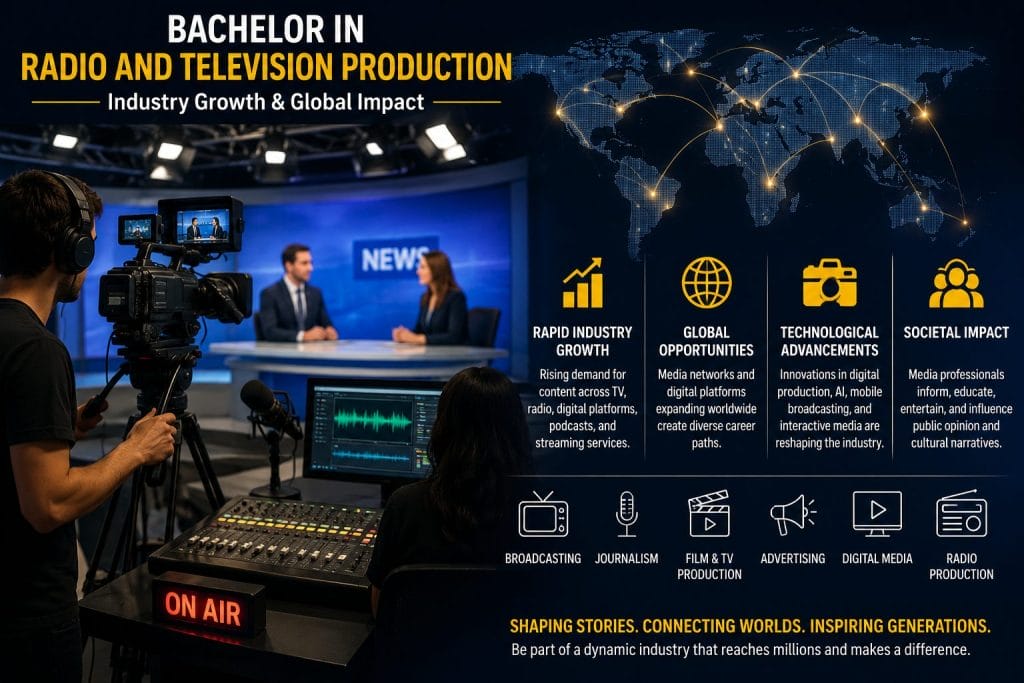
Bachelor in Radio and Television Production : Industry Growth & Global Impact

The radio, television and digital broadcasting industries are rapidly changing as consumers now have access to these types of content through traditional means as well as via streaming services, podcasts, social media and on-demand television. This growth of global demand for high quality audio-visual content has led to an increase in opportunities for everyone involved in producing, directing, editing, broadcasting and creating multimedia. 

Technological advancements in digital production methods, mobile broadcasting capabilities, Artificial Intelligence (AI) and interactive media are leading to change in how these types of content are made, shared and sold internationally. Radio and television professionals of bachelor in radio and television production  have an important function of providing information, education and entertainment to their audience while also impacting how society views itself and what society thinks about its citizens. Qualified graduates of the bachelor of radio and television production program will continue to be in demand throughout the television, radio, film, advertising, journalism, entertainment and other creative industries as media organizations look to expand their product offerings and reach larger broadcast production degree global audiences.
Bachelor in Radio And Television Production
This infographic illustrates the growth and worldwide reach of the Broadcasting and Production Industry. It features a contemporary broadcasting studio with professional cameras, audio-production capabilities and live coverage of news events, ensuring that the reader understands the trend towards growth in the industries of Broadcasting, Journalism, Digital Media, Advertising and Film Production.
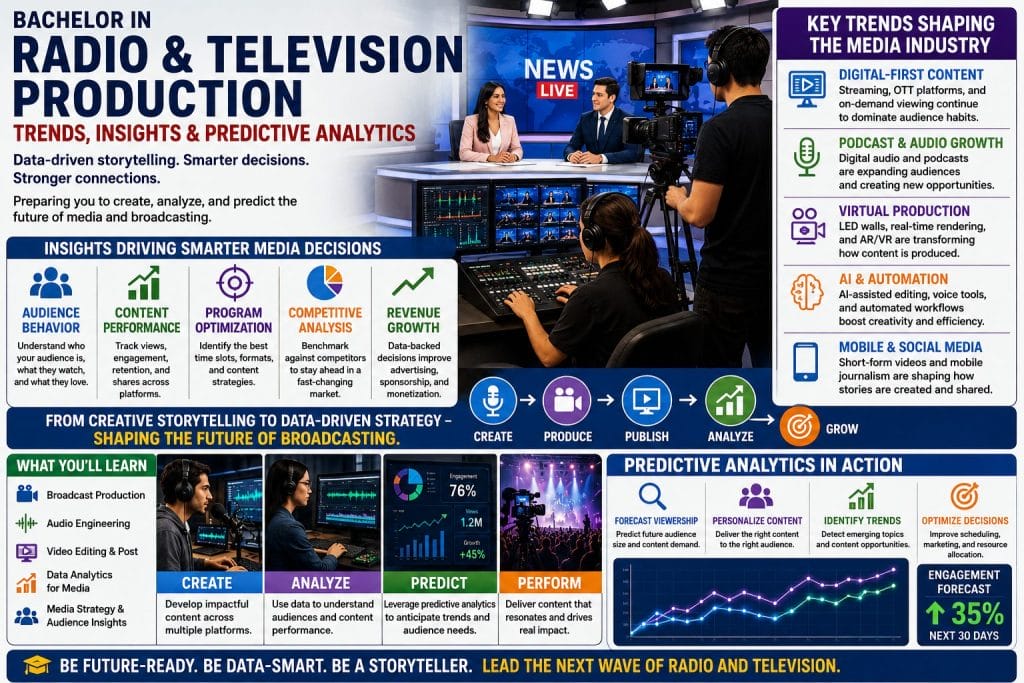
Bachelor in Radio and Television Production : Trends, Insights & Predictive Analytics

Digital streaming, artificial intelligence, audience analysis, and on-demand consumption are changing the media and broadcasting sectors. Professionals in television and radio increasingly use data to collect insights about their audience’s behaviour, and to help improve programming, tailor content to the audience, and target their audience better than before. Podcast growth, virtual production, AI-enhanced editing, mobile journalism, and multi-platform distribution are all examples of new ways to create and share content. Predictive analysis allows media companies to project what audiences will want to see, how well their content is performing, what new trends may be developing, and to make decisions in the production process based on that data. Understanding these innovations will help graduates remain competitive and create effective content in a rapidly changing global media marketplace.
Radio & Television Production
The infographic displays current trends in the radio and television production industry. The information included on this infographic will show how you can effectively leverage audience analytics and predictive decision making methods as a media professional, by analyzing what is going on today through emerging technologies and the use of AI to create and distribute content.

Career Opportunities & Professional Development 

Completing a bachelor in radio and television production degree completion program in Radio and Television creates many different types of career opportunities within the fields of broadcasting, journalism, film and television, digital media, podcasting, advertising, public relations and content creation. Graduates of television broadcasting program will be able to find work as a variety of different types of professionals such as television producers, radio broadcasters, news reporters, video editors, camera operators, audio engineers, scriptwriters, media consultants, and multimedia specialists.

The television production degree program helps develop radio broadcasting course students’ skills in critical storytelling, communication, production management, audience engagement and new/emerging media technologies that will be helpful in their future digital media production degree career. As global digital platforms continue to grow, professionals will be increasingly sought after for their skills in production and broadcasting within both traditional and new media.

The AI Experience: Future-Focused Areas in Radio and Television Production

Artificial Intelligence (AI) is changing the way the media and broadcasting industry operates and they give new opportunities for content creators, producers, and broadcasters. In bachelor in radio and television production courses, radio and television production careers audio and video production students will learn how AI-related technologies have changed how scripts are developed and used, analyzed by the audio and video production audience, edited automatically, and provided with recommendations, used to recognize speech, create virtual productions, and identify effective methods for digital storytelling. Students will also be aware of current trends such as AI-based video production, synthetic media, personalized broadcasting, real-time translation, and intelligent content distribution. Together bachelor in radio and television production traditional production skills and new technologies will allow graduates to develop new, innovative, data-driven, and engaging content that can reach a worldwide audience using the ever-changing digital and AI-enhanced mass communication degree media environment.

Contact Us Today!

Begin Your Journey!
AIU’s Summer of Innovation and Growth gives you the ability to earn up to $5000 in tuition credit by completing free lessons and courses.
Whether you’re looking to acquire new skills, advance your career, or simply explore new interests, AIU is your gateway to a world of opportunities. With free access to 3400 lessons and hundreds of courses the ability to earn credits and earn certificates there’s no better time to start learning.
Join us today as a Guest Student and take the first step towards a brighter, more empowered future.
Explore. Learn. Achieve.

Academic Freedom & Customized Curriculum

By allowing students to tailor their education through individualized academic freedom, radio and television production programs at the bachelor’s level can help students to achieve their unique creative passions as well as their career objectives and desired areas of specialization. Areas of study may include topics such as broadcast journalism, documentary filmmaking/television production/radio program production, digital media & content creation, audio engineering, and multimedia storytelling. By offering students a customized curriculum that combines experiential learning with emerging broadcast media technology, trends, and industry-related projects, radio and television production programs enable students to develop expertise in the media fields that will contribute to the realisation of each student’s professional goals. 

Offering students a flexible means to achieve their production degree academic objectives fosters creativity, innovation, critical thought, and practical production skill development, and ultimately benefits all graduates who will continue to exist and thrive in an ever-changing global media environment.

Why Study Radio and Television Production at AIU?

Benefits of Radio and Television Production

At AIU, you can earn your bachelor in radio and television production with a faculty that focuses on developing your creative and technological skills through an individualized, flexible, student-centered curriculum that meets the needs of each unique student. You’ll have the opportunity to focus your studies on your areas of interest such as broadcasting, journalism, television/video production, digital media, audio engineering, or content creation. 

The curriculum emphasizes the application of theory to the real world through independent study and the latest equipment and techniques in media production including AI-powered production tools and digital broadcasting systems. In addition, the faculty provide each media studies program student with opportunities for personalized accredited broadcast production degree program educational pathways, global networking, and hands-on experience by creating extensive portfolios of students’ work as part of their preparation for a successful online radio and television production degree career in an ever-changing media and entertainment industry.

Traditional vs Flexible Education : Bachelor in Radio and Television Production

Career preparation in the broadcasting and media production industry is changing. Traditional methods offer set schedules, standardized programs and classroom based training causing limitations where “creative” or “working” adults are attempting to develop their careers in media. However, AIU provides students the ability to create their own pathway based upon their interests (television production, radio broadcasting, digital content development, journalism, podcasting, film production, multimedia storytelling). As a result of the flexibility of AIU’s learning format (self-paced, independent broadcast production research, real-world project development), students can develop industry relevant skills while juggling personal and work responsibilities. This approach also promotes creativity, innovation, and adaptability—key components in achieving success within a highly competitive and rapidly changing market place.

Key Strengths of the Bachelor in Radio and Television Production at AIU

The bachelor in radio and television production offered by AIU has a unique flexible, student-centered model that allows students the option of developing curriculum that suits their individual interests and aspirations of working in the media field. The curriculum is based on fundamental principles of creative storytelling, broadcasting, digital media production and new/emerging technology. Students also have the opportunity to develop practical television production skills through independent research and project-based learning within the context of their area of specialization (e.g., broadcast, radio, journalism, podcasting, multimedia creation, digital communications, etc.). The B.A. in Radio and TV production will also give students the skills they need to be innovators, critical thinkers with global perspectives, and apply these skills in real-world media environments. This will better prepare them for a fast-paced, constantly changing, and technology-driven broadcasting industry.

Transform Your Journey at AIU

Click Here

Core Courses & Technical Skills

Important: Below is an example of the topics or areas you may develop and work on during your studies. By no means is it a complete or required list, as AIU programs do not follow a standardized curriculum. It is meant solely as a reference point and example. Want to learn more about the curriculum design at AIU? Check here: Course and Curriculum

Enrolment into the bachelor in radio and television production will provide students with a comprehensive foundation in the areas of media creation, broadcasting and digital communication. The program will allow students to develop expertise in content planning, storytelling, production management, audio and video technologies, and audience engagement, while also gaining an understanding of both traditional and emerging media platforms. The curriculum has been created with the intent to develop students’ creative, technical and communicative skills that are required for success within the modern-day broadcasting industry.

  • Introduction to Radio and Television Production
  • Broadcast Journalism and News Reporting
  • Scriptwriting for Radio, Television, and Digital Media
  • Audio Production and Sound Design
  • Video Production and Editing
  • Camera Operations and Lighting Techniques
  • Television Directing and Studio Production
  • Radio Programming and Broadcasting

Tools & Technologies You Will Master

Radio and Television Production Professionals use industry-standard tools to create, edit, broadcast, produce audio material, and produce multimedia stories. Students learn about various technologies used at all stages of the production process, including scriptwriting through to recording, post-production, live broadcasting, and distributing radio broadcasting digital content. Being familiar with these tools prepares bachelor in radio and television production  graduates with the technical skills necessary for careers in television, radio, podcasting, journalism, film production, as well as digital media.

  • Adobe Premiere Pro – The use of editing software and processes that can create professional content & manage many aspects of video creation (television, film & digital) adapted for many different industries.
  • Adobe Audition – An audio application capable of Recording, Editing, Mixing & Modifying Audio..
  • DaVinci Resolve –  An application or system of applications used for Video Editing, Colour Grading/Correction, VFX and Audio Post Production in the video production industry.
  • Avid Media Composer – Example of video editing applications (software) commonly used in Broadcast Television and Films (Standard in the Industry). 
  • OBS Studio – Open Source Video Production Application with capabilities of recording and/or live video streaming.
  • Audacity –  Application for Editing Audio & Podcast Production in the audio industry. 
  • Pro Tools – Professional digital audio workstation for sound recording and mixing..
  • Final Cut Pro –  Professional video editing software designed for high-performance media production.
  • vMix –  Live production and streaming software used for virtual events and broadcasts.
  • Canva – Graphic design platform for creating broadcast graphics, thumbnails, and promotional media content.

Career-Focused Learning in Radio and Television Production

Students gain the skills needed for success in a dynamic media industry via radio and television production programs that prepare professionals for careers in rapidly changing media sectors and for developing hands-on experience and developing their resumes through projects that meet established standards for projects in television, radio, streaming, and digital media. Graduates will leave with both the production and communications, leadership and media management/style/skills necessary skills. The curriculum is also designed to instill a spirit of adaptability and lifelong learning in graduates to position them to continue to be successful in the rapidly changing media landscape with technological advancements taking place almost daily and changing the ways that audiences consume media.

Real-World Projects & Capstone Experience

The bachelor in radio and television production program in Radio and TV Production focuses on experiential learning through real-world projects that replicate the modern-day media industry’s challenges and workflows. Students create radio shows, TV segments, documentaries, podcasts, news reports, multimedia campaigns, and digital content projects to apply their skills, develop new skills in research, scriptwriting, directing, shooting, editing, sound production, broadcasting, and audience engagement, promote creativity, and work collaboratively with professionals.

The final project/capstone experience is designed to allow students to create and implement a comprehensive media production project that aligns with their areas of interest; produce a documentary film, develop a TV series concept, create a podcast network, or implement a multimedia content campaign in order to demonstrate their ability to fuse technical expertise, storytelling skills, and strategic communication skills. The student’s resulting portfolio will thereby demonstrate their skills and employment readiness for a career in broadcasting, journalism, entertainment, and digital media production.
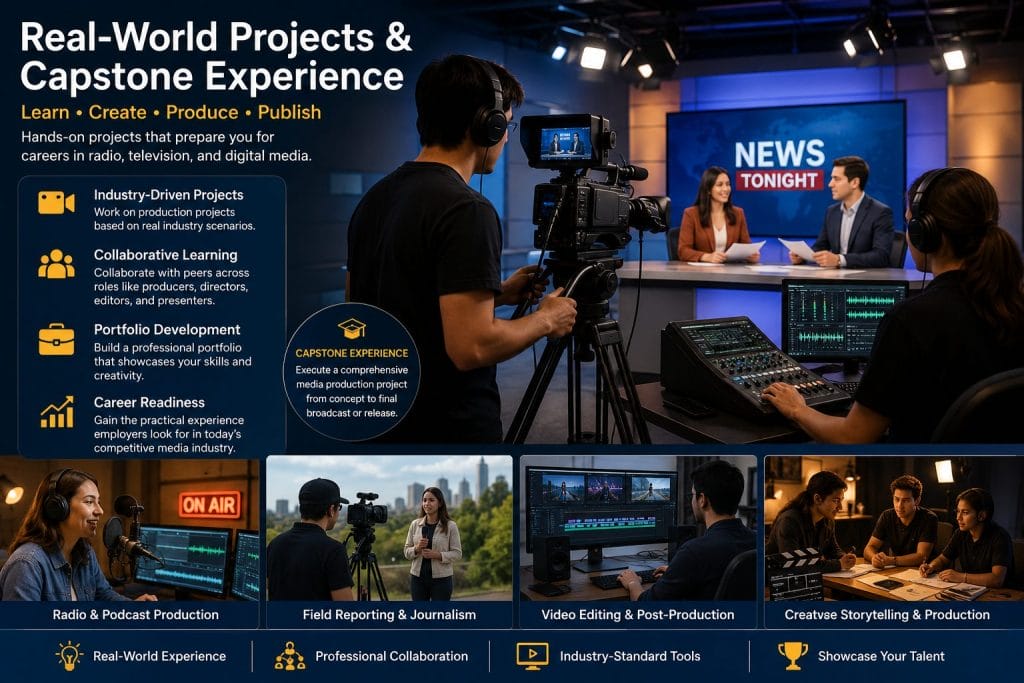
Real-World Projects & Capstone Experience
This picture highlights the experiential learning aspect of hands-on Radio and TV production via actual media projects and capstone projects (projects completed by students as they finish their degrees). The image demonstrates students performing television broadcasts, podcast production, field reporting, video editing, and collaborative storytelling. The image illustrates the industry standards of equipment used for each of the activities, teamwork, portfolio development, and production experience.
Bachelor in Radio and Television Production : Research Projects & Innovation

The role that research and innovation have in developing the broadcasting sector as well as digital media industries & content production industries is critical. Within the Bachelor of Arts in Radio and Television Production program, students will examine trends in the marketplace such as consumer trends (audience), technology used in media productions, storytelling strategies utilized in media production, and methods used for communicating with audiences through independent research projects and applied research projects.

Within this program, students will study topics that relate to digital broadcasting, creating podcasts, streaming services, analyzing consumer behaviors, creating AI driven media production, utilizing virtual studios, engaging with audiences through social media, and creating journalism through multiple forms of media. By developing innovative solutions to the challenges of producing media content for the public, students will gain an understanding of how technology is transforming the way that content is created, distributed and consumed.

Want to Explore Perpetual Evolution in Your Career ?

Contact AIU

Thesis & Research Defense Process

The Process for developing & defending an original thesis or research project will provide students with the opportunity to demonstrate their ability to articulate research, analytical thought processes and media production knowledge in relation to a specific area of study in Radio & Television Production (RTP). 

Students of bachelor in radio and television production  will conduct their own independent research, develop a comprehensive thesis/project and present their findings, as well as their creative works and recommendations to an academic review panel. This demonstrates that students have acquired broad knowledge of broadcasting principles, new media applications and techniques of storytelling, in addition to fulfilling requirements for best practices for the broadcast industry; while also providing an opportunity for students to enhance their professional communication and critical thinking skills.

Student Experience & Virtual Campus

The Bachelor of Radio and Television Production’s Student Experience program & Virtual Campus offers students an active place for learning by allowing students to be creative and develop professionally. By providing online digital classrooms and multimedia online materials, as well as providing academic support services, the Student Experience offers students numerous collaborative online communities; each of which provides creative opportunities and develops professionally. 

The Virtual Campus encourages student participation through discussions, research projects, project development and the opportunity to connect with students globally. Students enrolled in Radio and Television Production will have the ability to explore and learn about the fields of broadcasting, journalism, digital media, podcasting and content creation in an adaptable environment while building practical experience and valuable industry knowledge; thus, gaining a competitive edge towards successful careers in the ever-evolving media and entertainment industry.

Live Classes, Symposiums & Global Networking

Through the use of virtual classroom sessions, the opportunity for students to attend interactive workshops, participate in industry symposiums, and build a global network with fellow students (and faculty) and media experts from around the world gives students access to shared experiences across various forms of media, as well as to collaborating and sharing knowledge with one another and developing as professionals in order to stay current on radio, television, and digital media trends; industry practice; and new technologies in the field of radio, television and digital media.

Academic Resources & AI-Powered Learning

The Bachelor in Radio and Television Production provides many academic resources available to support students’ creative, technical, and professional development. Students can access numerous digital libraries, research databases, multimedia materials, recorded lectures, industry publications, and production-focused resources to enhance their skills through hands-on experience. 

Students may also utilize AI Learning Tools, which further enhance their educational experience by providing services for the areas of content research, scriptwriting, audience analysis, identifying media trends, language translation, and creating an individualized learning pathway. By using these academic and technology resources together, students will be able to stay up-to-date with the latest developments in their field, improve their productivity, and develop the skills necessary to succeed in the ever-changing environment of broadcasting and digital media.

Craft Your Success Story Innovatively 

Get Started

Admission Requirements

The bachelor in radio and television production  is relatively open to most applicants regardless of their past academic and professional experiences. Generally speaking, to be eligible to apply for admission into this program, you will be expected to have completed a secondary school diploma (or equivalent) from an accredited organization or institution. All potential candidates will also need to show that they are interested in media, communications, television, storytelling, writing for news or online media, and creating different types of digital content. 

While having some prior experience working with media, such as radio and television production, is a plus, it is not required to gain admission to the degree program. As part of your application for admission, you may be asked to provide transcripts and other forms of documentation within your academic record. We welcome applicants who are willing to learn new skills and develop their future careers in film and electronic media production through creative approaches to learning.

How to Apply ?

The Bachelor of Arts in Radio and Television Production allows students to apply easily and start their college experience. To get started, prospective students must fill out the online application form and provide any required academic documentation (high school transcript, etc.). If a student has prior experience in media, they are able to include a résumé, portfolio and/or statement of interest, but media experience is not typically a necessary requirement for admission. 

After a review of the application materials, candidates who are eligible for admission will receive admission/ enrollment guidance and information. When a prospective student has completed the registration process, they will have access to academic support services and resources for learning (studying) materials and their personalized pathway of study, and they can start to develop skills in broadcasting and media production, as well as developing digital communication.

Tuition, Financial Support & Scholarships

The Bachelor in Radio and Television Production will provide an affordable and flexible path towards obtaining higher education. There are two general reasons that tuition cost will differ from student to student: possible credit transfers as well as different degree programs. Therefore, there are various ways to complete your degree that will support your academic and financial goals. In addition, there are numerous forms of financial assistance (i.e., scholarships, loans, etc.,) available to students that may assist the in defraying the overall cost of an education in a quality media or broadcast arts program, allowing students to primarily concentrate on developing the creative, technical and professional skills necessary for career success in the global media industry.

FAQs

What is a Bachelor in Radio and Television Production?

An undergraduate degree called a Bachelor in Radio and Television Production prepares individuals who want to become career professionals in the areas of media production, broadcasting, journalism and digital content creation. Students develop skills using audio and video production techniques, such as script writing, editing, directing, broadcasting and multimedia storytelling allowing them to produce engagingly developed content for radio, television, streaming services as well as new emerging digital media outlets.

What can I do with a degree in radio and television production?

Having a Degree in Radio and Television Production will lead to various career paths such as announcer, broadcast technician, production assistant, sound technician, sports broadcaster, news anchor/reporter and more. Graduates from radio and television production programs can further develop within the field by working with organizations that include television networks (NBC, ABC, CBS, etc.), radio stations (i.e.- FM/AM frequencies), production companies and other related businesses that utilize these technologies (i.e.- clients). They can also work with independent entrepreneurs and businesses; such as blogging, writing articles and creating video blogs (VLOGS).

How long does it take to complete a radio and television production degree?

Approximately 3 years.

Can I study radio and television production online?

Yes, AIU offers radio and television production online.

Let us know your goals and aspirations so we can chart a path at AIU to achieve them!
//
Admissions Counselor
Prof. Emmanuel Gbagu
Available
//
Admissions Counselor
Rene Cordon
Available
//
Admissions Counselor
Sandra Garcia-Fierro
Available
//
Admissions Counselor
Jessica Garcia
Available

"*" indicates required fields

This field is for validation purposes and should be left unchanged.
Name*

"*" indicates required fields

This field is for validation purposes and should be left unchanged.
Name*

"*" indicates required fields

This field is for validation purposes and should be left unchanged.
Name*

"*" indicates required fields

This field is for validation purposes and should be left unchanged.
Name*

"*" indicates required fields

This field is for validation purposes and should be left unchanged.
Name*

"*" indicates required fields

This field is for validation purposes and should be left unchanged.
Name*

"*" indicates required fields

This field is for validation purposes and should be left unchanged.
Name*

"*" indicates required fields

This field is for validation purposes and should be left unchanged.
Name*

"*" indicates required fields

This field is for validation purposes and should be left unchanged.
Name*

"*" indicates required fields

This field is for validation purposes and should be left unchanged.
Name*

"*" indicates required fields

This field is for validation purposes and should be left unchanged.
Name*

"*" indicates required fields

This field is for validation purposes and should be left unchanged.
Name*

"*" indicates required fields

This field is for validation purposes and should be left unchanged.
Name*

"*" indicates required fields

This field is for validation purposes and should be left unchanged.
Name*

"*" indicates required fields

This field is for validation purposes and should be left unchanged.
Name*

"*" indicates required fields

This field is for validation purposes and should be left unchanged.
Name*

"*" indicates required fields

This field is for validation purposes and should be left unchanged.
Name*

"*" indicates required fields

This field is for validation purposes and should be left unchanged.
Name*

"*" indicates required fields

This field is for validation purposes and should be left unchanged.
Name*

"*" indicates required fields

This field is for validation purposes and should be left unchanged.
Name*

"*" indicates required fields

This field is for validation purposes and should be left unchanged.

Submit your data.

After submitting, a widget will appear at the bottom-left corner so you can start your training.

Name*

Do you hate spam? Don’t worry, we hate them too. Your email is 100% secure with us.

"*" indicates required fields

This field is for validation purposes and should be left unchanged.

Submit the form below to begin your interview.

After submitting, a widget will appear at the bottom-left corner so you to start your AI interview.

Name*
Accepted file types: docx, pdf, Max. file size: 500 MB.

Do you hate spam? Don’t worry, we hate them too. Your email is 100% secure with us.